
Oklo, U.S. Forged Rings Partner to Advance Domestic Manufacturing for Future Aurora Powerhouse Deployments
Initial finished component deliveries are scheduled to begin in 2030, with capacity intended to extend through 2035.
Sentiment and the balance of points
Rhea-AI Sentiment reads the wording of the document, how positive or negative its language is on a 1 to 5 scale. The balance of points shown with the takes weighs what the document actually discloses, so the two can disagree, for example when a trial that missed its main goal is described in upbeat language.


Agreement to secure planned
Partnership targets long-lead manufacturing needs for future Aurora projects, complementing the separate supply-chain work already underway in
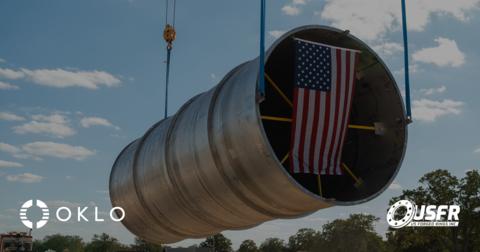
United States Forged Rings will support Oklo's long-term deployment of Aurora powerhouses through domestic manufacturing capacity for large reactor components. (Image: Oklo)
The agreement aims to help Oklo address a potential manufacturing bottleneck for future deployments by reserving planned domestic capacity for large components within the Aurora reactor module system.
Under the agreement, Oklo will reserve manufacturing capacity at USFR's planned industrial campus in
"Building nuclear powerhouses at scale means thinking well beyond the reactor itself. We need the fuel, manufacturing capabilities, suppliers and infrastructure in place to deliver projects repeatedly," said co-founder and CEO of Oklo Jacob DeWitte. "This agreement supports our effort to build an American supply chain for a growing Aurora fleet, with large reactor components manufactured here in
Large stainless-steel components, including reactor vessels, lids and supporting structures, can present significant manufacturing and logistical challenges. Producing these components may require multiple fabrication steps, transportation between suppliers, and additional welding, machining and inspection.
USFR's planned campus is designed to bring together casting, forging, ring rolling, heat treatment, machining, fabrication and inspection capabilities integrating several stages in one location, reducing transportation between suppliers and improving coordination across production. The multi-phase industrial campus in
"Today many of the largest steel components for nuclear reactors are sourced overseas," said US Forged Rings’ CEO & President Giacomo Sozzi. "Our planned
The agreement supports Oklo's longer-term manufacturing strategy and is separate from the procurement, manufacturing, and construction activities already advancing for its first Aurora powerhouse at Idaho National Laboratory.
About Oklo Inc.: Oklo Inc. is developing fast fission power plants to deliver clean, reliable, affordable energy at global scale; establishing a domestic supply chain for critical isotopes; and advancing nuclear fuel recycling to convert used nuclear fuel into clean energy. Oklo was the first to receive a site use permit from the
About US Forged Rings (USFR): The Company is developing a 2000+ acre campus in North Carolina, which including other planned Campus residents, will create the first USA based industrial cluster for ultra-heavy steel forged and fabricated components, ending the nation’s dependence on imports. The Cluster’s vertically integrated product offering will span from liquid steel production all the way to finished components for the nuclear, gas, hydro and geothermal power generation sectors, thanks to the co-location on Campus of USFR’s downstream added value customers.
FORWARD-LOOKING STATEMENTS
This press release contains forward-looking statements within the meaning of Section 27A of the Securities Act of 1933 and Section 21E of the Securities Exchange Act of 1934. These include statements concerning Oklo’s business strategy; the development, licensing, construction, deployment and operation of its powerhouses and fuel fabrication, fuel recycling and radioisotope facilities; anticipated schedules, costs and milestones; commercial and strategic arrangements and their expected benefits; customer demand and market opportunities; and capital requirements and funding. Words such as “expects,” “plans,” “believes,” “targets,” “anticipates,” “may,” “will” and similar expressions identify forward-looking statements, although not all forward-looking statements contain these words.
Forward-looking statements reflect current expectations and assumptions, are not guarantees of future performance, and are subject to risks and uncertainties that could cause actual results to differ materially. Important factors include our ability to complete first-of-a-kind design, testing, construction, commissioning and operations within anticipated costs and schedules; obtain and maintain Department of Energy, Nuclear Regulatory Commission, and other governmental approvals, including those needed to transition from demonstration to commercial operations; secure suitable sites and interconnection and transmission arrangements; obtain high-assay low-enriched uranium, plutonium and other fuels, specialized components, qualified suppliers and construction services at acceptable costs and within anticipated timelines; satisfy contractual conditions and realize the expected benefits of commercial and strategic arrangements, including through counterparty performance; integrate acquired businesses and realize anticipated benefits; accurately estimate costs, schedules and market demand; obtain additional financing on acceptable terms; and navigate changes in laws, regulations and governmental policies.
Additional information about these and other factors appears in Part I, Item 1A, “Risk Factors,” of our Annual Report on Form 10-K for the year ended December 31, 2025, and in Part I, Item 2, “Management’s Discussion and Analysis of Financial Condition and Results of Operations,” and Part II, Item 1A, “Risk Factors,” of our Quarterly Report on Form 10-Q for the quarter ended September 30, 2026, as updated by subsequent SEC filings. Investors should not place undue reliance on forward-looking statements, which speak only as of the date made. We undertake no obligation to update or revise these statements, except as required by law.
View source version on businesswire.com: https://www.businesswire.com/news/home/20261106023707/en/
Media and Communications for Oklo:
Bonita Chester, Head of Communications and Media at media@oklo.com
Investor Contact:
Sam Doane, Senior Director of Investor Relations at investors@oklo.com
Source: Oklo Inc.