
Universal Display Corporation Expands China Presence with Grand Opening of Chengdu OLED Technology and Innovation Center
Universal Display (Nasdaq: OLED) announced the grand opening of its OLED Technology and Innovation Center in Chengdu, China, a major OLED manufacturing hub.
Sentiment and the balance of points
Rhea-AI Sentiment reads the wording of the document, how positive or negative its language is on a 1 to 5 scale. The balance of points shown with the takes weighs what the document actually discloses, so the two can disagree, for example when a trial that missed its main goal is described in upbeat language.




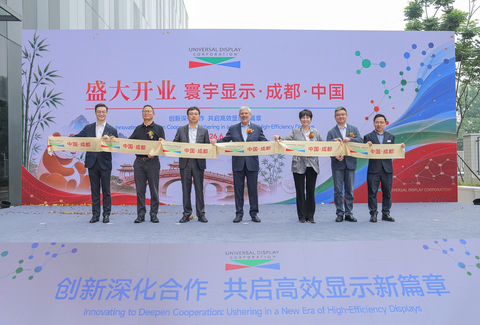
Ribbon-Cutting Ceremony at UDC Chengdu OLED Technology and Innovation Center. (From left to right, General Manager of UDC China, Mr. Yeyun Dou, General Manager of CSO Organization, BOE, Mr. Xiangdong Qin, Senior Vice President of BOE, Mr. Xiangnan Yun, Chief Executive Officer of UDC, Mr. Steven V. Abramson, Executive Vice President and Chief Technical Officer of UDC, Dr. Julie Brown, Deputy Secretary General of CODA LCD Branch, Mr. Chunming Hu, General Manager of UDC Chengdu, Mr. Hao Ye)
Located in one of China’s leading OLED manufacturing hubs, the
“The opening of our Chengdu OLED Technology and Innovation Center marks an important milestone in our continued growth in
About Universal Display Corporation
Universal Display Corporation (Nasdaq: OLED) is a leader in the research, development and commercialization of organic light emitting diode (OLED) technologies and materials for use in display and solid-state lighting applications. Founded in 1994 and with subsidiaries and offices around the world, the Company currently owns, exclusively licenses or has the sole right to sublicense more than 7,000 patents issued and pending worldwide. Universal Display licenses its proprietary technologies, including its breakthrough high-efficiency UniversalPHOLED® phosphorescent OLED technology that can enable the development of energy-efficient and eco-friendly displays and solid-state lighting. The Company also develops and offers high-quality, state-of-the-art UniversalPHOLED materials that are recognized as key ingredients in the fabrication of OLEDs with peak performance. In addition, Universal Display delivers innovative and customized solutions to its clients and partners through technology transfer, collaborative technology development and on-site training. To learn more about Universal Display Corporation, please visit https://oled.com/.
Universal Display Corporation and the Universal Display Corporation logo are trademarks or registered trademarks of Universal Display Corporation. All other Company, brand or product names may be trademarks or registered trademarks.
All statements in this document that are not historical, such as those relating to the projected adoption, development and advancement of the Company’s technologies, and the Company’s expected results, as well as the growth of the OLED market and the Company’s opportunities in that market, are forward-looking financial statements within the meaning of the Private Securities Litigation Reform Act of 1995. You are cautioned not to place undue reliance on any forward-looking statements in this document, as they reflect Universal Display Corporation’s current views with respect to future events and are subject to risks and uncertainties that could cause actual results to differ materially from those contemplated. These risks and uncertainties are discussed in greater detail in Universal Display Corporation’s periodic reports on Form 10-K and Form 10-Q filed with the Securities and Exchange Commission, including, in particular, the section entitled “Risk Factors” in Universal Display Corporation’s Annual Report on Form 10-K for the year ended December 31, 2025. Universal Display Corporation disclaims any obligation to update any forward-looking statement contained in this document.
Follow Universal Display Corporation
(OLED-C)
View source version on businesswire.com: https://www.businesswire.com/news/home/20260602647143/en/
Universal Display Contact:
Darice Liu
investor@oled.com
media@oled.com
+1 609-964-5123
Source: Universal Display Corporation