
Ouster Launches Stereolabs ZED X Nano: A Wrist-Mount Stereo Camera Built for Robotic Manipulation and Physical AI
Ouster (Nasdaq: OUST) launched the Stereolabs ZED X Nano, a wrist-mount stereo camera for robotic manipulation, available for pre-order with shipping beginning May 2026.




The ZED X Nano sets a new standard for wrist-mount stereo vision, delivering 2.3MP RGB, neural depth, zero-copy capture pipeline, and ruggedized GMSL2 connectivity in a
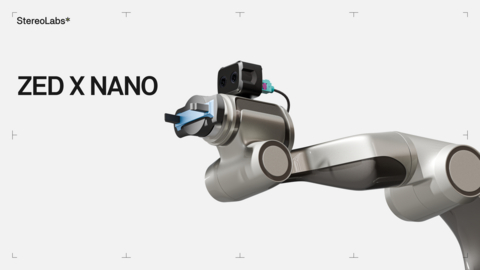
Stereolabs ZED X Nano: a compact wrist-mount stereo camera engineered for robotic manipulation, imitation learning, and high-throughput data collection.
Built for the robotic arm: smaller, tougher, faster
As robotics teams scale imitation learning and reinforcement learning for manipulation tasks, RGB image quality and end-to-end capture latency have become critical bottlenecks. Legacy cameras rely on USB connectivity, capture low-resolution 720p RGB and depth, and require CPU-mediated pipelines that limit throughput and add latency.
Stereolabs ZED X Nano was designed from the ground up to solve these problems. Measuring
Durability is designed in. Sporting an onboard vibration-proof IMU, the camera is powered by ruggedized GMSL2 connection and next-generation cabling engineered for the repeated motion and cable stress of robotic arms, replacing fragile USB-C with an industrial-grade link that carries video up to 15 meters with EMI resistance and locking connectors.
Zero-copy pipeline for Physical AI
At the heart of the ZED X Nano is an ultra-low-latency capture pipeline with a fully zero-copy path from sensor to GPU, with frames flowing directly into NVIDIA hardware encoders and AI inference pipelines simultaneously. For data collection teams, this means higher-throughput dataset capture at full resolution. For deployment teams, it means running perception, segmentation, and policy networks in parallel on the same frames with more GPU headroom for the models that matter.
Neural Depth with sub-millimeter accuracy
Depth is powered by Stereolabs's Neural Depth Engine, the leading AI stereo depth system with sub-millimeter accuracy in the Z-axis while delivering significantly better lateral (XY) positioning than traditional structured-light or time-of-flight cameras, a critical advantage for grasp pose estimation, fine placement, and assembly tasks where lateral error directly translates to manipulation failure. With a minimal depth sensing range of 3cm, the camera can also sense closer than comparable solutions in the market.
Native Integration with NVIDIA® Isaac™ and ROS
ZED X Nano is the latest Stereolabs product to offer first-class native integration with NVIDIA Isaac Sim and Isaac Lab for sim-to-real transfer, as well as native ROS and ROS 2 support. Teams building imitation learning or reinforcement learning pipelines can capture high-fidelity demonstrations, train in simulation with matched camera models, and deploy to hardware, all on the same sensor and software stack.
“Building on Stereolabs leadership in AI vision and perception solutions, the ZED X Nano allows us to go deeper into the industrial and robotics markets to win new sockets that require smaller form-factor placements,” said Ouster CEO Angus Pacala. "The future of Physical AI depends on massive amounts of high-quality, low-latency image data collected at the edge. With the ZED X Nano, we're giving roboticists a major upgrade to their vision systems, enabling machines to sense, think, act, and learn with unprecedented precision."
The ZED X Nano is available for pre-order starting today. For technical specifications, pricing, and integration details, visit www.stereolabs.com. Shipping begins May 2026.
About Ouster
Ouster (Nasdaq: OUST) is a leader in sensing and perception for Physical AI across industrial, robotics, automotive, and smart infrastructure. With a unified platform of high-performance digital lidar, cameras, AI compute, sensor fusion and perception software, and AI models, Ouster delivers solutions that improve quality of life in the physical world. Headquartered in
Forward-Looking Statements
This press release contains forward-looking statements within the meaning of the Private Securities Litigation Reform Act of 1995. The Company intends such forward-looking statements to be covered by the safe harbor provisions for forward-looking statements contained in Section 27A of the Securities Act of 1933, as amended and Section 21E of the Securities Exchange Act of 1934, as amended. Such statements are based upon current plans, estimates and expectations of management that are subject to various risks and uncertainties that could cause actual results to differ materially from such statements. The inclusion of forward-looking statements should not be regarded as a representation that such plans, estimates and expectations will be achieved. Words such as “expect,” “will”, “may,” “anticipate,” “intend,” “reflect,” “should,” “plan,” “can,” “could,” “offer,” “estimate,” “possible,” “potential,” “pursue,” “demonstrate,” and the negative of these terms and similar expressions are intended to identify forward-looking statements, though not all forward-looking statements use these words or expressions. All statements, other than historical facts, including statements regarding the development, capabilities, performance, demand and adoption of the Company’s products; product availability and shipping lead timelines; Ouster’s market and competitive positioning; industry and business trends, and Ouster’s business objectives and plans, all constitute forward-looking statements. All forward-looking statements are subject to risks and uncertainties that may cause actual results to differ materially from those that we expected, including, but not limited to, the possibility of cancellation or postponement of contracts or unsuccessful implementations; risks related to the adoption of Ouster’s products, inaccurate forecasts of market growth and customer demand; supply chain constraints and challenges; Ouster’s ability to respond to evolving regulations and standards; changes to trade policy, tariffs, and import/export regulations may have an adverse effect on Ouster’s business, financial condition and results of operation; conditions in the industries the Company targets or the global economy; and other important risk factors discussed in the Company’s Annual Report on Form 10-K for the year ended December 31, 2025, and as may be further updated from time to time in the Company’s other filings with the SEC. Readers are urged to consider these factors carefully and in the totality of the circumstances when evaluating these forward-looking statements, and not to place undue reliance on any of them. Any such forward-looking statements represent management’s reasonable estimates and beliefs as of the date of this press release. While Ouster may elect to update such forward-looking statements at some point in the future, it disclaims any obligation to do so, other than as may be required by law, even if subsequent events cause its views to change.
View source version on businesswire.com: https://www.businesswire.com/news/home/20260413750144/en/
For Investors
investors@ouster.io
For Media
press@ouster.io
Source: Ouster, Inc.