
PMET Increases Grade and Scale of Caesium Mineral Resource at Shaakichiuwaanaan
Maiden Helios and CV4 estimates expand the resource base, with updated project studies expected before year-end.
Sentiment and the balance of points
Rhea-AI Sentiment reads the wording of the document, how positive or negative its language is on a 1 to 5 scale. The balance of points shown with the takes weighs what the document actually discloses, so the two can disagree, for example when a trial that missed its main goal is described in upbeat language.
Rhea-AI Summary
PMET Resources (PMETF) increased contained caesium oxide in its Shaakichiuwaanaan mineral resource estimate by 55%, including the newly estimated Helios zone. Caesium resources comprise 1,844,000 tonnes at 4.40% Cs2O indicated and 981,000 tonnes at 3.00% inferred; grade rose 31% and tonnage 18%. Maiden rubidium resources were also declared.
The consolidated estimate, effective July 10, 2026, contains 113.9 million tonnes at 1.43% lithium oxide indicated and 33.8 million tonnes at 1.24% inferred. Contained lithium carbonate equivalent increased 5% versus the June 20, 2025 estimate. The update includes a maiden CV4 resource and tantalum estimates. PMET expects an updated CV5 lithium-tantalum feasibility study and a broader lithium-caesium-tantalum preliminary economic assessment before year-end. The update does not materially change current reserves or the economic conclusions of the October 2025 CV5 lithium-only feasibility study.
How this balance works
Rhea-AI gives every point it takes from this document a weight. Minor counts 1, Moderate 3 and Major 9, so one Major point outweighs several Minor ones. The bar adds up the weights on each side, and when neither side holds more than 65% of the total the balance reads Mixed.
It reads the document as published, with the same rules for every company, and it does not look at what the market expected or at how the stock traded, so a point can be objectively good on a day the stock falls.
Rhea-AI Sentiment measures something else, the tone of the wording.
Hollow bars mark forward-looking points. How the balance works
Positive
- Moderate pointCaesium resources increased 55% in contained Cs2O, 31% in grade and 18% in tonnage.
- Moderate pointConsolidated lithium resources increased 5% in contained lithium carbonate equivalent, with tonnage up 4% and grade up 0.2%.
- Moderate point. Forward-looking: it has not happened yet and may not happen.PMET expects updated CV5 lithium-tantalum feasibility and broader lithium-caesium-tantalum economic studies before year-end.
- Minor pointIndicated caesium resources reached 1,844,000 tonnes at 4.40% Cs2O, containing 81,200 tonnes Cs2O.
- Minor pointInferred caesium resources reached 981,000 tonnes at 3.00% Cs2O, containing 29,400 tonnes Cs2O.
8 minor points
- Minor pointMaiden rubidium resources grade 0.46% Rb2O indicated and 0.37% inferred within the Caesium Zone.
- Minor pointIndicated consolidated resources total 113,909,000 tonnes at 1.43% Li2O and 164 ppm Ta2O5.
- Minor pointInferred consolidated resources total 33,773,000 tonnes at 1.24% Li2O and 150 ppm Ta2O5.
- Minor pointMaiden CV4 inferred resources total 1,748,000 tonnes at 1.24% Li2O.
- Minor pointCV5 sensitivity analysis at 1.5% Li2O cut-off outlines 36.5 million tonnes indicated at 2.04% and 4.1 million inferred at 2.01%.
- Minor pointCV13 sensitivity analysis at 1.5% Li2O cut-off outlines 5.9 million tonnes indicated at 2.77% and 4.2 million inferred at 2.24%.
- Minor point. Forward-looking: it has not happened yet and may not happen.CV5's single principal dyke contains 87.4 million tonnes indicated and 2.2 million inferred; PMET anticipates simpler mining.
- Minor point. Forward-looking: it has not happened yet and may not happen.PMET anticipates a further resource update incorporating 2026 drilling in 2027.
Negative
- Minor pointResource mining shapes and cut-offs use lithium only; other elements are non-paid metals reported for reference.
- Minor point. Forward-looking: it has not happened yet and may not happen.Potential resource growth across the 1.5 km CV5–CV4 gap requires additional drilling.
AI-generated analysis. How Rhea-AI works. Not financial advice.


Mineral Resource update includes maiden estimates at the Helios Caesium Zone and CV4 Pegmatite, contributing to overall resource growth in all three critical minerals (Li, Cs, Ta) at the Shaakichiuwaanaan Property
HIGHLIGHTS
- Significant increase in contained caesium metal (
55% ), grade (31% ), and tonnage (18% ) of the Caesium Zone MRE1, inclusive of the Vega, Rigel, and newly estimated Helios Zones.- 1,844,000 t at
4.40% Cs2O (Indicated) – 81,200 t Cs2O in contained metal. - 981,000 t at
3.00% Cs2O (Inferred) – 29,400 t Cs2O in contained metal. - Already the world's largest pollucite (caesium) pegmatite, this MRE has further increased contained metal from 71,000 t to 110,600 t Cs2O.
- Additional critical mineral added to resource base with maiden rubidium (Rb) resources declared within the Caesium Zone MRE at a grade of
0.46% Rb2O (Indicated) and0.37% Rb2O (Inferred). Rubidium is a soft, silvery-white alkali metal used primarily in scientific research, precision timekeeping, and specialized technologies.
- 1,844,000 t at
- Consolidated MRE at Shaakichiuwaanaan confirms over 40 Mt of greater than
2% Li2O grade at CV5 and CV13 combined (indicated).- Sensitivity analysis outlines very high-grade (Li) subsets of the resource at significant tonnage, primarily reflecting the Nova (CV5) and Vega (CV13) Zones, respectively (at
1.5% Li2O cut-off):- 36.5 Mt at
2.04% Li2O (Indicated), 4.1 Mt at2.01% Li2O (Inferred). - 5.9 Mt at
2.77% Li2O (Indicated), 4.2 Mt at2.24% Li2O (Inferred).
- 36.5 Mt at
- 113.9 Mt at
1.43% Li2O and 164 ppm Ta2O5 (Indicated) – 4.03 Mt LCE. - 33.8 Mt at
1.24% Li2O and 150 ppm Ta2O5 (Inferred) – 1.03 Mt LCE. - MRE continues to re-affirm Shaakichiuwaanaan as one of the largest and highest-grade tantalum pegmatites globally.
- Sensitivity analysis outlines very high-grade (Li) subsets of the resource at significant tonnage, primarily reflecting the Nova (CV5) and Vega (CV13) Zones, respectively (at
|
______________ |
|
1 Mineral Resource Estimate. |
-
- Increase in contained LCE2 (
5% ) driven by combined impact of improved tonnage (4% ) and grade (0.2% ) of consolidated MRE at Shaakichiuwaanaan3: - A total of 87.4 Mt (Indicated) and 2.2 Mt (Inferred) is contained within a single dyke at the CV5 Pegmatite, which is anticipated to significantly limit external dilution and simplify mining.
- Includes 1.75 Mt at
1.24% Li2O (Inferred) maiden resource at the CV4 Pegmatite, approximately 1.5 km along strike and to the east of CV5, with the gap between offering further exploration potential for additional resource growth (more drilling required).
- Increase in contained LCE2 (
- MRE4 update announced herein to underpin an updated Feasibility Study for Li and Ta on the CV5 Pegmatite and a Preliminary Economic Assessment for Li, Cs, and Ta on the broader Project (CV5 & CV13 Pegmatites), on schedule to be announced before year end.
Darren L. Smith – Executive Vice President of Exploration commented: "Although the 2025 drill program focused on development objectives for the Project, the work has also grown the overall resource base for all three metals, highlighted by the significant increases in the Caesium Zone MRE grade, tonnage, and contained metal.
"Shaakichiuwaanaan continues to demonstrate considerable scale in lithium, caesium, and tantalum inclusive of very high-grade subsets of the resource. Given the size of the overall resource, it is easy to forget that the scale and grade of the Nova and Vega Zones are globally significant in their own right. This is an important part of what makes the Project so unique. We are very confident there is a lot more to discover as we expand our exploration focus in future programs," added Mr. Smith.
PMET RESOURCES INC. (THE "COMPANY" OR "PMET") (TSX: PMET) (ASX: PMT) (OTCQX: PMETF) (FSE: R9GA) is pleased to announce an updated Consolidated Mineral Resource Estimate ("Consolidated MRE") for its
|
________________________________ |
|
2 Lithium Carbonate Equivalent. |
|
3 Relative to the last Consolidated MRE (Effective Date of June 20, 2025). |
|
4 MRE announced herein (Effective Date July 10, 2026) does not materially change the current Mineral Reserve Estimate or the economic conclusions of the CV5 Lithium-Only Feasibility Study announced October 20, 2025. |
In addition to continued growth in the lithium-tantalum consolidated resource base (see below), MRE-55 has resulted in a significant increase in caesium ("Cs") resources both in terms of grade (
The scale of Shaakichiuwaanaan's caesium resource is particularly significant given the supply-constrained nature of the global caesium market. Caesium formate is a premium high-density drilling fluid used in high-pressure, high-temperature (HPHT) oil and gas wells, particularly in the North Sea, with potential for broader adoption in offshore basins such as
Additionally, a maiden rubidium ("Rb") Mineral Resource has been declared within the Caesium Zone MRE at a grade of
|
________________________________ |
|
5 The Consolidated MRE includes the CV5, CV13, and CV4 pegmatites and is estimated at a cut-off grade of |
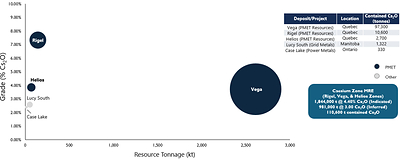
The updated Consolidated MRE demonstrates continued growth in the overall resource base with increases in lithium grade (
- 113.9 Mt at
1.43% Li2O and 164 ppm Ta2O5 (Indicated) – 4.03 Mt LCE and 18.7 kt Ta2O5 contained, respectively. - 33.8 Mt at
1.24% Li2O and 150 ppm Ta2O5 (Inferred) – 1.03 Mt LCE and 5.1 kt Ta2O5 contained, respectively.
Shaakichiuwaanaan continues to host one of the world's largest and highest-grade tantalum pegmatite MREs. Coupled with the scale and grade of the lithium and caesium resources, the tantalum provides another key differentiator for the Project.
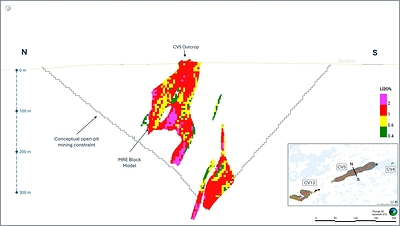
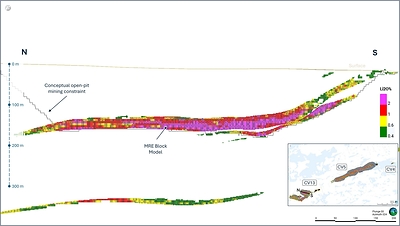
A total of 87.4 Mt (Indicated) and 2.2 Mt (Inferred) is contained within a single principal dyke at the CV5 Pegmatite, which extends nearly 5 km in length at true widths of up to ~125 m. The scale of the resources within this single, broad dyke is significant as it is anticipated to reduce external dilution, simplify the overall mining approach, and reduce the mineral processing risk.
Additionally, MRE-5 includes maiden resources at the CV4 Pegmatite totaling 1.75 Mt at
HIGH-GRADE NOVA AND
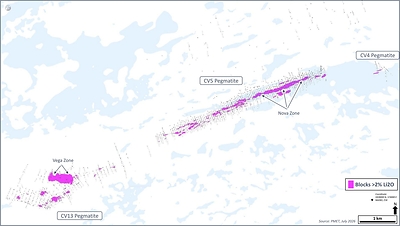
The relatively high-grade nature of the Shaakichiuwaanaan MRE, highlighted by the Nova (CV5) and
- 36.5 Mt at
2.04% Li2O (Indicated), 4.1 Mt at2.01% Li2O (Inferred). - 5.9 Mt at
2.77% Li2O (Indicated), 4.2 Mt at2.24% Li2O (Inferred).
These zones of intense spodumene mineralization at scale (both with 10+ m drill intervals at >
NEXT STEPS
MRE-5 – which includes drilling through to the end 2025 – is intended to underpin an updated Feasibility Study for Li and Ta on the CV5 Pegmatite and a Preliminary Economic Assessment for Li, Cs, and Ta on the broader Project (CV5 & CV13 Pegmatites), on schedule to be announced before year end. Drilling completed in 2026 will be incorporated into a future MRE update for the Project, anticipated in 2027.
MINERAL RESOURCE STATEMENT (NI 43-101) – MRE-5
Table 1: Consolidated Mineral Resource Statement for the Shaakichiuwaanaan Project.
|
Conceptual Mining Constraint |
Pegmatite |
Classification |
Tonnes |
Li2O |
Ta2O5 |
Ga |
Contained LCE |
Contained Ta2O5 |
|
Open-Pit |
CV5 |
Indicated |
98,810,000 |
1.40 |
161 |
66 |
3.42 |
15.91 |
|
Underground |
4,346,000 |
1.15 |
184 |
66 |
0.12 |
0.80 |
||
|
Total |
103,156,000 |
1.39 |
162 |
66 |
3.54 |
16.71 |
||
|
Open-Pit |
CV5 |
Inferred |
4,838,000 |
1.27 |
177 |
63 |
0.15 |
0.86 |
|
Underground |
9,616,000 |
1.24 |
146 |
60 |
0.30 |
1.40 |
||
|
Total |
14,454,000 |
1.25 |
156 |
61 |
0.45 |
2.25 |
||
|
|
|
|
|
|
|
|
|
|
|
Open-Pit |
CV13 |
Indicated |
10,533,000 |
1.86 |
181 |
75 |
0.48 |
1.91 |
|
Underground |
220,000 |
0.92 |
183 |
63 |
0.01 |
0.04 |
||
|
Total |
10,753,000 |
1.84 |
181 |
74 |
0.49 |
1.95 |
||
|
Open-Pit |
CV13 |
Inferred |
14,461,000 |
1.26 |
145 |
67 |
0.45 |
2.10 |
|
Underground |
3,110,000 |
1.06 |
177 |
60 |
0.08 |
0.55 |
||
|
Total |
17,571,000 |
1.23 |
151 |
66 |
0.53 |
2.65 |
||
|
|
|
|
|
|
|
|
|
|
|
Open-Pit |
CV4 |
Indicated |
- |
- |
- |
- |
- |
- |
|
Underground |
CV4 |
Inferred |
1,748,000 |
1.24 |
91 |
59 |
0.05 |
0.16 |
|
Total |
1,748,000 |
1.24 |
91 |
59 |
0.05 |
0.16 |
||
|
|
|
|
|
|
|
|
|
|
|
|
CV5 + CV13 + CV4 |
Indicated |
113,909,000 |
1.43 |
164 |
67 |
4.03 |
18.68 |
|
|
Inferred |
33,773,000 |
1.24 |
150 |
63 |
1.03 |
5.07 |
|
Table 2: Caesium Zone Mineral Resources within the CV13 Pegmatite.
|
Caesium Zone |
Classification |
Tonnes |
Cs2O |
Rb2O |
Contained Cs2O |
|
Rigel |
Indicated |
144,000 |
7.34 |
0.80 |
10,600 |
|
Inferred |
- |
- |
- |
- |
|
|
|
|
|
|
|
|
|
|
Indicated |
1,633,000 |
4.19 |
0.43 |
68,400 |
|
Inferred |
978,000 |
2.96 |
0.37 |
29,000 |
|
|
|
|
|
|
|
|
|
Helios |
Indicated |
67,000 |
3.35 |
0.36 |
2,200 |
|
Inferred |
3,000 |
15.16 |
0.39 |
500 |
|
|
|
|
|
|
|
|
|
Rigel + |
Indicated |
1,844,000 |
4.40 |
0.46 |
81,200 |
|
Inferred |
981,000 |
3.00 |
0.37 |
29,400 |
- Mineral Resources were prepared in accordance with National Instrument 43-101 – Standards for Disclosure for Mineral Projects ("NI 43-101"), the CIM Definition Standards (2014) and the JORC Code (2012). Mineral Resources that are not Mineral Reserves do not have demonstrated economic viability. This estimate of Mineral Resources may be materially affected by environmental, permitting, legal, title, taxation, sociopolitical, marketing, economic, or other relevant issues.
- The independent Competent Person (CP), as defined under JORC, and Qualified Person (QP), as defined by NI 43–101 for this resource estimate is Todd McCracken, P.Geo., Director – Mining & Geology –
Central Canada , BBA Consultants. The Effective Date of the estimate is July 10, 2026 (through drill hole CV25-1025). - Estimation was completed using a combination of inverse distance squared (ID2) and ordinary kriging (OK) for CV5 and for CV13 and inverse distance squared (ID2) for CV4 in Leapfrog Edge software with dynamic anisotropy search ellipse on specific domains.
- Drill hole composites at 1 m in length for the pegmatite domains and every 0.5 m for the caesium enriched zones (CV13). Block size is 10 m x 5 m x 5 m with sub-blocking.
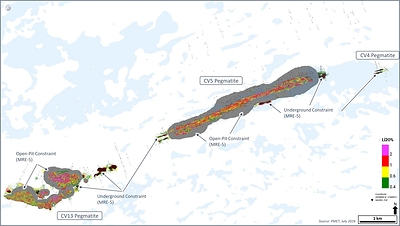
- Both underground and open-pit conceptual mining shapes were applied as constraints to demonstrate reasonable prospects for eventual economic extraction. Cut-off grades for open-pit constrained resources are
0.40% Li2O for both CV5 and CV13, and for underground constrained resources are0.60% Li2O for CV5 and CV4, and0.70% Li2O for CV13. Open-pit and underground Mineral Resource constraints are based on a spodumene concentrate price ofUS /tonne ($1,500 6% basis FOB Bécancour) and an exchange rate of0.74 USD /CAD. - The cut-off grades and mining shapes are based on Li2O (%) only. All other elements are non-paid metals and estimates are reported for reference purposes only. The Caesium Zone MRE is hosted within the CV13 Pegmatite's open-pit conceptual mining shape and sub-domained using a
0.50% Cs2O grade constraint and reported at a0.50% Cs2O cut-off grade. - Rounding may result in apparent summation differences between tonnes, grade, and contained metal content.
- Tonnage and grade measurements are in metric units.
- Conversion factors used: Li2O = Li x 2.153, LCE (i.e., Li2CO3) = Li2O x 2.473, Ta2O5 = Ta x 1.221, Cs2O = Cs x 1.0602, Rb2O = Rb x 1.0936.
- Densities for pegmatite blocks (CV5, CV13, & CV4) were estimated using a linear regression function (SG = 0.0674x (Li2O% + 0.81 x B2O3%) + 2.6202) derived from the specific gravity ("SG") field measurements and Li2O grade. Non-pegmatite blocks were assigned a fixed SG based on the field measurement median value of their respective lithology.
SENSITIVITY ANALYSIS
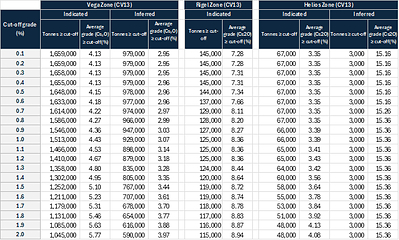
The sensitivity analysis for the Shaakichiuwaanaan Consolidated MRE and the Caesium Zone MRE are presented as the sum of the open-pit and underground constrained and classified resources at the same cut-off in Table 3 and Table 4, respectively. These tables should not be interpreted as a Mineral Resource. The data is presented to demonstrate the tonnage and grade sensitivity to various cut-off grades. Errors may occur in totals due to rounding.
Table 3: Sensitivity Analysis for Consolidated MRE Presented by Pegmatite.
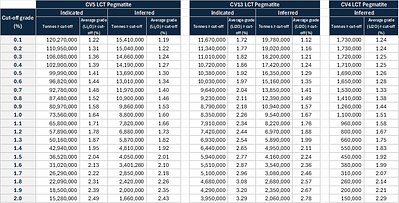
Table 4: Sensitivity Analysis for Caesium Zone MRE, hosted within the CV13 Pegmatite.
ABOUT CAESIUM
Mineral deposits of pollucite-hosted caesium are very rare globally and represent the most fractionated component of LCT pegmatite systems, which are effectively the only known primary economic source of caesium supply. Economic deposits of caesium pegmatite are typically on a smaller scale of <10 kt to 350 kt in size compared to deposits of lithium pegmatite that typically range in the millions of tonnes in size (<10 Mt to over 100 Mt).
The market for caesium compounds and metals is niche and largely opaque because it is not publicly traded like copper or gold, but rather through private bi-lateral and term contracts. Further, product prices vary depending on their contained caesium form, purity, and end-product use. As an example, caesium carbonate (Cs2CO3≥
|
____________________________________ |
|
6 SSM publishes an indicative spot price for |
Caesium is currently supply constrained, with only limited sources supplying the global market. Subject to further market analysis and assessment, a discovery at the size, grade, and scale of Shaakichiuwaanaan has the potential to become a primary source of supply for global markets over the long-term7. This includes existing applications for caesium in oil/gas drilling (a non-toxic and biodegradable high-density drill fluid), medical imaging, emissions reduction, atomic clocks, and precision GPS navigation, as well as new and potentially growing applications in the terrestrial solar panel industry. Caesium has been found to play a vital role in significantly improving next generation solar panel efficiency, stability, and life span. Additionally, the use of caesium in lithium-ion batteries to improve performance is actively being explored through use as an additive in certain cathode, anode, and electrolyte chemistries.
Caesium is on the official critical minerals list of several major jurisdictions including
|
____________________________________ |
|
7 A Preliminary Economic Assessment on the broader Project (CV5 & CV13), inclusive of lithium, caesium, and tantalum, is anticipated to be announced before year end and will provide the first preliminary economic evaluation of caesium for the Project. |
ABOUT RUBIDIUM
Rubidium is typically recovered as a by-product in certain LCT pegmatite processing circuits from pollucite and/or lepidolite minerals. At Shaakichiuwaanaan, the rubidium of interest is contained within pollucite (and associated subordinate lepidolite) specifically within the Caesium Zone MRE.
Rubidium is a soft, silvery-white alkali metal used primarily in scientific research, precision timekeeping, and specialized technologies. It is used in atomic clocks and precision GPS navigation, medical and biomedical applications, quantum technologies, and specialized electronic components. The market for rubidium is similar to caesium in that it is niche, opaque, and dominated by private sales. As an indicative example, prices for rubidium carbonate (Rb2CO3≥
GEOLOGICAL AND BLOCK MODELS (MRE-5)
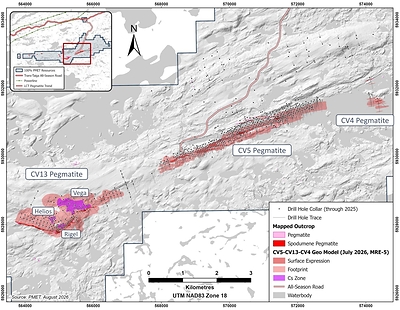
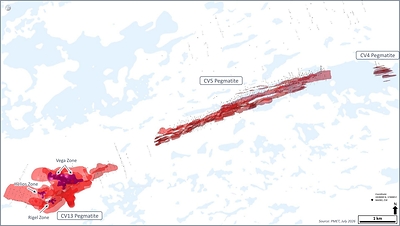
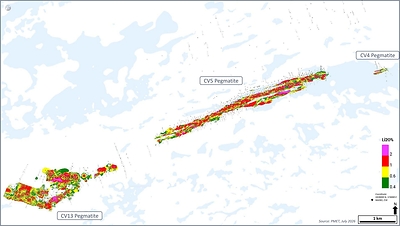
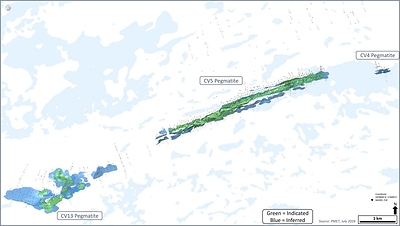
The geological models underpinning MRE-5 include the CV5, CV13, and CV4 LCT pegmatite clusters (Figure 3). Each cluster consists of a series of pegmatite dykes (remaining open in multiple directions) that range in orientation from near flat-lying at CV13 to near-vertical at CV5 and CV4. The dyke's range in true thickness from <5 m to upwards of 125 m with the largest dyke (the "principal" dyke at CV5) representing approximately
The Caesium Zone MRE is hosted within the CV13 Pegmatite and geologically sub-domained using a
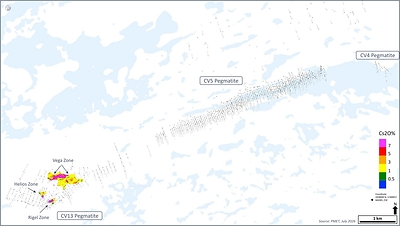
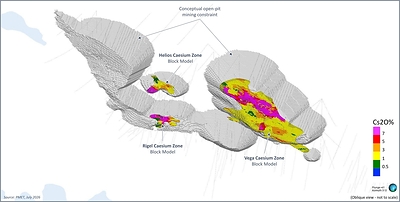
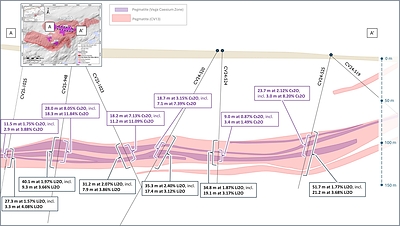
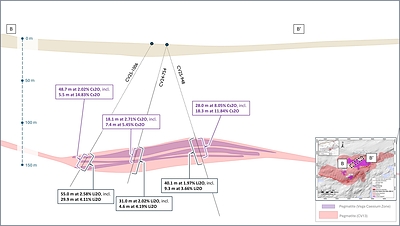
The geological and block models, classifications, and sections reflecting the Consolidated MRE and the Caesium Zone MRE are presented in Figure 4 to Figure 13.
ASX LISTING RULE 5.8
As the Company is listed on both the Toronto Stock Exchange (the "TSX") as well as the Australian Securities Exchange (the "ASX"), there are two applicable regulatory bodies resulting in additional disclosure requirements. This MRE has been completed in accordance with the Canadian National Instrument 43-101 – Standards of Disclosure for Mineral Projects. Additionally, in accordance with ASX Listing Rule 5.8 and the JORC 2012 reporting guidelines, a summary of the material information used to estimate the Mineral Resource for CV5, CV13, and CV4 (including the Rigel,
MINERAL TITLE
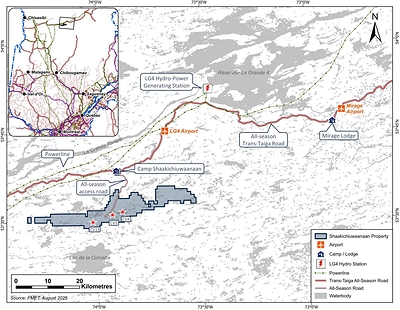
The Shaakichiuwaanaan Property is located approximately 220 km east of
The Property is comprised of 463 Exclusive Exploration Rights ("EER") (formerly known as CDC mineral claims) that cover an area of approximately 23,710 ha. All claims are registered
GEOLOGY AND GEOLOGICAL INTERPRETATION
The Property overlies a large portion of the Lac Guyer Greenstone Belt, considered part of the larger La Grande River Greenstone Belt, and is dominated by volcanic rocks metamorphosed to amphibolite facies. Rocks of the Guyer Group (amphibolite, iron formation, intermediate to mafic volcanics, peridotite, pyroxenite, komatiite, as well as felsic volcanics) predominantly underly the Property (Figure 15). The amphibolite rocks that trend east-west (generally steeply south dipping) through this region are bordered to the north by the Magin Formation (conglomerate and wacke) and to the south by an assemblage of tonalite, granodiorite, and diorite, in addition to metasediments of the Marbot Group (conglomerate, wacke). Several regional scale Proterozoic gabbroic dykes also cut through portions of the Property (Lac Spirt Dykes, Senneterre Dykes). The KCG claim block, located to the north of the principal claim group, is situated within the Bezier Suite (monzodiorite and granodiorite), and outside the Guyer Group.
At the Property, mineralization is observed to occur within lithium-caesium-tantalum ("LCT") pegmatites, hosted predominantly within amphibolite, metasediment, and ultramafic rocks of the Guyer Group within the principal claim group. The LCT Pegmatite Trend is currently recognized as an approximate 1-km wide and 25+ km long corridor, which is host to numerous distinct LCT pegmatite occurrences, and extends in a general east-west direction across the central and western portions of the Property. The LCT pegmatites along this trend may outcrop as isolated high-relief 'whale-back' landforms or relatively low-relief to flat landforms.
To date, eleven (11) distinct LCT pegmatite clusters have been discovered along this trend at the Property: CV4, CV5, CV8, CV9, CV10, CV12, CV13, CV14, CV15, Felix, and Cosma (Figure 16). The dominant lithium-bearing mineral is spodumene (typically decimetre to metre scale), with no significant contribution from other minerals, and the dominant tantalum-bearing mineral is tantalite (±columbite).
Of these clusters, CV5, CV12, CV13, and Cosma have confirmed pollucite-hosted caesium mineralization. Pollucite is an extremely rare mineral occurrence in LCT pegmatites and represents the most fractionated components of the system.
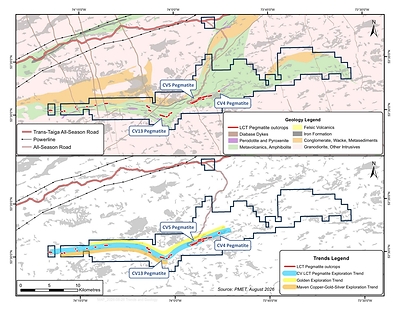
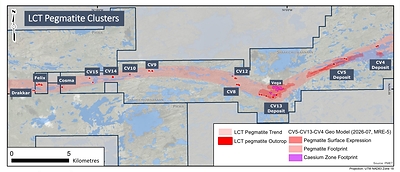
The Consolidated MRE for the Project (the fifth to date, i.e., MRE-5), which is comprised of the CV5, CV13, and CV4 Pegmatites, represents the core area of the LCT pegmatite trend (Figure 2 and Figure 3). The CV5 Pegmatite is the largest single occurrence of LCT pegmatite at the Property, with the principal dyke comprising approximately
The pegmatite dykes at CV5 trend west-southwest (approximately 250°/075° RHR), and therefore dip northerly, which is different than the host amphibolite, metasediment, and ultramafic rocks which dip moderately in a southerly direction.
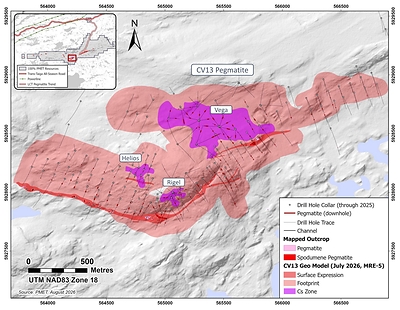
The CV13 Pegmatite is characterized by a series of flat-lying to moderately dipping (northerly), sub-parallel trending LCT pegmatite dykes, of which three appear to dominate. The pegmatite dykes are coincident with the apex of a regional structural flexure whereby they manifest a west arm trending ~290° and an east arm trending ~230°. The CV13 Pegmatite ranges in true thickness from <5 m to more than 40 m and extends continuously over a collective strike length of ~3.2 km (Figure 19). The high-grade (Li) Vega Zone, coincident with the Vega Caesium Zone, is hosted within the CV13 Pegmatite, and is marked by an increased abundance of large spodumene crystals as well as lenses of pollucite (Figure 5, Figure 12, and Figure 13).
The CV4 Pegmatite is characterized by a series of near-vertical dykes. The dykes, with an estimated true thickness of up to 10 m, dip steeply to the north, and have been traced in drill hole over at least a 300 m strike-length (Figure 18). CV4 is interpreted to represent a potential extension of the CV5 Pegmatite; however, the corridor between remains to be drill tested.
The Caesium Zone MRE is comprised of the
Using the
Vega has been traced over a general area of at least 800 m x 250 m and consists of multiple, sub-parallel, flat-lying lenses, at a depth of ~110 m, with a true thickness ranging from <2 m to ~10 m.- Rigel has been traced over a general area of at least 200 m x 100 m and consists of a single, shallow-dipping lens at a depth of ~50 m and true thickness ranging from <2 m to ~6 m.
- Helios has been traced over an area of ~180 m x 80 m and consists of two, near-horizontal, lenses at a depth of ~30 m and true thickness ranging from ~1m to 3 m.
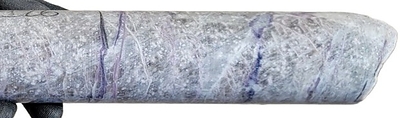
The pollucite is typically centimetre to decimetre-scale, presenting as clear to whitish-grey in colour with common late-stage veining of white pollucite/spodumene/lepidolite, as well as common white flecks (Figure 17). Pollucite commonly occurs with significant amounts of spodumene (lithium) and tantalite (tantalum).
DRILLING TECHNIQUES AND CLASSIFICATION CRITERIA
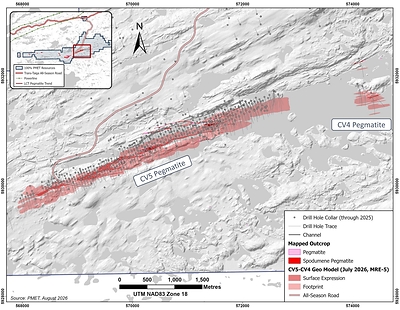
The Shaakichiuwaanaan Consolidated MRE (and host geological models), which includes the CV5, CV13, and CV4 pegmatites only, are supported by 857 diamond drill holes ("DDH") of NQ (predominant) or HQ size, completed through 2025, for a collective total of 263,424 m, as well as 614 m of outcrop channels (Figure 18, Figure 19). This equates to 579 DDH (196,620 m) and 173 m of outcrop channels at CV5, 261 DDH (59,446 m) and 439 m of outcrop channels at CV13, and 17 DDH (7,358 m) and 2 m of outcrop channels at CV4. Included within the CV13 dataset are 64 DDH totaling 13,940 m, completed over the 2022, 2023, 2024, and 2025 programs, as well as 7 m of channels, which were used to support the
Downhole deviation surveys for each drill hole were completed with a Devico DeviGyro tool (2021 and 2024 holes), Reflex Gyro Sprint IQ tool (2022, 2023, 2024, and 2025 holes), Axis Champ Gyro (2023 and 2024 holes), Reflex OMNI Gyro Sprint IQ (2024 and 2025 holes), or Reflex EZ-TRAC (2025 holes). Survey shots were typically continuous at approximately 3-5 m intervals. The use of the gyro tool system negated potential deflection issues arising from minor but common pyrrhotite within the host rock units. All collar and downhole deviation data have been validated by the Project geologists on site, and by the database lead.
Drill core has not been oriented; however, downhole optical and acoustic televiewer surveys have been completed on over 80 drill holes (through 2025) across both CV5 and CV13 to guide modelling.
Drill hole spacing over the resource is predominantly targeting 50 to 100 m pierce points of the pegmatite dyke(s) depending on resource classification being targeted. Orientations of drill holes may vary widely – including grid, fence, and fan based – depending on the orientation of the targeted dyke/lens. It is also common for multiple holes to be collared from the same pad. Drill hole spacing and orientation at the CV5, CV13, and CV4 pegmatites, including the Rigel,
All DDH were completed by Fusion Forage Drilling Ltd. of
Channel sampling followed industry best practices with a 3 to 5 cm wide, saw-cut channel completed across the pegmatite outcrop as practical, perpendicular to the interpreted pegmatite strike. Samples were collected at ~0.5 to 1 m contiguous intervals with the channel bearing noted, and high-accuracy GPS coordinates collected at the start and end points of the channel.
SAMPLING AND SUB-SAMPLING TECHNIQUES
Core sampling protocols meet industry standard practices. Upon receipt at the core shack at Mirage Lodge (2021 through winter 2025) or Camp Shaakichiuwaanaan (summer-fall 2025), all drill core is pieced together, oriented to maximum foliation, metre marked, geotechnically logged (TCR, RQD, ISRM, and Q-Method (since mid-winter 2023)), alteration logged, geologically logged (rock type), and sample logged on an individual sample basis. Wet and dry core box photos are also collected of all core drilled, regardless of perceived mineralization. Specific gravity ("SG") measurements of entire pegmatite samples were collected at systematic intervals (approximately 1 SG measurement every 4-5 m) using the water immersion method. SG measurements are also collected systematically from host rock samples (i.e., non-pegmatite).
Core sampling was guided by rock type as determined during geological logging (i.e., by a geologist). All pegmatite intervals were sampled in their entirety, regardless of whether mineralization was noted or not (in order to ensure an unbiased sampling approach) in addition to ~1 to 3 m of sampling into the adjacent host rock (dependent on pegmatite interval length) to "bookend" the sampled pegmatite. The minimum individual sample length is typically 0.3-0.5 m and the maximum sample length is typically 2.0 m. Targeted individual pegmatite sample lengths are 1.0 to 1.5 m. All drill core was saw-cut, using an
Channels were geologically logged upon collection on an individual sample basis; however, were not geotechnically logged. Channel recovery was effectively
The logging of drill core and channels was qualitative by nature, and included estimates of spodumene grain size, inclusions, and modal mineral estimates. These logging practices meet or exceed current industry standard practices and are of appropriate detail to support a Mineral Resource estimation and disclosure herein.
All core samples were bagged and sealed individually, and then placed in large supersacs for added security, palleted, and shipped by third party transport, or directly by representatives of the Company, to the designated sample preparation laboratory – Activation Laboratories Ltd. ("Actlabs") in
SAMPLE ANALYSIS METHOD AND QUALITY CONTROL
Core samples collected from 2021 drill holes were shipped to Actlabs in
Core samples collected from 2022 and 2023 drill holes were shipped to SGS Canada's laboratory in
All 2022 through 2025 core sample pulps were shipped by air to SGS Canada's laboratory in
A Quality Assurance / Quality Control (QAQC) protocol following industry best practices was incorporated into the drill programs and included systematic insertion of quartz blanks and certified reference materials ("CRMs") into sample batches, as well as collection of quarter-core duplicates (through hole CV23-190 only), at a rate of approximately
Additionally, the Company created two caesium focused CRMs from drill core material collected from the CV13 Pegmatite's Vega Zone – VCS-001 and VCS-002. The certificate of analysis and individual sample packets were provided by Smee & Associates Consulting Ltd., a third-party independent of the Company, which coordinated a six (6) lab round-robin to determine values for Cs, Li, and Ta. The VCS-001 and VCS-002 CRMs were first implemented in June 2025.
Channel samples collected in 2017 were shipped to SGS Canada's laboratory in
A QAQC protocol following industry best practices was incorporated into the channel programs and included systematic insertion of quartz blanks and certified reference materials into sample batches.
|
______________________________ |
|
8 AAS: Atomic Absorption Spectroscopy |
CRITERIA USED FOR CLASSIFICATION
The Consolidated MRE classification has been completed in accordance with the NI 43-101, JORC 2012, and CIM Definition Standards for Mineral Resources and Reserves reporting guidelines. All reported Mineral Resources have been constrained by conceptual open-pit or underground mineable shapes to demonstrate reasonable prospects for eventual economic extraction ("RPEEE").
Blocks were classified as Indicated when drill spacing was 70 m or lower, blocks were estimated with at least 2 drill holes and meeting the minimum estimation criteria parameters. Geological continuity and a minimum thickness of 2 m were mandatory, as well as grade continuity demonstrated at the reported cut-off grade.
Blocks were classified Inferred when drill spacing was between 70 m and 140 m and meeting the minimum estimation criteria parameters. Geological continuity and a minimum thickness of 2 m were also mandatory.
There are no Measured classified blocks. Pegmatite dykes or extensions with lower level of information / confidence were also not classified.
Classification shapes are created around contiguous blocks at the stated criteria with consideration for the selected mining method. The MRE appropriately reflects the view of the Competent Person.
ESTIMATION METHODOLOGY
Compositing was done every 1.0 m for the pegmatite and every 0.5 m for the caesium enriched zones. Unsampled intervals were assigned a grade of
CV5 Parameters
For the spodumene-rich domain within the CV5 principal pegmatite, no capping was required for Li2O and Ga, but Ta2O5 was capped at 3,800 ppm. For the feldspar-rich domain within the CV5 principal pegmatite, a capping of
At CV5, for Li2O, Ta2O5, and Ga, a well-structured variogram model was obtained for the CV5 principal pegmatite's spodumene-rich domain. For the CV5 principal pegmatite, both domains (spodumene-rich and feldspar-rich domains), vein CV5_150, and vein CV_160 were estimated using ordinary kriging (OK), using Leapfrog Edge. The remaining eight (8) pegmatite dykes at CV5 did not yield well-structured variograms for either Li2O, Ta2O5, or Ga and therefore were estimated using Inverse Distance Squared (ID2), also using Leapfrog Edge.
Three (3) orientated search ellipsoids were used to select data and interpolate Li2O, Ta2O5, and Ga grades in successively less restrictive passes. The ellipse sizes and anisotropies were based on the variography, drillhole spacing, and pegmatite geometry. For the first and second pass interpolation a minimum of five (5) composites and a maximum of fifteen (15) composites with a minimum of two (2) holes were needed to interpolate. For the third pass a minimum of three (3) composites with a maximum of fifteen (15) without a minimum per hole was used. Variable search ellipse orientations (dynamic anisotropy) were used to interpolate for ten of the adjacent dykes of the main pegmatite body (CV5_120, 130, 140, 141, 142, 150, 160, 170, 180, and 190). Spatial anisotropy of the dykes is respected during estimation using Leapfrog Edge's Variable Orientation tool. The search ellipse follows the trend of the hanging wall of each dyke.
CV13 Parameters
For the CV13 Pegmatite dykes, it was determined that no capping was required for Li2O and Ga, but a capping of 3,000 ppm Ta2O5 for
For Li2O, Ta2O5, Cs2O, Rb2O, and Ga a well-structured variogram model was obtained for zones CV13_100 and CV13_101. On CV13, Li2O, Ta2O5, Cs2O, Rb2O, and Ga were estimated using ordinary kriging (OK) for zones CV13_100 and CV13_101. The remaining pegmatite dykes at CV13 (19) did not yield well-structured variograms for either Li2O, Ta2O5, Cs2O, Rb2O, and Ga and therefore were estimated using Inverse Distance Squared (ID2), also using Leapfrog Edge.
The twenty-one (21) different pegmatite domains were separated into 2 groups with the same orientation.
CV4 Parameters
At CV4, variography analysis did not yield a well-structured variogram. Li2O, Ta2O5, and Ga were estimated using Inverse Distance Squared (ID2), also using Leapfrog Edge.
Three (3) orientated search ellipsoids were used to select data and interpolate Li2O, Ta2O5 and Ga grades in successively less restrictive passes. The ellipse sizes and anisotropies were based on drillhole spacing, and pegmatite geometry. For all pegmatite domains (10), the first, second, and third pass interpolation required a minimum of three (3) composites and a maximum of fifteen (15) composites with a minimum of two (2) holes to interpolate. Variable search ellipse orientations (dynamic anisotropy) were used to interpolate for the 10 pegmatite dykes (080; 085; 090; 100; 101; 105; 109; 110; 120, and 130). Spatial anisotropy of the dykes is respected during estimation using Leapfrog Edge's Variable Orientation tool. The search ellipse follows the trend of footwall of each dyke.
For CV5, CV13, and CV4, parent cells of 10 m x 5 m x 5 m, subblocked four (4) times in each direction (for minimum subcells of 2.5 m in x, 1.25 m in y, and 1.25 m in z) were used. Subblocks are triggered by the geological model. Li2O, Ta2O5, Cs2O, Rb2O, and Ga grades are estimated on the parent cells and automatically populated to subblocks.
The CV5, CV13, and CV4 block model are rotated around the Z axis (Leapfrog 340°). Hard boundaries between all the pegmatite domains were used for all Li2O, Ta2O5, Cs2O, Rb2O, and Ga estimates. For CV5, the MRE includes blocks within the pit shell above the cut-off grade of
Validation of the block model was performed using Swath Plots, nearest neighbours grade estimates, global means comparisons, and by visual inspection in 3D and along plan views and cross-sections.
CUT-OFF GRADE AND BASIS FOR SELECTION
The cut-off grade ("COG") adopted for the MRE is
Mineral Resources for the Rigel,
MINING & METALLURGICAL METHODS AND PARAMETERS, AND OTHER MODIFYING FACTORS CONSIDERED
Mineral Resources that are not Mineral Reserves do not have demonstrated economic viability. This estimate of Mineral Resources may be materially affected by environmental, permitting, legal, title, taxation, sociopolitical, marketing, economic, or other relevant issues.
The extraction scenario constraint retained for the MRE at the CV5 LCT Pegmatite is mainly open-pit. A pit slope ranging between 32° and 55° was assumed, resulting in a strip ratio of 7.5 (waste to mineable resource) at a revenue factor of 1. Underground long hole mining method accounts for approximately
The extraction scenario constraint retained for the MRE at the CV13 LCT Pegmatite is mainly open-pit. A pit slope of 45° was assumed, resulting in a strip ratio of 8.9 (waste to mineable resource) at a revenue factor of 1. The Mineral Resources for the
The extraction scenario constraint retained for the MRE at the CV4 LCT Pegmatite is underground long hole mining method only, it is considered that CV4 is an extension of CV5.
The metallurgical assumptions for lithium are supported by metallurgical test programs completed by SGS Canada at their
The metallurgical assumptions for recovery of caesium at the Rigel,
QUALIFIED/COMPETENT PERSON
The information in this news release that relates to the Consolidated MRE for the Shaakichiuwaanaan Project (CV5, CV13, and CV4 LCT pegmatites, including the Caesium Zone MRE), as well as other relevant technical information for the Property, is based on, and fairly represents, information compiled by Mr. Todd McCracken, P.Geo., who is a Qualified Person as defined by NI 43-101, and member in good standing with the Ordre des Géologues du
Mr. McCracken is Director – Mining & Geology –
The information in this news release that relates to the mineral processing for the Consolidated MRE (including the Caesium Zone MRE) is based on, and fairly represents, information compiled by Ryan Cunningham, M.Eng., P.Eng., who is a Qualified Person as defined by NI 43-101, and member in good standing with the Ordre des ingénieurs du
Mr. Cunningham is a process engineering consultant for Primero Group Americas Inc. and is independent of the Company. Mr. Cunningham does not hold any securities in the Company.
Mr. McCracken and Mr. Cunningham have sufficient experience, which is relevant to the style of mineralization, type of deposit under consideration, and to the activities being undertaken to qualify as a Competent Person as described by the JORC Code, 2012. Mr. McCracken and Mr. Cunningham consent to the inclusion in this news release of the matters based on the information in the form and context in which it appears.
APPENDIX 1 – JORC CODE 2012 TABLE 1 (ASX LISTING RULE 5.8.2)
Section 1 – Sampling Techniques and Data
|
Criteria |
JORC Code explanation |
Commentary |
|
Sampling techniques |
|
|
|
Drilling techniques |
|
|
|
Drill sample recovery |
|
|
|
Logging |
|
|
|
Sub-sampling techniques and sample preparation |
|
|
|
Quality of assay data and laboratory tests |
|
|
|
Verification of sampling and assaying |
|
|
|
Location of data points |
|
|
|
Data spacing and distribution |
|
|
|
Orientation of data in relation to geological structure |
|
|
|
Sample security |
|
|
|
Audits or reviews |
|
|
Section 2 – Reporting of Exploration Results
|
Criteria |
JORC Code explanation |
Commentary |
|
Mineral tenement and land tenure status |
|
|
|
Exploration done by other parties |
|
|
|
Geology |
|
|
|
Drill hole Information |
|
|
|
Data aggregation methods |
|
|
|
Relationship between mineralization widths and intercept lengths |
|
|
|
Diagrams |
|
|
|
Balanced reporting |
|
|
|
Other substantive exploration data |
|
|
|
Further work |
|
|
Section 3 – Estimate and Reporting of Mineral Resources
|
Criteria |
JORC Code explanation |
Commentary |
|
Database integrity |
|
|
|
Site visits |
|
|
|
Geological interpretation |
|
|
|
Dimensions |
|
|
|
Estimation and modelling techniques |
|
|
|
Moisture |
|
|
|
Cut-off parameters |
|
|
|
Mining factors or assumptions |
|
|
|
Metallurgical factors or assumptions |
|
|
|
Environmental factors or assumptions |
|
|
|
Bulk density |
|
|
|
Classification |
|
|
|
Audits or reviews |
|
|
|
Discussion of relative accuracy/ confidence |
|
|
APPENDIX 2
ABOUT PMET RESOURCES INC.
PMET Resources Inc. is a pegmatite critical mineral exploration and development company focused on advancing its district-scale
In late 2025, the Company announced a positive lithium-only Feasibility Study on the CV5 Pegmatite for the Shaakichiuwaanaan Property and declared a maiden Mineral Reserve of 84.3 Mt at
The Project hosts a Consolidated Mineral Resource10 totalling 113.9 Mt at
This news release has been approved by
"KEN BRINSDEN"
Kenneth Brinsden, President, CEO, & Managing Director
|
_____________________________ |
|
9 See Feasibility Study news release dated October 20, 2025. Probable Mineral Reserve cut-off grade is |
|
10 Consolidated MRE (CV5, CV13, & CV4 pegmatites) is reported at an Li2O cut-off grade of |
DISCLAIMER FOR FORWARD-LOOKING INFORMATION
This news release contains "forward-looking information" or "forward-looking statements" within the meaning of applicable Securities Laws.
All statements, other than statements of present or historical facts, are forward-looking statements. Forward-looking statements involve known and unknown risks, uncertainties and assumptions and accordingly, actual results could differ materially from those expressed or implied in such statements. You are hence cautioned not to place undue reliance on forward-looking statements. Forward-looking statements are typically identified by words such as "plan", "development", "growth", "continued", "intentions", "expectations", "strategy", "opportunities", "anticipated", "trends", "potential", "outlook", "ability", "additional", "on track", "prospects", "viability", "estimated", "reaches", "enhancing", "strengthen", "target", "will", "believes", or variations of such words and phrases or statements that certain actions, events or results "may", "could", "would", "might" or "will" be taken, occur or be achieved. In particular and without limitation, this news release contains forward-looking statements pertaining to the estimation of Mineral Resources, including the Caesium Zone MRE and the maiden rubidium estimate, and the assumptions on which such estimates are based, including those supporting reasonable prospects for eventual economic extraction; the scale of the pollucite-hosted caesium pegmatite Mineral Resource at Shaakichiuwaanaan and the Company's belief regarding its size relative to other publicly reported caesium Mineral Resources; the potential of such resource to be a significant supply source for global markets; the potential of the caesium opportunity at CV13 as an additional saleable product in the overall economic development of the Project; the potential of the development of the Company's Shaakichiuwaanaan Property; the potential recovery of caesium and rubidium as by-products; the potential for resource growth through continued drill exploration, including between the CV5 and CV4 Pegmatites; the Company's intentions with respect to its business and operations; the Company's potential position in the markets and industries it operates in; the perceived merit and further potential of the Company's properties; the results and conclusions of the CV5 Lithium-Only Feasibility Study; the anticipated updated Feasibility Study and Preliminary Economic Assessment, including the timing of their release and the expectation that MRE-5 will underpin such studies; the anticipated timing of a future MRE update; the anticipated filing of a technical report documenting MRE-5; exploration results and potential for production at the Company's properties within agreed specification under applicable offtake terms; the anticipated timing of a future MRE update and the incorporation of 2026 drilling; the Company's development schedule and priorities for the Shaakichiuwaanaan Project; the potential development of the Shaakichiuwaanaan Project; exploration targets, including the gap between CV5 and CV4; budgets and forecasted cash flows and return on capital; strategic plans; market price and demand for lithium, tantalum, caesium and rubidium and the Company's resilience to changes in market price and demand; permitting or other timelines; and government regulations and relations.
Key assumptions upon which the Company's forward-looking information is based include, without limitation: the key assumptions, parameters and methods used to estimate MRE-5 described in this news release, including a spodumene concentrate price of
Some of the risks the Company faces and the uncertainties that could cause actual results to differ materially from those expressed in the forward-looking statements include, among others : uncertainty inherent in Mineral Resource estimates, including that Inferred Mineral Resources have a lower level of confidence and may not be upgraded to Indicated Mineral Resources, and that Mineral Resources that are not Mineral Reserves do not have demonstrated economic viability; the risk that comparisons with other projects, which are based on third-party and, in some cases, historical estimates, are not accurate or comparable; the small, opaque and illiquid nature of the caesium and rubidium markets, the limited availability of reliable price information, and the risk that the Company may be unable to secure offtake for caesium or rubidium products; the risk that pollucite recovery and caesium or rubidium processing may not be achieved at commercial scale or on economic terms; the risk that the updated Feasibility Study or Preliminary Economic Assessment is delayed or that its results differ from current expectations; the Company's ability to execute on plans relating to its Shaakichiuwaanaan Project, including the timing thereof; the Company's ability to generate revenue and future capital requirements; the Company's profitability in the short or medium term; mineral resource estimation risks; exploration, development and operating risks and costs; the Company's dependence upon the Shaakichiuwaanaan Property; the titles to the Company's mineral properties being challenged or impugned; the Company receiving and maintaining licences and permits from appropriate governmental authorities; environmental and safety regulations; land access risk; access to sufficient used and new equipment; maintenance of equipment; the Company's reliance on key personnel; the Company's ability to obtain social acceptability by First Nations with respect to its Shaakichiuwaanaan Project; the Company's reliance on key business relationships; the Company's growth strategy; the Company's ability to obtain insurance; occupational health and safety risks; adverse publicity risks; third party risks; disruptions to the Company's business operations; the Company's reliance on technology and information systems; litigation risks; tax risks; unforeseen expenses; public health crises; climate change; general economic conditions; commodity prices and exchange rate risks; demand for lithium, tantalum, caesium and rubidium; volatility of share price; public company obligations; competition risk; dividend policy; policies and legislation; force majeure; and changes in technology.
Although the Company believes its expectations are based upon reasonable assumptions and has attempted to identify important factors that could cause actual actions, events or results to differ materially from those described in forward-looking statements, there may be other factors that cause actions, events or results not to be as anticipated, estimated or intended. There can be no assurance that forward-looking statements will prove to be accurate, as actual results and future events could differ materially from those anticipated in such statements. As such, these risks are not exhaustive; however, they should be considered carefully. If any of these risks or uncertainties materialize, actual results may vary materially from those anticipated in the forward-looking statements found herein. Due to the risks, uncertainties and assumptions inherent in forward-looking statements, readers should not place undue reliance on forward-looking statements.
Readers are cautioned that the foregoing list is not exhaustive of all factors and assumptions which may have been used. Forward-looking statements are also subject to risks and uncertainties facing the Company's business, any of which could have a material adverse effect on the Company's business, financial condition, results of operations and growth prospects. Readers should review the detailed risk discussion in the Company's most recent Annual Information Form filed on SEDAR+ for a fuller understanding of the risks and uncertainties that affect the Company's business and operations.
The forward-looking statements contained herein are made only as of the date hereof. The Company disclaims any intention or obligation to update or revise any forward-looking statements, whether as a result of new information, future events or otherwise, except to the extent required by applicable law. The Company qualifies all of its forward-looking statements by these cautionary statements.
 View original content to download multimedia:https://www.prnewswire.com/news-releases/pmet-increases-grade-and-scale-of-caesium-mineral-resource-at-shaakichiuwaanaan-302928498.html
SOURCE PMET Resources Inc.
FAQ
AI-generated questions and answers. How Rhea-AI works. Not financial advice.
How much did PMET's Shaakichiuwaanaan caesium resource increase?
Contained caesium oxide increased 55%, from 71,000 tonnes to 110,600 tonnes. The updated Caesium Zone estimate includes Vega, Rigel and the newly estimated Helios zone. Grade increased 31% and tonnage increased 18%.
What price assumptions underpin PMET's updated Shaakichiuwaanaan resource estimate?
The open-pit and underground resource constraints use a spodumene concentrate price of US$1,500 per tonne, on a 6% basis FOB Bécancour, and an exchange rate of 0.74 USD/CAD. Cut-off grades and mining shapes are based only on lithium oxide; other elements are non-paid metals reported for reference.
Are PMET's high-grade sensitivity figures additional mineral resources?
The sensitivity tables should not be interpreted as a Mineral Resource. They demonstrate how tonnage and grade vary with different cut-off grades, using the sum of open-pit and underground constrained and classified resources at the same cut-off.