
PMET Resources Delivers Positive CV5 Lithium-Only Feasibility Study for its Large-Scale Shaakichiuwaanaan Project
PMET Resources (OTCQX:PMETF) released a lithium-only Feasibility Study for the Shaakichiuwaanaan CV5 pegmatite in Eeyou Istchee, Quebec.
Rhea-AI Summary
PMET Resources (OTCQX:PMETF) released a lithium-only Feasibility Study for the Shaakichiuwaanaan CV5 pegmatite in Eeyou Istchee, Quebec.
Key outcomes: Maiden Mineral Reserve of 84.3 Mt at 1.26% Li2O Probable (≈2.62 Mt LCE); nameplate ~800,000 tpa SC5.5 spodumene concentrate production for ~20 years; after-tax NPV8% ≈US$1.19B and IRR ≈18.1% at long-term price US$1,221/t; total development capital ≈CA$1,978M (≈CA$1,510M net of anticipated pre-production credits); competitive AISC ≈US$597/t. FID targeted in H2 2027; NI 43-101 technical report to be filed within 45 days.
Positive
- Maiden Mineral Reserve 84.3 Mt at 1.26% Li2O (Probable)
- Steady-state production ~800,000 tpa SC5.5 spodumene concentrate
- Project NPV8% ~US$1.19B after tax (price assumption US$1,221/t)
- Competitive AISC ~US$597/t (SC5.5 basis)
- ~20-year mine life supporting long-life production profile
Negative
- Total development capital ~CA$1,978M (high upfront capex)
- Project economics reliant on long-term spodumene price of US$1,221/t
- FID timing deferred to H2 2027, delaying potential cash flows
Details
News Market Reaction – PMETF
In the Oct 21 session, PMETF declined 12.19%, reflecting a significant negative market reaction.
Data tracked by StockTitan Argus on the day of publication.
AI-generated analysis. How Rhea-AI works. Not financial advice.




Unlocking Shaakichiuwaanaan's maiden Mineral Reserve and a key step towards final mine authorisation
Highlights
-
Robust CV5 lithium-only Feasibility Study ("FS") completed on the Shaakichiuwaanaan Project (Project) providing a defined scope and technical foundation which supports the upcoming Environmental and Social Impact Assessment (ESIA) submissions.
- FS is a mandated requirement of the Environmental and Social Impact Assessment ("ESIA") which defines the entire scope for approvals sought and will kick-start the final mine authorisation process keeping the Project on track with the proposed permitting and development timeline.
-
Maiden Mineral Reserve of 84.3 Mt at
1.26% Li2O Probable (2.62 Mt LCE) at CV5.- Opportunities remain for additional conversion at CV5 and CV13, which hosts a Mineral Resource – inclusive of Reserves – of 108.0 Mt at
1.40% Li2O Indicated and 33.4 Mt of1.33% Li2O Inferred.
- Opportunities remain for additional conversion at CV5 and CV13, which hosts a Mineral Resource – inclusive of Reserves – of 108.0 Mt at
-
FS confirms the scope for a large-scale and long-life lithium operation, based solely on Mineral Reserve and including:
- Low strip ratio open pit mining and higher-grade underground mining;
- DMS (Dense Media Separation) only ore processing operation with less complexity and without the need of flotation and chemical reagents;
- Spodumene concentrate production spanning ~20 years and a nominal steady-state production rate of up to ~800,000 tpa SC5.5 spodumene concentrate upon achieving full production capacity; and
- Positioning PMET Resources (PMET) as potentially the 4th largest spodumene concentrate producer globally.
-
Competitive total cash operating cost1 and all-in sustaining cost ("AISC")2 of
~ /t ($729 ~US /t) and$544 ~ /t ($800 ~US /t), respectively for SC5.5, consistent with the prior PEA estimates.$597 - At a long-term spodumene price of
US /t (SC5.5 basis) the Project delivers an after-tax NPV$1,221 8% of~ ($1,594M US ) and after-tax IRR of ~$1,190M 18.1% . - Total development capital of
~ (or$1,978M ~ net of anticipated pre-production credits, including the Canadian Clean Technology Manufacturing – Investment Tax Credit ("CTM-ITC")3 and Tax Credit Relating to Resources ("TCRR")4).$1,510M - Underpins development of a 5.1 Mtpa ore processing operation producing up to 800ktpa for spodumene concentrate, positioning Shaakichiuwaanaan amongst the largest hard-rock lithium projects globally.
- The CV5 Lithium-only FS confirms the technical feasibility and economic viability of developing a large-scale, long-life spodumene pegmatite operation in the Eeyou Istchee (
James Bay ) Region ofQuébec . With a competitive cost production profile, the Project demonstrates resilience to lower market cycles, positioning the Project to become a potential cornerstone supplier to North American, European, and/or Asian battery supply chains. - The Project offers further upside potential through ongoing optimisation initiatives, including the opportunity to adopt a more scalable development pathway up to 5.1 Mtpa to optimize capital expenditure, as well as leveraging tantalum recovery and the recent caesium discovery, which could add further value alongside spodumene production.
- The Company has submitted an application to pursue an underground bulk sample advanced exploration program at CV5, targeting the high-grade Nova Zone, with the objective of further de-risking Project execution, supporting further design optimisation and for product validation purposes.
- A Final Investment Decision ("FID") remains targeted for the second half of 2027, consistent with the Company's development schedule. The decision at that time will be based on:
- Further optimised development scenarios derived from detailed engineering;
- Co-product recovery and the associated economic impact to the Project;
- Prevailing market conditions in key supply chains; and
- The Company's commercial relationships with customers and other key players in the battery and other critical minerals supply chains.
|
_________________________ |
|
1 Total cash operating cost (Incoterms DAP – 'Delivered at Place' |
|
2 All-in sustaining costs ("AISC") includes mining, processing, site administration and product transportation costs to |
|
3 Total cash operating cost (Incoterms DAP – 'Delivered at Place' |
|
4 All-in sustaining costs ("AISC") includes mining, processing, site administration and product transportation costs to |
Management Comment
Ken Brinsden, PMET Resources CEO and President, comments: "The CV5 Lithium-only Feasibility Study is a critical path item which defines the full scope and documentation necessary to formally commence and underpin the final mine authorisation process. In addition, it will facilitate our continued engagement with the government, community and industry downstream, for what is now clearly a globally significant Project. The FS encompasses a full scope to develop up to 5.1 Mtpa in ore processing capacity, matched to the upcoming ESIA submissions, that will frame approvals for the entire Project and importantly allow the Company to maintain its development timeline, while still allowing flexibility for expected ongoing optimisation that will occur during the detailed engineering phase.
Our large scale and long-life Project is ideally suited to support the emerging American, European, and Asian lithium raw materials supply chains. There are very few projects of this size & scale, quality, and low production cost that can assist in underwriting the expected capital investment supporting new supply chains and demand growth in western markets. Add to that the benefit of the other critical minerals in the Shaakichiuwaanaan resource that are expected to add further value to the Project, and you have a compelling proposition for future development.
"Further, it is widely anticipated that the overall market supply-demand balance tightens over the coming years, providing a potentially improved backdrop for spodumene pricing and a future Project FID at the appropriate scale", added Mr. Brinsden.
PMET Resources Inc. (the "Company" or "PMET") (TSX: PMET) (ASX: PMT) (OTCQX: PMETF) (FSE: R9GA) is pleased to announce the results of its lithium-only CV5 Feasibility Study ("FS") at the Company's wholly owned Shaakichiuwaanaan Property (the "Property" or "Project") located in the Eeyou Istchee James Bay region of
The lithium-only Feasibility Study reaffirms the scenario presented in the Company's 2024 Preliminary Economic Assessment ("PEA"), whereby the cornerstone CV5 Spodumene Pegmatite is developed via a hybrid model combining both open pit and underground mining methods. This scenario was confirmed to provide a solid base upon which to define the scope for approvals sought under the Company's Environmental and Social Impact Assessment ("ESIA") that will form the basis for final mine authorisation. With the FS being a mandated component of the ESIA, the Company will seek approvals for a broad scope to develop up to 5.1 Mtpa in processing capacity and have maximum optionality and flexibility over time to unlock the potential of the Shaakichiuwaanaan Project to position it as a leading lithium raw materials supplier to North American, European, and Asian markets.
The FS is based on a Mineral Reserve derived from the CV5 Pegmatite's Indicated Mineral Resource component, part of the current Shaakichiuwaanaan Consolidated Mineral Resource Estimate ("MRE"), which is the largest known lithium pegmatite MRE in the
Although no final investment decision ("FID") has been reached for the Shaakichiuwaanaan Project, the Feasibility Study reaffirms the potential for the CV5 Pegmatite to position the Company as a globally significant spodumene concentrate producer – potentially the 4th largest globally.
Following submission of the ESIA, and while awaiting the final mine and environmental approvals, the Company expects to further optimize the Project via various initiatives. These include (but are not limited to):
- Further refinement of Project phasing with a view to develop incrementally and optimize capital outlays;
- De-risk Project execution by pursuing an advanced exploration bulk sample program targeting the underground ore body, with emphasis on better geological understanding of the high-grade Nova Zone and to test product specification and quality at scale;
- Advance metallurgical work to support the development of a tantalum "bolt-on" recovery circuit at CV5 that could contribute meaningful co-products and further enhance the economics of the Project;
- Advance geological and metallurgical understanding of the caesium opportunity (at both CV13 and CV5) and how to integrate with the overall Project.
The Company expects that these opportunities (and potentially others), as they are assessed and mature over time, will be instrumental in realizing the Project's full potential.
This announcement has been prepared in accordance with the JORC Code (2012) and the ASX Listing Rules. A technical report prepared in accordance with National Instrument 43-101 Standards of Disclosure for Mineral Projects ("NI 43-101"), detailing the FS and the MRE, will be filed on SEDAR+ within 45 days of this announcement.
Unless otherwise indicated, all references to "$" or "CA$" in this release are to Canadian dollars and references to "US$" in this release are to US dollars. A foreign exchange conversation rate of 1.34 CA$/US$ has been used over the life-of-mine ("LOM").
Feasibility Summary
The lithium-only FS for Shaakichiuwaanaan's CV5 Pegmatite is a mandated requirement to formally commence the Company's final mine authorisation process. It confirms the Project's technical and economic viability while providing a broad project scope for the Company's ESIA submissions. Together, the FS and ESIAs (Federal and Provincial levels) will be matched to the full-scale scope for a mining and processing operation of up to 5.1 Mtpa and will be filed in tandem to advance the final mine authorisation process in
PMET Resources engaged external consultant G Mining Services Inc. as lead consultant, with contributions from Primero Group Americas Inc. (Primero), AtkinsRéalis Group Inc., BBA Inc., Paterson & Cooke Canada Inc. (Paterson & Cooke), Vision Geochemistry Ltd., Alius Mine Consulting, WSP Global Inc., Mailloux Hydrogeologie and GCM Expert, to prepare an independent Feasibility Study and Technical Report for the CV5 Pegmatite (lithium-only) at the Shaakichiuwaanaan Project.
The FS confirms that the CV5 Pegmatite, with a nameplate design production rate of approximately 800,000 tonnes per annum of SC5.5 spodumene concentrate, has the potential to position PMET among the top four spodumene concentrate producers globally. With planned ore processing capacity of up to 5.1 Mtpa and production spanning approximately 20 years, the Project reaffirms its global standing as a large-scale, long-life lithium pegmatite operation.
Shaakichiuwaanaan also maintains its competitive cost position, supported by projected AISC2 (SC5.5, DAP Grande-Anse as POL basis) of
The FS delivers an after-tax NPV
Importantly, the FS confirms that Shaakichiuwaanaan is both technically feasible and economically viable, and positions the Project to become a cornerstone supplier to the North American, European, and Asian EV supply chains. The combination of scale, longevity, and cost competitiveness, together with the ability to supply a coarse, high quality SC5.5 spodumene concentrate, provides a strong platform for future growth.
The Company will now advance to the next stage of development with detailed engineering, which will build on the FS to define an optimised and scalable development pathway aimed at maximising long-term value. This work will evaluate optimisation initiatives such as staging of capital, design refinements and operational efficiencies, while also assessing opportunities to capture incremental value through tantalum recovery and the recent high-grade caesium discovery at CV13.
To support this optimisation process and further de-risk the Project, the Company is preparing to advance its CV5 exploration program in the form of an underground bulk sample, which will provide data to validate key design assumptions, test product specification and quality at scale, and confirm mine plan enhancements.
In parallel, the completion of the FS positions the Company to now advance discussions with customers, strategic investors and government stakeholders, reflecting the Shaakichiuwaanaan Project's importance to develop a robust western-facing battery supply chain.
The FID (targeted for H2 2027) will take into account detailed engineering and optimised outcomes, prevailing market conditions, and the Company's commercial relationships and customer requirements across the battery supply chain.
Feasibility Study Outcomes
The Project is expected to yield an annual production rate of up to ~800,000 tpa of spodumene concentrate (SC5.5 basis). Based on this production rate, over the mine life, the Project is expected to generate an estimated after-tax NPV
This spodumene concentrate price is derived from a basket of reference sources including Benchmark Intelligence's long-term market analysis, consensus forecasts from leading financial institutions, and recent NI 43-101 technical report disclosures. These references indicate that spodumene concentrate prices for SC5.5 generally cluster in a range of
Table 1 : Summary of Estimated Project Economics
|
Financial Results |
Unit |
CA$ |
US$ |
|
Long term price assumption ( |
$/t |
1,636 |
1,221 |
|
Pre-Tax NPV |
M$ |
8,358 |
6,237 |
|
Pre-Tax NPV |
M$ |
2,514 |
1,876 |
|
After-Tax NPV |
M$ |
5,418 |
4,043 |
|
After-Tax NPV |
M$ |
1,594 |
1,190 |
|
Pre-Tax IRR |
% |
19.87 % |
|
|
After-Tax IRR |
% |
18.06 % |
|
|
Pre-Tax Payback Period |
year |
4.9 |
|
|
After-Tax Payback Period |
year |
4.7 |
|
Table 2 : Estimated Production Metrics
|
Key Metrics |
Unit |
Value |
|
Open Pit, Phase 1 Construction and Ramp Up Phase (incl. detailed engineering & procurement) |
year |
3.4 |
|
Open Pit, Phase 1 Construction and Ramp Up Phase (from breaking ground) |
year |
2.5 |
|
Underground, Phase 2 Expansion Construction and Ramp Up Phase |
year |
3.6 |
|
Life of Mine (LOM) |
year |
19 |
|
Open Pit |
|
|
|
Ore Mined |
Mt |
49.2 |
|
Waste Mined (including pre-stripping) |
Mt |
167.5 |
|
Total Tonnes Mined |
Mt |
216.7 |
|
LOM Open Pit Strip Ratio (waste tonnes: ore tonnes) |
w:o |
3.4:1 |
|
Underground |
|
|
|
Ore Mined |
Mt |
35.1 |
|
Waste Mined |
Mt |
5.2 |
|
Total Tonnes Mined |
Mt |
40.3 |
|
Total |
|
|
|
Total Mineral Reserve (Open Pit + Underground) mined and processed |
Mt |
84.3 |
|
Nominal Process Plant Feed Rate |
Mtpa |
5.1 |
|
Average Process Plant Feed Rate |
Mtpa |
4.4 |
|
Average Li2O recovery |
% |
68.9 |
|
Average Feed Grade |
% |
1.26 |
|
LOM Spodumene Concentrate |
Mt |
13.3 |
|
Spodumene Concentrate Grade |
% |
5.5 |
|
Nominal Spodumene Concentrate Production Rate |
ktpa |
801.6 |
|
LOM Average Spodumene Concentrate Production Rate |
ktpa |
693.8 |
Capital Expenditures
The development strategy for the Project outlined in the FS employs a similar approach as the PEA, i.e. a hybrid mining model combining open pit and underground extraction methods. The open pit operation is developed first, with Phase 1 providing an initial production capacity of ~400,000 tpa spodumene concentrate. The underground mine comes online second as Phase 2 and provides an additional production capacity of ~400,000 tpa spodumene concentrate, resulting in ~800,000 tpa nameplate capacity for the Project. Total development capital of
Initial Capital Costs include all construction and pre-production costs up to the date of commercial production, including some pre-investment into the Phase 2 underground mine as well as early engineering and procurement expenses incurred in 2027 prior to FID. Expansion Capital is all construction costs to develop the Phase 2 (underground and the associated additional processing facility) incurred post commercial production.
Table 3 : Summary of Estimated Capital Expenditures
|
Capital Expenditure |
Phase 1 OP |
Phase 2 UG |
Total
Initial (M$) |
Phase 2 UG |
Total Devel. Capital Cost (M$) |
LOM (M$) |
Total (M$) |
|
100 – Infrastructure |
124.9 |
- |
124.9 |
24.8 |
149.7 |
30.8 |
180.5 |
|
200 – Power and Electrical |
173.8 |
- |
173.8 |
46.2 |
220.0 |
25.0 |
245.1 |
|
300 – Water Management |
128.2 |
- |
128.2 |
18.7 |
146.9 |
100.5 |
247.3 |
|
400 – Surface Operations |
18.6 |
- |
18.6 |
- |
18.6 |
11.9 |
30.5 |
|
500 – Mining |
120.0 |
99.1 |
219.1 |
36.4 |
255.5 |
550.5 |
806.0 |
|
600 – Process Plant |
217.3 |
20.1 |
237.4 |
167.0 |
404.4 |
- |
404.4 |
|
700 – Construction Indirects |
262.8 |
0.1 |
262.9 |
123.8 |
386.7 |
- |
386.7 |
|
800 – General Services / Owner's Cost |
99.8 |
4.7 |
104.5 |
13.4 |
117.9 |
31.6 |
149.6 |
|
900 – Pre-production, Start-up, Comm. |
73.3 |
9.3 |
82.6 |
1.5 |
84.1 |
186.1 |
270.2 |
|
Total Initial Capital Expenditures (Excl. Contingency) |
1,218.7 |
133.3 |
1,352.0 |
431.8 |
1,783.8 |
936.4 |
2,720.3 |
|
990 – Contingency |
130.7 |
15.0 |
145.7 |
48.7 |
194.4 |
- |
194.4 |
|
Total Initial Capital Expenditures |
1,349.4 |
148.3 |
1,497.7 |
480.5 |
1978.2 |
936.4 |
2,914.7 |
|
|
|
|
|
|
|
|
|
|
Less: Pre-Prod1. Credit net of TC/RC & Royalties |
(101.7) |
- |
(101.7) |
- |
(101.7) |
- |
(101.7) |
|
Total Initial Capex Net of Pre-Production Credit |
1,247.7 |
148.3 |
1,396.0 |
480.5 |
1,876.5 |
936.4 |
2,813.0 |
|
|
|
|
|
|
|
|
|
|
Less: CTM-ITC Tax Credit |
(210.1) |
- |
(210.1) |
(113.2) |
(323.3) |
(36.5) |
(359.8) |
|
Less: TCRR Tax Credit |
(29.0) |
(14.3) |
(43.3) |
- |
(43.3) |
(13.8) |
(57.1) |
|
Total Initial Capex Net of Pre-Prod & Tax Credit |
1,008.6 |
134.0 |
1,142.6 |
367.3 |
1,509.9 |
886.1 |
2,396.0 |
|
100: Infrastructure includes site roads, bridges, truck shop, mine dry and offices, administrative building, camp facilities as well as the fuel and explosives storage and infrastructure earthworks. 200: Power and Electrical includes the main electrical powerline and substations as well as secondary power generation and power distribution at site. 300: Water Management relates to all infrastructure required to collect, manage and treat fresh water, potable water, process water contact and non-contact water. 400: Surface operations relates to construction, process plant and G&A mobile equipment. 500: Mining includes haul roads, open pit equipment purchase, pit surface preparation and some underground infrastructure (ventilation and compressors). 600: Process plant includes capital expenditures for the first production train with a capacity of 2.5 Mtpa and certain early works from the second production train with an additional capacity of 2.5 Mtpa. 700: Construction Indirects include project management and logistics, temporary construction infrastructure and equipment, energy and engineering. 800: General Services / Owner's costs include general and administrative costs, security, IT, owner's costs, logistics, taxes and insurances as well as camp operations costs, health & safety and environment services. 900: Pre-Production costs relate to operating costs incurred in processing and mining prior to achieving commercial production. 990: An overall contingency has been applied to all direct and indirect costs based on quality and engineering level of inputs. |
|
1. Pre-Production c redits relate to spodumene concentrate revenues expected to be realized during the ramp-up period before reaching commercial production. |
Operating Costs
Operating costs have been derived from first principles using supplier quotations whenever available and/or using available benchmarks, adjusted for inflation. All operating costs assume owner-run operations, except for overburden removal for the open pit and for years 1-2 of the underground development, that are assumed to be performed by a contractor.
The estimated cash operating cost5 at site is
Table 4: Estimated Cash Operating Costs per Tonne of Concentrate
(SC5.5 – DAP Grande-Anse as POL basis)
|
Financial Results |
CA$/t |
US$/t |
|
Mining |
320.1 |
238.9 |
|
Processing |
91.2 |
68.0 |
|
Site Administration |
100.7 |
75.1 |
|
Cash Operating Cost at Site5 |
511.9 |
382.0 |
|
Transportation cost |
217.2 |
162.1 |
|
Total Cash Operating Cost (DAP Grande-Anse as POL)6 |
729.1 |
544.1 |
|
Sustaining Capital |
70.7 |
52.7 |
|
All-In Sustaining Cost – (DAP Grande-Anse as POL)7 |
799.8 |
596.8 |
Revenue and Market Pricing Assumption
Price forecasts in the market are generally presented on a
In preparing this FS, PMET has followed the Canadian Institute of Mining (CIM) disclosure guidelines, which require long-term price assumptions benchmarked against independent consensus forecasts and peer technical reports. This ensures that the pricing assumptions adopted are transparent, defensible and robust.
On this basis, the FS adopts a long-term spodumene price assumption of
While EVs remain the primary driver of lithium demand, the rapid expansion of battery energy storage systems (BESS) has become an increasingly material factor. Global BESS installations grew more than
On the supply side, achieving the growth required to meet projected demand will be highly challenging. A significant portion of the future supply pipeline is expected to come from projects that are either not yet in production, in care and maintenance, or at early development stages. These categories of projects carry elevated execution and financing risks, and historically many have faced delays or failed to progress as planned. As a result, there is considerable uncertainty as to whether the necessary supply capacity will be delivered on the timelines assumed in market forecasts. Benchmark Intelligence projects that, despite the sizeable development pipeline, structural supply deficits are expected to emerge from 2030 onwards, with shortfalls of approximately 290,000 tonnes LCE by 2035 and nearly 600,000 tonnes LCE on average between 2035 and 2040.
Taken together, accelerating BESS demand and the uncertainty of future supply additions are expected to place further upward pressure on long-term spodumene pricing.
The Company has an offtake binding term sheet for 100,000 tonnes (SC5.5) per year for a period of 10 years with PowerCo (see news release dated December 18, 2024), with pricing largely linked with reported market price references. Based on ongoing engagement with industry, the Company views the balance of its production (~700,000 tonnes per year at full production) being readily placed to customers consistent with the Project development and expansion schedule.
These factors, together with the increasing focus in Western markets on establishing resilient and sustainable supply chains for battery materials supports the decision to adopt a long-term spodumene price assumption of
|
______________________ |
|
5 Cash operating cost at site includes mining, processing, and site administration, it is a non-IFRS measure, and when expressed per tonne, a non-IFRS ratio. Refer to the "Non-IFRS and other financial measures" section of this press release for further information on these measures. |
|
6 Total cash operating cost (DAP Grande-Anse as POL) includes mining, processing, site administration, and product transportation to |
|
7 All-in sustaining costs ("AISC") includes mining, processing, site administration, and product transportation costs to |
Sensitivity Analysis
A sensitivity analysis was conducted on the base case post-tax NPV
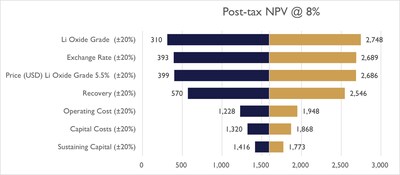
Current market conditions (as defined by a recent spot price of
Funding & Strategic Engagement
Since completion of the Preliminary Economic Assessment (PEA), the Company has been evaluating a range of potential funding solutions designed to deliver the most cost-effective and value-enhancing package(s) for both the Company and its shareholders. This work continues to progress alongside the FS and ESIA development process and will continue as the Company moves through project optimization and permitting. Potential funding solutions under consideration include an appropriate combination of strategic, debt and listed equity, and government programs, integrated with potential downstream collaboration opportunities to further enhance project value.
The scale, quality, and strategic positioning of the Project have already enabled PMET to attract globally recognized partners. Volkswagen AG, through its financing subsidiary, invested approximately
Discussions are also ongoing with several industry participants and strategic groups interested in further long-term supply arrangements, reflecting growing global efforts to establish diversified, transparent, resilient supply chains for lithium and other critical minerals.
PMET continues to build strong engagement with governmental and institutional stakeholders, including both Canadian and international export credit agencies, alongside tier-1 commercial financiers and equity funding groups. These discussions are progressing in support of a targeted project financing package aligned with an FID by the end of FY2027.
Furthermore, the Governments of
Taken together, these relationships and initiatives provide a strong foundation for PMET's future funding strategy, positioning the Company to advance toward FID with credible partners, robust institutional support, and a competitive project ready to anchor new supply chains across
Mineral Resource Estimate
The Shaakichiuwaanaan Consolidated Mineral Resource Estimate (MRE), which includes both the CV5 and CV13 pegmatites, has been completed in accordance with NI 43-101, and CIM Definition Standards for Mineral Resources and Reserves reporting guidelines and is presented in Table 5. As the Company is dual listed on the ASX in
Table 5 : Shaakichiuwaanaan Consolidated Mineral Resource Estimate
|
Pegmatite |
Classification |
Tonnes |
Li2O |
Cs2O |
Ta2O5 |
Ga |
Contained
|
|
Mt |
% |
% |
ppm |
ppm |
|||
|
CV5 & CV13 |
Indicated |
108.0 |
1.40 |
0.11 |
166 |
66 |
3.75 |
|
Inferred |
33.4 |
1.33 |
0.21 |
155 |
65 |
1.09 |
|
1. |
Mineral Resources were prepared in accordance with NI 43-101 – Standards for Disclosure of Mineral Projects and the CIM Definition Standards (2014). Mineral Resources that are not Mineral Reserves do not have demonstrated economic viability. This estimate of Mineral Resources may be materially affected by environmental, permitting, legal, title, taxation, sociopolitical, marketing, economic, or other relevant issues. |
|
2. |
The independent Competent Person (CP), as defined under JORC, and Qualified Person (QP), as defined by NI 43‑101 for this resource estimate is Todd McCracken, P.Geo., Director – Mining & Geology – |
|
3. |
Estimation was completed using a combination of inverse distance squared (ID2) and ordinary kriging (OK) for CV5 and inverse distance squared (ID2) for CV13 in Leapfrog Edge software with dynamic anisotropy search ellipse on specific domains. |
|
4. |
Drill hole composites at 1 m in length. Block size is 10 m x 5 m x 5 m with sub-blocking. |
|
5. |
Both underground and open-pit conceptual mining shapes were applied as constraints to the Consolidated MRE to demonstrate reasonable prospects for eventual economic extraction. Cut-off grades for open-pit constrained resources are |
|
6. |
Mineral Resources for the Rigel and |
|
7. |
Rounding may result in apparent summation differences between tonnes, grade, and contained metal content. |
|
8. |
Tonnage and grade measurements are in metric units. |
|
9. |
Conversion factors used: Li2O = Li x 2. 153; LCE (i.e., Li2CO3) = Li2O x 2.473, Ta2O5 = Ta x 1.221, Cs2O = Cs x 1.0602 |
|
10. |
Densities for pegmatite blocks (both CV5 & CV13) were estimated using a linear regression function (SG = 0.0674x (Li2O% + 0.81 x B2O3%) + 2.6202) derived from the specific gravity ("SG") field measurements and Li2O grade. Non-pegmatite blocks were assigned a fixed SG based on the field measurement median value of their respective lithology. |
|
11. |
The Mineral Resources are inclusive of the Mineral Reserves. |
All reported Mineral Resources have been constrained by conceptual open pit and underground mineable shapes to demonstrate reasonable prospects for eventual economic extraction ("RPEEE"). The cut-off grade is variable depending on the mining method and pegmatite (
The FS presented has been completed for lithium only on the CV5 Pegmatite's Mineral Resource component (of the Consolidated MRE), which includes 101.8 Mt at
The CV5 Pegmatite is a Li-Cs-Ta (LCT) pegmatite situated central to the Property within the Guyer Greenstone Belt, considered part of the larger La Grande River Greenstone Belt, and intrudes predominantly amphibolite, metasediment, and lesser ultramafic rock types. The principal lithium mineral is spodumene which is present typically as decimetre to metre scale crystals.
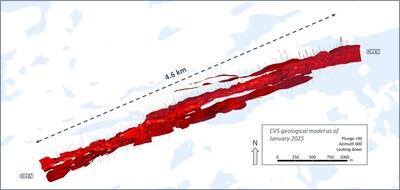
The CV5 Pegmatite, including the principal dyke, is modelled to extend continuously over a lateral distance of at least 4.6 km and remains open along strike at both ends and to depth along a large portion of its length (Figure 2). The principal dyke ranges from <10 m to more than 125 m in true width, and may pinch and swell aggressively along strike, as well as up and down dip. It is primarily the thickest at near-surface to moderate depths (<225 m), forming a relatively bulbous, elongated shape, which may flare to surface and to depth variably along its length. The principal dyke also hosts the high-grade Nova Zone, which has been traced over a strike length of at least 1.1 km and includes multiple drill intersections ranging from 2 m to 25 m (core length) at >
Mineral Reserve Estimate
The mine design and Mineral Reserve estimate were completed on the CV5 Pegmatite to a level appropriate for feasibility studies. The Mineral Reserves were estimated in accordance with the CIM Estimation of Mineral Resources & Mineral Reserves Best Practice Guidelines (November 29, 2019) and CIM Definition Standards for Mineral Resources and Reserves (May 10, 2014) and also comply with the JORC Code 2012.
In line with these standards, the Mineral Reserves for the CV5 Pegmatite are based solely on Indicated Mineral Resources, and for lithium only. Any Inferred Resources that fall within the mine design envelope have been treated as waste and assigned a grade of
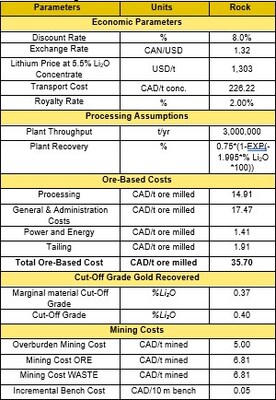
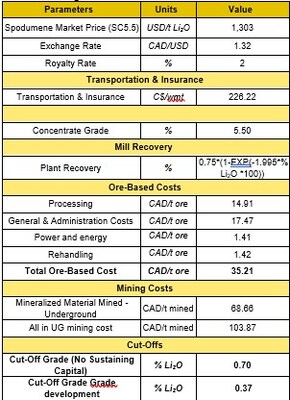
To evaluate the potentially economical portion of the Mineral Resource Estimate, separate break-even cut-off grades were calculated for the open pit and the underground components. The calculation used operating costs reflecting current labour and fuel price, inclusive of mining, processing, G&A, concentrate transport, and royalties. The metallurgical recovery assumption followed a grade/recovery curve determined via extensive testing undertaken by SGS Canada. The cut-off grade calculation also takes into account dilution and mining recovery assumptions. The resulting cut-off grades used for the open pit and the underground Mineral Reserves are
A zone-by-zone approach was applied to validate the economic viability of each area of the deposit by integrating zone-specific sustaining capital costs into the economic analysis for the underground Reserve, whereby stope clusters that did not support development costs to access them, were not converted to Reserves. Underground stopes located within the crown pillar were not converted to Reserves.
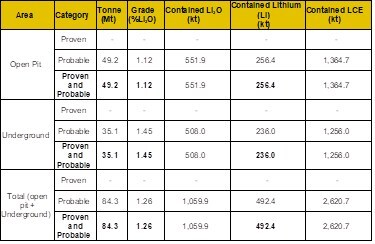
A maiden Mineral Reserve for the Shaakichiuwaanaan Project (lithium-only CV5) has been estimated at 84.3 Mt at
No material risks have been identified at this stage of Project development with respect to social or governmental approvals, therefore no additional assumptions have been applied to the Mineral Reserve Estimate for the purposes of these factors.
It is the opinion of the Qualified/Competent Person that the Mineral Reserves estimate is supported by appropriate design, scheduling and costing work reported to a feasibility study level of detail. Sufficient modifying factors and economic considerations have been applied to the Indicated Mineral Resource to declare the Probable Mineral Reserve. As such, Mineral Reserves are reported commensurate with the Probable classification.
Sections 1 to 4 of the JORC Code Table 1 Report is included in Appendix 1 in accordance with ASX Listing Rule 5.9.
Table 6 : Shaakichiuwaanaan Mineral Reserve (CV5)
|
Area |
Classification |
Tonnes |
Grade |
Contained Li2O |
Contained Li |
Contained LCE |
|
Open Pit |
Proven |
- |
- |
- |
- |
- |
|
Probable |
49.2 |
1.12 |
0.55 |
0.26 |
1.36 |
|
|
Underground |
Proven |
- |
- |
- |
- |
- |
|
Probable |
35.1 |
1.45 |
0.51 |
0.24 |
1.26 |
|
|
TOTAL |
Proven |
- |
- |
- |
- |
- |
|
Probable |
84.3 |
1.26 |
1.06 |
0.49 |
2.62 |
|
1. |
The Mineral Reserves were estimated using the CIM Estimation of Mineral Resources & Mineral Reserves Best Practice Guidelines (November 29 ,2019) and CIM Definition Standards for Mineral Resources and Reserves (May 10, 2014). |
|
2. |
The mine design and Mineral Reserve estimate have been completed to a level appropriate for feasibility studies. Mineral Reserves are based on the Indicated Mineral Resources only. The Inferred Mineral Resources contained within the mine design are not included and classified as waste. |
|
3. |
Mineral Reserves are estimated using a long-term lithium price of USD 1,303/t of spodumene concentrate at |
|
4. |
The Qualified Person for the estimate is Carl Michaud, P.Eng., MBA. The estimate has an Effective Date of September 11, 2025. |
|
5. |
The Mineral Reserves for open pit are estimated using a cut-off grade of |
|
6. |
The following mill recovery equation was used in the cut-off grade recovery: |
|
7. |
The open pit strip ratio is 3.40 and dilution factor is |
|
8. |
The underground mine average external dilution factor is |
|
9. |
For the underground Mineral Reserves, a minimum mining width of 5 m was applied with a mining recovery of |
|
10. |
Contained lithium oxide (Li2O), lithium (Li), and lithium carbonate equivalent (LCE) are reported without accounting for metallurgical recovery. |
|
11. |
Total may not sum due to rounding. |
Operations
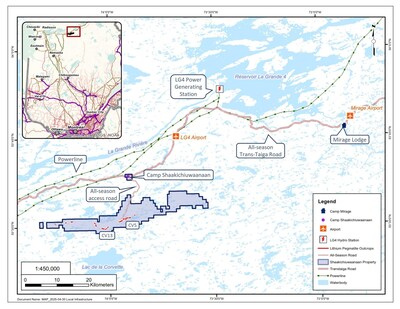
The Shaakichiuwaanaan Property is located in the Eeyou Istchee James Bay region of
The La Grande 4 ("LG-4") hydroelectric dam complex is located approximately 30 km north-northeast of the Property. The CV5 Spodumene Pegmatite is located central to the Property, approximately 13 km south of KM-270 on the Trans-Taiga Road, 14 km south of the powerline, and 50 km southwest of the LG-4 dam complex.
The Property is situated on Category III Land within the Eeyou Istchee Cree Territory (Cree Nation of
Mining Summary
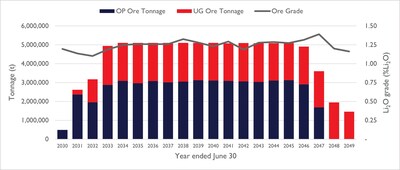
The CV5 Pegmatite deposit consists of a large principal dyke, flanked by several smaller dykes striking approximately east-west. Planned mining operations will incorporate both conventional open pit ("OP") mining and mechanized long hole open stoping underground ("UG") mining methods. The pegmatite dykes dip at approximately 80° northerly and extend over a strike length of approximately 4.6 km with mineralization modelled from surface to a depth of 650 m. A significant portion of the orebody is located under Lake 001, which will require partial dewatering to enable OP operation.
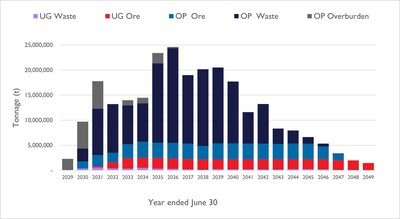
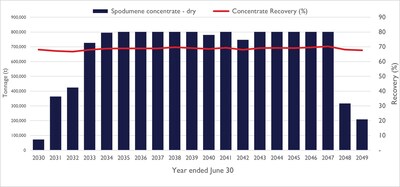
The OP and UG mined tonnes, processing schedule, and concentrate production are based solely on Mineral Reserve and presented in Figure 4, Figure 5, and Figure 6.
|
1. During the year ending June 2029, overburden mining will take place for four months. |
Mining Methods and Assumptions
Open Pit
The OP operation will utilize a fleet of diesel-powered equipment, including drills, hydraulic shovels, and off-highway haul trucks. The Project consists of a two (2) staged single pit, both mined with sub pits. In total, the operations will be executed in six (6) separate sub pits. The OP peak mining rate is 23.0 Mtpa over a LOM of 19 years including the pre-production period. A total of 49.2 Mt at
The primary loading and hauling fleet will consist of 15 m3 diesel-hydraulic shovels paired with 140 tonne off-highway mining trucks. The OP mining operation will be primarily owner-operated, with contractors responsible for overburden removal and explosives handling. Pre-production mining will extend over approximately 24 months, by providing construction material and removing overburden to establish initial access to the orebody.
A total of 10.5 Mt of waste and 1.5 Mt of ore will be mined during the pre-production and commissioning period. This waste will be used for construction purposes, while the ore will be stockpiled until the process plant commences operation.
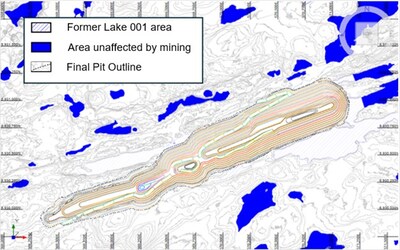
A plan view of the OP is presented in Figure 7.
Underground Mine
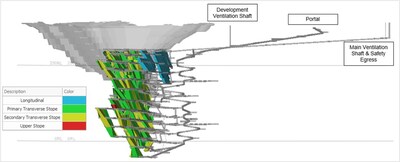
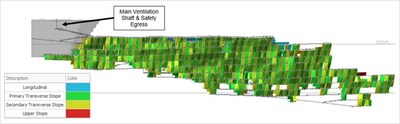
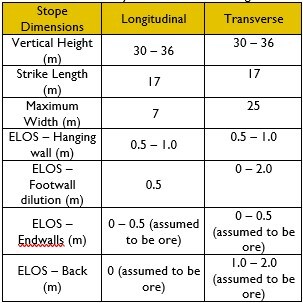
The UG operation comprises a single ramp accessible through a portal located near the run-of-mine (ROM) pad. The selected mining method is long-hole open stoping (LHOS) with cemented paste backfill (CPB), using both transverse and longitudinal stoping techniques (Figure 8 and Figure 9).
The LOM for the UG mine is expected to be 21 years including construction, development, pre-production, and the full production period. Over this LOM, the UG mine is expected to be at full production for 16 years. A two-year pre-production period is planned to allow sufficient underground development to be completed to sustain full production. The UG mine is expected to achieve an average production rate of 5,475 tpd of ore, with 5,200 tpd from stope production and an average 275 tpd from lateral development. Development of the UG mine includes approximately 96.7 km of lateral and 1.4 km of vertical development to be excavated. A total of 35.1 Mt of ore is expected to be mined at an average diluted lithium oxide grade of
Overburden, Waste Rock and Tailings Storage Facilities
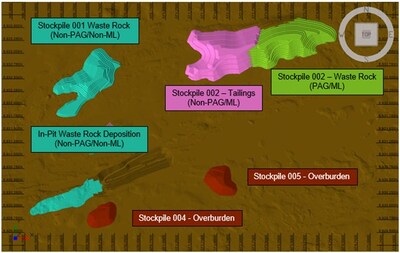
A total of 155 Mt of waste rock, 12 Mt overburden, and 54 Mt tailings will be stored on site, primarily in stockpiles (Figure 10). Stockpile 001 and the in-pit waste rock deposition will contain non-potentially acid-generating/non-metal leaching (Non-PAG/Non-ML) waste rock. Stockpile 002 will store both potentially acid-generating/metal leaching (PAG/ML) waste rock and Non-PAG/ML tailings material. Overburden will be stored in Stockpile 004 and Stockpile 005. Aside overburden, which will be mined using smaller contractor equipment, all waste rock will be hauled to the Stockpiles and dry stacked using 140 t off-highway mining trucks and tracked dozers.
Processing Summary
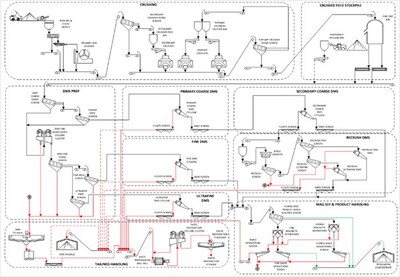
The mineral processing facility is designed to produce spodumene concentrate from the run-of-mine (ROM – ore mined and delivered to stockpile). The facility will include ROM stockpiling, crushing, beneficiation, dewatering, and load-out areas. Crushing, beneficiation, and dewatering will be performed using two (2) identical parallel process trains that could be operated independently of one another. Each process train will account for half (
Each process train will be inside three (3) main buildings: the primary crushing building, the secondary and tertiary crushing building, and the main process plant. The crushed mineralized material will be stored under domes located on a concrete pad. The process trains may have shared or separate buildings.
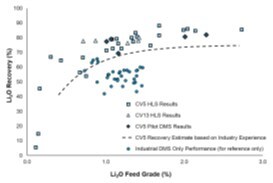
The mineral processing facility is designed to produce spodumene concentrate at
The concentrator has a recovery that is a function of the feed lithia grade (i.e., % Li2O). The recovery can be estimated with the following function:
Recovery % = 75 % × (1 – e –2(Li2O Feed Grade %) )
Infrastructure
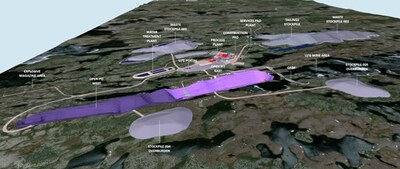
The site infrastructure plan has been outlined to minimize environmental impacts on surrounding water bodies, improve vehicle traffic safety and distances, optimize construction, costs and maximize operational efficiency and flexibility.
The main site infrastructure includes the following:
- Site main access road.
- Open-pit mine.
- Underground mine and portal.
- Surface infrastructure for underground mine as mine ventilation and heating, UG raises to surface.
- Mine laydown area.
- Process plant (crusher and screening, crushed ore silos, DMS concentrators, concentrate and tailings loadouts).
- Paste backfill plant.
- Vehicle maintenance garage.
- Administrative offices, dry rooms, warehouses, laboratory and auxiliary buildings for the concentrator and the mine areas.
- Waste rock and tailings management piles with their associated ditching and basin systems for water management.
- Overburden piles storage with their associated ditching and basin systems.
- Fresh / raw water lake intake and water treatment plants.
- Electrical substation and overhead electrical powerlines.
- Site roads and pads with their associated ditching and culvert, and bridge systems for drainage.
- Aggregate crushing plant area.
- Emulsion plant and explosive storage magazines buildings.
- Laydown area.
- Fuel storage pad and refuelling stations.
- Run-Of-Mine (ROM) pad.
- Water diversion dams and diversion channel for Lake 001.
- Permanent workers camp for construction and operational needs.
- First Nation cultural centre.
- Temporary construction facilities.
Power Supply and Distribution
The site is expected to be powered by Hydro-
An off-site 315/120 kV substation, rated at 50 MVA, will be constructed approximately 2 km from the existing 735/315 kV Tilly substation. This facility will step down the transmission voltage and supply 120 kV power to the mine site via a new 54 km 120 kV overhead transmission line. Wherever feasible, the transmission line routing will follow existing roadways to reduce environmental impact and simplify construction logistics.
Power supply to site will form part of the Company's continued engagement with regulatory authorities. Authority to access power will be subject to continued engagement on the detailed engineering solutions and approval to access power via the Hydro Quebec and Quebec Government application process.
Concentrate Transport
The mine site is located along the Trans-Taiga Highway, approximately 844 km from the Matagami Transshipment Center. This route includes 290 km on the east–west Trans-Taiga Road and 554 km on the north–south Billy Diamond Highway.
For the purpose of the FS, transportation of concentrate was modelled as a contracted service. At nominal plant capacity, daily output totals 2,191 t of concentrate to be hauled. Trucks with a 75 t capacity are assumed (and will require special annual permits from the regulator). Special conditions are also expected during seasonal thaw periods.
These 75 t vehicles will consist of a four-axle tractor and a five-axle bi-train trailer, equipped with a trailer cover and side-discharge system. Accounting for an additional
From
Approvals, Social Acceptability, and License to Operate
In February 2025, PMET submitted its Initial Project Description for the Shaakichiuwaanaan lithium-only Project on the CV5 Pegmatite to the Impact Assessment Agency of
Both levels of government have issued tailored guidelines for the Project. Over the past three years, the Company has completed environmental baseline data collection programs and community consultations, providing a strong foundation for the ESIA submissions to both federal and provincial regulators. In addition, a copy of the Project Notice has also been sent to the Cree Nation Government, as required under the
Full closure and reclamation considerations have been included within the FS outcomes.
Key Opportunities
With the FS now completed, the Company is in a position to finalize and file the ESIAs that will support the final mine authorisations for a full project scope with processing facilities of up to 5.1 Mtpa. Concurrently with this process, that is expected to take approximately 18 to 24 months, the Company will start detailed engineering work on the Project, with a view to further optimize the Project schedule and economic outcomes to inform a FID which remains targeted for 2027. This demonstrates the Company's commitment to optimizing the Project and maximizing shareholder value.
Some of the key opportunities with the potential to further enhance and optimize Project efficiency and sustainability include:
- Project Schedule Optimisation: Streamline Project schedules and further refine the phased approach to optimize capital and operational expenditure.
- Modularization of Construction: Investigate the potential to modularize key infrastructure with a view to further improve Project execution schedule and reduce costs by reducing constraints from seasonality.
- Realize Tantalum Co-Product Benefits: Finalize testwork to support the development of a "bolt-on" tantalum recovery circuit at CV5, which has the potential to generate additional revenue (in the form of a byproduct credit) with expected modest upfront capital investment. This project could also add robustness and market resilience to the Project by exposing it to a second commodity, potentially helping it weather lithium downcycles.
- Further De-Risk CV5 Underground Execution Via a Bulk Sample Program: The Company is considering the development of a 2,300 metres exploration ramp to access the mineralized zone at two distinct elevations (125 metres depth and 215 metres depth) to validate key geological, geotechnical, and hydrogeological assumptions for the Project. Development in the mineralized zone would specifically target the high-grade Nova Zone, and even more specifically high-grade lithium-caesium-tantalum intercepts in order to improve geological understanding.
- Fully Realize the Potential of the Nova Zone: Reviewing processing and access strategy of the Nova Zone could supply higher-grade process plant feed and lower operating costs earlier in the production cycle, which could improve Project economics.
- CV13 and Caesium Co-Product Benefits: Continuing to progress exploration at CV13 for potential inclusion into the LOM production profile (lithium and tantalum), as well as advancing geological and metallurgical understanding of pollucite (caesium) component for its eventual development as a co-product of lithium production.
- Increase Mineral Resources and Conversion to Mineral Reserves: Focus on increasing Mineral Resources and Reserves to extend mine life through further exploration of the Project and surrounding zones like CV13, including its high-grade Vega Zone. Each additional year of plant feed is expected to benefit Project economics and optimize the mine plan.
- Valorizing Lithium in DMS Tailings: The DMS middlings and undersize still contain a meaningful amount of lithium which may be recoverable later in the mine-life through the future addition of a flotation circuit.
Government Tax Incentive/Assistance
The Company, in consultation with its tax advisors, reviewed the Project's initial capital budget and identified material tax credits and other governmental support programs for which the Project may be eligible.
The CTM-ITC provides up to a
The Project also stands to benefit from Québec's tax holiday for large investment projects, offering substantial tax relief on capital investment. This incentive is expected to enhance the financial attractiveness of the Shaakichiuwaanaan Project and has been incorporated in the tax model. Based on the location of the Project and planned eligible investment expenditures, the new tax holiday could provide income tax savings of
In addition, the Project should also benefit from
Conclusion
The completion of the FS represents a major milestone for PMET and the Shaakichiuwaanaan Project, confirming its strong technical and economic foundations as one of the more advanced hard-rock lithium developments in the
The study also underscores significant upside potential through ongoing optimization and co-product recovery for tantalum and caesium, two critical minerals with strategic applications. Integration of these co-products offers a pathway to enhance project economics, diversify revenue streams, and reinforce the Project's resilience across market cycles.
Having completed the FS, PMET is now positioned to finalize its ESIA for submission, initiating the final permitting stages while advancing detailed engineering and partnership discussions with strategic, governmental, and institutional stakeholders. These initiatives will underpin a FID targeted for the end 2027.
PMET's Shaakichiuwaanaan Project combines scale, quality, and jurisdictional advantage to deliver a sustainable, long-term source of spodumene concentrate supported by high-value co-products. With continued government collaboration, strong community partnerships, and growing international interest, PMET is on track to transition from feasibility to development and to create enduring value for shareholders.
Non-IFRS and other financial measures
This press release includes non-IFRS financial measures and non-IFRS financial ratios. The Company believes that these measures provide additional insight, but these measures are not standardized financial measures prescribed under IFRS and therefore should not be confused with, or used as an alternative for, performance measures calculated according to IFRS. Furthermore, these measures should not be compared with similarly titled measures provided or used by other issuers.
The non-IFRS financial measures and non-IFRS financial ratios used in this news release and common to the mining industry are defined below:
- Cash operating costs at site and cash operating costs at site per tonne: Cash operating costs at site is a non-IFRS financial measure which includes mining, processing, and site administration. Cash operating costs at site per tonne is a non-IFRS financial ratio which is calculated as cash operating costs at site divided by anticipated production expressed in tonnes. These measures capture the important components of the Company's anticipated production and related costs and are used to indicate anticipated cost performance of the Company's operations.
-
Total cash operating costs (DAP Grande-Anse as POL) and total cash operating costs per tonne (DAP Grande-Anse as POL): Total cash operating costs (DAP Grande-Anse as POL) is a non-IFRS financial measure which includes mining, processing, site administration, and product transportation to
Grande-Anse . Total cash operating costs (DAP Grande-Anse as POL) per tonne is a non-IFRS financial ratio which is calculated as total cash operating costs (DAP Grande-Anse as POL) divided by anticipated production expressed in tonnes. These measures capture the important components of the Company's anticipated production and related costs and are used to indicate anticipated cost performance of the Company's operations. -
All
-in sustaining cost (AISC) and AISC per tonne: All-in sustaining cost is a non-IFRS financial measure which includes mining, processing, site administration, and product transportation to
Grande-Anse and sustaining capital but excludes royalties. All-in sustaining cost per tonne of spodumene concentrate is a non-IFRS financial ratio which is calculated as all-in sustaining cost divided by anticipated production expressed in tonnes. These measures capture the important components of the Company's anticipated production and related costs and are used to indicate anticipated cost performance of the Company's operations.
The Company does not currently have operations and therefore does not have historical equivalent measures to compare and cannot therefore reconcile with historical measures.
About PMET Resources Inc.
PMET Resources Inc. is a pegmatite critical mineral exploration and development company focused on advancing its district-scale
For further information, please contact us at info@pmet.ca or by calling +1 (604) 279-8709, or visit www.pmet.ca. Please also refer to the Company's continuous disclosure filings, available under its profile at www.sedarplus.ca and www.asx.com.au, for available exploration data.
This news release has been approved by
"KEN BRINSDEN"
Kenneth Brinsden, President, CEO, & Managing Director
|
_________________________________ |
|
8 The Consolidated MRE cut-off grade is variable depending on the mining method and pegmatite ( |
|
9 Determination based on Mineral Resource data, sourced through July 11, 2025, from corporate disclosure. |
Disclaimer for Forward-looking Information
This press release contains "forward-looking information" or "forward-looking statements" within the meaning of applicable Securities Laws.
All statements, other than statements of present or historical facts, are forward-looking statements. Forward-looking statements involve known and unknown risks, uncertainties and assumptions and accordingly, actual results could differ materially from those expressed or implied in such statements. You are hence cautioned not to place undue reliance on forward-looking statements. Forward-looking statements are typically identified by words such as "plan", "development", "growth", "continued", "intentions", "expectations", "strategy", "opportunities", "anticipated", "trends", "potential", "outlook", "ability", "additional", "on track", "prospects", "viability", "estimated", "reaches", "enhancing", "strengthen", "target", "will", "believes", or variations of such words and phrases or statements that certain actions, events or results "may", "could", "would", "might" or "will" be taken, occur or be achieved. Forward-looking statements in this release include, but are not limited to, statements concerning: the results of the FS, including, without limitation, project economics, financial and operational parameters such as expected throughput, production, processing methods, cash costs, all-in sustaining costs, other costs, capital expenditures, free cash flow, NPV, IRR, payback period and life of mine, upside potential, opportunities for growth and expected next steps in the development of the project, including timing for potential commencement of construction and first production of concentrate, the economic potential of the Project, including its potential resilience to lower market cycle, the upcoming ESIA, including the proposed permitting and development timeline, the opportunities for additional conversion at CV5 and CV13, the anticipated production rate, the potential for the Project to become a cornerstone supplier to North American, European, and/or North Asian battery supply chains, the timing of the FID, the eligibility to tax credits and other governmental support programs, and the release of the FS,
Although the Company believes its expectations are based upon reasonable assumptions and has attempted to identify important factors that could cause actual actions, events or results to differ materially from those described in forward-looking statements, there may be other factors that cause actions, events or results not to be as anticipated, estimated or intended. There can be no assurance that forward-looking information will prove to be accurate, as actual results and future events could differ materially from those anticipated in such information. Key assumptions upon which the Company's forward-looking information is based include without limitation, assumptions regarding development and exploration activities; the timing, extent, duration and economic viability of such operations, including any mineral resources or reserves identified thereby; the ability to achieve production and the timing thereof; the accuracy and reliability of estimates, projections, forecasts, studies and assessments; the Company's ability to meet or achieve estimates, projections and forecasts; the availability and cost of inputs; the price and market for outputs; foreign exchange rates; taxation levels; the timely receipt of necessary approvals or permits; the ability to meet current and future obligations; the ability to obtain timely financing on reasonable terms when required; the current and future social, economic and political conditions; and other assumptions and factors generally associated with the mining industry. Readers are cautioned that the foregoing list is not exhaustive of all factors and assumptions which may have been used.
Forward-looking statements are also subject to risks and uncertainties facing the Company's business, any of which could have a material adverse effect on the Company's business, financial condition, results of operations and growth prospects. Some of the risks the Company faces and the uncertainties that could cause actual results to differ materially from those expressed in the forward-looking statements include, among others, requirements for additional capital, operating and technical difficulties in connection with mineral exploration and development activities; actual results of exploration activities, including on the Project; the estimation or realization of mineral reserves and mineral resources; the timing and results of estimated future production; the costs of production, capital expenditures, the costs and timing of the development of new deposits, requirements for additional capital; future prices of spodumene; changes in general economic conditions; changes in the financial markets and in the demand and market price for commodities; lack of investor interest in future financings; the Company's ability to secure permits or financing for the completion of construction activities; and the Company's ability to execute on plans relating to the Project. In addition, readers should review the detailed risk discussion in the Company's most recent Annual Information Form filed on SEDAR+ for a fuller understanding of the risks and uncertainties that affect the Company's business and operations. These risks are not exhaustive; however, they should be considered carefully. If any of these risks or uncertainties materialize, actual results may vary materially from those anticipated in the forward-looking statements found herein.
Forward-looking statements contained herein are presented for the purpose of assisting investors in understanding the Company's business plans, financial performance and condition and may not be appropriate for other purposes.
The forward-looking statements contained herein are made only as of the date hereof. The Company disclaims any intention or obligation to update or revise any forward-looking statements, whether as a result of new information, future events or otherwise, except to the extent required by applicable law. The Company qualifies all of its forward-looking statements by these cautionary statements.
Competent Person Statement (ASX Listing Rule 5.23)
The mineral resource estimate in this release was reported by the Company in accordance with ASX Listing Rule 5.8 on July 20, 2025. The Company confirms that, as of the date of this news release, it is not aware of any new information or data verified by the competent person that materially affects the information included in the announcement and that all material assumptions and technical parameters underpinning the estimates in the announcement continue to apply and have not materially changed. The Company confirms that, as at the date of this announcement, the form and context in which the competent person's findings are presented have not been materially modified from the original market announcement.
Qualified Person(s)
The information in this news release that relates to geology and the Consolidated MRE for the Shaakichiuwaanaan Project, which includes the CV5 Pegmatite, is based on, and fairly represents, information compiled by Mr. Todd McCracken, P.Geo., who is a Qualified Person as defined by NI 43-101, and member in good standing with the Ordre des Géologues du
The information in this news release that relates to the market study and price assumption for spodumene concentrate is based on information compiled by PMET and BBA Inc. and has been reviewed and approved by Hugo Latulippe, P.Eng., who is a Professional Engineer registered with the Ordre des Ingénieurs du
The information in this news release that relates to Mineral Reserve, mining, and financial and economic analysis sections, presented in Section 4 of the Appendix I are based on information compiled by G Mining Services Inc. and reviewed and approved by Carl Michaud, who is a Professional Engineer registered with the OIQ. Mr. Michaud is a mining engineer and Vice President, Mining and Engineering at G Mining Services Inc., a consulting firm based in
The information in this news release that relates to capital cost and project infrastructure presented in Section 4 of the Appendix I are based on information compiled by G Mining Services Inc. and reviewed and approved by Pascal Droz, who is a Professional Engineer registered with the OIQ". Mr. Droz is an electrical engineer and E&I Engineering Director at G Mining Services Inc., a consulting firm based in
The information in this news release that relates to processing is based on information compiled by Primero Group Americas Inc. and reviewed and approved by Ryan Cunningham P. Eng., who is a Professional Engineer registered with the OIQ. Mr. Cunningham is a processing engineer and Process Engineering Consultant for Primero Group Americas Inc., a consulting firm based in
The statements relating in this news release that relates to mine waste geochemistry are based on information compiled by Vision Geochemistry Ltd. and reviewed and approved by Mr. Neal Sullivan, Ph.D., P.Geo., who is a Qualified Person as defined by NI 43-101, and member in good standing with the OGQ and with the PGO. Mr. Sullivan is the President & Principal Geochemist of Vision Geochemistry Ltd., a geochemical research & consulting company based in
The information in this news release that relates to tailings, waste rock and overburden stockpile design is based on information compiled by AtkinsRéalis and reviewed and approved by Philip Addis P. Eng., who is a Professional Engineer registered with the OIQ. Mr. Addis is Principal Tailings Engineer at AtkinsRéalis and based in
The information in this news release that relates to water balance, pumping and water treatment design is based on information compiled by AtkinsRéalis and reviewed and approved by Antoine Cogulet, P. Eng., who is a Professional Engineer registered with the OIQ. Mr. Cogulet is Project Engineer, Mine Water Management at AtkinsRéalis and based in
The information in this news release that relates to water management is based on information compiled by AtkinsRéalis and reviewed and approved by Holman Tellez, P. Eng., who is a Professional Engineer registered with the OIQ. Mr. Tellez is a civil engineer and Senior Expert Hydraulics/Hydrology at AtkinsRéalis and based in
The information in this news release that relates to hydrogeology baseline and efficiency of the seepage control measures in Stockpile 002 is based on information compiled by AtkinsRéalis and reviewed and approved by Geneviève
The information in this news release that relates to closure design and management is based on information compiled by AtkinsRéalis and reviewed and approved by Sandra Pouliot, P. Eng., M.Sc.A. PMP, who is a Professional Engineer registered with the OIQ. Ms. Pouliot is Senior Mining Environment Engineer at AtkinsRéalis and based in
The information in this news release that relates to the paste backfill plant and paste backfill underground distribution system is based on information compiled by Paterson & Cooke Canada Inc. and reviewed and approved by Ryan Smilovici, P. Eng., who is a Professional Engineer registered with the OIQ. Mr. Smilovici is Process Engineer for Paterson & Cooke Canada Inc., an engineering consulting firm based in
The statements in this news release that relate to mine geotechnics and geomechanics, are based on information compiled by Alius Mine Consulting Inc. and reviewed and approved by Sebastien Guido, who is a Professional Engineer registered with the OIQ. Mr. Guido is a mining engineer and Senior Engineer, Rock Mechanics at Alius Mine Consulting Inc., a consulting firm based in
The information in this news release that relates to mine ventilation design is based on information compiled by CGM Expert Inc. and reviewed and approved by Charles Gagnon, P.Eng., who is a Professional Engineer registered with the OIQ. Mr. Gagnon is a mine ventilation specialist at CGM Expert Inc. and based in
The information in this news release that relates to environmental and social aspects is based on information compiled by WSP and reviewed and approved by Nathalie Fortin, Eng., M.Env., who is a Professional Engineer registered with the OIQ. Ms. Fortin is Vice-President, Environmental Management Earth Sciences and Environment at WSP and based in
The information in this news release that relates to hydrogeology is based on information compiled by Mailloux Hydrogéologie and reviewed and approved by Michel Mailloux, P.Eng., who is a Professional Engineer registered with the OIQ. Mr. Mailloux is a Hydrogeologist and Owner at Mailloux Hydrogéologie and based in
Appendix 1 – JORC Code 2012 Table 1 (ASX Listing Rule 5.8.2)
Section 1 – Sampling Techniques and Data
|
Criteria |
JORC Code explanation |
Commentary |
|
Sampling techniques |
|
|
|
Drilling techniques |
|
|
|
Drill sample recovery |
|
|
|
Logging |
|
|
|
Sub-sampling techniques and sample preparation |
|
|
|
Quality of assay data and laboratory tests |
|
|
|
Verification of sampling and assaying |
|
|
|
Location of data points |
|
|
|
Data spacing and distribution |
|
|
|
Orientation of data in relation to geological structure |
|
|
|
Sample security |
|
|
|
Audits or reviews |
|
|
Section 2 – Reporting of Exploration Results
|
Criteria |
JORC Code explanation |
Commentary |
|
Mineral tenement and land tenure status |
|
|
|
Exploration done by other parties |
|
|
|
Geology |
|
|
|
Drill hole Information |
|
|
|
Data aggregation methods |
|
|
|
Relationship between mineralization widths and intercept lengths |
|
|
|
Diagrams |
|
|
|
Balanced reporting |
|
|
|
Other substantive exploration data |
|
|
|
Further work |
|
|
Section 3 – Estimate and Reporting of Mineral Resources
|
Criteria |
JORC Code explanation |
Commentary |
|
Database integrity |
|
|
|
Site visits |
|
|
|
Geological interpretation |
|
|
|
Dimensions |
|
|
|
Estimation and modelling techniques |
|
|
|
Moisture |
|
|
|
Cut-off parameters |
|
|
|
Mining factors or assumptions |
|
|
|
Metallurgical factors or assumptions |
|
|
|
Environmental factors or assumptions |
|
|
|
Bulk density |
|
|
|
Classification |
|
|
|
Audits or reviews |
|
|
|
Discussion of relative accuracy/ confidence |
|
|
Section 4 – Estimate and Reporting of Ore Reserves
|
Criteria |
JORC Code explanation |
Commentary |
|
Mineral Resource estimate for Conversion to Ore Reserves |
|
|
|
Site Visits |
|
|
|
Study Status |
|
|
|
Cut-off parameters |
|
Open Pit
Underground
|
|
Mining factors or assumptions |
|
Underground
|
|
Metallurgical factors or assumptions |
|
|
|
Environment |
|
Studies of Potential Environmental Impacts of the operations as a whole:
Waste and Tailings Management Facilities and characterization:
|
|
Infrastructure |
|
|
|
Costs |
|
The following assumptions apply to the capital and operating cost estimate:
|
|
Revenue factors |
|
|
|
Market assessment |
|
|
|
Economic |
|
|
|
Social |
|
|
|
Other |
|
|
|
Classification |
|
|
|
Audits or reviews |
|
|
|
Discussion of relative accuracy/ confidence |
|
|

 View original content to download multimedia:https://www.prnewswire.com/news-releases/pmet-resources-delivers-positive-cv5-lithium-only-feasibility-study-for-its-large-scale-shaakichiuwaanaan-project-302589419.html
SOURCE PMET Resources Inc.
FAQ
AI-generated questions and answers. How Rhea-AI works. Not financial advice.