
PROCEPT BioRobotics® Advances Prostate Cancer Program with WATER IV Study Enrollment Completion and Expanded IDE Approval
Sentiment and the balance of points
Rhea-AI Sentiment reads the wording of the document, how positive or negative its language is on a 1 to 5 scale. The balance of points shown with the takes weighs what the document actually discloses, so the two can disagree, for example when a trial that missed its main goal is described in upbeat language.
Rhea-AI Summary
PROCEPT BioRobotics (Nasdaq: PRCT) reported two key milestones in its WATER IV prostate cancer program: completion of enrollment in the randomized WATER IV RP study comparing Aquablation therapy with radical prostatectomy, and expanded FDA IDE approval for a second randomized WATER IV AS protocol versus active surveillance.
WATER IV RP has fully enrolled 280 patients, with primary endpoint results expected at the AUA Annual Meeting in spring 2027. WATER IV AS will enroll up to 333 patients and, along with WATER IV RP, will follow men for ten years to assess disease control and quality-of-life outcomes.
Positive
- Randomized WATER IV RP study fully enrolled with 280 prostate cancer patients
- FDA IDE approval granted for second randomized WATER IV AS protocol
- WATER IV AS planned enrollment of up to 333 patients globally
- Both WATER IV protocols include 10-year follow-up for long-term outcomes
- Primary endpoint results for WATER IV RP expected by spring 2027
Negative
- None.
Details
News Market Reaction – PRCT
On May 28, the day this news came out, PRCT closed 2.80% above the previous close.
Data tracked by StockTitan Argus for the May 28 session.
Key Figures
- WATER IV RP enrollment
- 280 patients
- First randomized study vs radical prostatectomy
- WATER IV AS enrollment cap
- 333 patients
- Second randomized study vs active surveillance
- Follow-up duration
- 10 years
- Patient follow-up in both randomized WATER IV protocols
- Biopsy assessment
- 1 year
- Biopsy-based assessment timepoint in WATER IV AS
- MRI evaluation
- 3 years
- MRI-based whole gland evaluation in WATER IV AS
- Gland resection extent
- >95% of gland
- Aquablation robotic waterjet resection description
- Prostate cancer grades
- Grade Group 1 and 2
- Patient risk profile in WATER IV AS trial
Historical Context
-
AUA guidelines strengthened Aquablation recommendation for a broad prostate size range.
-
Announcement of management presentations at three upcoming healthcare investor conferences.
-
Q1 2026 results with 20% revenue growth and confirmed full-year guidance.
-
Notification of Q1 2026 results release date and accompanying conference call.
-
EAU upgraded Aquablation to a strong surgical recommendation for BPH.
24h Move is the share-price change in the day after each event; other market factors may also have contributed.
Key Terms
investigational device exemption (ide) regulatory
radical prostatectomy medical
active surveillance medical
biopsy medical
mri medical
transurethral medical
AI-generated analysis. How Rhea-AI works. Not financial advice.




SAN JOSE, Calif., May 28, 2026 (GLOBE NEWSWIRE) -- PROCEPT BioRobotics (Nasdaq: PRCT) today announced two milestones in its WATER IV prostate cancer clinical program: completion of enrollment in the randomized WATER IV study evaluating Aquablation® therapy versus radical prostatectomy, and FDA Investigational Device Exemption (IDE) approval for a second randomized protocol evaluating Aquablation therapy versus active surveillance.
The first randomized WATER IV study (WATER IV RP) fully enrolled 280 planned patients and is the only FDA randomized study comparing Aquablation therapy to radical prostatectomy, the established surgical standard of care. Based on current timelines, the Company expects to present the WATER IV RP primary endpoint results at the American Urological Association (AUA) Annual Meeting in spring 2027.
The second randomized study in the WATER IV clinical program (WATER IV AS) will enroll up to 333 patients globally and evaluate Aquablation therapy versus active surveillance in men with Grade Group 1 and 2 prostate cancer. Active surveillance is commonly used for men with lower-risk prostate cancer to avoid the quality-of-life impact associated with radical treatment, although many patients ultimately progress to surgery or radiation over time. WATER IV AS is designed to evaluate whether Aquablation therapy may provide an earlier treatment option for men on active surveillance before the disease progresses further. Patients will be followed for ten years, including biopsy assessment at one year and MRI-based whole gland evaluation at three years.
“We are excited to complete enrollment in the first randomized WATER IV protocol, reflecting strong interest from physician investigators as well as patients in evaluating Aquablation as a new approach to prostate cancer treatment,” said Larry Wood, President and Chief Executive Officer of PROCEPT BioRobotics. “The IDE approval for the additional randomized WATER IV protocol enables us to evaluate whether earlier intervention with Aquablation may offer men on active surveillance a quality-of-life-preserving treatment option rather than waiting for the disease to progress.”
Both randomized WATER IV protocols will follow patients for ten years and are designed to evaluate the long-term experience of men with prostate cancer. The studies will assess both disease control and quality-of-life outcomes over time, including the impact of treatment on urinary, sexual, and overall function. No other prostate cancer therapy has been evaluated with such a level of rigor early in its development, reflecting the company’s continued commitment to advancing science and innovation in prostate care.
For more information on the WATER IV study, please visit: https://clinicaltrials.gov/study/NCT06651632
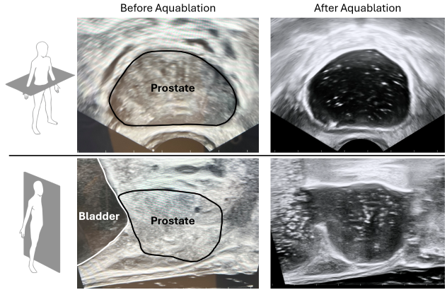
Figure: Aquablation Therapy for Prostate Cancer
Ultrasound-guided, transurethral robotic waterjet resection of the prostate designed to remove cancer, at-risk tissue, and any obstructive tissue resulting in >
About PROCEPT BioRobotics® Corporation
PROCEPT BioRobotics is a surgical robotics company focused on advancing patient care by developing transformative solutions in urology. The Company manufactures the AQUABEAM® and HYDROS® Robotic Systems. The HYDROS Robotic System is the only AI-powered, robotic technology that delivers Aquablation therapy. PROCEPT BioRobotics designed Aquablation therapy to deliver effective, safe, and durable outcomes for males suffering from lower urinary tract symptoms or LUTS, due to BPH that are independent of prostate size and shape or surgeon experience. In addition to its leadership in BPH treatment, the Company is pursuing clinical research initiatives in prostate cancer utilizing investigational applications of its robotic and AI-enabled technologies. BPH is the most common prostate disease and impacts approximately 40 million men in the United States. The Company has developed a significant and growing body of clinical evidence with approximately 250 peer-reviewed publications, supporting the benefits and clinical advantages of Aquablation therapy.
Forward-Looking Statements
This press release may contain forward-looking statements within the meaning of federal securities laws. Forward-looking statements are subject to numerous risks and uncertainties that could cause actual results to differ materially from those anticipated or implied in such statements. PROCEPT BioRobotics undertakes no obligation to publicly update or revise any forward-looking statements.
Important Safety Information
All surgical treatments have inherent and associated side effects. For a list of potential side effects visit https://aquablation.com/safety-information/
Media Contact:
Kevin Waters
Executive VP, Chief Financial Officer
PROCEPT BioRobotics
k.waters@procept-biorobotics.com
A photo accompanying this announcement is available at https://www.globenewswire.com/NewsRoom/AttachmentNg/4f4bd11e-cbd0-4365-8b2c-b55a77eb8bdd.

FAQ
AI-generated questions and answers. How Rhea-AI works. Not financial advice.