
Robert Half survey: Today's professionals share what early career workers need to succeed -- beyond AI skills
Robert Half (RHI) published survey findings (April 16, 2026) showing what experienced workers think early career hires need beyond AI skills.
Rhea-AI Summary
Robert Half (RHI) published survey findings (April 16, 2026) showing what experienced workers think early career hires need beyond AI skills. Key stats: 36% say applicants should demonstrate AI knowledge, 71% prioritize time management, and 80% recommend evaluating roles for long-term growth.
Respondents emphasize foundational behaviors—punctuality, appearance, communication—and a learning mindset as differentiators for first professional roles. The firm also published a Job Search Strategies Guide to help new graduates apply these insights.
Positive
- None.
Negative
- None.
Details
News Market Reaction – RHI
On Apr 16, the day this news came out, RHI closed 4.31% below the previous close.
Data tracked by StockTitan Argus for the Apr 16 session.
AI-generated analysis. How Rhea-AI works. Not financial advice.




- While AI knowledge is expected by some, a focus on human skills can set candidates apart
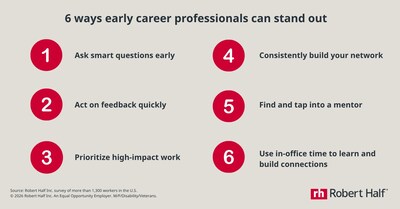
Where can early career professionals gain a competitive edge?
Respondents point to foundational workplace behaviors as key areas where new professionals can stand out, including:
- Time management and punctuality (
71% ) - Professional appearance (
51% ) - Communication and responsiveness (
50% )
"Proficiency in AI is rapidly becoming a baseline expectation," said Dawn Fay, operational president of Robert Half. "What will define early career success is how someone can apply judgment and accountability to their work."
What should new professionals prioritize in their job search?
A first professional role can set the foundation for long-term success and according to survey respondents:
80% recommend evaluating opportunities based on long-term career growth potential67% advise being open to in-office work to accelerate learning and relationship-building
"Employers don't expect first-time professionals to have everything figured out on day one," Fay said. "What stands out is a willingness to learn, an understanding of professional expectations and a focus on building skills and relationships that drive long-term career success."
Robert Half's latest Job Search Strategies Guide offers practical advice aligned with these insights, helping early career professionals apply this guidance as they enter today's workforce.
FAQ:
What level of AI proficiency is expected from early career professionals?
Employers aren't necessarily expecting deep technical expertise. Instead, workers should demonstrate familiarity with AI tools—particularly the ability to review AI-generated content, recognize its limitations and take responsibility for the final product.
Which workplace skills matter most for early career success?
Foundational workplace behaviors are critical, including time management, punctuality, professional appearance and effective communication.
How important is a learning mindset for early career success?
A learning mindset is essential for early-career professionals. Employers look for curiosity, openness to feedback and a willingness to build professional skills over time, particularly as technology and workplace expectations continue to evolve.
About the research
The research is gathered from a survey developed by Robert Half and conducted by an independent research firm in March 2026. The survey contains responses from more than 1,300 employed workers in
About Robert Half
Robert Half (NYSE: RHI) is the world's first and largest specialized talent solutions and business consulting firm, connecting highly skilled job seekers with rewarding opportunities at great companies. We offer contract talent and permanent placement solutions in the fields of finance and accounting, technology, marketing and creative, legal, and administrative and customer support, and we also provide executive search services. Robert Half is the parent company of Protiviti®, a global consulting firm that delivers internal audit, risk, business and technology consulting solutions. In the past 12 months, Robert Half, including Protiviti, has been named one of the Fortune® Most Admired Companies™ and 100 Best Companies to Work For. Explore talent solutions, research and insights at roberthalf.com.

 View original content to download multimedia:https://www.prnewswire.com/news-releases/robert-half-survey-todays-professionals-share-what-early-career-workers-need-to-succeed--beyond-ai-skills-302743838.html
SOURCE Robert Half
FAQ
AI-generated questions and answers. How Rhea-AI works. Not financial advice.