
Sterling Metals Continues to Intersect Continuous Copper Mineralization from Surface
Sterling Metals (TSXV:SAG, OTCQB:SAGGF) reported assay results from three additional 2026 drill holes (SC-26-07/08/09) at the Soo Copper Project near Batchewana Bay, Ontario.
Sentiment and the balance of points
Rhea-AI Sentiment reads the wording of the document, how positive or negative its language is on a 1 to 5 scale. The balance of points shown with the takes weighs what the document actually discloses, so the two can disagree, for example when a trial that missed its main goal is described in upbeat language.
Rhea-AI Summary
Sterling Metals (TSXV:SAG, OTCQB:SAGGF) reported assay results from three additional 2026 drill holes (SC-26-07/08/09) at the Soo Copper Project near Batchewana Bay, Ontario. The holes, testing the northwest and west extents of the MEPS Zone, intersected broad, near-surface copper mineralization ranging from 247.0 m to 305.1 m, grading approximately 0.30%–0.34% CuEq. Higher-grade sub-intervals include 26.0 m at 0.64% CuEq in SC-26-07, 38.2 m at 0.53% CuEq in SC-26-08, and 12.7 m at 0.94% CuEq in SC-26-09, with individual samples up to about 6.5% CuEq. Sterling reports a strong correlation between copper mineralization and IP chargeability anomalies, supporting its exploration model. The company is drilling the 30th hole of its 2026 program, having completed about 15,000 m of a minimum 20,000 m campaign and over 25,000 m since spring 2025.
Positive
- 247–305 m mineralized intervals grading about 0.30–0.34% CuEq near surface
- High-grade sub-intervals up to 12.7 m at 0.94% CuEq in SC-26-09
- Individual samples up to 6.57% CuEq (SC-26-07) and 6.08% CuEq (SC-26-09)
- Strong correlation of copper mineralization with IP chargeability anomalies
- Approximately 15,000 m drilled of a minimum 20,000 m 2026 program
- Cumulative drilling at Soo Copper has surpassed 25,000 m since spring 2025
Negative
- Reported mineralized intervals may not represent true widths, which are not yet known
- CuEq grades assume 80% metallurgical recoveries for all metals, which are not yet demonstrated
- Broad intervals described as having modest copper grades due to lower host rock permeability
- No grade capping applied to reported assay intervals, increasing sensitivity to high-grade samples
News Explained
The July 13 release adds near-surface drill evidence to an ongoing exploration program, but does not change ownership, financing, or project completion status.
Sterling Metals reported assay results from three holes in its ongoing 2026 drilling program at the Soo Copper Project, with near-surface mineralized intervals ranging from
The reported lengths are drill intersections, not confirmed true widths, and the company says true widths are not yet known. Copper-equivalent grades use the stated metal-price assumptions and
The reported results therefore extend an active exploration program rather than mark a completed resource or development milestone.
The next relevant disclosure is the company's future drilling and technical reporting on the scale, geometry, true widths, and higher-grade zones of MEPS; the current release provides no resource estimate or economic study.
Details
News Market Reaction – SAGGF
On Jul 13, the day this news came out, SAGGF closed 9.97% below the previous close.
Data tracked by StockTitan Argus for the Jul 13 session.
AI-generated analysis. How Rhea-AI works. Not financial advice.




TORONTO, ON / ACCESS Newswire / July 13, 2026 / Sterling Metals Corp. (TSXV:SAG)(OTCQB:SAGGF) ("Sterling" or the "Company") is pleased to report assay results from three additional drill holes completed as part of its ongoing 2026 drilling program at the Soo Copper Project ("Soo Copper" or the "Project"), located near Batchewana Bay, Ontario. Each hole intersected broad intervals of continuous copper mineralization beginning near surface, further defining the scale of the MEPS Zone ("MEPS") and reinforcing Sterling's interpretation of a large, copper-dominant system with significant expansion potential. Holes SC-26-07, SC-26-08 and SC-26-09 tested the northwest and west extents of MEPS, intersecting 248.0 m to 323.0 m grading
Highlights:
Three additional near-surface copper intersections of up to 325 m averaging greater than
0.3% CuEq continue to define the scale, continuity and shallow nature of the MEPS Zone.
Drilling continues to support Sterling's interpretation of a large copper system with widespread mineralization. Higher-grade copper zones appear to be associated with favourable host rocks, providing a clear framework for targeting additional high-grade mineralization.
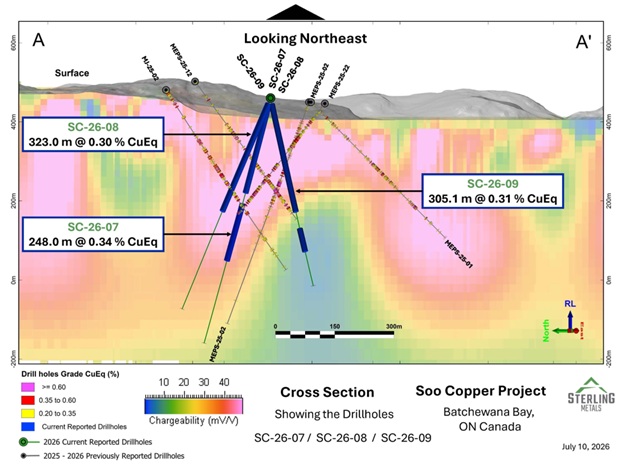
Strong correlation between copper mineralization and IP chargeability anomalies continue to validate Sterling's exploration model and highlight significant potential to expand the footprint of MEPS.
Jeremy Niemi, P.Geo., Senior Vice President, Exploration and Evaluation, commented, "These results reflect the methodical exploration approach we are taking at Soo Copper. SC-26-07, SC-26-08 and SC-26-09 each intersected thick mineralized intervals within the first few metres of bedrock, extending continuous mineralization to the northeast and reinforcing our interpretation of a large, copper-dominant system. The shallow nature of mineralization further enhances the project's potential as we continue to define its scale and geometry. With each hole, we are refining our understanding of the geological and structural controls on copper mineralization, expanding the footprint of the system and vectoring toward more concentrated, higher-grade zones."
Watch the VRIFY Presentation: CEO Mathew Wilson and Senior Vice President, Exploration and Evaluation, Jeremy Niemi, discuss today's drill results and how they continue to refine the geological model and expand the scale of the MEPS discovery. Click the link https://youtu.be/8Lhd_IOFZ0I or the image below to view the presentation
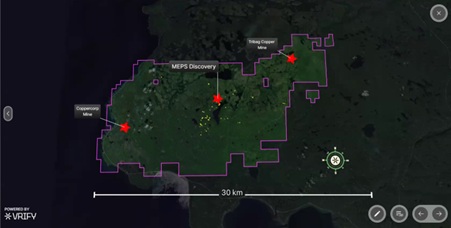
Figure 1. Plan map of 2026 drilling over Lidar data showing reported holes and MEPS Zone highlighted.
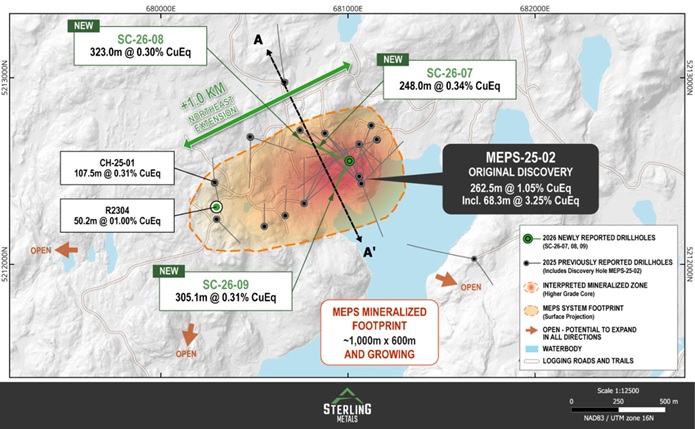
Figure 2. Cross-section of MEPS area highlighting reported copper intervals (in blue) for holes SC-26-07/08/09 (in blue); background image is IP Chargeability from 2024 survey.
Technical Discussion
Copper-dominant sulphide mineralization is expansive and largely hosted by potassically altered Neoarchean mafic volcanic rocks that have been intruded by a multiphase complex of Mesoproterozoic "Keweenawan" felsic porphyry intrusions, clustered across the MEPS Zone. The highest-grade copper mineralization is commonly found adjacent to strongly altered and veined felsic dykes that appear to have acted as conduits for the copper-rich magmatic hydrothermal fluids. Thin basaltic flows, especially pillowed flow tops, and tuffs are the best host rocks for copper mineralization, in contrast to more massive less permeable gabbroic rocks that likely form the cores of thicker flows and perhaps also subvolcanic feeder intrusions.
It is clear that the copper-rich magmatic hydrothermal event was robust and widespread, the fluids having pervasively permeated the mafic host rock package. Importantly grade is primarily determined by host rock permeability, both primary lithologic permeability and secondary, structurally imposed permeability, and so very high-grade intervals are consistently found in areas of very high host rock permeability, particularly in proximity to syn-mineral felsic dykes. Broad intervals of continuous yet modest copper grades are a product of lower host rock permeability rather than a weak hydrothermal system or a narrow copper zone. Holes SC-26-07, 08 and 09 while extensively mineralized were generally less permeable than other areas within the MEPS discovery area both in past and in future drilling.
Figure 3. Mineralized core in hole SC-26-07 at 134.64m grading
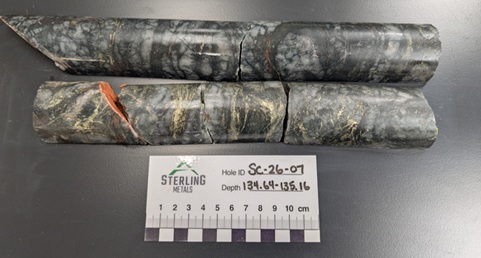
Figure 4. Mineralized core in hole SC-26-09 at 134.64m grading
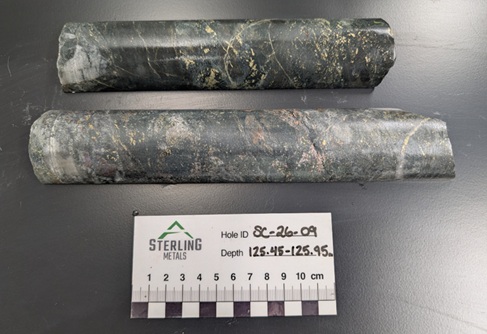
Table 1. Significant Assay Intervals
Hole ID | From | To | Length | Cu (%) | Mo (ppm) | Au (g/t) | Ag (g/t) | CuEq (%) |
SC-26-07 | 7.0 | 255.0 | 247.0 | 0.28 | 36.96 | 0.03 | 1.54 | 0.34 |
Including | 71.4 | 84.0 | 12.6 | 0.35 | 8.22 | 0.04 | 1.46 | 0.41 |
And | 111.0 | 136.0 | 26.0 | 0.53 | 27.56 | 0.07 | 3.47 | 0.64 |
And | 156.0 | 163.0 | 7.0 | 0.55 | 31.00 | 0.06 | 3.44 | 0.66 |
And | 189.0 | 240.0 | 51.0 | 0.40 | 48.13 | 0.04 | 2.29 | 0.48 |
SC-26-07 | 290.0 | 437.0 | 147.0 | 0.17 | 22.25 | 0.03 | 0.90 | 0.22 |
SC-26-08 | 37.7 | 329.0 | 291.3 | 0.26 | 31.37 | 0.03 | 1.56 | 0.32 |
Including | 119.0 | 167.0 | 48.0 | 0.34 | 40.37 | 0.04 | 2.04 | 0.42 |
And | 204.0 | 242.2 | 38.2 | 0.42 | 31.01 | 0.07 | 3.04 | 0.53 |
And | 298.8 | 313.0 | 14.3 | 0.40 | 4.05 | 0.03 | 2.38 | 0.46 |
SC-26-09 | 3.0 | 308.5 | 305.1 | 0.25 | 47.25 | 0.03 | 1.45 | 0.31 |
Including | 120.6 | 133.7 | 12.7 | 0.78 | 59.41 | 0.05 | 7.39 | 0.94 |
And | 202.2 | 226.0 | 23.8 | 0.40 | 11.74 | 0.05 | 1.43 | 0.47 |
And | 239.8 | 280.0 | 40.2 | 0.35 | 258.71 | 0.07 | 2.39 | 0.58 |
SC-26-09 | 353.4 | 415.0 | 61.6 | 0.11 | 134.08 | 0.62 | 0.01 | 0.20 |
Intervals may not represent true widths, which are not yet known, and capping has not been applied to grades. Copper Equivalent (CuEq) for drill intersections is calculated based on a three-year trailing average for each commodity (2023, 2024 and 2025), which equates to US
Table 2. Hole Locations, Directions and Final Depths
Hole number | Easting | Northing | Elevation | Depth | Dip | Azimuth |
SC-26-07 | 681,009 | 5,212,554 | 460 | 657 | -70.00 | 292.00 |
SC-26-08 | 681,009 | 5,212,554 | 460 | 609 | -60.00 | 292.00 |
SC-26-09 | 681,009 | 5,212,554 | 460 | 508 | -70.00 | 210.00 |
Exploration Update
Drilling continues at Soo Copper. Sterling is currently drilling the 30th hole of its 2026 program and has completed approximately 15,000m of a minimum 20,0000m campaign and has surpassed the 25,000m mark since initiating drilling in spring 2025. The Company's objectives are to continue defining the scale of the near-surface copper system and to prioritize targets with potential for large zones of higher-grade copper mineralization within that system.
Sampling Procedures - Quality Assurance/Quality Control
Analytical services were provided by Actlabs, which is an independent, CALA- and SCC-accredited analytical services firm registered to ISO 17025 and ISO 9001 standard. Drill core samples were logged and split in half with a diamond core saw. Half-core samples were securely stored at the core logging facility until being delivered to Actlabs Thunder Bay lab by commercial transport. Samples were crushed (< 7 kg) up to 90% passing 2mm (10 mesh), riffle split to 250 g and pulverized by mild steel to 95% passing 105μm (150 mesh). Samples splits underwent a 4-acid near total digestion followed by a multi-element analysis, including base metals, using an ICP method for 35 elements. Selected sample pulps were then analyzed for gold using a 30 g aliquot mixed with fire assay fluxes and Ag as a collector, placed in a fire clay crucible, gradually heated to 1060ºC for 60 min, and followed with an AA finish.
Laboratory QA/QC for the ICP analysis was
Qualified Person
Jeremy Niemi, P.Geo., Senior Vice President, Exploration and Evaluation for Sterling Metals has reviewed and approved the technical information presented herein.
About the Soo Copper Project
The Soo Copper Project sits just 20 minutes off the Trans-Canada Highway, one hour north of Sault Ste. Marie, and 20km from rail and deep-water access. With near-surface copper-one of the most critical of all critical metals-alongside gold, and with the project now demonstrating both scale and grade, Sterling sees the potential for Soo Copper to become a nationally significant asset as Canada accelerates its efforts to secure strategic copper resources. Prime Minister Carney's recent designation of copper as one of Canada's first five strategic assets underscores the importance of this discovery and its potential to emerge as a key project of national interest.
About Sterling Metals
Sterling Metals is a mineral exploration company focused on large scale and high-grade Canadian exploration opportunities. The Company is advancing the 25,000-hectare Soo Copper Project in Ontario which has past production, and multiple breccia and porphyry targets strategically located near robust infrastructure and the 29,000-hectare Adeline Project in Labrador which covers an entire sediment-hosted copper belt with significant silver credits. Both opportunities have demonstrated potential for important new copper discoveries, underscoring Sterling's commitment to pioneering exploration in mineral rich Canada.
Sterling Metals acknowledges that its exploration activities within the Soo Copper project are conducted on the traditional lands of the First Nations of the North Shore of Lake Superior. We recognize and respect the longstanding and diverse relationships Indigenous Peoples have with the land and are committed to engaging in a manner that is respectful, transparent, and inclusive.
For more information, please contact:
Sterling Metals Corp.
Mathew Wilson, CEO and Director
Tel: (416) 643-3887
Email: info@sterlingmetals.ca
Website: www.sterlingmetals.ca
Neither the TSX Venture Exchange nor its Regulation Services Provider (as that term is defined in the policies of the TSX Venture Exchange) accepts responsibility for the adequacy or accuracy of this release. This news release contains certain "forward-looking information" within the meaning of applicable securities laws. Forward looking information is frequently characterized by words such as "plan", "expect", "project", "intend", "believe", "anticipate", "estimate", "may", "will", "would", "potential", "proposed" and other similar words, or statements that certain events or conditions "may" or "will" occur. These statements are only predictions. Forward-looking information is based on the opinions and estimates of management at the date the information is provided and is subject to a variety of risks and uncertainties and other factors that could cause actual events or results to differ materially from those projected in the forward-looking information. For a description of the risks and uncertainties facing the Company and its business and affairs, readers should refer to the Company's Management's Discussion and Analysis. The Company undertakes no obligation to update forward-looking information if circumstances or management's estimates or opinions should change, unless required by law. The reader is cautioned not to place undue reliance on forward-looking information.
SOURCE: Sterling Metals Corp.
View the original press release on ACCESS Newswire
FAQ
AI-generated questions and answers. How Rhea-AI works. Not financial advice.