
SAGA Metals Completes HQ Drill Program for Planned Metallurgical Pilot Study Associated with PEA / PFS - Level Evaluation at Radar Critical Minerals Project
The next pilot phase depends on successful laboratory work and SAGA approval, with its scope and budget still to be established.
Sentiment and the balance of points
Rhea-AI Sentiment reads the wording of the document, how positive or negative its language is on a 1 to 5 scale. The balance of points shown with the takes weighs what the document actually discloses, so the two can disagree, for example when a trial that missed its main goal is described in upbeat language.
Rhea-AI Summary
SAGA Metals (SAGMF) completed a 1,010-metre drilling program to supply core for metallurgical testing at its Radar project in Labrador. The four large-diameter holes at Trapper North were drilled in October 2026. R-0096 logged 259.9 metres of oxide units and R-0097 logged 125.9 metres; these are visual observations, not grades. Assays are pending, and logging of the other two holes continues.
The company plans to use the core to produce concentrate for downstream testing supporting potential preliminary economic assessment and prefeasibility-level evaluation. Stage 2 laboratory optimization with Temas Resources is approximately halfway through its planned timeline. A subsequent pilot program requires successful completion of Phase 1 and SAGA approval. That pilot phase is expected to run for 10 weeks, with its final scope and budget to be established after Phase 1.
Positive
- Minor pointFour holes totaling 1,010 metres completed at Trapper North to supply core for metallurgical testing.
- Minor pointR-0096 logged 259.9 metres of oxide units, including 222.5 metres of semi-massive oxide; assays pending.
- Minor pointR-0097 logged 125.9 metres of oxide units, including 45.2 metres of semi-massive oxide; assays pending.
- Minor pointStage 2 laboratory optimization is approximately halfway through its planned timeline with Temas Resources.
- Minor point. Forward-looking: it has not happened yet and may not happen.Planned downstream testing aims to recover first high-purity titanium dioxide, vanadium and iron samples for product evaluation.
- Minor point. Forward-looking: it has not happened yet and may not happen.Phase 2 is expected to run over 10 weeks, generating operating data and preliminary capital and operating cost inputs.
Negative
- Minor pointPilot advancement requires successful completion of Phase 1 and SAGA approval; final scope and budget remain to be established.
- Minor pointHQ assays remain pending; logged oxide lengths are visual observations, not laboratory-confirmed grades.
- Minor pointR-0100 and R-0101 logging remains in progress.
AI-generated analysis. How Rhea-AI works. Not financial advice.


Vancouver, British Columbia--(Newsfile Corp. - November 4, 2026) - SAGA Metals Corp. (TSXV: SAGA) (OTCQX SAGMF) (FSE: 20H) ("SAGA" or the "Company"), a North American exploration company focused on critical mineral discoveries, is pleased to announce the completion of a four-hole, 1,010-metre HQ-diameter diamond drill program at Trapper North on its Radar Titanium-Vanadium-Iron Project ("Radar" or the "Project") near Cartwright, Labrador. The holes were drilled to recover large-diameter drill core for metallurgical test work.
Highlights
Four HQ holes completed. R-0096, R-0097, R-0100 and R-0101 were drilled in October for a total of 1,010 m (Table 1, Figure 1).
More core per metre. HQ core is 63.5 mm in diameter and provides about 1.8 times as much core per metre as the NQ core (47.6 mm) used in the Company's MRE drilling. The program aimed to recover approximately 500 m of semi-massive oxide core.
Core for metallurgical test work. The core will provide feed for metallurgical test work, including the production of concentrate for downstream pilot study testing associated with PEA/PFS-level evaluation.
Drilled in the centre of Trapper North. The holes were collared on drill sections N09, N10 and N11, three of them from existing MRE drill pads, in the part of Trapper North drilled on 100 m sections during the MRE program.
Oxide logged in two holes to date. R-0096 logged 259.9 m of oxide units over its 341 m length, and R-0097 logged 125.9 m over its 161 m length (Table 2). Logging of R-0100 and R-0101 is in progress. Logged lengths are visual observations, not grades; assays are pending.
Michael Garagan, Chief Geological Officer and Director, commented:
"The 85-hole MRE drill program established the continuity and scale of the oxide ore body at the Trapper zone. These four HQ holes were deliberately sited in the heart of Trapper North to recover large-diameter, representative semi-massive oxide core for metallurgical testing. With roughly 1.8 times the core mass of NQ, this material will allow us to produce the volumes of concentrate required for downstream pilot-scale work for future PEA/PFS-level evaluation at the Radar Project. It's the necessary bridge between defining the resource and determining what high-purity titanium, vanadium and iron products can be delivered."
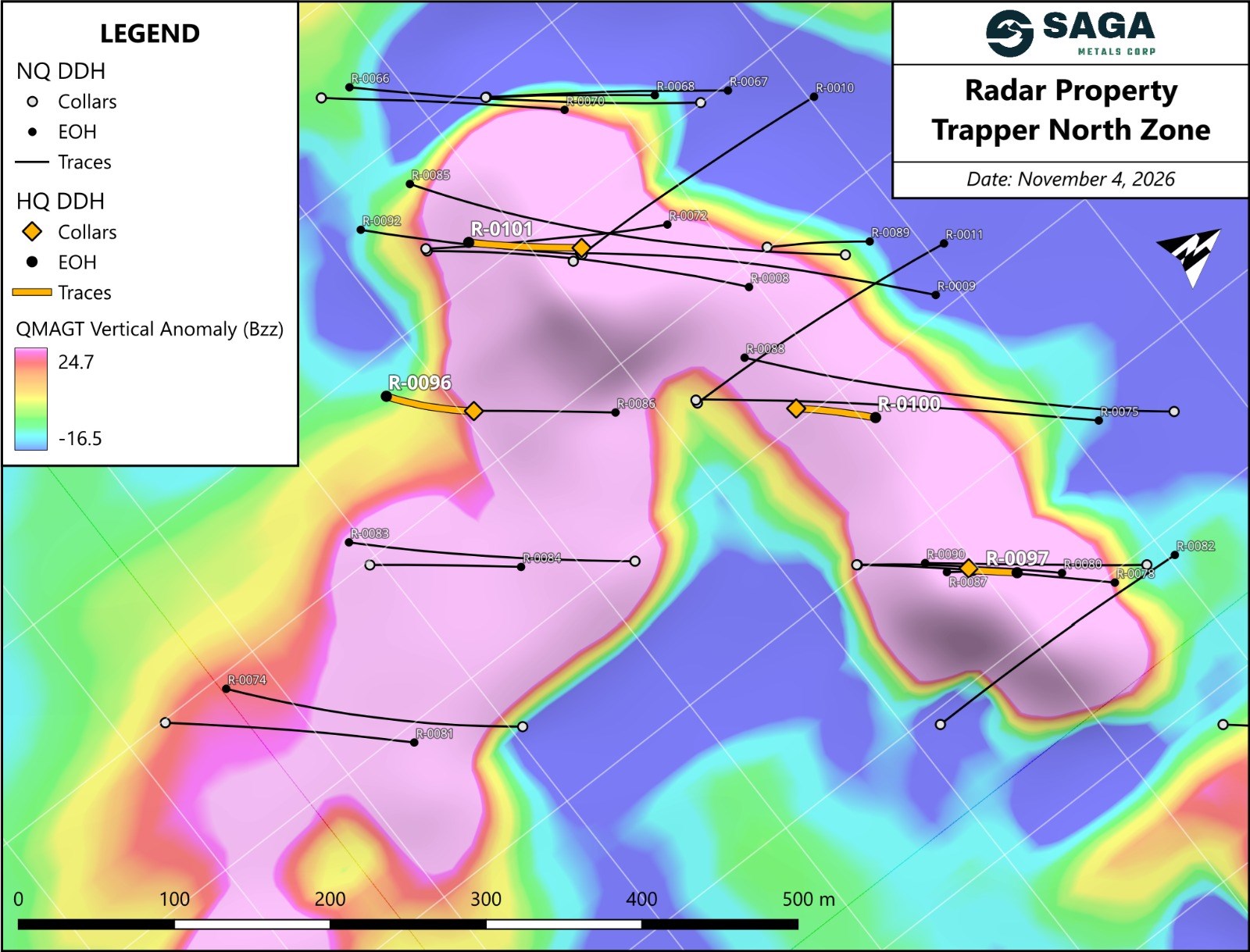
Figure 1: Trapper North plan map showing the four HQ metallurgical holes (R-0096, R-0097, R-0100 and R-0101) and the NQ diameter MRE drill holes (R-0008 to R-0092) on 100 m drill sections, over the Dias QMAGT vertical-gradient (Bzz) magnetic data. The magnetic response reflects magnetite content and is not a measure of grade.
To view an enhanced version of this graphic, please visit:
https://images.newsfilecorp.com/files/12336/322459_84477b8e64282af4_001full.jpg
HQ Metallurgical Drill Program
The HQ program followed the Company's 85-hole, 22,432-metre Mineral Resource Estimate ("MRE") drill program at the Trapper Zone, completed in August 2026. HQ drilling recovers about 1.8 times as much core per metre as NQ drilling, so a small number of holes can supply the larger sample masses for the initial concentrate and downstream testing requirements.
The four holes were drilled on sections N09, N10 and N11 (Figure 1). R-0096, R-0097 and R-0101 were collared from existing MRE drill pads (those of R-0086, R-0087 and R-0092), and R-0100 from a new pad on section N10. R-0096, R-0097 and R-0100 were drilled at about −80° and R-0101 at −70° (Table 1). All core was oriented.
Table 1: HQ drill hole summary
| Hole | Section | Azimuth (°) | Dip (°) | Length (m) | Started | Completed |
| R-0096 | N10 | 220 | −80 | 341 | Oct 6 | Oct 10 |
| R-0097 | N09 | 40 | −80 | 161 | Oct 11 | Oct 13 |
| R-0100 | N10 | 41 | −80 | 296 | Oct 21 | Oct 25 |
| R-0101 | N11 | 218 | −70 | 212 | Oct 25 | Oct 27 |
| Total | 1,010 | |||||
| Azimuth and dip are from the first downhole survey station. Lengths are drilled lengths. Started and completed dates are in 2026. | ||||||
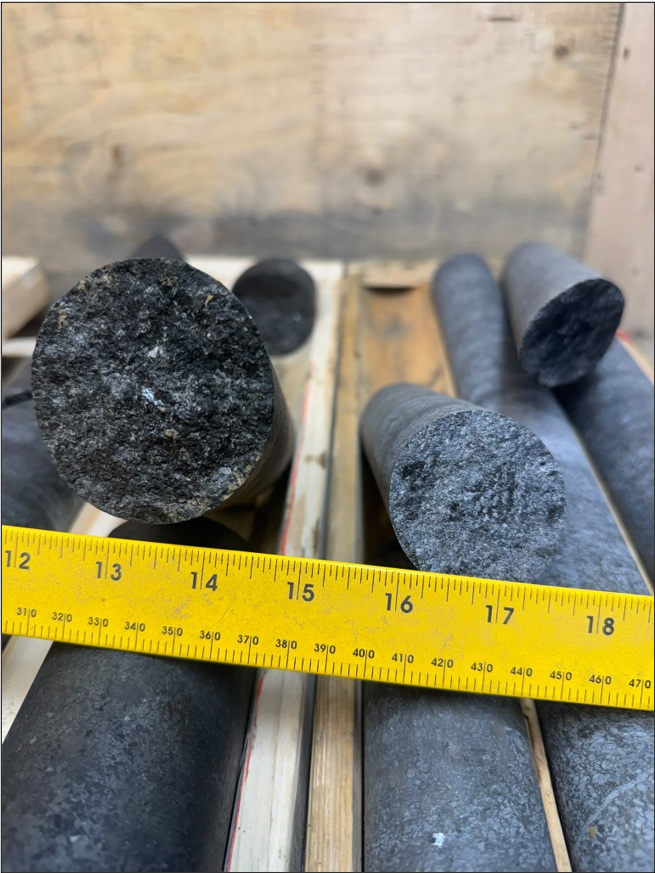
Figure 2: Size comparison of the HQ semi-massive oxide drill core (63.5mm) from R-0101 relative to the NQ intercumulate oxide drill core (47.6mm).
To view an enhanced version of this graphic, please visit:
https://images.newsfilecorp.com/files/12336/322459_saga-figure2.jpg
Geological Logging
R-0096 and R-0097 have been logged (Table 2). Both intersected the semi-massive and rhythmic (intercumulate) oxide gabbronorite units that host the titanomagnetite and ilmenite mineralization at Trapper. R-0096 logged 259.9 m of oxide units, of which 222.5 m is semi-massive oxide. R-0097, a shorter hole, logged 125.9 m of oxide units, of which 45.2 m is semi-massive oxide. Logging of R-0100 and R-0101 is in progress, and their logged oxide will be reported with the assays.
Table 2: Logged oxide in the HQ holes
| Hole | Section | Length (m) | Semi-massive oxide (m) | Intercumulate oxide (m) | Total logged oxide (m) |
| R-0096 | N10 | 341 | 222.5 | 37.4 | 259.9 |
| R-0097 | N09 | 161 | 45.2 | 80.7 | 125.9 |
| R-0100 | N10 | 296 | Logging in progress | - | - |
| R-0101 | N11 | 212 | Logging in progress | - | - |
| Logged oxide lengths are downhole core lengths of visually logged oxide units. They are not estimates of grade or of true thickness, and visual observations are not a substitute for laboratory analysis. Assays are pending. | |||||
Metallurgical Test Work
The HQ core will be used for metallurgical test work, including the production of magnetic concentrate for downstream testing following the completion of Stage 2 detailed bench-scale optimization. Processing of the Radar Titanium-Vanadium-Iron oxide mineralization is being conducted by Temas Resources Corp. ("Temas") utilizing their proprietary Regenerative Chloride Leach ("RCL") technology.
The Stage 2 program is approximately half-way through the planned timeline. Program details include testing two run-of-mine ("ROM") Massive Oxide samples side by side, comparing titanium, vanadium and iron extraction, reagent consumption, leach kinetics, solution quality, residue characteristics, grinding requirements and overall process performance.
Optimization will focus on the key RCL operating variables, including hydrochloric acid and magnesium chloride concentrations, temperature, oxidation-reduction potential, retention time, solids concentration and particle size. The objective is to establish reproducible conditions that maximize extraction while improving reagent efficiency and solution quality.
Downstream Flowsheet and First Products
This optimization phase also develops the downstream solvent extraction circuit for iron, titanium and vanadium, testing extraction, scrubbing and stripping conditions and developing McCabe-Thiele isotherms to establish preliminary solvent extraction operating parameters.
The optimized leaching program is intended to generate sufficient pregnant leach solution to run the solvent extraction circuit and recover first samples of high-purity titanium dioxide, vanadium and iron. These samples are designed to bridge metallurgical testing and commercial product evaluation, and to support assessment of end-use markets in pigment, titanium sponge feed, steel, energy storage and related industrial applications.
Temas' RCL process consists of an atmospheric chloride leach followed by successive solvent extraction of titanium, vanadium and iron. The process is designed to produce a high-purity titanium-bearing strip solution that can be converted to TiO2 products, a high-purity vanadium product suitable for steel or battery applications, and a high-purity iron product suitable for pigment or iron production. RCL employs commercially proven unit operations and is flexible across a range of titanium-vanadium-iron feedstocks.
Stage-Gated Path to Pilot Testing
This phase is expected to deliver:
Comparative characterization and leaching results;
Optimized RCL leaching and downstream solvent extraction conditions;
McCabe-Thiele isotherms;
Selection of the preferred feed material; and
A recommendation regarding readiness for mini-pilot testing.
These deliverables along with the HQ oxide material will provide the basis for establishing a SAGA pilot program at Radar.
Subject to successful completion of Phase 1 (includes stage 1 & 2) and approval by SAGA, Phase 2 would advance to a pilot study program generating continuous operating data, process design criteria and product samples, together with the technical basis for preliminary CAPEX and OPEX evaluation. Phase 2 is expected to run over a 10-week period, with the final scope and budget to be established on completion of Phase 1.
Advancing through defined technical gates, rather than moving directly from laboratory testing to larger-scale processing, is intended to de-risk the flowsheet and mark the transition from metallurgical validation to the engineering, product and scale-up data required for potential commercial development and PEA/PFS-level evaluation.
Next Steps
Complete logging and sampling of R-0100 and R-0101.
Deliver the HQ core to IGS for analysis and concentration for further metallurgical test work.
Report assays for the HQ holes when received.
Complete Stage 2 Detailed Bench-Scale Optimization Phase with Temas' RCL beneficiation process.
Initiate pilot study program utilizing concentrate material for the HQ metallurgical drill program.
About the Radar Critical Mineral Property in Labrador
The Radar Property comprises 690 mineral claims across 9 mineral licenses, totalling approximately 24,175 hectares in southeastern Labrador, located approximately 10 km south of Cartwright. The Property entirely encloses the Dykes River Intrusive Complex (~160 km² at the surface) and is accessible year-round via paved Route 510, a Cartwright logging road, and a SAGA-constructed access trail. Infrastructure advantages include the deep-water port at Cartwright, the Cartwright Airport (YRF), and proximity to regional hydroelectric power from Muskrat Falls and Churchill Falls.
Diamond drilling, geophysics, trenching and geological mapping have confirmed a 29 km2 oxide-bearing lopolith that host the Trapper, Falcon and Hawkeye Zones. VTM mineralization at Radar is comparable to that of global Fe-Ti-V systems such as Panzhihua (China) and Bushveld (South Africa). Subject to further exploration, resource definition, and metallurgical testing, the Project may represent a strategic source of titanium, vanadium, and iron for North American markets.
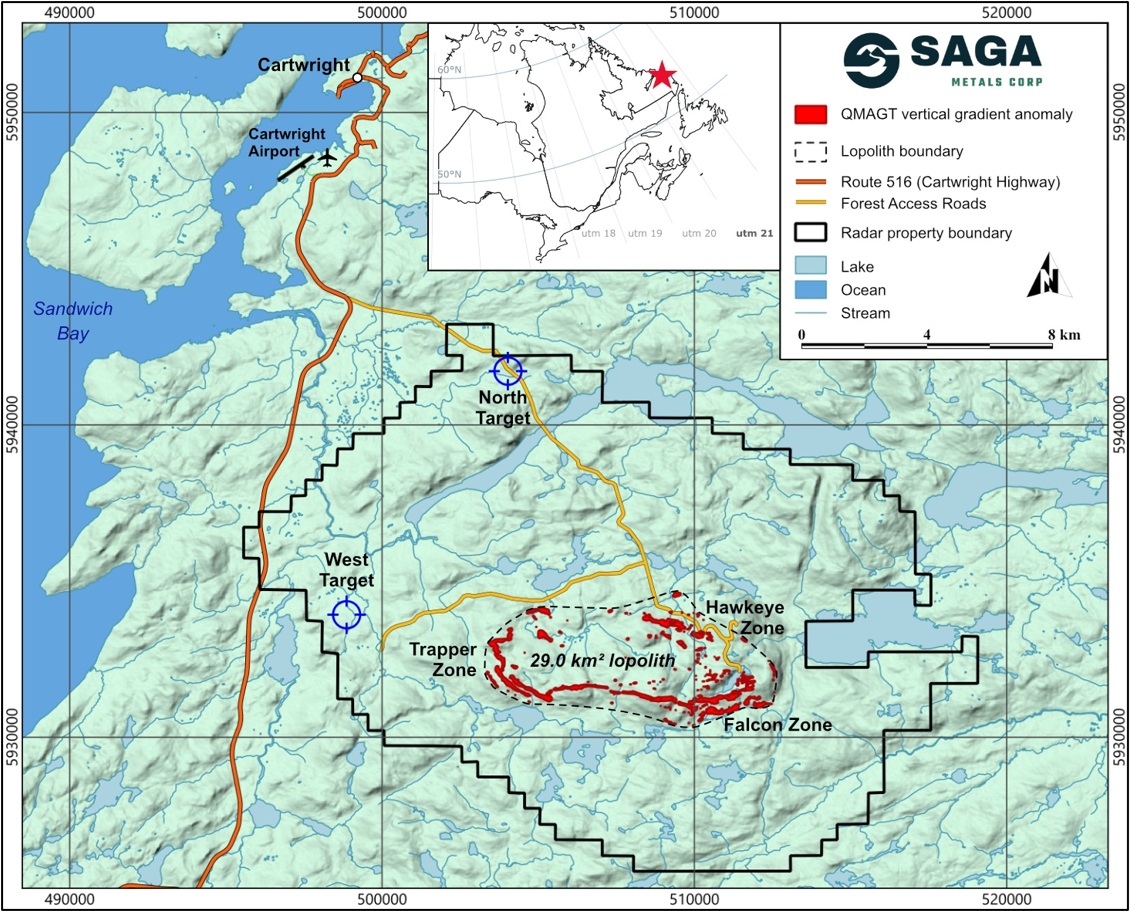
Figure 3: The Radar Property with the Dias QMAGT vertical gradient (Bzz) anomaly footprint shown in red (high-amplitude pixels only). The QMAGT-imaged central oxide-layering lopolith validated over a 29 km2 area, encompassing the Trapper Zone, Hawkeye Zone, and the new Falcon Zone, with additional targets highlighted to the west and north. The Property is well serviced by road access and is conveniently located near the town of Cartwright, Labrador.
To view an enhanced version of this graphic, please visit:
https://images.newsfilecorp.com/files/12336/322459_saga-figure3.jpg
Qualified Person
Dr. A. Miller, P. Geo., PEGNL, is an Independent Qualified Person as defined under National Instrument 43-101 and has reviewed and approved the technical information disclosed in this news release.
Technical Information
The HQ core is 63.5 mm in diameter. All core from the program was oriented. Core is logged and sampled by Company personnel at SAGA's core facility in Cartwright, Labrador. The core was cut lengthwise using a diamond saw, and one half was retained in the core box, while the other half was sampled at designated intervals for analysis and will be further concentrated for metallurgical test work. Samples for assay are prepared and analysed by Impact Global Solutions Inc. ("IGS") in Québec, a laboratory independent of the Company, by lithium-borate fusion with X-ray fluorescence finish. Certified reference materials, coarse blanks, and coarse and pulp duplicates are inserted into the sample stream at regular intervals. Crush rejects and pulps are retained in secure storage.
Semi-massive oxide and rhythmic (intercumulate) oxide are lithological units logged visually from the abundance and texture of oxide minerals. Logged lengths are downhole core lengths.
About SAGA Metals Corp.
SAGA Metals Corp. is a North American mining company focused on the exploration and discovery of a diversified suite of critical minerals that support the North American transition to supply security. The
The
The
Additionally, SAGA owns the Legacy Lithium Project in Quebec's Eeyou Istchee James Bay region. This project spans 73,866 hectares and has geological attributes similar to nearby terrains currently being explored by Rio Tinto, Li-FT Power, SOQUEM, and Loyal Metals.
With a portfolio spanning key commodities critical to the clean energy future, SAGA is strategically positioned to play an essential role in securing critical minerals.
On Behalf of the Board of Directors
Mike Stier, Chief Executive Officer
For more information, contact:
Rob Guzman, Investor Relations
SAGA Metals Corp.
Tel: +1 (844) 724-2638
Email: rob@sagametals.com
www.sagametals.com
Neither the TSX Venture Exchange nor its Regulation Service Provider (as that term is defined in the policies of the TSX Venture Exchange) accepts responsibility for the adequacy or accuracy of this release.
Cautionary Disclaimer
This news release contains forward-looking statements within the meaning of applicable securities laws that are not historical facts. Forward-looking statements are often identified by terms such as "will", "may", "should", "anticipates", "expects", "believes", and similar expressions or the negative of these words or other comparable terminology. All statements other than statements of historical fact, included in this release are forward-looking statements that involve risks and uncertainties. In particular, this news release contains forward-looking information pertaining to the Company's plans and objectives related to its Radar Project. There can be no assurance that such statements will prove to be accurate, and actual results and future events could differ materially from those anticipated in such statements. Important factors that could cause actual results to differ materially from the Company's expectations include, but are not limited to, changes in the state of equity and debt markets, fluctuations in commodity prices, delays in obtaining required regulatory or governmental approvals, environmental risks, limitations on insurance coverage, inherent risks and uncertainties involved in the mineral exploration and development industry, particularly given the early-stage nature of the Company's assets, and the risks detailed in the Company's continuous disclosure filings with securities regulations from time to time, available under its SEDAR+ profile at www.sedarplus.ca. The reader is cautioned that assumptions used in the preparation of any forward-looking information may prove to be incorrect. Events or circumstances may cause actual results to differ materially from those predicted, as a result of numerous known and unknown risks, uncertainties, and other factors, many of which are beyond the control of the Company. The reader is cautioned not to place undue reliance on any forward-looking information. Such information, although considered reasonable by management at the time of preparation, may prove to be incorrect and actual results may differ materially from those anticipated. This cautionary statement expressly qualifies forward-looking statements contained in this news release. The forward-looking statements contained in this news release are made as of the date of this news release, and the Company will update or revise publicly any of the included forward-looking statements only as expressly required by applicable law.

To view the source version of this press release, please visit https://www.newsfilecorp.com/release/322459
FAQ
AI-generated questions and answers. How Rhea-AI works. Not financial advice.
What did SAGA Metals complete at the Radar project?
SAGA completed four large-diameter drill holes totaling 1,010 metres at Trapper North in October 2026. The program recovered core for metallurgical test work, including concentrate production for downstream pilot testing associated with potential preliminary economic assessment and prefeasibility-level evaluation.
What must happen before SAGA Metals starts the Radar pilot study?
The pilot phase requires successful completion of Phase 1 and approval by SAGA. Phase 1 includes Stages 1 and 2. The subsequent pilot phase is expected to run over a 10-week period, with the final scope and budget established after Phase 1.
What will SAGA Metals test during Radar's Stage 2 optimization?
Stage 2 compares two run-of-mine massive oxide samples for metal extraction, reagent consumption and processing performance. Testing also examines leaching conditions and downstream solvent extraction, a process for separating dissolved metals, to select preferred feed material and assess readiness for mini-pilot testing.