
SAGA Metals Completes Diamond Drill Program at the Wolverine Rare Earth Project - All 22 Holes Totalling 3,241 Metres Intersect Prospective REE-Bearing Alteration
Assays remain pending as SAGA prepares further exploration beyond Wolverine's initial drill footprint.
Sentiment and the balance of points
Rhea-AI Sentiment reads the wording of the document, how positive or negative its language is on a 1 to 5 scale. The balance of points shown with the takes weighs what the document actually discloses, so the two can disagree, for example when a trial that missed its main goal is described in upbeat language.
Rhea-AI Summary
SAGA Metals (SAGMF) completed its maiden diamond drilling program at the wholly owned Wolverine Heavy Rare Earth Element Project in Labrador. The program comprised 22 holes totalling 3,241 metres. Preliminary logging identified alteration interpreted as associated with rare earth element mineralization in every hole; assays remain pending.
Two holes are fully logged and sampled, with alteration intervals of 180.2 metres and approximately 178.65 metres. Logging and sampling continue on the remaining 20 holes. Prospecting collected 136 grab samples, with assays pending, and identified additional pegmatites and aplite dykes beyond the drill area. SAGA plans an induced polarization geophysical survey in Q2 2027; its interpretation, combined with geological and assay results, is expected to guide follow-up drilling targeting downward extensions of interpreted hydrothermal feeder structures.
How this balance works
Rhea-AI gives every point it takes from this document a weight. Minor counts 1, Moderate 3 and Major 9, so one Major point outweighs several Minor ones. The bar adds up the weights on each side, and when neither side holds more than 65% of the total the balance reads Mixed.
It reads the document as published, with the same rules for every company, and it does not look at what the market expected or at how the stock traded, so a point can be objectively good on a day the stock falls.
Rhea-AI Sentiment measures something else, the tone of the wording.
Hollow bars mark forward-looking points. How the balance works
Positive
- Moderate point22 holes totalling 3,241 metres completed Wolverine's first systematic diamond drilling program.
- Moderate pointAll 22 holes showed alteration interpreted as associated with rare earth element mineralization.
- Minor pointW26-001 logged 180.2 metres of alteration, including a 118.75-metre interval of Unit 4.
- Minor pointW26-002 logged approximately 178.65 metres of alteration, including a 50.97-metre interval of Unit 4.
- Minor pointProspecting expanded mapped prospective volcanic units and identified additional pegmatite and aplite dyke targets.
2 minor points
- Minor point. Forward-looking: it has not happened yet and may not happen.Q2 2027 geophysical survey is planned to help guide follow-up drilling with geological and assay results.
- Minor point. Forward-looking: it has not happened yet and may not happen.2027 exploration strategy and maiden Mineral Resource Estimate are intended to draw on the new data set.
Negative
- Moderate pointDrill and 136 grab-sample assays remain pending; reported drill observations are preliminary geological interpretations.
- Minor point20 holes still require completion of logging and sampling before sample submission.
AI-generated analysis. How Rhea-AI works. Not financial advice.


The 2026 field program had three primary objectives: (1) execute a maiden diamond drill program to test REE mineralization previously documented by historic reverse circulation (RC) drilling, backpack drilling, and surface sampling; (2) conduct detailed alteration and outcrop mapping in the vicinity of the drill program; and (3) undertake prospecting and rock sampling of additional potentially mineralized areas outside the immediate drill footprint.
Program Highlights
- Completion of 22 diamond drill holes totalling 3,241 metres.
- Promising alteration assemblage interpreted as related to REE mineralization identified in all 22 holes.
- Two holes fully logged and sampled, returning thick intervals of Unit 4 (up to 118.75 m) with extensive alteration from near surface to end of hole.
- Prospecting confirmed and expanded the distribution of Units 3, 4, and 5 over a large portion of the property.
- New and historic pegmatites and aplite dykes located in the south of the property, significantly expanding the targeted areas.
- Early indications of structurally controlled, sub vertical epithermal-style mineralization with potential depth extent.
Diamond Drill Program Details
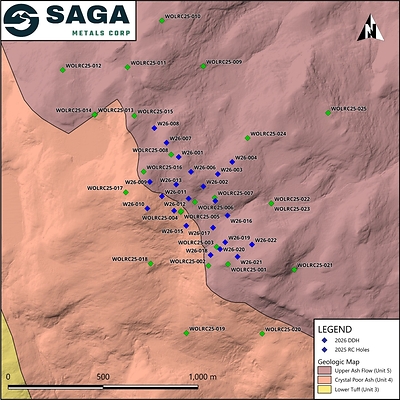
All 22 holes were drilled at an azimuth of 230° and a dip of -85°. The program focused on an area of known REE mineralization and systematically tested the crystal-poor ash tuff (Unit 4), its upper contact with crystal tuff (Unit 5), and its lower contact with crystal tuff (Unit 3), together with multiple step-out holes. End-of-hole depths ranged from 43 m to 204 m.
Quick logging completed by the on-site geologist identified an alteration assemblage interpreted to be associated with REE mineralization in all 22 holes (see Figure 1 for completed drill holes). To date, two holes have been fully logged and sampled:
- W26-001 (182 m total depth): The upper 13.1 m intersected a red quartz-feldspar crystal tuff of Unit 5, which grades into a variable sequence of ash tuff, lithic tuff, ignimbrite, and crystal tuff of Unit 4. Alteration cycles between sericite-dominant and chlorite-dominant intervals, both associated with sulphides. Unit 4 is 118.75 m thick and grades into Unit 3 crystal tuff at 120.55 m, which continues to the end of the hole. Alteration was logged from 1.8 m to the end of the hole (total alteration interval of 180.2 m). 138 core samples were collected.
- W26-002 (179 m total depth): The upper 31.9 m is red quartz-feldspar crystal tuff of Unit 5, grading into ignimbrite, ash tuff, and crystal tuff of Unit 4. Alteration switches between sulphidic, chloritic, and sericitic intervals. Unit 4 is 50.97 m thick and grades into beige crystal tuff of Unit 3 by 82.87 m, which continues to the end of the hole. Alteration was logged from 0.35 m essentially to the end of the hole (total alteration interval of approximately 178.65 m). 139 core samples were collected.
Logging and sampling of the remaining 20 holes are in progress. Assay results from the fully sampled holes are pending. The Company anticipates receiving and reporting initial assay results in batches in due course.
Prospecting and Rock Sampling
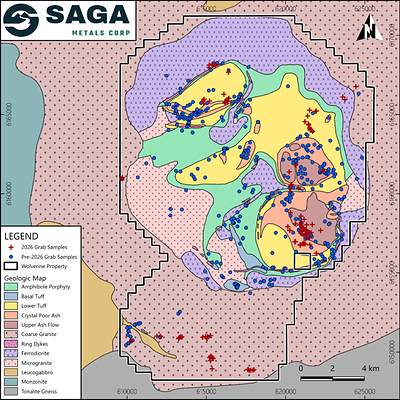
Prospecting was conducted during the diamond drill program over a two-month period across other portions of the Wolverine property. A total of 136 grab samples were collected (see Figure 2 for sample locations); assays are pending. Units 5, 4, and 3 were identified in multiple locations across the property, indicating that the prospective volcanic sequence has significant lateral extent and that future drilling can be meaningfully expanded beyond the 2026 drill footprint.
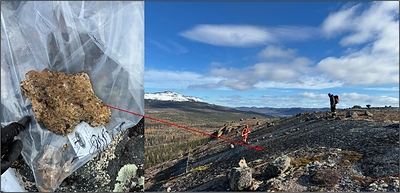
Scintillometer-supported prospecting in the southern part of the property confirmed the presence of multiple previously identified pegmatites and resulted in the discovery of numerous new pegmatites and aplite dykes (See Figure 3).
Alteration-structural observations
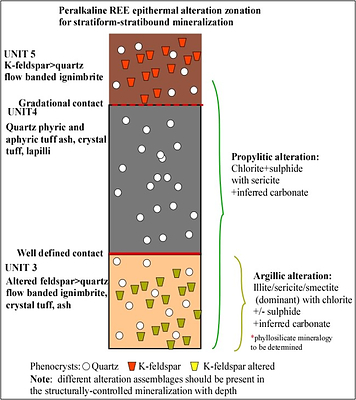
Preliminary observations from core and outcrop support the interpretation that the REE mineralization is hosted within a propylitic (chlorite-dominant) alteration zone developed in Units 3, 4, and 5 (Figure 4) Limited intervals of argillic alteration Chloritization occurs both as pervasive replacement of the volcanic rocks and is accompanied by chlorite+sulphide+REE-bearing carbonate-bearing veins, fractures and breccias oriented at various angles to the core axis. Notably, many of the more significant fracture and breccia domains are oriented parallel to sub-parallel to the core axis. Given the steep inclination of the drill holes, these fracture-breccia structures are interpreted as sub vertical hydrothermal feeder structures that formed stratiform-like alteration zones in volcanic units 5, 4 and 3. These structurally-controlled, sub vertical fracture-breccia networks have the mineralogical attributes that unequivocally indicate formation from a volatile-rich magmatic-hydrothermal fluid derived from an overpressured hydrothermal reservoir related to peralkalaine intrusions.
Next Steps
The Company will complete logging and sampling of the remaining holes and submit samples for assay. Detailed mapping data will be fully analysed and integrated with the drill results. An induced polarization (IP) survey is planned for Q2 2027; interpretation of the IP data, combined with the 2026 geological and assay results, is expected to guide a follow-up drill program targeting the downward extensions of the interpreted hydrothermal feeders into potential source rocks.
Michael Garagan, Director and Chief Geological Officer of Saga Metals, commented: "The 2026 maiden diamond drill program at Wolverine has successfully confirmed the presence of the target alteration assemblage in every hole drilled and has provided the first systematic look at the volcanic sequence at depth. Combined with the mapping and prospecting results, which demonstrate that the prospective units and additional pegmatite targets extend well beyond the current drill area, we have generated a substantial data set that will shape our 2027 exploration strategy and maiden Mineral Resource Estimate. We look forward to receiving the assay results, advancing the geological model and continuing our goal of proving that the Flowers River Igneous Suite contained within the Wolverine project, the largest peralkaline intrusive volcanic complex in
Qualified Person
Dr. A. Miller, P. Geo., PEGNL, is an Independent Qualified Person as defined under National Instrument 43-101 and has reviewed and approved the technical information disclosed in this news release.
About SAGA Metals Corp.
SAGA Metals Corp. is a North American mining company focused on the exploration and discovery of a diversified suite of critical minerals that support the North American transition to supply security. The
The
The
Additionally, SAGA owns the Legacy Lithium Project in Quebec's Eeyou Istchee James Bay region. This project spans 73,866 hectares and has geological attributes similar to nearby terrains currently being explored by Rio Tinto, Li-FT Power, SOQUEM, and Loyal Metals.
With a portfolio spanning key commodities critical to the clean energy future, SAGA is strategically positioned to play an essential role in securing critical minerals.
On Behalf of the Board of Directors
Mike Stier, Chief Executive Officer
For more information, contact:
Rob Guzman, Investor Relations
SAGA Metals Corp.
Tel: +1 (844) 724-2638
Email: rob@sagametals.com
www.sagametals.com
Neither the TSX Venture Exchange nor its Regulation Service Provider (as that term is defined in the policies of the TSX Venture Exchange) accepts responsibility for the adequacy or accuracy of this release.
Cautionary Disclaimer
This news release contains forward-looking statements within the meaning of applicable securities laws that are not historical facts. Forward-looking statements are often identified by terms such as "will", "may", "should", "anticipates", "expects", "believes", and similar expressions or the negative of these words or other comparable terminology. All statements other than statements of historical fact, included in this release are forward-looking statements that involve risks and uncertainties. In particular, this news release contains forward-looking information pertaining to the Company's Wolverine Project. There can be no assurance that such statements will prove to be accurate, and actual results and future events could differ materially from those anticipated in such statements. Important factors that could cause actual results to differ materially from the Company's expectations include, but are not limited to, changes in the state of equity and debt markets, fluctuations in commodity prices, delays in obtaining required regulatory or governmental approvals, environmental risks, limitations on insurance coverage, inherent risks and uncertainties involved in the mineral exploration and development industry, particularly given the early-stage nature of the Company's assets, and the risks detailed in the Company's continuous disclosure filings with securities regulations from time to time, available under its SEDAR+ profile at www.sedarplus.ca. The reader is cautioned that assumptions used in the preparation of any forward-looking information may prove to be incorrect. Events or circumstances may cause actual results to differ materially from those predicted, as a result of numerous known and unknown risks, uncertainties, and other factors, many of which are beyond the control of the Company. The reader is cautioned not to place undue reliance on any forward-looking information. Such information, although considered reasonable by management at the time of preparation, may prove to be incorrect and actual results may differ materially from those anticipated. This cautionary statement expressly qualifies forward-looking statements contained in this news release. The forward-looking statements contained in this news release are made as of the date of this news release, and the Company will update or revise publicly any of the included forward-looking statements only as expressly required by applicable law.

 View original content to download multimedia:https://www.prnewswire.com/news-releases/saga-metals-completes-diamond-drill-program-at-the-wolverine-rare-earth-project--all-22-holes-totalling-3-241-metres-intersect-prospective-ree-bearing-alteration-302915831.html
SOURCE SAGA Metals Corp.
FAQ
AI-generated questions and answers. How Rhea-AI works. Not financial advice.
What did SAGA Metals find in its first Wolverine diamond drilling program?
Preliminary logging identified alteration interpreted as associated with rare earth element mineralization in all 22 holes, totalling 3,241 metres. Assay results remain pending, so the reported observations are geological interpretations rather than new assay grades.
What are SAGA Metals' next exploration steps at Wolverine?
SAGA plans to finish logging and sampling, submit samples for assay and conduct an induced polarization survey in Q2 2027. The company expects the survey interpretation, combined with geological and assay results, to guide follow-up drilling targeting downward extensions of interpreted hydrothermal feeder structures.