
SAGA Metals Highlights Radar Project's VTM Enriched Magnetic Concentrate up to 0.9% V2O5 Relative to Panzhihua, China Benchmark of 0.3% V2O5
Rhea-AI Summary
SAGA Metals (OTCQB:SAGMF) reported preliminary Davis Tube Analysis from the Hawkeye zone at its 100%-owned Radar Ti-V-Fe Project in Labrador, comparing results to the Panzhihua VTM benchmark in China.
Hawkeye magnetic concentrates average ~0.80% V2O5, with a subset at ~0.81–0.90% V2O5 versus Panzhihua’s ~0.3% V2O5 concentrate. Bench-scale tests indicate ~73–81% V2O5 recoveries to the magnetic fraction at mass yields of ~18–38%. Over 86% of TiO2 reports to the non-magnetic fraction, suggesting a potential ilmenite-rich stream. Radar covers 24,175 ha with a 29 km² oxide corridor. Further metallurgical, mineralogical and process-design work is planned to confirm repeatability across Hawkeye and Trapper zones.
Positive
- Preliminary Hawkeye magnetic concentrates average ~0.80% V2O5, subset ~0.81–0.90% V2O5
- V2O5 recoveries to magnetic fraction commonly ~73–81% at 18–38% mass yield
- Over 86% of TiO2 reports to non-magnetic fraction, indicating ilmenite-rich stream potential
- Radar property spans 24,175 ha with a 29 km² oxide corridor over Dykes River intrusive complex
- Bench-scale DTA suggests vanadium reports mainly to magnetic Fe-V concentrate, supporting Fe-V product pathway
- Planned test program targets grind/magnetic optimization, ilmenite separation and product-quality data for future evaluation
Negative
- Radar is an exploration-stage project with mineral resource estimate still in progress
- All metallurgical results are preliminary and require confirmation across Hawkeye and Trapper zones
- Downstream Fe-V and Ti processing routes remain untested beyond bench-scale concepts
- Potential ilmenite concentrate in mid-40s TiO2 range is theoretical and needs dedicated separation and hydrometallurgical work
News Market Reaction – SAGMF
In the Jun 18 session, SAGMF gained 5.60%, reflecting a notable positive market reaction.
Data tracked by StockTitan Argus on the day of publication.
AI-generated analysis. How Rhea-AI works. Not financial advice.




Vancouver, British Columbia--(Newsfile Corp. - June 18, 2026) - SAGA Metals Corp. (TSXV: SAGA) (OTCQB: SAGMF) (FSE: 20H) ("SAGA" or the "Company"), a North American exploration company focused on critical mineral discoveries, is pleased to provide a technical benchmark comparison between its
These preliminary Davis Tube Analysis (DTA) results from the Hawkeye zone show strong vanadium pentoxide (V₂O₅) upgrading in the magnetic concentrate relative to the published Panzhihua VTM concentrate benchmark. The comparison focuses on potential advantages in vanadium recovery and downstream processing at the Radar Project.
Panzhihua/Pangang demonstrates that VTM systems can support large-scale vanadium production with a mean grade of
Highlights
Panzhihua is the vanadium benchmark. The Panzhihua VTM district is one of the world's most important Fe-Ti-V systems. The main Panzhihua intrusion has been reported to contain approximately 1.333 billion tonnes with a mean grade of
33% Fe,12% TiO2 and0.3% V2O5 (Ma et al., 2003)1 oxide ore reserves, and Pangang/Panzhihua has been reported to account for approximately40% of global vanadium product output2.Radar shows early vanadium upgrading. A preliminary Hawkeye Davis Tube sample suite produced magnetic concentrates averaging approximately
0.80% V₂O₅, with a substantial subset grading approximately 0.81-0.90% V₂O₅ at magnetic mass yields typically in the 18-38% range.Vanadium recovery to the magnetic fraction is encouraging. For the higher-quality subset of Hawkeye Davis Tube tests, the corresponding V₂O₅ recoveries for the magnetic concentrate typically range from
73% to81% . These results are preliminary and require confirmation across representative samples from Hawkeye and Trapper zones.Low TiO₂ in the magnetic concentrate is a key differentiator. Panzhihua's processing challenge is that Ti in titanomagnetite reports largely to a high-Ti slag rather than to a high-value titanium product. High TiO₂ in titanomagnetite concentrates can contribute to viscous slag, slag foaming, titanium-bearing furnace accretions, and complex Ti recovery. A lower-Ti magnetic concentrate may offer a potentially simpler Fe-V processing route.
High TiO2 in non-magnetic fraction may carry additional value at Radar. DTA interpretation indicates that the non-magnetic fraction commonly contains approximately 86
-92% of the head TiO₂ and may represent a potential ilmenite-rich stream.
Panzhihua remains a highly relevant benchmark because it proves the industrial scale of VTM-hosted vanadium production. In the published Panzhihua flowsheet, Fe and V are recovered principally through the magnetite/titanomagnetite stream, with vanadium reporting to vanadiferous hot metal and subsequently to vanadium slag.
Panzhihua illustrates the value of vanadium in VTM systems, but also the cost of carrying high TiO₂ through the Fe-V concentrate stream.
Radar's preliminary Hawkeye results suggest a potentially cleaner Fe-V magnetic product, with most titanium reporting to the non-magnetic fraction rather than to the magnetic concentrate.
SAGA believes this distinction is important. If the vanadium-enriched magnetic concentrate response is replicated across representative Hawkeye and Trapper samples, Radar may offer two separate evaluation pathways: a magnetic Fe-V concentrate focused on iron and vanadium recovery, and a Ti-rich non-magnetic stream focused on ilmenite upgrading.
Michael Garagan, CGO & Director of SAGA Metals, commented:
"Panzhihua demonstrates that VTM systems can become globally significant vanadium producers. The important distinction for Radar is that our preliminary Davis Tube tests from Hawkeye zone drill core show strong vanadium enrichment in the magnetic concentrate, while the TiO₂ is primarily reporting to a Ti-rich, non-magnetic stream, which is not seen in the Panzhihua concentrate benchmark. If this response is confirmed across representative samples from Hawkeye and Trapper zones, Radar could have a cleaner Fe-V concentrate pathway and a separate Ti-rich stream for ilmenite evaluation. Encouragingly, we are seeing consistently higher grades of TiO2 and V2O5 in the Trapper zone along the 3+ km oxide strike. The next step is to turn this early deportment advantage into repeatable recovery, product-quality and process-design data."
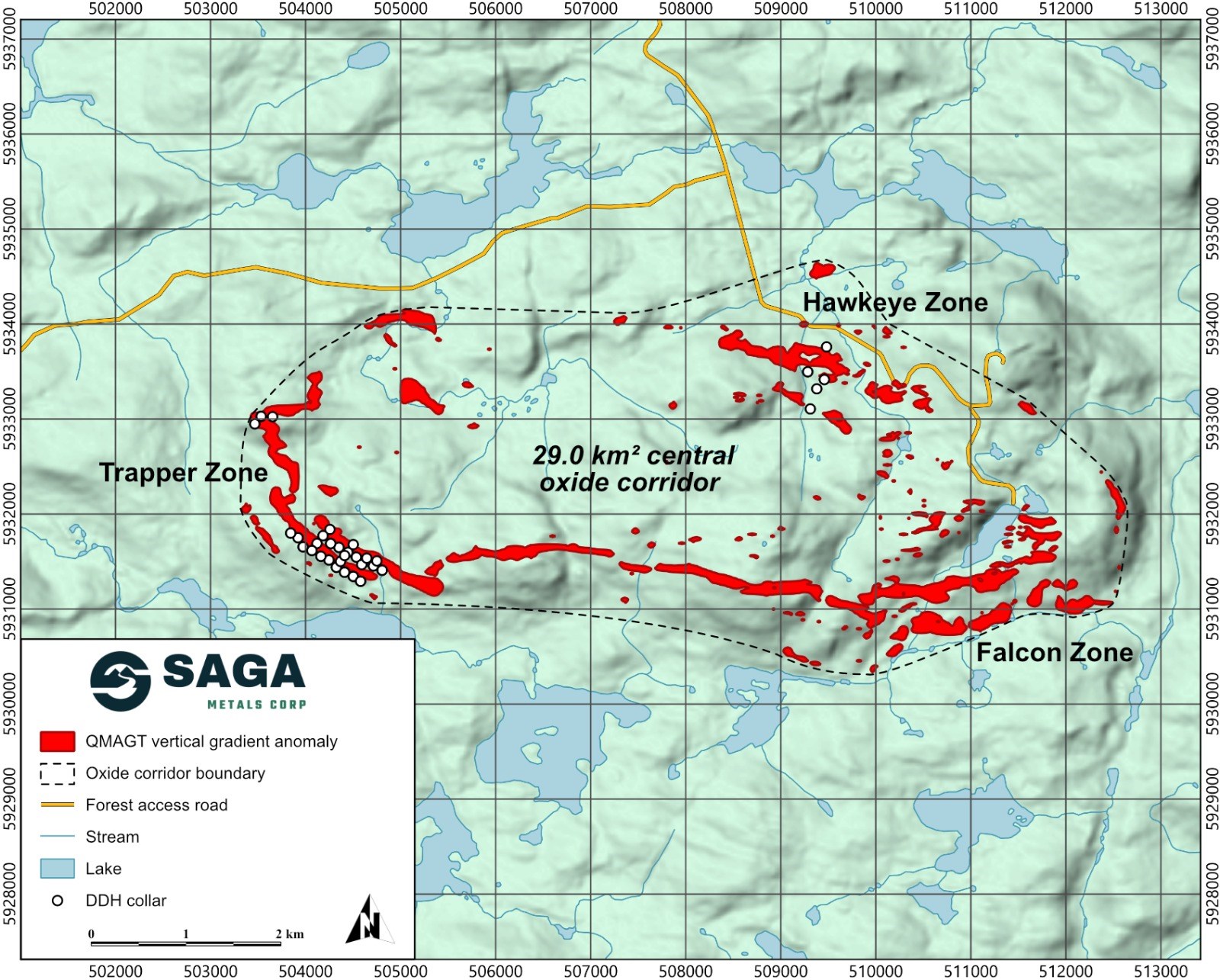
Figure 1: The Radar Property with the Dias QMAGT vertical gradient (Bzz) anomaly footprint shown in red (high-amplitude pixels only). The QMAGT-imaged central oxide-layering corridor validated over 29 km2, encompassing the Trapper Zone, Hawkeye Zone, and the new Falcon Zone.
To view an enhanced version of this graphic, please visit:
https://images.newsfilecorp.com/files/12336/302009_c1a49af1a435da62_001full.jpg
Technical Deposit Comparison: Radar Versus Panzhihua
| Metric | Panzhihua VTM benchmark, China | SAGA Radar VTM Project, Labrador |
| Project status | Producing / mature Fe-Ti-V district | Exploration-stage VTM project; MRE in-progress |
| Deposit setting | Layered mafic intrusion-hosted Fe-Ti-V oxide system | Layered mafic intrusion-hosted Ti-V-Fe oxide system |
| Reported scale | Main intrusion reported at ~1,333 Mt of ore reserves @ | 24,175 ha property covering ~160 km² Dykes River intrusive complex with a 29 km2 oxide corridor |
| Vanadium context | Pangang/Panzhihua is reported as a major global producer, with 2021 output accounting for about | Significant V2O5 concentrate. Vanadium recovery potential is being evaluated through DTA, Satmagan correlation and future metallurgical testing. |
| V₂O₅ in magnetic concentrate | Published ore reserve concentrate: ~ | Preliminary Hawkeye DTA magnetic concentrate: batch average ~ |
| TiO₂ in magnetic concentrate | High TiO₂ reported in titanomagnetite, reported as | Preliminary Hawkeye DTA highlights over |
| Vanadium recovery pathway | The industrial route recovers V via the Fe-V hot metal/vanadium slag pathway. | Bench-scale DTA indicates V reports mainly to the magnetic fraction; subset recoveries commonly ~73 |
| Metallurgical implication | Proven Fe-V production but high-Ti smelting and Ti-recovery complexity | Potentially cleaner Fe-V concentrate and ilmenite stream with simplified processing; downstream testing required |
Modelling of the VTM contents at the Trapper and Hawkeye Zones returned a targeted VTM mineralized system very similar to Panzhihua VTM deposit. Despite an abundance of world resources of Ti ores, the industry continues to seek higher-quality concentrates, primarily because of processing costs and waste-disposal problems associated with the high iron and trace-element contents of ilmenite and titanomagnetite. The simple, coarse-grained VTM mineralization at Saga Metals' Radar Project has the potential for a clean VTM concentrate with high recovery.
The QMAGT-imaged magnetic footprint of the central Radar oxide-layering corridor (shown in Figure 2 below) represents only a portion of the 24,175-hectare Radar Property, which entirely encloses the approximately 160 km² Dykes River Intrusive Complex. The Property's land position is shown at the same map scale as the digitized ore outline of Panzhihua's deposit, providing visual context for the relative scale of the geological system that hosts the Radar mineralization.
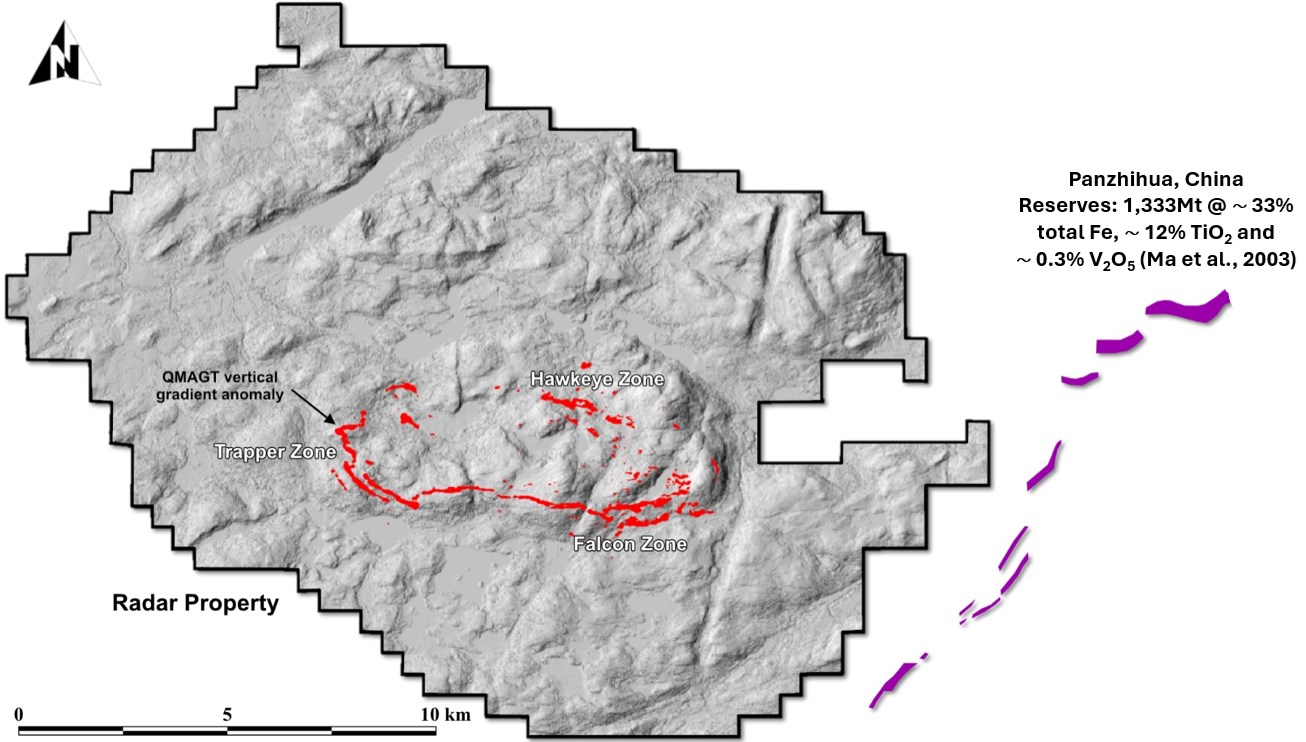
Figure 2: The Radar Property (outlined) with the Dias QMAGT vertical gradient (Bzz) anomaly footprint shown in red (high-amplitude pixels only), shown at the same map scale as the digitized ore outlines of the Panzhihua deposit (Sichuan, China). The QMAGT-imaged central oxide-layering corridor - encompassing the Trapper Zone, Hawkeye Zone, and the new Falcon Zone - is shown for direct visual comparison with the world's most significant titanium-vanadium-iron producer.
To view an enhanced version of this graphic, please visit:
https://images.newsfilecorp.com/files/12336/302009_c1a49af1a435da62_002full.jpg
Why the Vanadium Comparison Matters
In VTM deposits, vanadium value depends on deportment as much as grade. The preferred outcome is for vanadium to report with titanomagnetite into a magnetic Fe-V concentrate. At the same time, Ti is directed to a separate ilmenite-rich stream or to a downstream Ti product pathway. This is why Radar's early DTA response is noteworthy: the magnetic concentrate is enriched in V₂O₅ relative to the Panzhihua concentrate benchmark.
The non-magnetic fraction is also strategically relevant. DTA interpretation indicates that the non-magnetic fraction contains a chemically coherent Fe-Ti-V oxide population consistent with an ilmenite stream. A theoretical oxide normalization suggests a potential ilmenite concentrate in the mid-40s TiO₂ range with meaningful V₂O₅ content, but this must be confirmed by dedicated ilmenite separation, mineralogy and hydrometallurgical test work.
With a preliminary understanding of how the Fe-V and Ti minerals are reporting within the mineralized system, further test work is underway to confirm repeatability across zones, optimize grind size and magnetic intensity, quantify mineral liberation, and evaluate downstream processing routes for both the Fe-V magnetic stream and the Ti-rich non-magnetic stream.
Recommended Next Steps
SAGA's next phase of metallurgical work to focus on converting the encouraging vanadium deportment and titanium-rich ilmenite signal into repeatable recovery and product-quality data. Priority work to include:
Davis Tube and Satmagan/Borate Fusion calibration across representative Hawkeye, Trapper North and Trapper South lithologies, zones and grade ranges;
Automated mineralogy and EPMA/SEM-EDS work to quantify vanadium in titanomagnetite, ilmenite, silicates and other phases;
Grind-size and magnetic-intensity optimization to maximize V₂O₅ recovery while maintaining a cleaner magnetic concentrate;
Preliminary downstream evaluation of Fe-V concentrate options, including smelting, roast-leach, direct-reduction or other relevant pathways;
Bench-scale separation of the Ti-rich non-magnetic fraction to assess ilmenite grade, recovery, impurities and residual V₂O₅ value;
Product-quality testing for magnetic concentrate, including Fe grade, V₂O₅ grade, TiO₂, SiO₂, Al₂O₃, MgO, CaO, S, P and pelletizing behaviour;
Geometallurgical domain modelling and recovery/yield functions suitable for future resource-stage economic evaluation.
About the Radar Critical Mineral Property in Labrador
The Radar Property comprises 690 mineral claims across 9 mineral licenses, totalling approximately 24,175 hectares in southeastern Labrador, located approximately 10 km south of Cartwright. The Property entirely encloses the Dykes River Intrusive Complex (~160 km² at the surface) and is accessible year-round via paved Route 510, a Cartwright logging road, and a SAGA-constructed access trail. Infrastructure advantages include the deep-water port at Cartwright, the Cartwright Airport (YRF), and proximity to regional hydroelectric power from Muskrat Falls and Churchill Falls.
Diamond drilling, geophysics, trenching and geological mapping have confirmed a 29 km2 oxide corridor encompassing the Trapper, Falcon and Hawkeye Zones. VTM mineralization at Radar is comparable to that of global Fe-Ti-V systems such as Panzhihua (China) and Bushveld (South Africa). Subject to further exploration, resource definition, and metallurgical testing, the Project may represent a strategic source of titanium, vanadium, and iron for North American markets.
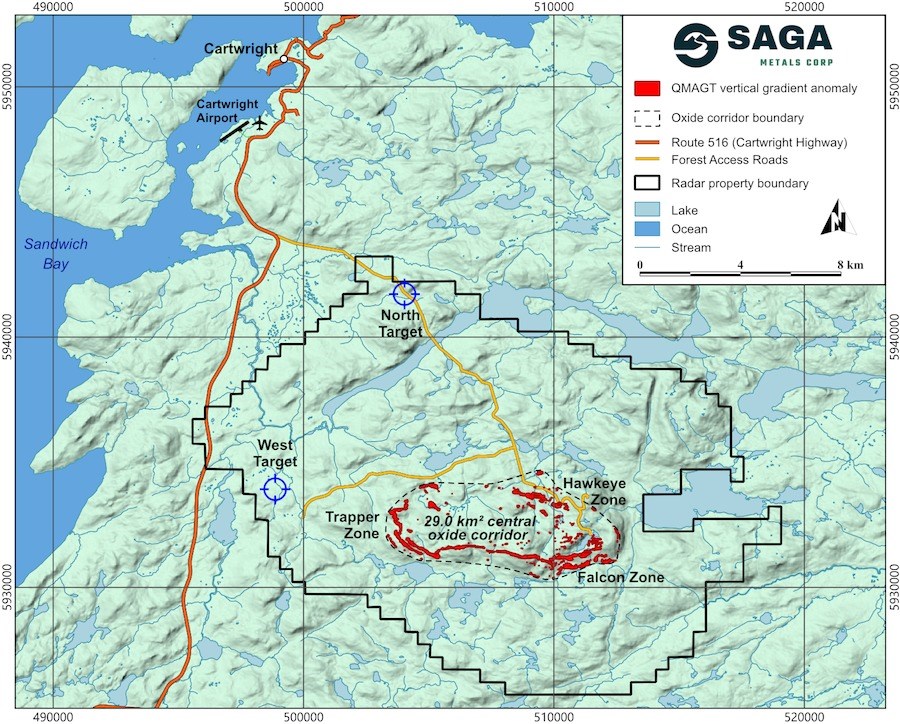
Figure 3: The Radar Property with the Dias QMAGT vertical gradient (Bzz) anomaly footprint shown in red (high-amplitude pixels only). The QMAGT-imaged central oxide-layering corridor validated over a 29 km2 area, encompassing the Trapper Zone, Hawkeye Zone, and the new Falcon Zone, with additional targets highlighted to the west and north. The Property is well serviced by road access and is conveniently located near the town of Cartwright, Labrador.
To view an enhanced version of this graphic, please visit:
https://images.newsfilecorp.com/files/12336/302009_c1a49af1a435da62_003full.jpg
Cautionary Note Regarding Panzhihua Comparison
The Panzhihua deposit and Pangang operation are used in this news release solely as geological and metallurgical benchmarks. Published reserve, production, concentrate and process data from Panzhihua are external benchmark information and are not necessarily indicative of mineralization, metallurgy, tonnage, grade, recoverability or economic viability at Radar. Radar does not currently have a mineral resource estimate, mineral reserve estimate, preliminary economic assessment, pre-feasibility study or feasibility study. The current Hawkeye DTA results should not be treated as final product specifications. They are bench-scale pre-concentration results from selected medium- to high-grade samples. However, they provide a clear testable hypothesis for the next phase of metallurgy as described above.
Qualified Person
The technical information in this news release has been reviewed and approved by Paul McGuigan, P. Geo., a Qualified Person as defined under National Instrument 43-101. The QP has reviewed the technical disclosure relating to the Radar Project and has verified the Radar DTA/Satmagan disclosure to the extent appropriate for the current stage of exploration and metallurgical test work. Preliminary Davis Tube results are bench-scale tests and should not be interpreted as final process recoveries, final concentrate specifications or evidence of economic viability.
Sources:
- https://www.sciencedirect.com/science/article/abs/pii/S0024493710001659
- https://pubs.usgs.gov/myb/vol1/2020/myb1-2020-vanadium.pdf
About SAGA Metals Corp.
SAGA Metals Corp. is a North American mining company focused on the exploration and discovery of a diversified suite of critical minerals that support the North American transition to supply security. The Radar Ti-V-Fe Project comprises 24,175 hectares and entirely encloses the Dykes River intrusive complex, mapped at 160 km² on the surface near Cartwright, Labrador. Exploration to date, including 13,809 m of drilling, has confirmed a large, mineralized layered mafic intrusion hosting vanadiferous titanomagnetite (VTM) and ilmenite mineralization with strong grades of titanium and vanadium.
The Company has signed a definitive agreement to acquire
The Double Mer Uranium Project covers 25,600 hectares and features uranium radiometrics that highlight an 18 km east-west trend, with a confirmed 14 km section producing samples as high as
Additionally, SAGA owns the Legacy Lithium Project in Quebec's Eeyou Istchee James Bay region. This project spans 65,849 hectares and shares significant geological continuity with other major players in the area, including Rio Tinto, Li-FT Power, SOQUEM, and Loyal Metals.
With a portfolio spanning key commodities critical to the clean energy future, SAGA is strategically positioned to play an essential role in securing critical minerals.
On Behalf of the Board of Directors
Mike Stier, Chief Executive Officer
For more information, contact:
Rob Guzman, Investor Relations
SAGA Metals Corp.
Tel: +1 (844) 724-2638
Email: rob@sagametals.com
www.sagametals.com
Neither the TSX Venture Exchange nor its Regulation Service Provider (as that term is defined in the policies of the TSX Venture Exchange) accepts responsibility for the adequacy or accuracy of this release.
Cautionary Disclaimer
This news release contains forward-looking statements within the meaning of applicable securities laws that are not historical facts. Forward-looking statements are often identified by terms such as "will", "may", "should", "anticipates", "expects", "believes", and similar expressions or the negative of these words or other comparable terminology. All statements other than statements of historical fact, included in this release are forward-looking statements that involve risks and uncertainties. In particular, this news release contains forward-looking information pertaining to the Company's Radar Project, the results of the preliminary DTA work and the comparison to the Panzhihua deposit in China. There can be no assurance that such statements will prove to be accurate, and actual results and future events could differ materially from those anticipated in such statements. Important factors that could cause actual results to differ materially from the Company's expectations include, but are not limited to, changes in the state of equity and debt markets, fluctuations in commodity prices, delays in obtaining required regulatory or governmental approvals, environmental risks, limitations on insurance coverage, inherent risks and uncertainties involved in the mineral exploration and development industry, particularly given the early-stage nature of the Company's assets, and the risks detailed in the Company's continuous disclosure filings with securities regulations from time to time, available under its SEDAR+ profile at www.sedarplus.ca. The reader is cautioned that assumptions used in the preparation of any forward-looking information may prove to be incorrect. Events or circumstances may cause actual results to differ materially from those predicted, as a result of numerous known and unknown risks, uncertainties, and other factors, many of which are beyond the control of the Company. The reader is cautioned not to place undue reliance on any forward-looking information. Such information, although considered reasonable by management at the time of preparation, may prove to be incorrect and actual results may differ materially from those anticipated. This cautionary statement expressly qualifies forward-looking statements contained in this news release. The forward-looking statements contained in this news release are made as of the date of this news release, and the Company will update or revise publicly any of the included forward-looking statements only as expressly required by applicable law.

To view the source version of this press release, please visit https://www.newsfilecorp.com/release/302009