
Scandium Canada Intersects 124.9 m at 232 ppm Scandium Oxide at Crater Lake and Identifies a Favourable Corridor of Nearly 3 km
Scandium Canada (OTCQB:SCDCF, TSXV:SCD) reported first assay results from its 2026 diamond drilling at the Crater Lake scandium project in Nunavik, Québec.
Sentiment and the balance of points
Rhea-AI Sentiment reads the wording of the document, how positive or negative its language is on a 1 to 5 scale. The balance of points shown with the takes weighs what the document actually discloses, so the two can disagree, for example when a trial that missed its main goal is described in upbeat language.
Rhea-AI Summary
Scandium Canada (OTCQB:SCDCF, TSXV:SCD) reported first assay results from its 2026 diamond drilling at the Crater Lake scandium project in Nunavik, Québec. Bulk-sample holes in the TG deposit’s South Lobe intersected scandium-bearing ferrosyenites with grades consistent with the 2025 mineral resource estimate, including 124.9 m at 232 ppm Sc₂O₃ in hole CLB26072 and intervals up to 641 ppm.
A new high-density drone magnetic survey outlined a magnetic corridor of favorable host rocks extending nearly 5 km, with about 3 km from the Discovery zone through the TG deposit and its extensions. The survey refined drill targeting, leading to added resource-extension and exploration holes, with about 4,500 m of drilling remaining in 2026. Management now plans an updated mineral resource estimate by late 2026 and will complete a NI 43-101 Preliminary Economic Assessment, while postponing the previously planned 2026 pre-feasibility study. Process optimization work suggests a less costly flowsheet, and the scandium oxide plant is planned for a brownfield site in the Schefferville region, supplied by ore trucked roughly 350 km from the mine.
Positive
- 124.9 m at 232 ppm Sc₂O₃ in CLB26072 within TG South Lobe
- Individual drill assays up to 641 ppm Sc₂O₃, confirming high-grade intervals
- Drone magnetic survey defines ~3 km corridor of favorable host rocks through TG
- 2026 program expanded with 24 new exploration holes plus additional extension/infill drilling
- About 4,500 m of drilling still planned in 2026 for resource growth
- Process optimization indicates a less costly and less complex metallurgical flowsheet
Negative
- Pre-feasibility study originally planned for summer 2026 has been postponed in favor of a PEA first
- Project economics depend on a ~350 km ore haul road to a Schefferville-region plant site
Details
News Market Reaction – SCDCF
On Aug 26, the day this news came out, SCDCF closed 6.47% above the previous close.
Data tracked by StockTitan Argus for the Aug 26 session.
AI-generated analysis. How Rhea-AI works. Not financial advice.




HIGHLIGHTS
- First drill assay results from the 2026 Crater Lake drilling program confirm TG deposit grade intersected as shallow as 7.3 m downhole;
- A new high-density, low-altitude drone magnetic survey has identified a magnetic corridor running close to 5 km, from the south of the STG zone to the northern limit of the TG deposit. About 3 km of that corridor runs from the southern limit of the Discovery Area to the north of the TG deposit;
- An updated mineral resource estimate is targeted for before the end of 2026, which will be the base of a Preliminary Economic Assessment (PEA)
Montréal, Québec--(Newsfile Corp. - August 26, 2026) - Scandium Canada Ltd. (TSXV: SCD) (the "Company") is pleased to announce the first assay results from the 2026 diamond drilling program at its Crater Lake scandium project in Nunavik, Québec.
The Company has received the assay results for the samples from the first drill holes collared to extract a bulk sample from the TG deposit. Every hole drilled for that purpose and reported to date intersected the targeted lithologies and mineralization, namely scandium-bearing olivine-rich or pyroxene-rich ferrosyenites, at grades consistent with those of the mineral resource estimate (MRE 2025) of the TG deposit.
The Company also completed a new high-density, low-altitude drone magnetic survey this summer, which produced a very high-resolution map of the geophysical anomalies. The map sharpens the geophysical delineation of the host lithological corridors favorable to scandium (Sc) mineralization over close to 5 km, from the south of the STG zone to the northern limit of the TG deposit.
Three kilometers of that distance run from the southern limit of the Discovery Area through the TG deposit and its southern and northern extensions. The survey also identified new exploration targets and improved the targeting of the extension and exploration holes already planned. The Company is drilling those targets now.
DRILLING RESULTS
The assay results received come from bulk sample drill holes CLB26070, CLB26072 and CLB26073, located in the South Lobe of the TG deposit, as delineated in the mineral resource estimate (MRE 2025) dated May 2, 2025.
Reported intervals are core lengths.
Table 1: 2026 drillhole intersections and assay results
| Hole | From (m) | To (m) | Thickness (m) | Sc₂O₃ (ppm) |
| CLB26070 | 32.70 | 46.15 | 13.45 | 315 |
| CLB26070 | 122.00 | 187.40 | 65.40 | 175 |
| Including | 178.00 | 185.20 | 7.20 | 316 |
| CLB26070 | 225.20 | 234.15 | 8.95 | 181 |
| CLB26072 | 7.30 | 37.50 | 30.20 | 228 |
| CLB26072 | 55.10 | 180.00 | 124.90 | 232 |
| Including | 71.00 | 81.35 | 10.35 | 461 |
| CLB26073 | 8.90 | 23.05 | 14.15 | 227 |
| CLB26073 | 41.20 | 75.00 | 33.80 | 222 |
| CLB26073 | 90.90 | 122.65 | 31.75 | 223 |
| Including | 94.35 | 101.50 | 7.15 | 346 |
| Number of intervals | 8 |
| Lowest individual Sc₂O₃ assay value (ppm) | 28 |
| Highest individual Sc₂O₃ assay value (ppm) | 641 |
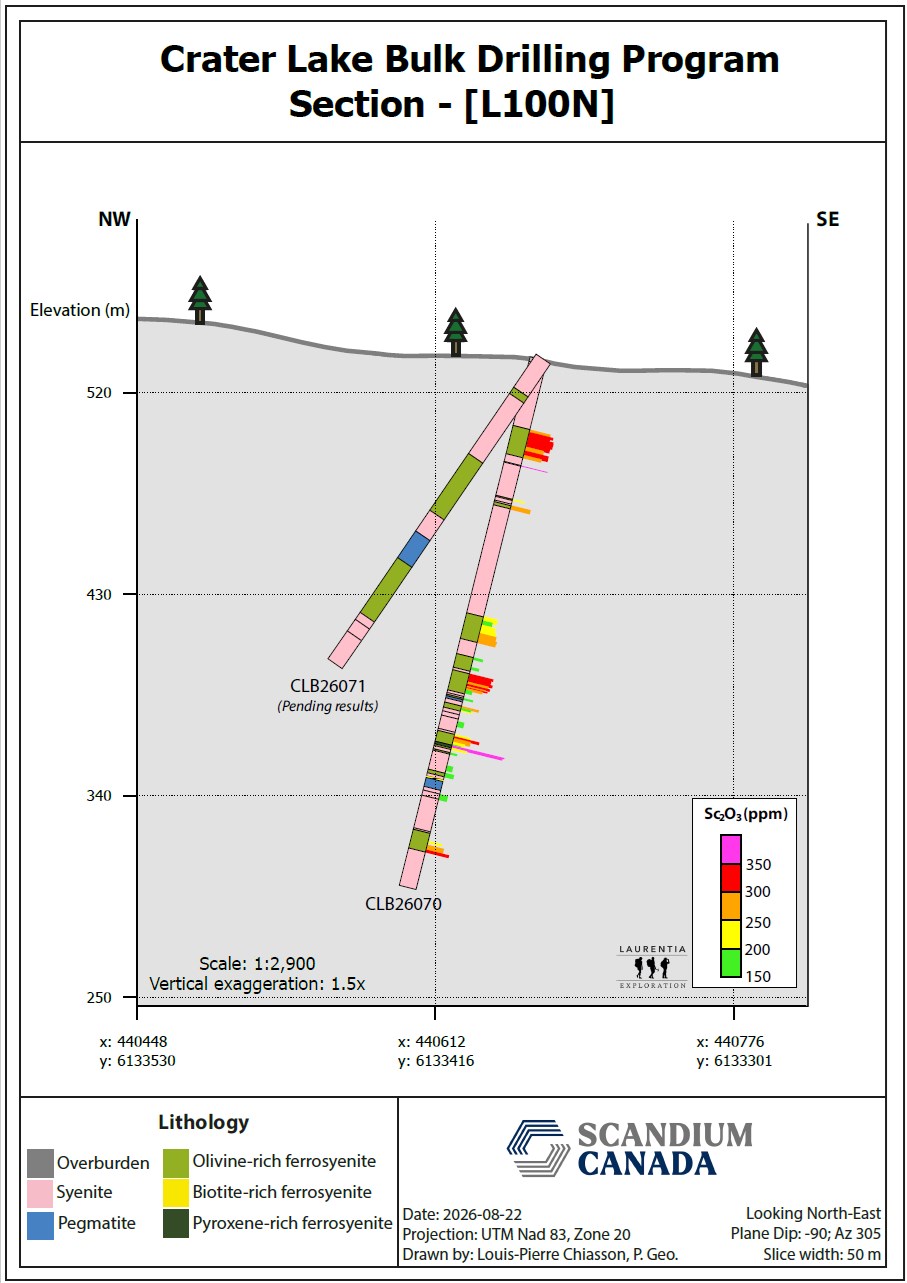
Figure 1.a : Section L100N
To view an enhanced version of this graphic, please visit:
https://images.newsfilecorp.com/files/12191/311576_c9dfa98c341cc81c_002full.jpg 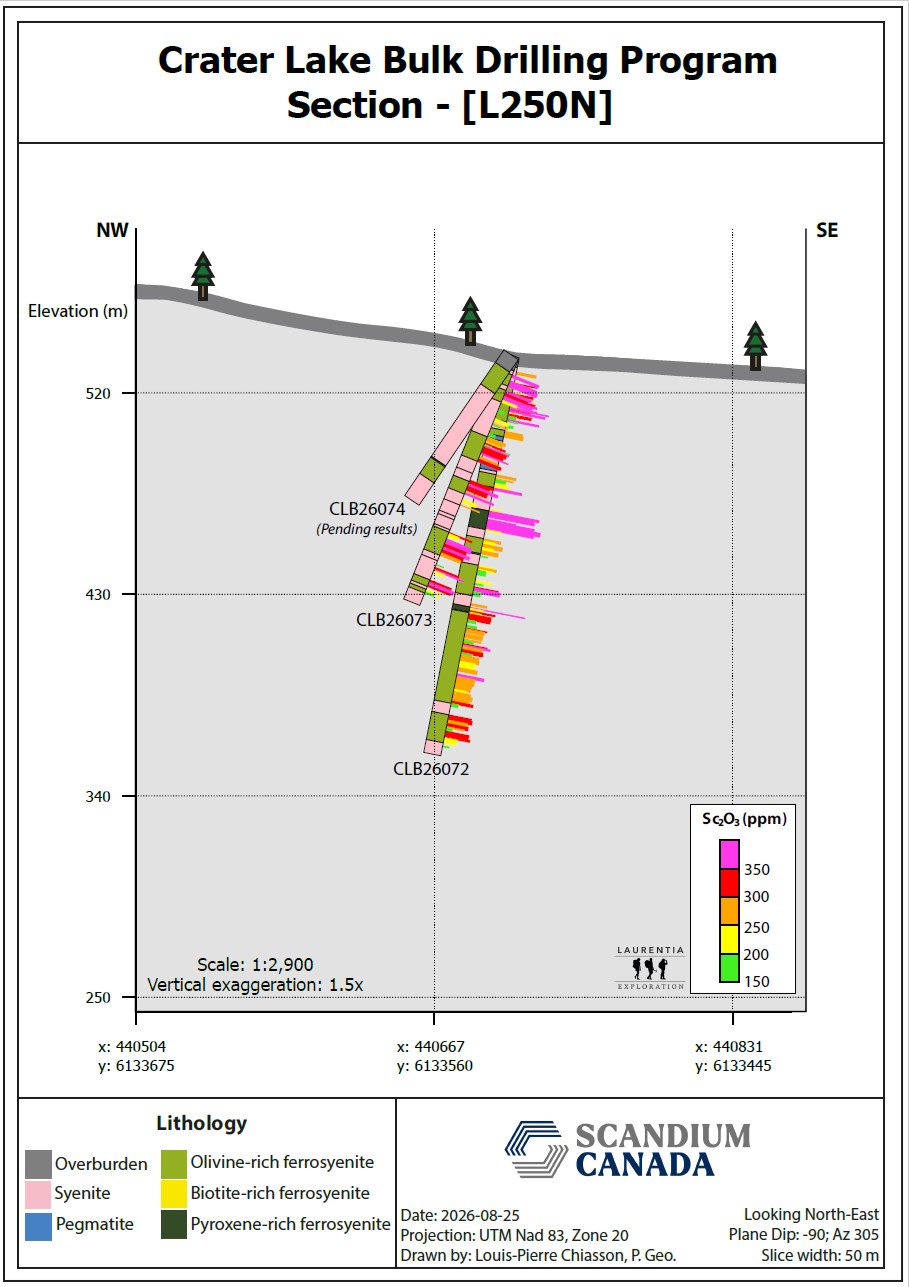
Figure 1.b : Section L250N
To view an enhanced version of this graphic, please visit:
https://images.newsfilecorp.com/files/12191/311576_c9dfa98c341cc81c_003full.jpg
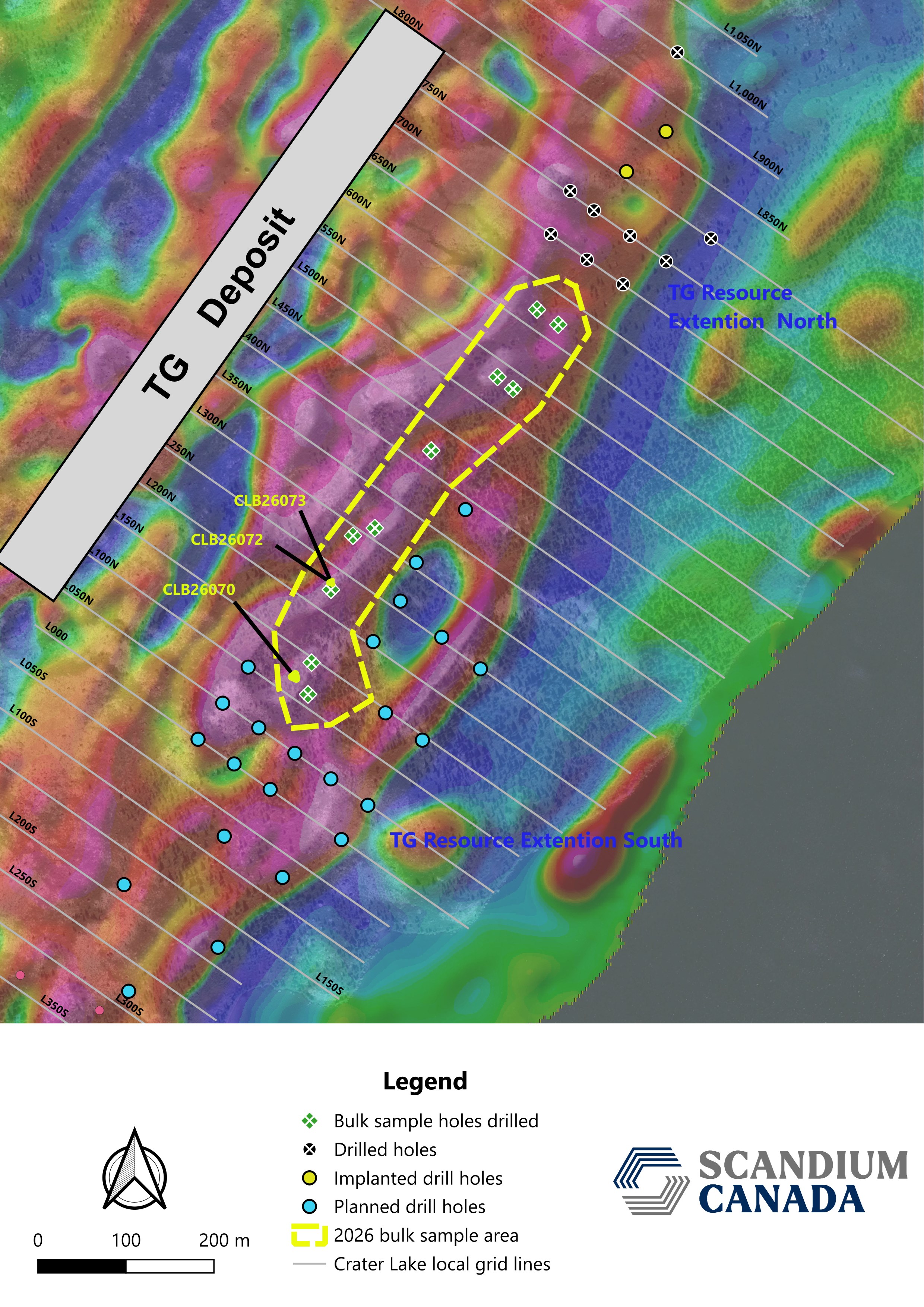
Figure 1.c: Map of the 2026 campaign drill holes, update from the last press release
To view an enhanced version of this graphic, please visit:
https://images.newsfilecorp.com/files/12191/311576_c9dfa98c341cc81c_004full.jpg
With the drilling for the representative bulk sample now completed, the campaign continues, to demonstrate the lateral continuity of the TG deposit and to test the mineral potential of the exploration targets between the Discovery Area and the current TG deposit southern limit.
High-resolution magnetic survey
During the summer of 2026, the Company completed a new high-resolution drone magnetic survey covering, among other areas, the STG and Discovery zones, the TG deposit and its southern and northern extensions, the north of the TG zone and the North Zone (see Figure 2).
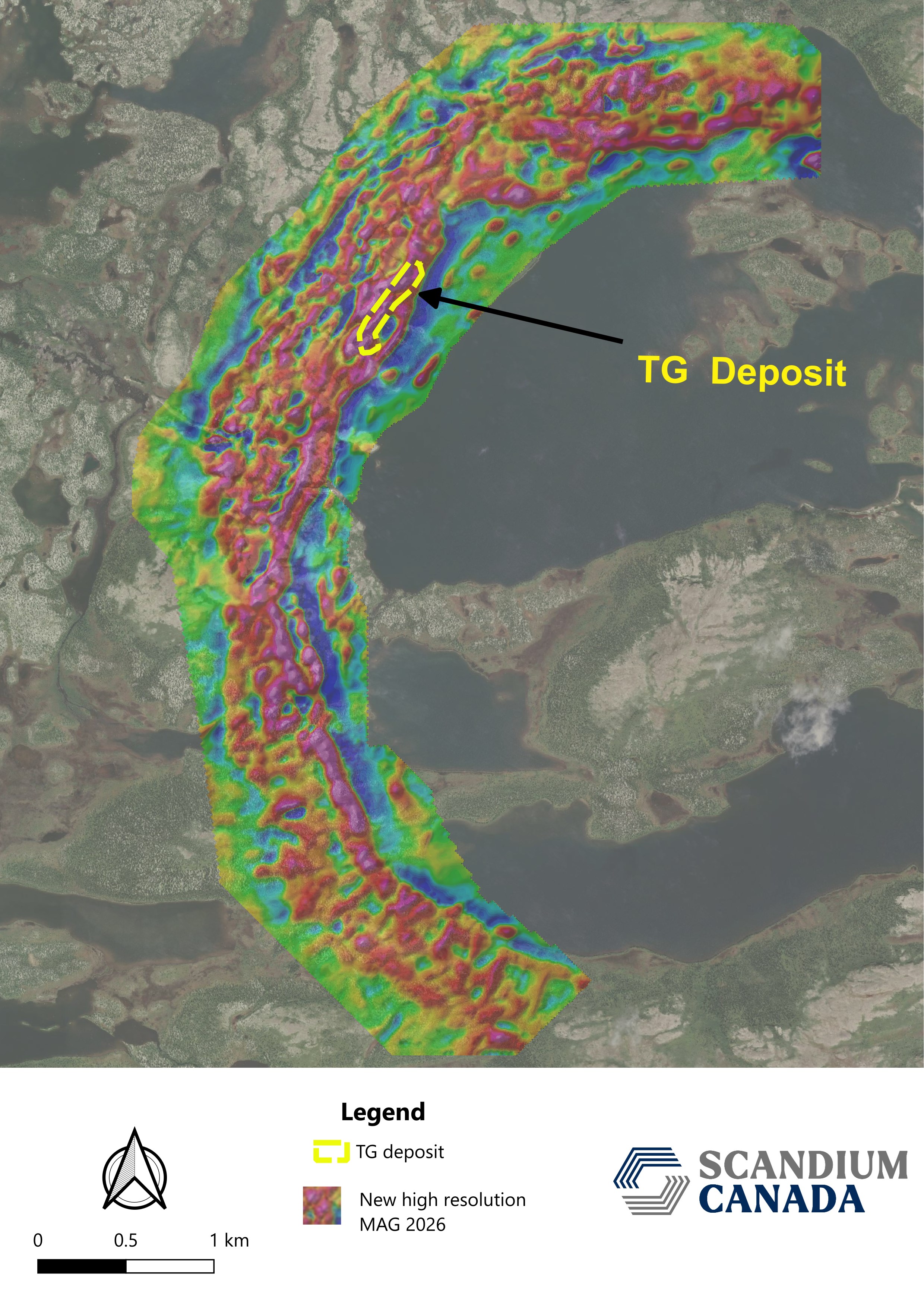
Figure 2: New 2026 high-resolution MAG survey on a satellite image base
To view an enhanced version of this graphic, please visit:
https://images.newsfilecorp.com/files/12191/311576_c9dfa98c341cc81c_005full.jpg
The survey brought out magnetic signatures that are corroborated by the drilling completed to date on the TG, Discovery, STG and North Zone areas. It supports the interpretation of a corridor of favorable host rocks running close to 3 km, from the southern limit of the Discovery zone through the TG deposit to the northern limit of the TG zone.
The most important result of the campaign to date is the survey itself. It gives a far sharper picture of the property and lets the Company place and orient its drill holes more precisely. Those holes are aimed at confirming the lateral extensions of the TG deposit, at supporting the exploration drilling under way, and at finding or confirming scandium anomalies in the Discovery and STG areas and across the Crater Lake property.
On the strength of this interpretation, the Company has adjusted its 2026 drilling program to prioritize resource extension holes. It has added 24 exploration holes to test the magnetic corridor from the south of the TG zone and the Discovery Area to the northern extension of the deposit and of the TG zone, as well as the ground at depth below the TG resource. It has also added 2 extension and infill holes on the East flank, together with a line of 3 further resource extension holes designed to extend the resource of the northern extension of the TG deposit by another 50 m. The new MAG survey, combined with historical drilling data, also refined the positioning of the 15 resource expansion holes already planned. About 4,500 meters of drilling remain to be completed in 2026.
Next steps: Updated Mineral Resource Estimate and Preliminary Economic Assessment
Because of the drilling results received to date and the effect they will have on the resources of the TG deposit, management has decided to postpone the pre-feasibility study originally planned for the summer of 2026.
Alongside the drilling campaign, additional metallurgical work identified significant optimizations to the process, which is now less costly and less complex than first contemplated. Management has also determined that the scandium oxide plant should be built in the Schefferville region of Québec, preferably on a brownfield site of a former mining operation.
The time needed to finalize the acquisition of a site in that region and to complete metallurgical testing of the recommended optimized process supports completing a preliminary economic assessment (PEA) under NI 43-101, incorporating the resource update that will follow the end of the current drilling campaign in early November 2026.
The PEA will put a value on the TG deposit and allow the Company to discuss partnerships with current figures and defined logistics, without delaying the engineering work required for the studies that lead to a compliant feasibility study.
Standard engineering practice calls for a PEA that reflects the new technical and logistical elements of the project. The project will be based on a mine, with ore hauled to a concentrator and hydrometallurgical plant in the Schefferville region over a road of approximately 350 km. The Company notes that the Naskapi Nation of Kawawachikamach has begun consultation work on the construction of access roads on its territory.
Quote from the President and CEO
"In my view, advancing a Preliminary Economic Assessment at the appropriate stage of development creates greater long-term value than accelerating a pre-feasibility study that may not fully reflect the current scope and potential of the Crater Lake Project. A PEA incorporating updated and improved resource, process optimization, and infrastructure assumptions provides a more relevant basis for evaluating project economics and engaging potential strategic partners. This approach is particularly appropriate as Scandium Canada's near-term priority is to accelerate the commercialization of Scalium+'s aluminum-scandium alloys, thereby fostering sustainable market demand that can support the future development of the Crater Lake Project over the medium and long term," said Simon Thibault, President and Chief Executive Officer, Scandium Canada
Sampling, analysis, quality assurance and quality control (QA/QC)
Strict QA/QC procedures, compliant with the disclosure requirements of National Instrument 43-101 and with industry best practice, were applied to sample handling for the Crater Lake project, including the insertion of certified reference materials (standards), duplicates and blanks at regular intervals through the sequence of samples. A total of 429 drill core samples, and 26 QA-QC samples made up of OREAS certified standards and blanks, were sent to Activation Laboratories Ltd. All sample preparation and analytical work was carried out at its facilities in Ancaster, Ontario. Several analytical techniques were used to characterize the samples, which Actlabs combines in the analytical package "8-REE". The package covers whole-rock and trace element analysis. Whole-rock analyses are performed by crushing and fusing the sample with lithium metaborate/tetraborate to ensure total decomposition, then analyzed by ICP-OES and ICP-MS.
Qualified Person
The scientific and technical information contained in this press release has been reviewed and approved by Eric Kinnan, P.Geo. (OGQ No. 00788), an independent consulting geologist and a Qualified Person as defined by National Instrument 43-101 - Standards of Disclosure for Mineral Projects. Mr. Kinnan has reviewed the data disclosed herein and has verified the information through examination of the project database, geological records, assay certificates, and the applicable quality assurance and quality control (QA/QC) protocols and procedures.
About Scandium Canada Ltd.
Scandium Canada (TSXV: SCD) is a critical advanced materials company developing North America's only vertically integrated primary source of scandium, from its Crater Lake project in Nunavik, Québec, to aluminum-scandium (Al-Sc) alloy products. Through Scalium+, its wholly owned commercialization subsidiary, the Company brings proprietary, patent-pending Al-Sc alloys and the Scalium® line of alloys and technologies to market today, while advancing the Crater Lake mining project for the future. This dual-engine strategy positions Scandium Canada to anchor a secure, resilient North American scandium supply chain and to shape the future of lighter, stronger and longer-lasting materials for advanced manufacturing end users, while committing itself to building a more responsible economy through innovation and agility.
Forward-looking statements
This news release contains forward-looking information within the meaning of applicable Canadian securities laws, including, without limitation, statements regarding the results and the completion of the 2026 drilling program, the interpretation of geophysical data, the completion and timing of an updated mineral resource estimate, the completion and timing of a preliminary economic assessment and of a feasibility study, the acquisition of a site for the hydrometallurgical plant and concentrator, the access road project, the development of the Crater Lake project and, generally, the above "About Scandium Canada Ltd." paragraph which essentially describes the Company's outlook.
Forward-looking statements are necessarily based upon a number of estimates and assumptions that, while considered reasonable by the Company at the time such statements are made, are inherently subject to significant business, economic and competitive uncertainties and contingencies. These estimates and assumptions may prove to be incorrect. Many of these uncertainties and contingencies can directly or indirectly affect, and could cause, actual results to differ materially from those expressed or implied in any forward-looking statements, and future events could differ materially from those anticipated in such statements. A description of the assumptions used to develop such forward-looking information and a description of the risk factors that may cause actual results to differ materially from forward-looking information can be found in the Company's disclosure documents on the SEDAR+ website at www.sedarplus.ca.
By their very nature, forward-looking statements involve inherent risks and uncertainties, both general and specific, and risks exist that estimates, forecasts, projections and other forward-looking statements will not be achieved or that assumptions do not reflect future experience. Forward-looking statements are provided for the purpose of providing information about management's endeavours to develop the Crater Lake project and, more generally, its expectations and plans relating to the future. Readers are cautioned not to place undue reliance on these forward-looking statements, as a number of important risk factors and future events could cause the actual outcomes to differ materially from the beliefs, plans, objectives, expectations, anticipations, estimates, assumptions and intentions expressed in such forward-looking statements. All of the forward-looking statements made in this press release are qualified by these cautionary statements and by those made in our other filings with the securities regulators of Canada. The Company disclaims any intention or obligation to update or revise any forward-looking statement or to explain any material difference between subsequent actual events and such forward-looking statements, except to the extent required by applicable law.
Neither the TSX Venture Exchange nor its Regulation Services Provider (as that term is defined in the policies of the TSX Venture Exchange) accepts responsibility for the adequacy or accuracy of this release.
FOR FURTHER INFORMATION, PLEASE CONTACT:
| Scandium Canada Ltd. Arnaud Bourassa Francoeur Director, Communications and Marketing Telephone: +1 (418) 609-4900 Email: info@scandium-canada.com | Website: www.scandium-canada.com LinkedIn: Scandium Canada Ltd. X: @ScandiumCanada Facebook: Scandium Canada Instagram: @scandiumcanada |

To view the source version of this press release, please visit https://www.newsfilecorp.com/release/311576
FAQ
AI-generated questions and answers. How Rhea-AI works. Not financial advice.