
Strategic Metals Identifies Eight Stacked Skarn Horizons Flanking Suspected Porphyry Target at Harry Project, Yukon
Surface sampling adds copper, zinc and tungsten results to a project previously explored for high-grade gold veins.
Sentiment and the balance of points
Rhea-AI Sentiment reads the wording of the document, how positive or negative its language is on a 1 to 5 scale. The balance of points shown with the takes weighs what the document actually discloses, so the two can disagree, for example when a trial that missed its main goal is described in upbeat language.
Rhea-AI Summary
Strategic Metals (SMDZF) identified eight stacked skarn horizons during its 2026 exploration program at the wholly owned Harry Project in Yukon. The mineralized rock layers span roughly 325 m of stratigraphy and range from approximately 2 m to 10 m thick. A 1,200 m by 700 m molybdenum soil anomaly marks a suspected porphyry target associated with a buried intrusion.
Continuous chip sampling returned 0.11% copper over 10.80 m in horizon 4 and 0.12% copper and 0.47% zinc over 8.70 m in horizon 5. Horizon 7 returned 0.16% copper and 219 ppm tungsten over 2.00 m. Northwest horizon 4 returned 103 ppm tungsten, 47 ppm tin and 22 ppm molybdenum over 14.40 m. Strategic interprets the geochemistry and stockwork-veined rock fragments as evidence of a nearby, unexposed intrusive source; the buried intrusion remains conceptual.
Positive
- Minor pointEight stacked skarn horizons identified across roughly 325 m of stratigraphy at wholly owned Harry.
- Minor point1,200 m by 700 m molybdenum soil anomaly outlines a suspected porphyry target.
- Minor pointHorizon 5 returned 0.12% copper and 0.47% zinc over 8.70 m, including 0.16% copper over 3.80 m.
- Minor pointHorizon 4 returned 0.11% copper over 10.80 m, including 0.19% copper over 4.00 m.
- Minor pointHorizon 7 returned 0.16% copper and 219 ppm tungsten over 2.00 m.
5 minor points
- Minor pointNorthwest horizon 4 returned 103 ppm tungsten, 47 ppm tin and 22 ppm molybdenum over 14.40 m.
- Minor pointSeparate horizon 5 interval returned 0.27% copper, 16 ppm bismuth and 8.6 ppm tellurium over 2.40 m.
- Minor point2015 selective grab samples returned 5.49–31.3 g/t gold in four of six samples from historical trenches.
- Minor pointBest 2015 sample also returned 95.3 g/t silver and 4.46% copper.
- Minor pointYukon Mineral Exploration Program funding supported the 2026 work at Harry.
Negative
- Minor pointBuried intrusion and porphyry target remain interpretations based on surface geochemistry and rock fragments.
- Minor pointHorizon 5 sampling includes a 4 m unexposed gap before the separate 2.40 m interval.
AI-generated analysis. How Rhea-AI works. Not financial advice.




VANCOUVER, BC / ACCESS Newswire / October 14, 2026 / Strategic Metals Ltd. (TSXV:SMD) ("Strategic" or the "Company") is pleased to announce results from its 2026 exploration program at the Company's wholly-owned Harry Project, located 75 km southeast of Whitehorse and 12 km southeast of the community of Tagish. Mapping and prospecting at Harry have outlined eight stacked, foliation-parallel skarn horizons within roughly 325 m of stratigraphy. Rock and soil geochemistry demonstrate a tungsten-tin-molybdenum signature that strengthens to the northwest and down-section, toward a suspected porphyry centre related to a buried intrusion. This target is marked by a strong, 1,200 m by 700 m molybdenum soil anomaly (Figure 1).
Previous work at Harry focused on high-grade gold in quartz-arsenopyrite veins along the Pennycook Shear Zone, located about 1.7 km north of the skarn occurrences. The shear is 10 to 25 m wide, strikes east, dips steeply, and has been traced for about 1,700 m by historical trenching, drilling and electromagnetic surveys. In 2015, four of six selective grab samples collected by Strategic from the historical trenches returned 5.49 to 31.3 g/t gold. The best sample, from semi-massive arsenopyrite in smoky quartz, also returned 95.3 g/t silver and
The skarn horizons range from approximately 2 m to 10 m in thickness and parallel foliation in a volcaniclastic sequence (Figure 2). The skarns consist of garnet, diopside and epidote with pyrrhotite and chalcopyrite. Dykes of various compositions cut the skarnified sequence, while angular float of felsic hypabyssal dyke containing abundant drusy stockwork quartz veins occurs within the molybdenum-in-soil anomaly to the northwest. In 2026, continuous chip samples were collected across several of the skarn horizons. Results are reported in the table below as length-weighted averages. (Skarn thicknesses have not yet been confirmed by drilling and true widths are estimated from surface exposures).
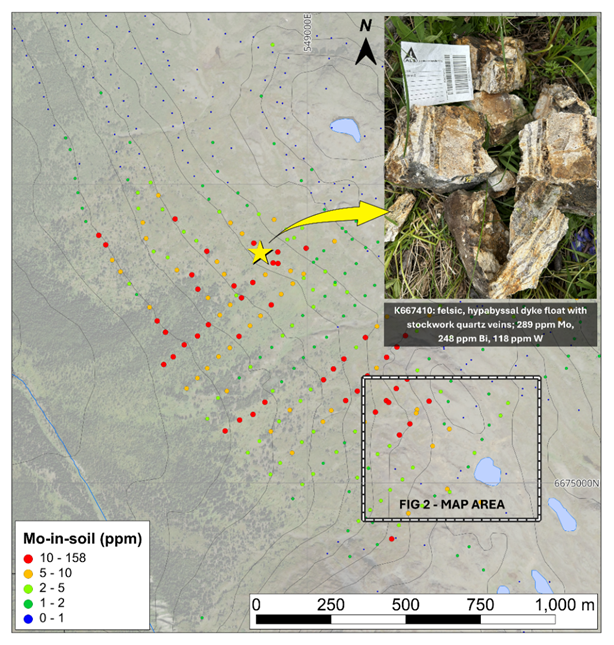
Figure 1 - Molybdenum-in-soil geochemistry, showing the location of float sample K667410 (inset photo) and the area of Figure 2.
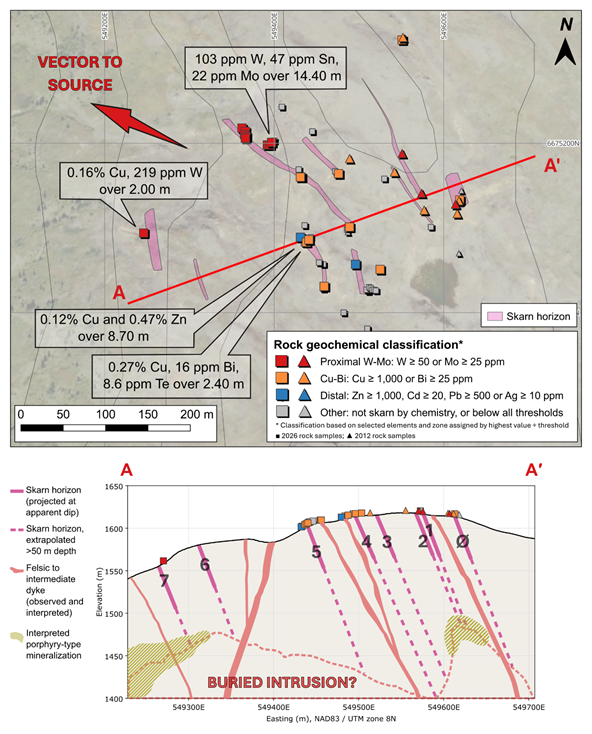
Figure 2 - Skarn horizons and rock geochemistry. Plan view (top) with selected chip sample results, and conceptual cross-section A-A′ looking north-northwest (bottom) showing the interpreted buried intrusion and porphyry-type target. Skarn horizons are numbered Ø (uppermost) to 7 (lowest) identified to date.
Skarn Horizon | Location | Highlight |
| 4 | Northwest end | 103 ppm W, 47 ppm Sn, 22 ppm Mo over 14.40 m |
| 4 | Central | |
including | ||
| 5 | Central | |
including | ||
| 5 | Central, beyond 4 m unexposed gap | |
| 7 | Lowest horizon identified |
The geochemistry at Harry follows the zoning expected around an intrusion-related skarn system. Elevated values of tungsten, tin and molybdenum in rocks mark the highest-temperature, most proximal assemblage. Copper, bismuth and tellurium sit in an intermediate zone, while zinc, cadmium and indium, typical of more distal positions, are locally enriched. The uppermost horizon is distinguished by coarse garnet, tin-tungsten enrichment and overprinting copper-bismuth sulphides, suggesting higher-temperature and lower-temperature stages are telescoped at this location. Section A-A′ (Figure 2) shows a conceptual interpretation of the horizons and a possible intrusion at depth.
Molybdenum in soil correlates with tungsten, tin and bismuth, as well as potassium, rubidium, cesium and thallium, consistent with alteration around an evolved felsic intrusion. A float sample of a molybdenum-bismuth-tungsten-bearing stockwork dyke lies within the anomaly and suggests a nearby, unexposed intrusive source. Together, the size of the molybdenum anomaly, its alkali-element association and the stockwork-veined felsic float suggest a porphyry-type target associated with a buried intrusion beneath the soil anomaly.
The geochemical signature at Harry shares several features with the Late Cretaceous Surprise Lake plutonic suite, which outcrops near Atlin, B.C., about 75 km to the south-southeast. The suite hosts the Ruby Creek (Adanac) porphyry molybdenum deposit, as well as nearby tin and tungsten skarns, and is broadly coeval with the Casino suite of west-central Yukon. Casino-aged porphyry occurrences are typically copper-gold-molybdenum systems, extending northwesterly from the Aishihik Lake area of southwestern Yukon into east-central Alaska.
Strategic gratefully acknowledges the financial support of the Government of Yukon, Department of Energy, Mines and Resources, through the Yukon Mineral Exploration Program (YMEP), which supported the 2026 work at Harry.
Analytical work at Harry was performed by ALS Minerals, with sample preparation in Whitehorse, Yukon, and assays and geochemical analyses completed in North Vancouver, British Columbia. Rock and soil samples were analyzed for gold by 30 g fire assay with an inductively coupled plasma-atomic emission spectroscopy finish (Au-ICP21), and for 51 elements by aqua regia digestion with inductively coupled plasma-mass spectrometry and atomic emission spectroscopy finishes (ME-MS41).
Technical information in this news release has been approved by Strategic's Vice President Exploration, Jackson Morton, P.Geo., a qualified person as defined under the terms of National Instrument 43-101.
About Strategic Metals Ltd.
Strategic is a project generator with 28 royalty interests, 8 projects under option to others, and a portfolio of approximately 70 wholly owned projects that are the product of over 50 years of focussed exploration and research by a team with a track record of major discoveries. Projects available for option, joint venture or sale include drill-confirmed prospects and drill-ready targets with high-grade surface showings and/or geochemical anomalies and geophysical features that resemble those at nearby deposits.
Strategic has a current cash position of approximately
ON BEHALF OF THE BOARD
"W. Douglas Eaton"
President and Chief Executive Officer
For further information concerning Strategic or its various exploration projects please visit our website at www.strategicmetalsltd.com or contact:
Corporate Information
Strategic Metals Ltd.
W. Douglas Eaton
President and C.E.O.
Tel: (604) 688-2568
Investor Inquiries
Richard Drechsler
V.P. Communications
Tel: (604) 687-2522
NA Toll-Free: (888) 688-2522
rdrechsler@strategicmetalsltd.com
http://www.strategicmetalsltd.com
Neither the TSX Venture Exchange nor its Regulation Services Provider (as that term is defined in the policies of the TSX Venture Exchange) accepts responsibility for the adequacy or accuracy of this release.
This news release may contain forward looking statements based on assumptions and judgments of management regarding future events or results that may prove to be inaccurate as a result of exploration and other risk factors beyond its control, and actual results may differ materially from the expected results.
SOURCE: Strategic Metals Ltd.
View the original press release on ACCESS Newswire
FAQ
AI-generated questions and answers. How Rhea-AI works. Not financial advice.
What did Strategic Metals identify at the Harry Project in 2026?
Strategic Metals identified eight stacked skarn horizons within roughly 325 m of stratigraphy. Surface sampling returned copper, zinc and tungsten results, while a 1,200 m by 700 m molybdenum soil anomaly marks a suspected porphyry target associated with a buried intrusion.
How were Strategic Metals' Harry Project samples analyzed?
ALS Minerals prepared samples in Whitehorse and completed assays and geochemical analyses in North Vancouver. Rock and soil samples underwent 30 g fire assay for gold and aqua regia digestion for 51 elements, followed by instrumental analysis.