
Smith+Nephew’s REGENETEN◊ Bioinductive Implant shows post-operative recovery times halved, and high healing rates for partial-thickness rotator cuff tears1,*
Smith+Nephew (NYSE:SNN) reported randomized controlled trial results showing the REGENETEN Bioinductive Implant halved early post‑operative recovery times versus traditional suture anchor repair for partial‑thickness rotator cuff tears.
Sentiment and the balance of points
Rhea-AI Sentiment reads the wording of the document, how positive or negative its language is on a 1 to 5 scale. The balance of points shown with the takes weighs what the document actually discloses, so the two can disagree, for example when a trial that missed its main goal is described in upbeat language.
Rhea-AI Summary
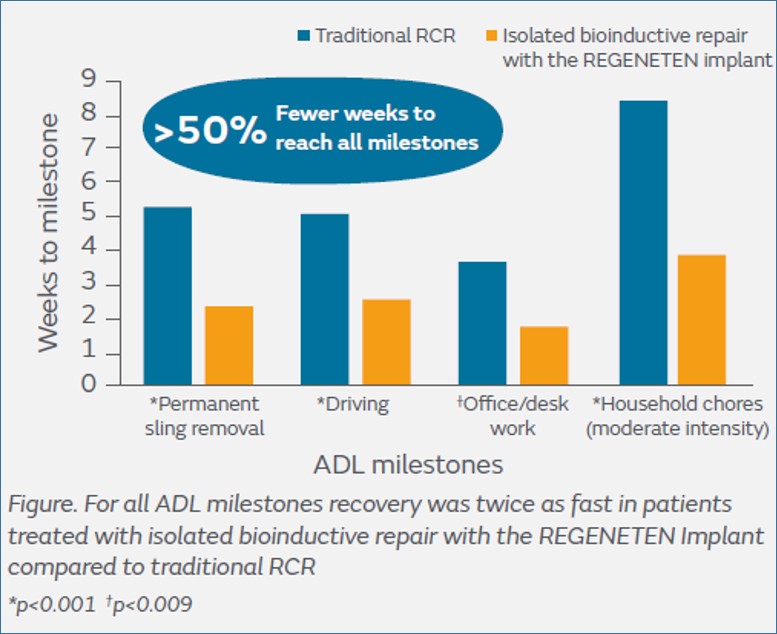
Smith+Nephew (NYSE:SNN) reported randomized controlled trial results showing the REGENETEN Bioinductive Implant halved early post‑operative recovery times versus traditional suture anchor repair for partial‑thickness rotator cuff tears. Driving: 2.3 vs 5.1 weeks; office work: 1.7 vs 3.6 weeks; household chores: 3.8 vs 8.4 weeks (all p≤0.009).
The study found better quality of life at 6 weeks and 3 months and high tendon healing rates at 12 months comparable to standard repair; rehabilitation protocols differed between groups.
Positive
- Early recovery times halved versus traditional repair
- Driving recovery reduced to 2.3 weeks from 5.1 weeks
- Office work return in 1.7 weeks vs 3.6 weeks
- High 12‑month tendon healing rates comparable to anchors
- 250,000 procedures performed globally since 2014
Negative
- Study groups used different, faster post‑op rehabilitation with implant
- Rehabilitation protocol difference may confound early recovery comparisons
Details
News Market Reaction – SNN
On Apr 9, the day this news came out, SNN closed 0.30% above the previous close.
Data tracked by StockTitan Argus for the Apr 9 session.
Key Figures
- Return to driving
- 2.3 vs 5.1 weeks
- Early recovery time REGENETEN vs suture anchor repair
- Return to office work
- 1.7 vs 3.6 weeks
- Recovery time REGENETEN vs suture anchor repair
- Household chores recovery
- 3.8 vs 8.4 weeks
- Moderate-intensity chores REGENETEN vs suture anchor repair
- Driving p-value
- p<0.001
- Return-to-driving comparison between treatment groups
- Office work p-value
- p=0.009
- Return-to-office work comparison between groups
- Procedures completed
- >250,000 procedures
- Global REGENETEN Bioinductive Implant use since 2014
- QoL timepoints
- 6 weeks and 3 months
- Better quality-of-life outcomes vs comparator
- Healing assessment
- 1 year
- High tendon healing rates on 12‑month MRI
Historical Context
-
Launch of ALLEVYN COMPLETE CARE advanced foam dressing for wound management.
-
Showcasing orthopaedic handheld robotics and trauma technologies at AAOS 2026.
-
Featuring REGENETEN implant and Tendon Seam Repair System at AAOS 2026.
-
Exclusive US distribution agreement for A’TOMIC Nitinol Fixation System.
-
Distribution agreement adding SI-BONE’s iFuse TORQ trauma and fusion portfolio.
24h Move is the share-price change in the day after each event; other market factors may also have contributed.
Key Terms
randomized control trial medical
bioinductive implant medical
rotator cuff medical
arthroscopic rotator cuff repair medical
mri medical
510(k) premarket notification regulatory
AI-generated analysis. How Rhea-AI works. Not financial advice.




Results from the first-ever randomized control trial for the REGENETEN Implant in partial-thickness rotator cuff repair
Smith+Nephew (LSE:SN, NYSE:SNN), the global medical technology company, today announces compelling new randomized control trial (RCT) data confirming significant outcome improvements for patients with partial-thickness rotator cuff tears treated with the REGENETEN Bioinductive Implant in isolation.1,*
Compared with a traditional suture anchor repair, early recovery time was halved1 for patients returning to daily activities such as:
- Driving: 2.3 vs 5.1 weeks (p<0.001)1,**
- Office work: 1.7 vs 3.6 weeks (p=0.009)1,**
- Moderate-intensity household chores: 3.8 vs 8.4 weeks (p<0.001)1,**
The study, recently published in the Orthopaedic Journal of Sports Medicine, also concluded that REGENETEN Implant patients enjoyed a better quality of life at 6 weeks and 3 months, and high rates of tendon healing at 1 year, comparable to suture anchor-based repairs.1 This is the third RCT demonstrating that the REGENETEN Bioinductive Implant improves outcomes versus traditional rotator cuff repair techniques.2-7
“We conducted a randomised controlled study of patients with symptomatic partial-thickness rotator cuff tears and found that those patients treated with the tendon sparing REGENETEN Bioinductive Implant recovered functional independence much faster than patients treated with standard surgery,” said Dr. Allan Wang, Clinical Professor of Orthopedic Surgery at the University of Western Australia. “Time to sling removal, return to driving, office duties, and household tasks all occurred sooner with the REGENETEN Bioinductive Implant. Importantly, these milestones were achieved without an increase in patients’ pain and without compromise in rotator cuff tendon healing on 12-month MRI scans. This study marks an important shift in the evolving standard of care for partial-thickness rotator cuff tears.”
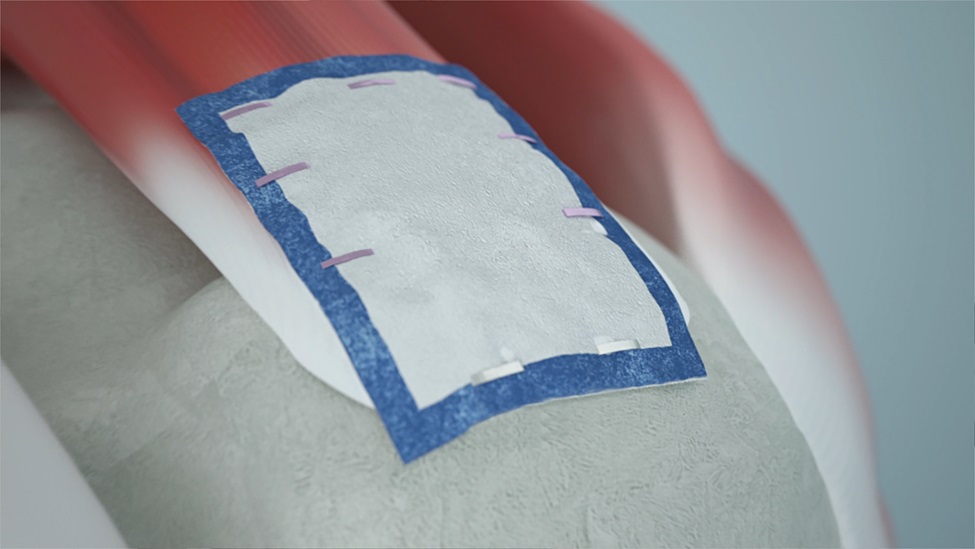
With more than 250,000 procedures8 completed globally since its introduction in 2014, the REGENETEN Bioinductive Implant has had a transformative impact, offering a better solution for thousands of patients with rotator cuff injuries every year.9 The collagen-based implant supports the body’s natural healing response to facilitate the formation of new tissue to biologically augment repairs.2-5, 10
This evidence follows the recent revision to the American Academy of Orthopaedic Surgeons Clinical Practice Guideline on the ‘Management of Rotator Cuff Injuries’ which highlights the value of bioinductive implants in rotator cuff repair based on an independent analysis of studies.
The REGENETEN Bioinductive Implant is part of Smith+Nephew’s comprehensive Advanced Healing Solutions portfolio – redefining biological healing in rotator cuff repair. To learn more about the REGENETEN Bioinductive Implant, please click here.
- ends –
Media Enquiries
Dave Snyder +1 (978) 749-1440
Smith+Nephew david.snyder@smith-nephew.com
* Compared with standard arthroscopic rotator cuff repair
** Rehabilitation protocols differed between treatment groups: isolated REGENETEN Bioinductive Implant use employed a faster post-op rehab protocol vs traditional repair
References
- Wang A, et al. Orthop J Sports Med. 2026;14(3):23259671261418675.
- Bokor DJ, et al. Muscles, Ligaments Tendons J 2016;6(1):16-25.
- Bokor DJ, et al. Muscles, Ligaments Tendons J 2019;9(3):338-347.
- Ruiz Iban MA, et al. Arthroscopy. 2025;41(10):3869-3879.
- Ruiz Iban MA, et al. Arthroscopy. 2024;40(6):P1760-1773.
- American Academy of Orthopedic Surgeons (AAOS). Rotator Cuff Repair Clinical Practice Guideline. Available at: https://www.aaos.org/quality/quality-programs/rotator-cuff/. [Accessed August 2025].
- Camacho Chacón et al. J Shoulder Elbow Surg. 2024;33(9):1894-1904.
- Smith+Nephew. Internal Data.
- FDA. 510(k) Premarket Notification: K242631 [Accessed May 2025]
- Arnoczky SP, et al. Arthroscopy. 2017;33(2):278-283.
About Smith+Nephew
Smith+Nephew is a portfolio medical technology business focused on the repair, regeneration and replacement of soft and hard tissue. We exist to restore people’s bodies and their self-belief by using technology to take the limits off living. We call this purpose ‘Life Unlimited’. Our 17,000 employees deliver this mission every day, making a difference to patients’ lives through the excellence of our product portfolio, and the invention and application of new technologies across our three global business units of Orthopaedics, Sports Medicine & ENT and Advanced Wound Management.
Founded in Hull, UK, in 1856, we now operate in around 100 countries, and generated annual sales of
For more information about Smith+Nephew, please visit www.smith-nephew.com and follow us on X, LinkedIn, Instagram or Facebook.
Forward-looking Statements
This document may contain forward-looking statements that may or may not prove accurate. For example, statements regarding expected revenue growth and trading profit margins, market trends and our product pipeline are forward-looking statements. Phrases such as "aim", "plan", "intend", "anticipate", "well-placed", "believe", "estimate", "expect", "target", "consider" and similar expressions are generally intended to identify forward-looking statements. Forward-looking statements involve known and unknown risks, uncertainties and other important factors that could cause actual results to differ materially from what is expressed or implied by the statements. For Smith+Nephew, these factors include: conflicts in Europe and the Middle East, economic and financial conditions in the markets we serve, especially those affecting healthcare providers, payers and customers; price levels for established and innovative medical devices; developments in medical technology; regulatory approvals, reimbursement decisions or other government actions; product defects or recalls or other problems with quality management systems or failure to comply with related regulations; litigation relating to patent or other claims; legal and financial compliance risks and related investigative, remedial or enforcement actions; disruption to our supply chain or operations or those of our suppliers; competition for qualified personnel; strategic actions, including acquisitions and disposals, our success in performing due diligence, valuing and integrating acquired businesses; disruption that may result from transactions or other changes we make in our business plans or organisation to adapt to market developments; relationships with healthcare professionals; reliance on information technology and cybersecurity; disruptions due to natural disasters, weather and climate change related events; changes in customer and other stakeholder sustainability expectations; changes in taxation regulations; effects of foreign exchange volatility; and numerous other matters that affect us or our markets, including those of a political, economic, business, competitive or reputational nature. Please refer to the documents that Smith+Nephew has filed with the U.S. Securities and Exchange Commission under the U.S. Securities Exchange Act of 1934, as amended, including Smith+Nephew's most recent annual report on Form 20-F, which is available on the SEC’s website at www. sec.gov, for a discussion of certain of these factors. Any forward-looking statement is based on information available to Smith+Nephew as of the date of the statement. All written or oral forward-looking statements attributable to Smith+Nephew are qualified by this caution. Smith+Nephew does not undertake any obligation to update or revise any forward-looking statement to reflect any change in circumstances or in Smith+Nephew's expectations.
◊ Trademark of Smith+Nephew. Certain marks registered in US Patent and Trademark Office.

FAQ
AI-generated questions and answers. How Rhea-AI works. Not financial advice.