
Slam Mobilizes Drill Team to Moose Lake, Intersecting Broad Zones of Brecciated and Altered Rock With Visible Stibnite Along the Moose Lake Fault Zone
Visible antimony mineralization extends below the Moose Lake trenches, but drill assays remain pending and broken ground stopped both holes.
Sentiment and the balance of points
Rhea-AI Sentiment reads the wording of the document, how positive or negative its language is on a 1 to 5 scale. The balance of points shown with the takes weighs what the document actually discloses, so the two can disagree, for example when a trial that missed its main goal is described in upbeat language.
Rhea-AI Summary
SLAM Exploration (SXLXF) has drilled two holes at Moose Lake after moving its drill team from the completed Goodwin campaign. The holes total 224.5 core meters, with visible stibnite, an antimony mineral, in altered and fractured rock. Assays for 145 samples are pending. Both holes stopped in highly broken ground while still in altered rock; ML26-02 ended at 147.5 meters in quartz veining with traces of stibnite.
Selected Skull trench grab samples returned 3.73%, 1.38% and 1.14% antimony after re-analysis. Separate Skull samples returned up to 1.965 grams per tonne gold and 73.5 grams per tonne silver. Grab samples may not represent the property's mineralization. SLAM plans follow-up drilling at Skull and further testing of Moose Lake's approximately 850-meter antimony-bearing breccia. Goodwin drilling totaled 3,349 core meters across 19 holes, with 235 assay results pending.
Positive
- Minor pointMoose Lake drilling completed 224.5 core meters across two holes, encountering visible stibnite below trenched areas.
- Minor pointML26-01 intersected altered, fractured rock with visible sulphide minerals, including stibnite, from 5.0 to 77.0 meters.
- Minor pointML26-02 encountered altered rock with stibnite from 5.0 to 57.6 meters, continuing in altered breccia to 147.5 meters.
- Minor pointSkull trench grab samples returned re-analyzed antimony grades of 3.73%, 1.38% and 1.14%.
- Minor pointSkull sample L458057 returned 1.965 grams per tonne gold and 39.6 grams per tonne silver.
8 minor points
- Minor pointSkull sample L458056 returned 73.5 grams per tonne silver and 1.090 grams per tonne gold.
- Minor pointMoose Lake selected grab samples included two above 1.00% antimony.
- Minor pointMoose Lake sample M188448 returned 0.735 grams per tonne gold and 13.6 grams per tonne silver.
- Minor point. Forward-looking: it has not happened yet and may not happen.Follow-up plans include Skull drilling and further testing of approximately 850 meters of antimony-bearing Moose Lake breccia.
- Minor pointGoodwin's completed campaign comprised 19 holes totaling 3,349 core meters.
- Minor pointGoodwin hole GW26-29 returned 0.968% copper-equivalent over 29.85 core meters, calculated using 95% recovery.
- Minor pointGoodwin hole GW26-33 returned 1.533% copper-equivalent over 14.45 core meters, calculated using 95% recovery.
- Minor pointGoodwin's new sulphide discovery in GW26-36 returned 0.448% copper-equivalent over 42.5 core meters, using 95% recovery.
Negative
- Minor pointMoose Lake's 145 drill samples await assays; the reported drill observations do not establish grades.
- Minor pointHighly broken ground stopped both Moose Lake holes while they remained in altered and brecciated rock.
- Minor pointSelective grab samples may not represent the mineralization on the property.
- Minor pointSkull mineralized horizons measured in trenches were 20 to 30 centimeters wide.
- Minor pointGoodwin has 235 assay results pending for holes GW26-37 to GW26-43.
AI-generated analysis. How Rhea-AI works. Not financial advice.


MIRAMICHI, NB / ACCESS Newswire / October 23, 2026 / SLAM Exploration Ltd. (TSXV:SXL)(OTCQB:SXLXF) ("SLAM" or the "Company") is pleased to announce that the Drill Team has mobilized to the Company's Moose Lake Gold-Antimony-Silver Project following completion of the 2026 Goodwin Copper-Nickel-Cobalt drill campaign. Two NQ diamond drill holes, ML26-01 and ML26-02 were drilled along the Moose Lake Fault Zone beneath antimony bearing trenches completed by the Company.
"Our trenching crews have exposed antimony mineralization at two separate occurrences along the Moose Lake Fault Zone, both being hosted within a silicified breccia," said Jimmy Gravel, President and CEO of SLAM. "At Moose Lake, we have antimony in trenches and outcrop over roughly 850 meters, and at Skull we see high-grade antimony sitting next to gold- and silver-rich quartz. With the Goodwin program complete, the rig has moved onto a fault system with known mineral occurrences that has seen little historical exploration or drilling".
Figure 1: Moose Lake Drilling: Left side highlighting visible stibnite mineralization within altered and silicified host rock. Right: Fault induced broken core with abundant quartz veining in a brecciated matrix from drillhole ML26-02.
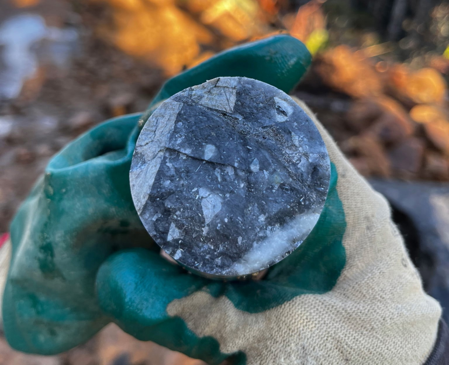 | 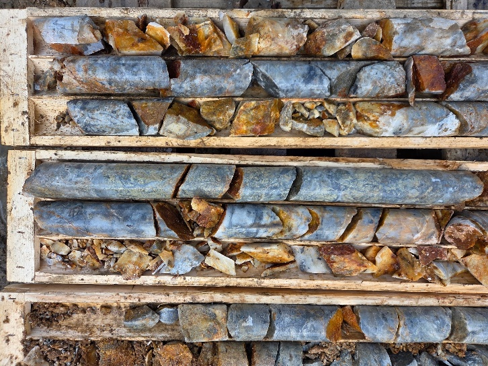 |
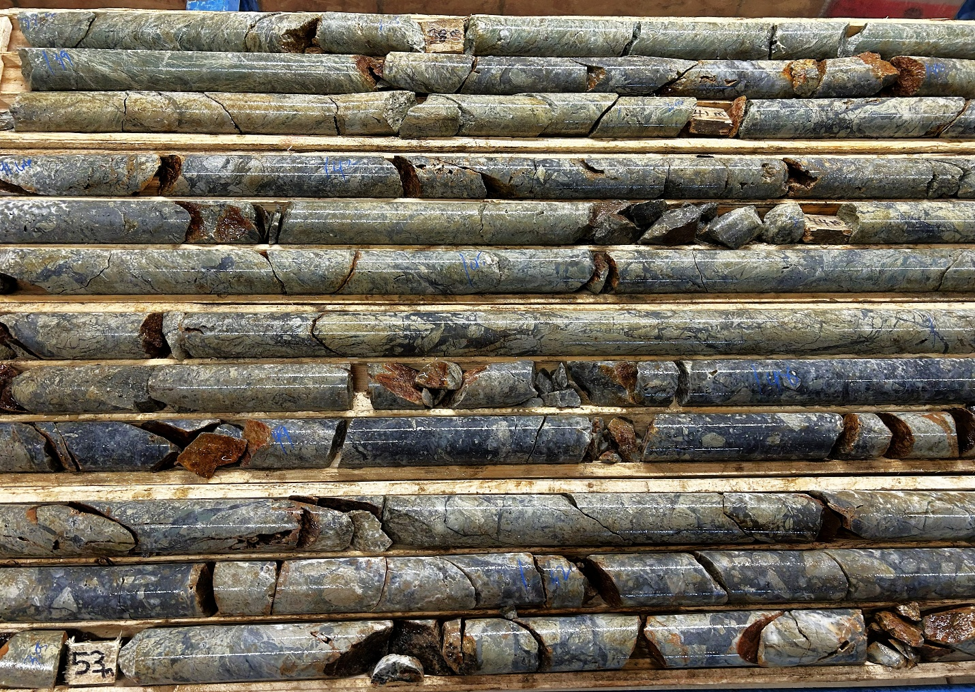
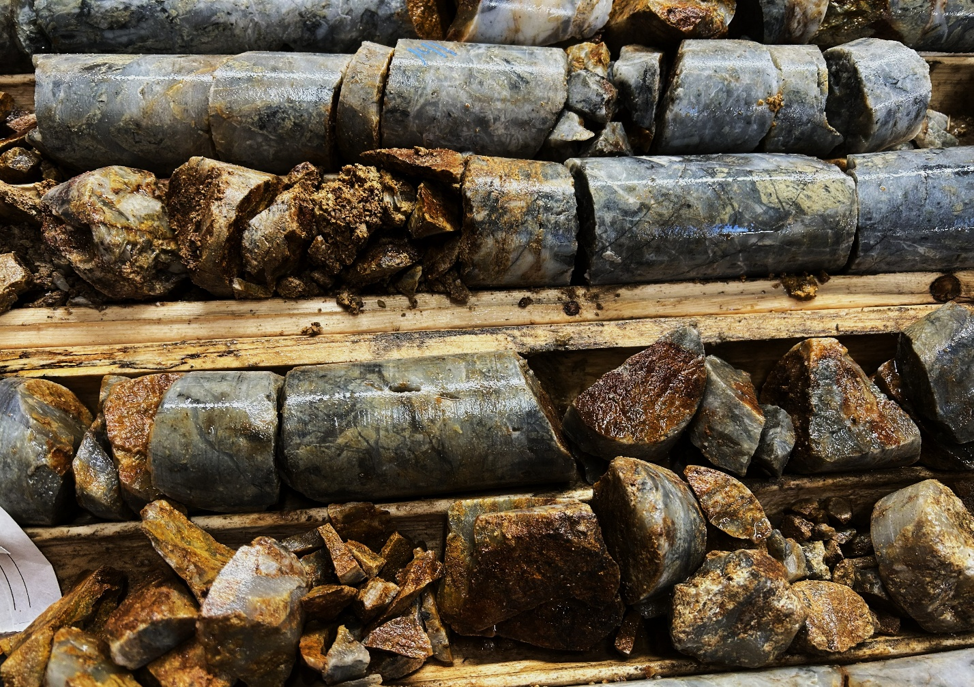
Drilling has currently intersected faulted and brecciated altered rock containing visible pyrite, arsenopyrite and stibnite. A total of 224.5 core meters has been drilled over 2 core-holes with 145 samples collected for ICP-Multi element analysis and Gold Assay by Fire Assay. Assay results are currently pending. Both holes were collared near previously trenched areas exposing mineralized brecciated rock containing gold, silver, and antimony. Drill collar information is present in Table 1.
Table 1 Moose Lake 2026 Drill Collar Information
| Hole | Easting | Northing | Elevation (m) | Azimuth | Dip | Length (m) |
| ML26-01 | 697714 | 5231693 | 446 | 20° | -60° | 77.0 |
| ML26-02 | 697894 | 5231645 | 450 | 70° | -70° | 147.5 |
Coordinates are UTM NAD83 Zone 19, located by handheld GPS.
The drilling follows up on the 2026 trenching and sampling program, which exposed antimony, gold and silver mineralization at both the Skull and Moose Lake occurrences along the northwest-trending Moose Lake Fault Zone.
Highlights of the 2026 drilling program to date include:
- Hole ML26-01 intersected brecciated, fractured and altered metasedimentary rocks visible pyrite, arsenopyrite and stibnite from 5.0 meters to the end of the hole at 77.0 meters, including a fault zone with clay gouge and graphite between 25.0 and 32.3 meters.
- Hole ML26-02 intersected strongly brecciated, clay and sericite-altered rock with pyrite, arsenopyrite and stibnite from 5.0 to 57.6 meters, including strong silicification and quartz flooding from 51.4 to 57.6 meters. The hole continued intersecting heavily altered and brecciated rock to the end of the hole at 147.5 meters.
- Both holes were stopped in highly broken ground while still in altered and brecciated rock; ML26-02 ended in a brecciated quartz vein with traces of pyrite and stibnite.
"The initial observations from the Moose Lake drilling show that the brecciated, altered and stibnite-bearing rock we mapped in the trenches carries on below surface," said Jimmy Gravel, President and CEO of SLAM. "Both holes stayed in altered breccia with sulphides from near surface to the bottom of the hole, and ML26-02 was still in quartz veining with stibnite when ground conditions forced us to stop. With antimony in trenches over roughly 850 meters at Moose Lake and high-grade antimony next to gold- and silver-rich quartz at Skull, we look forward to the assay results from this fault system, which has seen very little drilling. Antimony is a critical mineral."
2026 Trenching and Sampling Results
Results for 61 grab samples have been received to date from the 2026 trenching and prospecting program: 47 samples (35 trench and 12 outcrop) from the Moose Lake occurrence and 14 trench samples from the Skull occurrence. Initial results from the Skull trenches were reported on September 22, 2026. Three Skull samples that originally reported above the antimony detection limit have since been re-analyzed using the Sb-ICP08 method and returned
Table 2 Moose Lake Occurrence - Selected Trench and Outcrop Results
| Sample | Type | Easting | Northing | Gold g/t | Silver g/t | Antimony % |
| L458087 | Outcrop | 697886 | 5231651 | 0.126 | 1.9 | >1.00* |
| C960037 | Trench | 697607 | 5231765 | 0.005 | 1.1 | >1.00* |
| L458097 | Outcrop | 697842 | 5231683 | 0.091 | 2.0 | 0.938 |
| L458086 | Outcrop | 697882 | 5231651 | 0.057 | 0.9 | 0.824 |
| C960036 | Trench | 697652 | 5231741 | 0.005 | 0.3 | 0.810 |
| M188439 | Trench | 697893 | 5231650 | 0.031 | 0.7 | 0.741 |
| L458088 | Outcrop | 697935 | 5231645 | 0.031 | 1.2 | 0.536 |
| M188440 | Trench | 697912 | 5231645 | 0.020 | 1.8 | 0.518 |
| M188448 | Trench | 697767 | 5231695 | 0.735 | 13.6 | 0.0379 |
Table 3 Skull Occurrence - Selected Trench Results (Antimony >
| Sample | Type | Easting | Northing | Gold g/t | Silver g/t | Antimony % |
| L458064 | Trench | 694563 | 5233242 | 0.048 | 7.5 | 3.73 |
| L458052 | Trench | 694550 | 5233269 | 0.013 | 2.4 | 1.38 |
| L458051 | Trench | 694553 | 5233264 | 0.017 | 1.1 | 1.14 |
| L458057 | Trench | 694699 | 5233169 | 1.965 | 39.6 | 0.0232 |
| L458056 | Trench | 694702 | 5233173 | 1.090 | 73.5 | 0.0261 |
| L458058 | Trench | 694775 | 5233142 | 1.330 | 37.9 | 0.0172 |
| L458059 | Trench | 694764 | 5233120 | 0.227 | 60.7 | 0.0145 |
*Easting and Northing are UTM coordinates in meters. Grab samples are selective by nature and may not be representative of the mineralization hosted on the property.
The Skull and Moose Lake trench areas are approximately 3.5 kilometers apart along the Moose Lake Fault Zone, which hosts three known antimony occurrences (Skull, Moose Lake and Stewart) over approximately 4.7 kilometers.
Geology of the Moose Lake Project
Located in the Bathurst Mining Camp, the Moose Lake Project covers three epithermal gold-antimony occurrences, the Skull, Moose Lake and Stewart, which are spatially associated with the northwest-trending regional Moose Lake Fault Zone and are spread along approximately 4.7 kilometers. The fault appears to act as a pathway for epithermal fluids, containing highly silicified breccia zones cut by quartz veining with visible stibnite and arsenopyrite. The breccia zones are commonly found along the contacts between sedimentary and granitic rocks.
At the Moose Lake occurrence, mineralization is hosted by a siliceous breccia composed of creamy, pale green cherty and steel-grey siliceous fragments in a fine-grained, grey to dark grey siliceous matrix, locally cut by quartz-vein stockwork. Stibnite occurs as disseminations, blebs, stringers and needles with arsenopyrite, together with minor pyrite and chalcopyrite. The mineralized breccia is accompanied by clay alteration and iron-carbonate alteration that weathers to distinctive yellow, orange and brown surfaces, and is locally in contact with fault gouge.
At the Skull occurrence, mineralization is hosted by smoky grey quartz and quartz breccia within silicified sedimentary rocks and possible felsic tuff-breccia, with iron-carbonate alteration on weathered surfaces. Mineralized horizons measured in the trenches are 20 to 30 centimeters wide, strike between 100° and 108° and dip steeply at approximately 80°, sub-parallel to the trend of the Moose Lake Fault Zone.
Mineralization Trends Along the Moose Lake Fault Zone
Initial results from the 2026 drill program outline several trends that will guide further exploration activities along the project:
- Continuity at depth: The first drill holes show that the brecciation, alteration and visible stibnite seen in the Moose Lake trenches continue below surface. ML26-02, drilled at -70°, remained in altered and veined breccia to a vertical depth of approximately 135 meters below the collar.
- Alteration as a vector: Strong silicification, brecciation, iron-carbonate, clay and sericite alteration accompany the mineralization at both occurrences and in drill core and provide mappable guides to the mineralized structure.
- Extension to the southeast: Contiguous to Moose Lake, SLAM's wholly owned Slacks Lake claim group covers a number of antimony anomalies detected in regional till surveys and associated with the Moose Lake Fault Zone, indicating potential for the mineralized trend to continue beyond the known occurrences.
Assay results from the 2026 trenching program have not only provided anomalous targets for drilling, but have identified the potential for metal zoning:
- Metal zoning: At Skull, the antimony-rich samples (
1.14% to3.73% Sb) are separated by roughly 150 to 230 meters from samples rich in gold and silver (up to 1.965 g/t Au and 73.5 g/t Ag) but low in antimony. At Moose Lake, mineralization to date is antimony-dominant with lower gold and silver. This separation of antimony-rich and gold-silver-rich material suggests metal zoning, which the Company intends to test with systematic sampling and drilling.
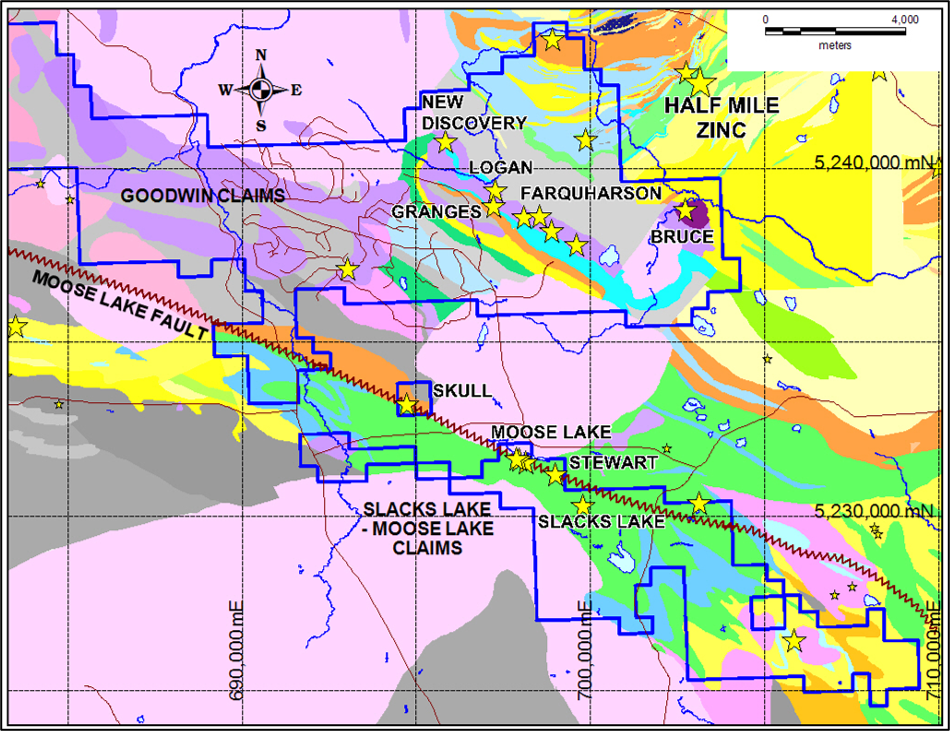
The Project covers 3,895 hectares, is road-accessible and is in close vicinity to SLAM's Goodwin Copper-Nickel-Cobalt Project. The mineral occurrences and claim boundaries for the Slacks Lake-Moose Lake project and for the Goodwin Copper-Nickel-Cobalt project are shown on Figure 2. Mineral occurrences and deposits are shown as yellow stars. The Moose Lake Fault Zone also transects the southern projection of the Goodwin claim group.
Next Steps
The drilling campaign is designed to test the continuity of the antimony-gold-silver mineralization exposed in the 2026 trenches below surface and along strike. Assay results from ML26-01 and ML26-02 will be integrated with the trenching results to guide follow-up drilling, including drilling beneath the high-grade antimony and gold-silver trenches at Skull to test the metal zoning observed at surface, and further testing of the approximately 850-meter antimony-bearing breccia at the Moose Lake occurrence. Results will be used to refine the structural model for the Moose Lake Fault Zone and to prioritize targets along the remainder of the 4.7-kilometer trend, including the Stewart occurrence.
The Moose Lake project was acquired through an option agreement dated March 30, 2026, as announced April 07, 2026.
Goodwin Project
The rig moved to Moose Lake after the Company completed 19 NQ-sized diamond drill holes totaling 3,349 core meters on the Goodwin copper-nickel-cobalt project between June and October 5th, 2026. A total of 235 assay results are pending at the time of this release for holes GW26-37 to GW26-43. Current highlights include 29.85 core meters grading
Exploration, Mining, and Petroleum Conference - EMP 2026
SLAM is excited to be taking part in the 51st annual Exploration, Mining, and Petroleum (EMP) Conference, hosted by the New Brunswick Department of Natural Resources. The conference runs from October 25th-27th, 2026 at the Delta Hotel by Marriott in Fredericton. The Company will be exhibiting at the conference trade show, with attendees encouraged to visit the booth to meet the SLAM team, and discuss the Company's exploration portfolio in New Brunswick, including the Moose Lake and Goodwin Projects. Mike Taylor, Chairman of the Board will also provide a company presentation on October 26th, 2026, at 11:48 AM; discussing the recent drilling and exploration successes.
Qualifying Statement
Mike Taylor, P.Geo., Chairman of the Board of SLAM Exploration Ltd., is a qualified person as defined by National Instrument 43-101 and has reviewed and approved the contents of this news release.
Sampling and QA/QC Procedures
Moose Lake drill core is NQ size and was logged by SLAM geologists. After logging, samples were sawn using a diamond blade. Sawn half-core samples were numbered, collected in bags, tagged, and delivered to ALS Chemex laboratory (ALS) in Moncton. ALS will perform multi-element analysis using ME-ICP41 and Gold Assay by Fire Assay. Quality control samples, comprising certified reference standards and blanks, were inserted at regular intervals in accordance with industry-standard protocols. All samples were collected, labelled and sealed by SLAM field personnel. Core is stored securely at the Company's core logging facility in Bathurst.
The Moose Lake trenching samples are collected from trenches and outcrops by SLAM field personnel. All samples were collected, labelled and sealed by SLAM field personnel then shipped to ALS Chemex laboratory (ALS) in Moncton. ALS will perform multi-element analysis using ME-ICP41 and Gold Assay by Fire Assay. Grab samples are selective by nature and the values reported may not be representative of the mineralization on the property. Additional assay results will be reported in subsequent news releases as they are received.
About SLAM Exploration Ltd.
SLAM Exploration Ltd. is a publicly listed resource company with a 40,000-hectare portfolio of mineral claim holdings in the mineral-rich province of New Brunswick. The portfolio is built around the Goodwin Copper Nickel Cobalt project in the Bathurst Mining Camp ("BMC") of New Brunswick. The Company also holds the Jake Lee gold project, where a new gold vein discovered in 2025 has returned up to 40.5 g/t gold and 63.30 g/t silver from channel samples, and the Menneval gold project, where a soil anomaly measuring approximately 3,000 by 2,500 meters has returned gold-bearing samples up to 0.683 g/t gold.
SLAM is a project generator and expects to receive further cash and share payments in 2026. In 2025, the Company received 1,200,000 shares plus cash from Nine Mile Metals Inc. (NINE) pursuant to the Wedge project agreement, and a cash payment of
To view SLAM's corporate presentation, click here. Additional information is available on SLAM's website and on SEDAR+ at www.sedarplus.ca. Follow SLAM on X @SLAMGold, and join the Company newsletter here to receive timely company updates and news releases.
Contact Information
Jimmy Gravel, President & CEO
902-273-2387 · jimmy@slamexploration.com
Mike Taylor, Chairman of the Board
506-623-8960 · mike@slamexploration.com
SEDAR+: 00012459
Forward-Looking Statements
This news release contains "forward-looking statements" and "forward-looking information" within the meaning of applicable Canadian securities laws. Forward-looking statements are not historical facts but instead represent management's expectations, estimates and projections regarding future events or circumstances, and are often identified by words such as "expects," "plans," "anticipates," "believes," "intends," "estimates," "projects," "potential," "may," "could," "would," "might," or "will," and similar expressions.
Forward-looking statements in this news release include, but are not limited to, statements regarding: the interpretation of drilling, trenching, sampling and till geochemical data at the Moose Lake and Slacks Lake properties; the inferred continuity of mineralization at depth and along strike of the Moose Lake Fault Zone, including toward the Stewart occurrence and the Slacks Lake claims; the potential for metal zoning and the Company's plans to test it; the anticipated receipt, timing and significance of pending assay results from Moose Lake and Goodwin; the scope and timing of follow-up drilling and other exploration; the Company's ability to satisfy the terms of the Moose Lake option agreement; copper-equivalent grades, including the recovery and metal price assumptions used to calculate them; and the significance of antimony as a critical mineral.
Forward-looking statements are based on assumptions that management believes are reasonable, including that geological interpretations, including interpretations based on visual observations of drill core, are reasonable; that pending assay results will be received within anticipated timeframes; that the assumed
Forward-looking statements involve known and unknown risks, uncertainties and other factors that may cause actual results, performance or achievements to differ materially from those expressed or implied, including the speculative nature of mineral exploration; the risk that exploration results, including pending assay results, may not confirm historical data or current interpretations; the risk that visual observations of sulphide mineralization are not confirmed by assay results; adverse ground, weather and seasonal conditions; the absence of metallurgical testwork supporting assumed recoveries; failure to satisfy the terms of the Moose Lake option agreement; volatility and limited market liquidity for antimony; uncertainty regarding the continuity, grade and extent of mineralization; delays or changes to exploration programs; availability and cost of labour, equipment and contractors; fluctuations in commodity prices; availability of financing on acceptable terms; regulatory, environmental and permitting risks; operating hazards; and general economic, market and business conditions. Additional risk factors are described in the Company's most recently filed Management's Discussion and Analysis and other continuous disclosure documents available under the Company's profile on SEDAR+.
Readers are cautioned not to place undue reliance on forward-looking statements. The Company does not undertake to update or revise any forward-looking statements, whether as a result of new information, future events or otherwise, except as required by applicable securities laws.
Neither the TSX Venture Exchange nor its Regulation Services Provider (as that term is defined in the policies of the TSX Venture Exchange) accepts responsibility for the adequacy or accuracy of this release.
SOURCE: SLAM Exploration Ltd.
View the original press release on ACCESS Newswire
FAQ
AI-generated questions and answers. How Rhea-AI works. Not financial advice.
What has SLAM Exploration found in its first Moose Lake drill holes?
SLAM's first two Moose Lake holes encountered altered and fractured rock containing visible stibnite, an antimony mineral, but assays remain pending. The holes total 224.5 core meters. Both stopped in highly broken ground while still in altered and brecciated rock.
What antimony grades did SLAM report from the Skull trenches?
Three Skull trench grab samples returned 3.73%, 1.38% and 1.14% antimony after re-analysis using the Sb-ICP08 method. These samples originally exceeded the antimony detection limit. Grab samples are selective and may not represent the property's mineralization.
What metal zoning does SLAM plan to test at Moose Lake and Skull?
SLAM intends to test whether the separation of antimony-rich material from gold- and silver-rich material reflects metal zoning. At Skull, those sample groups are roughly 150 to 230 meters apart; Moose Lake results to date are antimony-dominant with lower gold and silver. The company plans systematic sampling and drilling to test this interpretation.
How will SLAM use the Moose Lake drill assays to choose further targets?
SLAM plans to combine the drill assays with trenching results to guide follow-up drilling and refine its structural model for the Moose Lake Fault Zone. Target prioritization will extend along the remainder of the approximately 4.7-kilometer trend, including the Stewart occurrence.
How are SLAM's Goodwin copper-equivalent drill grades calculated?
The Goodwin copper-equivalent grades combine recovered copper, nickel and cobalt grades using a 95% recovery rate and metal prices published by Daily Metal Price on October 7, 2026. The new sulphide discovery in hole GW26-36 is located 2,000 meters northwest of the Logan zone.