STOCK TITAN

New Research: Why Enterprise Agentic AI Stalls Before It Scales

(Moderate)
(Neutral)
Tags
AI

Teradata (NYSE:TDC) released new global research on why enterprise agentic AI often stalls before scaling. The study of 1,000 senior technology and data leaders introduces an Agentic AI Maturity Index and highlights context fragmentation, weak data foundations, and low pilot-to-production conversion as key barriers.

Only 7% of enterprises report fully operationalized agentic AI with multi-step workflows and measurable impact, while most remain in early stages. Despite 90% planning to increase investments, 63% see only small or emerging ROI. The report proposes an “Autonomous Knowledge” approach, focusing on contextualized, governed, high-value data to enable organizational AI.

Loading...
Loading translation...

AI-generated analysis. How Rhea-AI works. Not financial advice.

Positive

  • None.

Negative

  • None.

What This Means

The study underscores that just 7% of enterprises have fully operationalized agentic AI and many pil...
Analysis

The study underscores that just 7% of enterprises have fully operationalized agentic AI and many pilots stall before production. In light of Teradata’s ongoing AI initiatives, execution on converting this demand into durable platform adoption remains a key watchpoint.

Key Figures

Survey sample size: 1,000 leaders Top maturity stage: 7% of enterprises Early-stage users: 68% of enterprises +5 more
8 metrics
Survey sample size 1,000 leaders Global senior technology and data leaders across six markets
Top maturity stage 7% of enterprises Reached Operationalizing stage of Agentic AI Maturity Index
Early-stage users 68% of enterprises Still in Experimenting or Developing stages for agentic AI
Planned AI investment 90% of leaders Expect to increase agentic AI investments over next 12 months
Limited ROI so far 63% of leaders Report only small or emerging positive returns on agentic AI
Well-contextualized data 77% say ≤20% Portion of enterprise data sufficiently contextualized for agents
Pilot failure rate 40% report >40% Share of AI pilots failing to reach production due to infrastructure limits
High pilot conversion 15% of organizations Successfully get 80% or more of AI pilots into production

Previous AI Reports

5 past events · Latest: Jun 02 (Positive)
Same Type Pattern 5 events
Date Event Sentiment 24h Move Catalyst
Jun 02 Leadership appointment Positive -0.9% Combined Chief Data and AI Officer and CIO roles under a single leader.
May 12 Industry recognition Positive -1.8% Rated Exemplary across seven ISG Buyers Guides categories for AI and data platforms.
Apr 21 AI customer momentum Positive +1.6% Highlighted over 150 AI-focused customer engagements completed during 2025 across industries.
Apr 14 Product launch Positive -1.1% Launched Analyst Agent on Microsoft Marketplace for AI-assisted analytics in Azure.
Apr 06 AI award recognition Positive +1.8% Named to the 2026 CRN AI 100 list in the AI Data and Analytics category.

24h Move is the share-price change in the day after each event; other market factors may also have contributed.

Pattern Detected

AI-themed announcements have often seen share moves diverge from their generally positive tone, with several past AI news days followed by modest declines.

Historical Comparison

-0.1% avg move · Across five recent AI-tagged announcements, Teradata’s typical next-day move was modest at about -0....
AI
-0.1%
Average Historical Move AI

Across five recent AI-tagged announcements, Teradata’s typical next-day move was modest at about -0.08%, with mixed alignment to upbeat news. This research-heavy AI study fits the theme of thought leadership rather than a discrete product or deal catalyst.

Recent AI-tagged news traces a progression from platform and agent launches through customer momentum and industry recognition, alongside leadership alignment around data and AI strategy.

Regulatory & Risk Context

Short Interest: 13.58%
Short Interest
13.58% of float
0% 15% 30%+
moderate as of 2026-06-15 Days to cover: 5.72

Short positioning appears elevated, implying room for sharper volatility and the potential for squeeze-like dynamics if sentiment or liquidity shifts abruptly.

Key Terms

agentic ai, organizational ai, agentic ai maturity index, autonomous knowledge
4 terms
agentic ai technical
"enthusiasm to deploy agentic AI is near-universal, foundational data systems"
Agentic AI refers to computer systems that can make their own decisions and take actions without needing someone to tell them what to do each time. It's like giving a robot a degree of independence to solve problems or achieve goals on its own, which matters because it could change how we work and interact with technology in everyday life.
organizational ai technical
"to organizational AI, which works on behalf of the whole company"
Artificial intelligence tools and systems designed to operate across a company's people, processes, and data to automate work, improve decisions, and coordinate activities. Like adding a smart assistant that learns how a business runs and helps teams do tasks faster or spot patterns, organizational AI can change how revenue, costs and risks behave by reshaping workflows, talent needs and data use. Investors care because those changes can affect productivity, margins, compliance exposure and competitive position.
agentic ai maturity index technical
"The report introduces the Agentic AI Maturity Index to track where organizations"
A composite score that measures how advanced and reliable an artificial intelligence system is at acting autonomously—planning, making decisions, learning from experience, and interacting with people or other systems. It combines technical factors such as autonomy, robustness, interpretability, and safety into a single rating so investors can gauge potential operational value, deployment complexity, competitive edge, and regulatory or oversight risks; think of it like a performance and safety rating for AI.
autonomous knowledge technical
"charts a path forward through what it calls Autonomous Knowledge — enterprise data"
Information or data that is organized, updated, and used by a system or process without needing constant human intervention; it enables machines or automated services to draw conclusions, make decisions, or perform tasks on their own. For investors, it matters because systems that rely on autonomous knowledge can scale, react faster to new inputs, and reduce manual costs—think of it like a self-updating reference book that a robot worker consults to do its job.

AI-generated analysis. How Rhea-AI works. Not financial advice.

See more from StockTitan in Google Search and AI answers. Adds StockTitan as a preferred source · opens Google
Add on Google

Study of 1,000 global senior technology and data leaders uncovers what's blocking enterprises from making the leap from personal AI to organizational AI
SAN DIEGO, July 7, 2026 /PRNewswire/ -- Teradata (NYSE: TDC) today released findings from a commissioned Wakefield Research study of 1,000 senior technology and data leaders across six global markets. The report, "Arrested Automation: Why Agentic AI Stalls at the Enterprise Level," finds that while enthusiasm to deploy agentic AI is near-universal, foundational data systems were not built for agents and need rethinking to deliver the ROI organizations expect.

Arrested Automation: Why Agentic AI Stalls at the Enterprise Level

Many of the hurdles outlined in the report (and summarized below) are easier to understand by recognizing the need to move from personal AI — tools like chatbots and writing assistants that help individuals work faster — to organizational AI, which works on behalf of the whole company using shared knowledge, appropriate access levels, and well-designed governance. The returns enterprises are chasing don't happen until AI operates at the organizational level.

The report introduces the Agentic AI Maturity Index to track where organizations stand on that journey and charts a path forward through what it calls Autonomous Knowledge — enterprise data with enough context, lineage, and governance for AI agents to act on it reliably at scale.

The Agentic AI Maturity Index: Where Enterprises Actually Stand
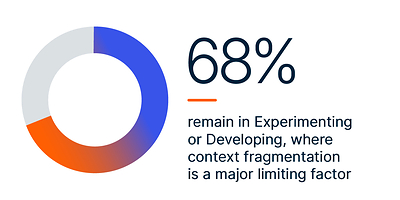
This four-stage framework maps where organizations stand: Experimenting, Developing, Building, and Operationalizing, which is where AI is executing multi-step workflows with measurable business impact. Currently, only 7% of the global enterprises have reached the final stage where tangible outcomes occur. The majority (68%) remain in Experimenting or Developing, where context fragmentation — when data exists but carries no usable meaning for agents — is a major limiting factor.

Notably, 69% of C-suite executives say their organization is already operating with agentic AI, while only 57% of VPs say the same.

Report Breadth: Industry and Country Comparisons
The report breaks down findings across industries including healthcare, financial services, IT, manufacturing, and retail, and across six markets: the United States, United Kingdom, France, Germany, Japan, and Saudi Arabia. The agentic AI challenge is a global phenomenon, but not a uniform one. The research points to several barriers.

The ROI Gap
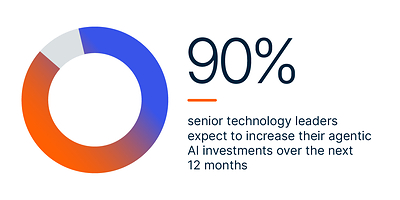
Nine in ten (90%)senior technology leaders expect to increase their agentic AI investments over the next 12 months; yet nearly two-thirds (63%)report they have seen no more than a small or emerging positive return on those investments to date. The gap between investment and returns is not a lack of ambition, but a data foundation that was built for human users, not autonomous AI agents.

"Individual productivity gains — faster code, better drafts, quicker research — are real benefits, but they don't show up on the P&L in a way that justifies significant infrastructure investment. The ROI executives expect requires agents operating at the organizational level: automating decisions, executing workflows, driving measurable business outcomes. Most organizations are measuring enterprise AI ROI against personal AI infrastructure — and wondering why the numbers don't add up."

-Louis Landry, Chief Technology Officer at Teradata

Context Fragmentation
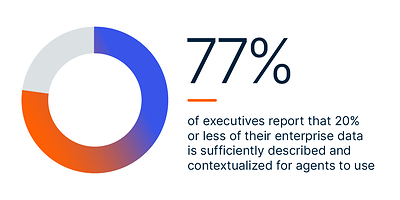
At the core of the agentic AI stall is context fragmentation: enterprise data that lacks the meaning, lineage, and governance AI agents need to act reliably across an organization. According to the report, 77% of executives report that 20% or less of their enterprise data is sufficiently described and contextualized for agents to use. And 78% find it challenging to unify data and knowledge across business functions so agents can reason across the full enterprise.

The top two barriers leaders cite — data lacking the necessary metadata, context, and relationships (43%) and data fragmented across systems that cannot be connected in real time (42%) — point to the same root problem. The challenge isn't how much data organizations have, but whether that data carries enough meaning to be trusted when agents use it. When it cannot, the pilot does not make it to production.40% of tech leaders report that more than 40% of their AI pilot projects fail to reach production because infrastructure systems were never built for autonomous use. Only 15% of organizations are successfully getting 80% or more of their AI pilots into production.

"The goal of contextualizing your entire data estate is likely the wrong goalpost, and chasing it is part of why organizations stall. Instead, identify the highest-value portion of your data, structured and/or unstructured, and focus on getting that portion fully described, governed, and agent-ready. If most of the data is unusable, the answer isn't to fix all of it at once. It's to be ruthlessly selective about where you start."

- Josh Fecteau, Chief Data and AI Officer & Chief Information Officer at Teradata

The Action Bridge
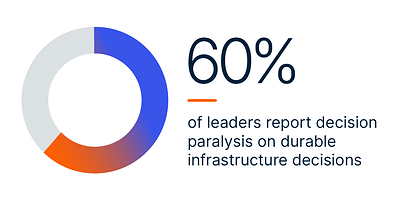
Even when organizations make progress on context fragmentation, implementing autonomous action is still hard. 60% of leaders report decision paralysis on durable infrastructure decisions. The hesitation may not be about technology selection (though 30% are worried about vendor lock-in) but instead a lack of trust in what's being deployed. Until organizations trust the data their agents are operating on, they won't let those agents act autonomously. 51% of leaders cite accuracy and reliability of outputs as a significant deployment barrier.

There is also a location problem. AI output currently lives outside the systems where consequential work actually happens. When intelligence is surfaced inside a tool or app where someone is already working, action follows. When it lives in a separate dashboard, it usually does not. Both problems stem from the same deficit: data that lacks enough context, lineage, and meaning to be trusted.

The Path Forward: Autonomous Knowledge
The report identifies Autonomous Knowledge as what organizations need to move from personal AI to organizational AI. It outlines a phased approach: audit and contextualize the highest-value portions of the data estate, embed governance directly into the data layer, and build for architectural portability. Organizations that have done this are already seeing returns. Those that have not are still waiting for their pilots to reach production.

About the Research
Arrested Automation: Why Agentic AI Stalls at the Enterprise Level was conducted by Wakefield Research on behalf of Teradata. The study surveyed 1,000 senior technology and data leaders at the vice president level or above, at companies with a minimum of 500 employees, across the United States (500), United Kingdom (100), France (100), Germany (100), Japan (100), and Saudi Arabia (100). Fieldwork was conducted between March 23 and April 5, 2026.

To download the full report, visit: https://www.teradata.com/insights/white-papers/why-agentic-ai-stalls-enterprise

About Teradata 
Teradata empowers enterprises to turn intelligence into autonomous action, grounding AI agents in deep business context and trusted data. As AI agents multiply, Teradata is the context foundation, governance layer, and performance backbone that companies need now. The Teradata Autonomous Knowledge Platform puts AI into production across cloud, on-premises, and hybrid environments.

The Teradata logo is a trademark, and Teradata is a registered trademark of Teradata Corporation and/or its affiliates in the U.S. and worldwide.

MEDIA CONTACT
January Machold
january.machold@teradata.com
Arrested Automation: Why Agentic AI Stalls at the Enterprise Level

Arrested Automation: Why Agentic AI Stalls at the Enterprise Level

Arrested Automation: Why Agentic AI Stalls at the Enterprise Level

Cision View original content to download multimedia:https://www.prnewswire.com/news-releases/new-research-why-enterprise-agentic-ai-stalls-before-it-scales-302818887.html

SOURCE Teradata

FAQ

What did Teradata (NYSE:TDC) announce in its July 7, 2026 agentic AI research?

Teradata announced new research explaining why enterprise agentic AI efforts often stall before scaling. According to Teradata, the Wakefield study of 1,000 senior leaders identifies data context, governance, and infrastructure gaps as core barriers, and introduces an Agentic AI Maturity Index and Autonomous Knowledge framework.

What is Teradata's Agentic AI Maturity Index and how many enterprises are operationalizing AI?

The Agentic AI Maturity Index maps organizations across four stages: Experimenting, Developing, Building, and Operationalizing. According to Teradata, only 7% of global enterprises have reached the Operationalizing stage, where agents run multi-step workflows with measurable business impact, while 68% remain in early Experimenting or Developing phases.

What ROI are leaders seeing from agentic AI investments according to Teradata's 2026 study (TDC)?

Leaders report limited returns so far from agentic AI investments. According to Teradata, 90% of senior technology leaders expect to increase spending within 12 months, yet about 63% say they have seen only small or emerging positive ROI, reflecting misaligned data foundations and personal versus organizational AI deployment.

How does context fragmentation hinder enterprise agentic AI in Teradata's TDC research?

Context fragmentation leaves enterprise data without enough meaning, lineage, or governance for agents to act reliably. According to Teradata, 77% of executives say 20% or less of their data is sufficiently contextualized, and 78% struggle to unify data and knowledge across business functions for cross-enterprise reasoning.

What does Teradata mean by Autonomous Knowledge in its 2026 agentic AI report?

Autonomous Knowledge refers to enterprise data enriched with context, lineage, and governance so agents can reliably act at scale. According to Teradata, the recommended approach is to audit and contextualize the highest-value data, embed governance in the data layer, and design architectures for portability across systems.

What did Teradata's study reveal about AI pilot project failure rates and production deployment?

Many AI pilots fail to reach production because infrastructure was not built for autonomous agents. According to Teradata, 40% of tech leaders say over 40% of their AI pilots never reach production, and only 15% of organizations successfully move 80% or more of pilots into production.

Which countries and industries were covered in Teradata's July 2026 agentic AI study (TDC)?

The research covered major industries including healthcare, financial services, IT, manufacturing, and retail. According to Teradata, the 1,000 surveyed leaders came from the United States, United Kingdom, France, Germany, Japan, and Saudi Arabia, all at companies with at least 500 employees.