Teledyne (NYSE:TDY) announced that its Space Imaging division deployed Speedster HyViSI Focal Plane Arrays aboard NASA's BlackCAT CubeSat, which launched on January 11, 2026 on SpaceX's Twilight rideshare.
Rhea-AI Sentiment reads the wording of the document, how positive or negative its language is on a 1 to 5 scale. The balance of points shown with the takes weighs what the document actually discloses, so the two can disagree, for example when a trial that missed its main goal is described in upbeat language.
CAMARILLO, Calif.--(BUSINESS WIRE)--
Teledyne Technologies Incorporated (NYSE:TDY), a leading provider of advanced imaging solutions, is proud to announce that its Space Imaging division has successfully deployed its cutting-edge Speedster HyViSI (Hybrid Visible Silicon Imager) Focal Plane Arrays (FPAs) aboard NASA’s BlackCAT CubeSat Mission. The mission launched on January 11, 2026, aboard SpaceX’s “Twilight” rideshare mission. The BlackCAT mission, led by the Pennsylvania State University and designed as an x-ray observatory within a CubeSat platform, will detect x-ray transient events, study bursts of x-rays from the collapse of early stars into black holes, and study the early universe using the sensitivity of Teledyne’s imager.
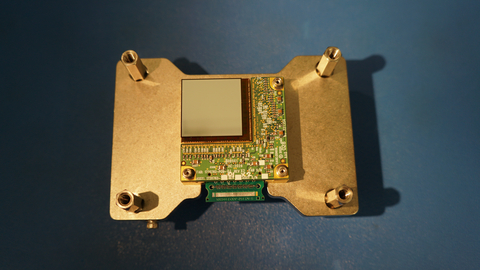
An example of the Speedster HyViSI (Hybrid Visible Silicon Imager) that is aboard BlackCat. Image courtesy of Teledyne Imaging Sensors.
The Speedster focal plane array, at the heart of the mission’s instrument and assembled in 2x2 mosaic, is integral to BlackCAT’s capability to observe some of the universe’s most energetic phenomena. Featuring a Si-PIN hybrid CMOS architecture, this detector is a leading X-ray detection technology for space application. Its highly efficient Si-PIN array ensures exceptional sensitivity to soft X-ray photons, while its Complementary Metal-Oxide Semiconductor (CMOS) functionality offers advantages such as the novel event-driven fast readout, low power consumption, and radiation-hard performance — making it an ideal choice for space-based X-ray applications.
“X-ray detection is the natural extension of Teledyne’s HyViSI technology applications,” commented by Dr. Yibin Bai, Director of FPA Development. “With its highly adaptable CMOS features and advanced absorber design, the Speedster HyViSI establishes itself as a high-performance alternative to other sensors for x-ray astronomy in space.”
Teledyne Space Imaging is a global leader in engineered and complex space solutions, manufacturing advanced electronics, imaging and sensor systems for operation in the growing global space economy.
About Teledyne Space Imaging
Teledyne Space Imaging has a long heritage of developing space-qualified imaging sensors, focal plane arrays and camera instrument systems for the world's foremost space agencies, NASA, ESA, JAXA, and KARI, collaborating on over 250 space projects. We deliver across a wide range of applications for institutional requirements through to commercial space specifications. Teledyne Space Imaging designs, tests and manufactures a range of CCD, CMOS, and IR detectors with optical filters, package options and close-proximity electronics to meet every performance requirement. For more information, visit Teledyne Space Imaging’s website at www.TeledyneSpaceImaging.com.
About Teledyne Technologies
Teledyne Space Imaging is part of Teledyne Technologies, a leading provider of sophisticated digital imaging products and software, instrumentation, aerospace and defense electronics, and engineered systems. Teledyne's operations are primarily located in the United States, Canada, the United Kingdom, and Western and Northern Europe. For more information, visit Teledyne's websites at www.teledyne.com.
A hybrid visible silicon imager is a camera sensor built by bonding a light-sensitive silicon layer that captures visible light to a separate electronic readout layer, combining the best of both pieces into one device. For investors, it signals potential advantages in image quality, speed, power use and manufacturing flexibility—factors that can affect product competitiveness, production cost and demand in markets like consumer cameras, smartphones and medical or industrial imaging. Think of it as a sandwich where each layer specializes in either seeing light or processing the signal, together making a better camera.
focal plane arraystechnical
An array of light-detecting elements placed at the spot where a lens focuses an image, converting photons into electrical signals that form pictures or measurements. Investors care because focal plane arrays determine a sensor’s sensitivity, resolution and speed—qualities that affect product performance, market competitiveness and potential sales in areas like satellites, defense, medical imaging and autonomous vehicles; better arrays can unlock new capabilities and higher margins.
cubesattechnical
A cubesat is a very small, standardized satellite about the size of a shoebox or smaller that carries simple instruments for tasks like communications, imaging, or testing new technology. Because cubesats cost far less and can be built and launched faster than traditional satellites—think of them as the startup-friendly version of a large spacecraft—they matter to investors as an affordable way to enter space markets, enable new services or data streams, and scale up constellations, while also carrying technical, regulatory and launch risks that affect potential returns.
complementary metal-oxide semiconductortechnical
A complementary metal-oxide semiconductor (CMOS) is a widely used technology for building the tiny electronic switches and sensors inside chips found in phones, cameras, computers and many devices. Think of it as a proven, energy-efficient blueprint for making large numbers of small electronic parts; its use affects a product’s battery life, cost, performance and manufacturing scale, which can influence revenue, margins and supply-chain risk for companies that make or use these chips.
x-ray photonstechnical
X-ray photons are tiny packets of very energetic light that can pass through tissues and many materials, creating images or enabling treatments by showing internal structure much like a strong flashlight that can see through cardboard. They matter to investors because they are the fundamental tool behind medical imaging, cancer therapies, security scanners and certain manufacturing inspections, so demand, regulation, safety rules and technological advances around x-ray systems directly affect companies’ revenue, costs and market prospects.