
Thesis Gold & Silver Identifies Two Distinct Porphyry Targets on the Lawyers-Ranch Project
Thesis Gold & Silver (OTCQX: THSGF) identified two distinct porphyry exploration targets at Ranch and Ranch East within its 100%‑owned Lawyers–Ranch project (Toodoggone district).
Sentiment and the balance of points
Rhea-AI Sentiment reads the wording of the document, how positive or negative its language is on a 1 to 5 scale. The balance of points shown with the takes weighs what the document actually discloses, so the two can disagree, for example when a trial that missed its main goal is described in upbeat language.
Rhea-AI Summary
Thesis Gold & Silver (OTCQX: THSGF) identified two distinct porphyry exploration targets at Ranch and Ranch East within its 100%‑owned Lawyers–Ranch project (Toodoggone district).
The 2025 program combined mapping, geochemistry and geophysics to define a lithocap with a Moly upflow zone at Ranch and an exposed inner‑propylitic, copper‑silver system at Ranch East. This adds upside to the project's December 2025 PFS (after‑tax NPV5% C$2.37B; 54.4% IRR; 1.1 year payback at US$2,900 gold).
Positive
- After‑tax NPV5% of C$2.37 billion reported in the 2025 PFS
- High IRR of 54.4% and 1.1 year payback in the PFS base case
- Two porphyry targets identified: lithocap/upflow at Ranch and inner‑propylitic at Ranch East
- Surface copper assays at Ranch East include 2.31% Cu and 1.76% Cu with 14.0 ppm Ag
Negative
- None.
Details
News Market Reaction – THSGF
On Mar 30, the day this news came out, THSGF closed 2.54% above the previous close.
Data tracked by StockTitan Argus for the Mar 30 session.
AI-generated analysis. How Rhea-AI works. Not financial advice.




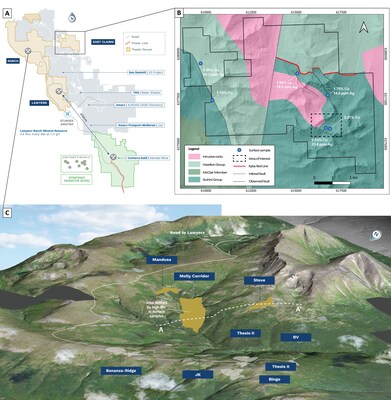
The 2025 exploration program focused on two priorities: advancing the understanding of near-surface, high-grade gold in areas such as Bingo, and Steve, and testing for porphyry potential at Ranch and Ranch East, a non-contiguous claim package 15 kilometres ("km") east of the Ranch resource area (Figure 1). Geological mapping, geochemical sampling, reinterpretation of alteration patterns, and insights from the 2025 drill program have identified two distinct porphyry exploration targets. The emerging porphyry potential identified by the Thesis geology team adds to an already strong project foundation established by the 2025 Prefeasibility Study (the "PFS") (see the news release dated Dec. 1, 2025, entitled "Thesis Gold Announces Positive Prefeasibility Study for Lawyers-Ranch Project: After-Tax NPV5% of
With metal prices currently well above those base-case assumptions, the project already carries meaningful economic upside. The newly identified porphyry targets at Ranch and Ranch East represent additional opportunity to expand the resource base at Lawyers–Ranch and highlight real potential for this project beyond the development case established in the PFS.
Key Highlights
- Two high-quality porphyry exploration targets identified within the Lawyers–Ranch project represent different exposure levels within the continuum of porphyry–epithermal systems:
- Ranch:
- The established resource is hosted in a well-developed high-sulfidation lithocap defined by silicic and advanced argillic alteration (alunite, pyrophyllite, dickite, pyrite)
- A major hydrothermal upflow zone at Moly Corridor was identified by targeting elevated molybdenum in surface samples and coincident resistivity and chargeability anomalies
- Well-developed silicic alteration and the presence of gusano textures and diatreme breccia supports proximity to a porphyry system
- Interpretation: Ranch lithocap is inferred to overlie a potential porphyry system at depth
- Ranch East:
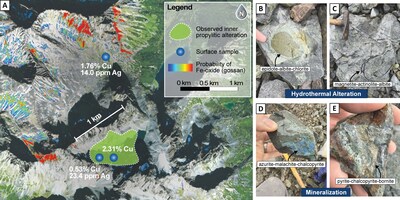
- Exposes high-temperature inner propylitic alteration at surface across a >1 km footprint
- Includes magnetite–actinolite veins with albite halos and clast-selective epidote alteration
- Surface grab sampling returned elevated copper and silver values, including:
2.31% Cu (bornite-bearing)1.76% Cu with 14.0 ppm Ag (chalcopyrite-bearing)
- Interpretation: consistent with exposure of deeper levels of a porphyry system
- Ranch:
- Exploration Implications: The presence of both lithocap-hosted and deeper porphyry-level alteration indicates potential for multiple porphyry systems within the Lawyers-Ranch district
- The target identified at Ranch underlies many existing shallow, high-grade gold targets
- During the 2026 field season, Thesis will continue the work to advance these drill targets in addition to critical-path data collection required for an upcoming Feasibility Study
Ewan Webster, President and CEO, commented, "The identification of two porphyry systems at different levels of exposure highlights the district-scale potential emerging at Ranch. Ranch East provides a rare window into deeper levels of a porphyry system, while Ranch preserves the upper lithocap portion of a similar system. Together, these observations significantly expand the exploration potential across the project area, provide compelling new targets for further exploration, and represent exciting upside to the mining scenario already established in our 2025 PFS."
Porphyry Exploration in a Magmatic-Hydrothermal System
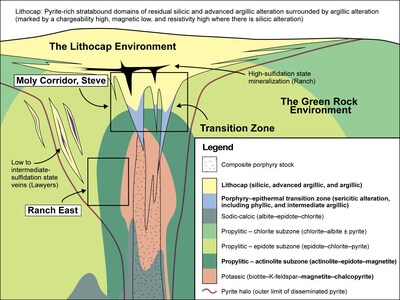
Porphyry–epithermal systems are characterized by predictable alteration patterns and overprinting relationships that can be used to vector toward mineralized intrusions at depth (Figure 2). At deeper levels, these systems commonly develop a domain of propylitic alteration (Figure 2: "The Green Rock Environment") that is zoned outward from a central intrusive complex. This alteration is characterized by mineral assemblages that transition from actinolite-bearing through epidote-dominant and outward into chlorite-altered rocks, reflecting a decrease in temperature away from the intrusion.
At shallow crustal levels, these systems may be overprinted by lithocaps consisting of silicic, advanced argillic, and argillic alteration, which may host high-sulfidation mineralization (Figure 2: "The Lithocap Environment"). The Ranch resource area is characterized by the features that define a Lithocap environment.
The Green Rock and Lithocap environments are separated by a sericite-dominated transition zone, characterized by phyllic and intermediate argillic alteration. This zone represents the interface between lithocap and porphyry environments (Figure 2: "Transition Zone"). Identifying this transition zone, and particularly where hydrothermal fluids were focused, is critical for vectoring toward a porphyry intrusion at depth.
Ranch Lithocap: High-Sulfidation System Above a Potential Porphyry
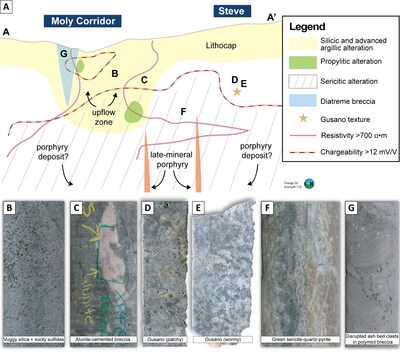
Within the Ranch area, high-sulfidation deposits like at Bonanza-Ridge, BV, and the Thesis Corridor (Figure 1C), are hosted within a lithocap defined by silicic, advanced argillic, and argillic alteration (Figure 3). These characteristics are typical of high-sulfidation epithermal environments that develop above deeper porphyry systems.
Within this broader system, the Moly Corridor emerged as a key zone of interest for the 2025 exploration program based on elevated molybdenum and gold values in surface samples and coincident geophysical anomalies (Figure 1C). Elevated molybdenum is atypical of high-sulfidation epithermal systems and more commonly associated with porphyry environments, suggesting the lithocap may overlie a porphyry system at depth.
Several additional features further support this interpretation. Gusano textures, defined by wormy and patchy domains of dickite, pyrophyllite, diaspore, and white mica (Figure 3A, D, E), have been observed at depth at the Steve zone. In lithocap systems, these textures are commonly associated with the transition zone directly above porphyry deposits (Figure 2: "Transition Zone").
A diatreme breccia (Figure 3A, E) has also been identified within the Moly Corridor. In lithocap environments, these breccias are typically linked to the focused release of hydrothermal fluids above underlying porphyry intrusions and can highlight zones of concentrated fluid "upflow". The interpretation of a hydrothermal upflow zone adjacent to the diatreme in the Moly Corridor is supported by intensely developed silicic and alunite-dominant advanced argillic alteration and a coincident resistivity anomaly (Figure 3A, B, C). Similar upflow zones in high-sulfidation systems are typically positioned directly above porphyry intrusions and represent key vectors toward mineralized centres at depth.
At both Steve zone and Moly Corridor, alteration transitions from advanced argillic assemblages into sericite-dominant alteration with localized windows of propylitic alteration. This transition is broadly coincident with a chargeability anomaly, interpreted to reflect the presence of a pyrite-rich plume (Figures 2 and 3).
Taken together, these geological, geochemical, and geophysical observations are interpreted to define the transition from lithocap alteration into porphyry-style alteration, supporting the presence of a preserved porphyry system beneath the Ranch lithocap.
Ranch East: Inner Propylitic Alteration and Copper–Silver Mineralization
Ranch East claims were staked in 2024 in part, due to the presence of the regionally significant "Kyba Red Line," which represents the unconformable boundary between Triassic and Jurassic volcanic units. In both the Golden Triangle and the greater Toodoggone district, this boundary is spatially associated with numerous porphyry and epithermal deposits (Figure 1B), and is widely accepted as a prospectivity marker for potential porphyry-style mineralization.
In contrast to the Ranch lithocap and underlying transition zone, the target at Ranch East is characterized by high-temperature, inner propylitic alteration (actinolite subzone) and copper–silver mineralization. These characteristics were observed at surface during a 2025 field mapping campaign and suggest that erosion has exposed the deeper portions of a porphyry system (Figures 2 and 4) in this area.
The zone of inner-propylitic-altered rock outlined in Figure 4A contains clast-selective and pervasive epidote alteration and veins (Figure 4A, B), quartz–sulfide veins, and, most notably, magnetite–actinolite veins with albite halos (Figure 4C) developed within volcanic host rocks. These features are extensive and occur across an area at least one km in length within a surrounding ~3 km long gossanous zone. Copper–silver mineralization identified through surface sampling is locally associated with the inner-propylitic features described above and is more broadly present across the Ranch East tenure.
Together, these observations, and the spatial extent across which they occur indicate that Ranch East represents a compelling porphyry exploration target and provides a rare window into deeper levels of a porphyry-style hydrothermal system within the district.
Exploration Implications
The coexistence of inner propylitic alteration at Ranch East and a high-sulfidation lithocap and underlying upflow zone at Ranch indicates that the district preserves multiple levels of porphyry-related hydrothermal systems. This framework significantly expands the exploration potential across the Ranch area and supports the interpretation that additional porphyry systems may be present within the broader project area.
Future exploration in 2026 will focus on advancing these targets through continued mapping and sampling across the Ranch East alteration system, expanding geophysical surveys to refine potential intrusive centres, and drilling to test priority porphyry targets across the project.
Quality Assurance and Control
Samples were analyzed at Bureau Veritas Minerals Laboratories in
The technical content of this news release has been reviewed and approved by Michael Dufresne, M.Sc, P.Geol., P.Geo., a non-independent qualified person as defined by National Instrument 43-101.
Grant of Equity Compensation
Thesis granted, to directors, officers and employees an aggregate of: (i) 1,360,000 stock options (the "Options") (ii) 402,000 restricted share units ("RSUs"); (iii) 393,000 performance share units ("PSUs"); and (vi) 261,000 deferred share units ("DSUs") with all awards governed by the Company's Omnibus Long-Term Incentive Plan and each applicable award agreement.
Each vested Option entitles the holder to purchase one common share of the Company (each, a "Common Share") at an exercise price of
Each vested RSU entitles the holder to receive one Common Share upon settlement. The RSUs vest one third on the first, second and third anniversaries of the Grant Date.
Each vested PSU entitles the holder to receive one Common Share upon settlement. The PSUs vest upon satisfaction of certain corporate objectives established by the Company over a three year period.
Each vested DSU entitles the holder to receive one Common Share upon settlement. The DSUs vest and settle on the DSU holder's termination date.
On behalf of the Board of Directors,
Thesis Gold & Silver Inc.,
"Ewan Webster"
Ewan Webster Ph.D., P.Geo. President, CEO, and Director
About Thesis Gold & Silver Inc.
Thesis Gold & Silver Inc. is Canadian precious metals development company focused on advancing its
Thesis Gold & Silver is advancing Lawyers-Ranch through feasibility, permitting, and continued exploration, with the objective of unlocking long-term value for shareholders and stakeholders.
Neither the TSX Venture Exchange nor its Regulation Services Provider (as that term is defined in the policies of the TSX Venture Exchange) accepts responsibility for the adequacy or accuracy of this press release.
Cautionary Statement Regarding Forward-Looking Information
This press release contains "forward-looking information" within the meaning of applicable Canadian securities legislation. Forward-looking information includes, without limitation, statements regarding the potential for Steve to contribute to future mineral resource growth, support mine plan expansion and provide a foundation for follow-up drilling in 2026, interpretations with respect to vertically extensive epithermal systems and reinforcement of potential depth extensions at the Lawyers-Ranch Project, demonstration of scale and upside potential of the system, future growth through continued exploration, and the Company's advancement toward feasibility-level studies. Generally, forward-looking information can be identified by the use of forward-looking terminology such as "plans", "expects" or "does not expect", "is expected", "budget", "scheduled", "estimates", "forecasts", "intends", "anticipates" or "does not anticipate", or "believes", or variations of such words and phrases or state that certain actions, events or results "may", "could", "would", "might" or "will be taken", "occur" or "be achieved". Forward-looking statements are necessarily based upon a number of assumptions that, while considered reasonable by management, are inherently subject to business, market, and economic risks, uncertainties, and contingencies that may cause actual results, performance, or achievements to be materially different from those expressed or implied by forward-looking statements. Although the Company has attempted to identify important factors that could cause actual results to differ materially from those contained in forward-looking information, there may be other factors that cause results not to be as anticipated, estimated, or intended. There can be no assurance that such information will prove to be accurate, as actual results and future events could differ materially from those anticipated in such statements. Accordingly, readers should not place undue reliance on forward-looking information. Other factors which could materially affect such forward-looking information are risks respecting the ability of Thesis to complete further exploration activities, including drilling, the ability of exploration activities to accurately predict mineralization, errors in management's geological and financial modeling, changes to the parameters of the Lawyers-Ranch Project, including budget and schedule, uncertainties with respect to actual results of current exploration activities, delays in the advancement of the Lawyers-Ranch Project, including with respect to drilling activities, equipment availability and/or issues, labour force shortages, fluctuations in metal and foreign exchange rates, limitation on insurance coverage, accidents, lack of available capital to the Company, failure to obtain necessary regulatory approvals as the Lawyers-Ranch Project advances, labour disputes and other risks of the mining industry, the ability of the Company and stakeholders to realize the anticipated benefits of the Lawyers-Ranch Project, delays in obtaining governmental approvals or in the completion of development or construction activities, opposition by social and non-government organizations to mining projects, including First Nations communities, the Company's interest in and title to its properties, including the Lawyers-Ranch Project, resulting from unanticipated title disputes, claims or litigation, the ability of the Company to maintain all current and required permits, cyber-attacks and other cybersecurity risks and changes to tax regimes and other regulatory environments in the jurisdictions relevant to the Company, the ability of the Company to obtain additional financing on satisfactory terms or at all, the ability of management of the Company to operate and grow Thesis' business effectively, fluctuations in metal prices, the speculative nature of mineral exploration and development, and other risks described in the Company's filings, including in the risk factors in the Company's most recent management's discussion and analysis, which are available on the Company's profile on SEDAR+ at www.sedarplus.ca. The Company does not undertake to update any forward-looking information, except in accordance with applicable securities laws.

 View original content to download multimedia:https://www.prnewswire.com/news-releases/thesis-gold--silver-identifies-two-distinct-porphyry-targets-on-the-lawyers-ranch-project-302728191.html
SOURCE Thesis Gold & Silver
FAQ
AI-generated questions and answers. How Rhea-AI works. Not financial advice.
What porphyry targets did Thesis Gold & Silver (THSGF) identify on March 30, 2026?
How do the Ranch and Ranch East targets affect the Lawyers–Ranch project valuation for THSGF?
What specific surface assay results support the Ranch East porphyry target for THSGF?
What geological evidence indicates a porphyry system beneath the Ranch lithocap (THSGF)?
What exploration work will Thesis (THSGF) pursue in 2026 to test the new porphyry targets?
How does the 2025 PFS financial case relate to current metal prices for THSGF investors?
Keep reading
More on THSGF
- Sep 28, 2026 Thesis Gold & Silver Submits Detailed Project Description for Its Lawyers-Ranch Gold-Silver Project
- Sep 15, 2026 Thesis Gold & Silver Announces Results of Annual General and Special Meeting of Shareholders
- Aug 17, 2026 Thesis Gold & Silver Announces AngloGold Ashanti to Increase Its Strategic Investment Through a C$58.5M Offering