
Theralase(R) Releases Q32026 Financial Statements
Sentiment and the balance of points
Rhea-AI Sentiment reads the wording of the document, how positive or negative its language is on a 1 to 5 scale. The balance of points shown with the takes weighs what the document actually discloses, so the two can disagree, for example when a trial that missed its main goal is described in upbeat language.
Rhea-AI Summary
Theralase Technologies (TLTFF) reported unaudited nine-month results, with a narrower net loss despite lower revenue. For the period ended September 30, 2026, net loss fell 12% year over year to C$3,013,858 and revenue fell 11% to C$527,506. Cash used in operations rose 24% to C$2,552,478. Private placements raised approximately C$9.7 million in net cash proceeds during the period. At September 30, cash was C$7,204,200 and working capital was C$7,907,730. Theralase said it still needs additional financing.
Theralase completed enrollment in its Phase II Ruvidar bladder cancer study. Interim results showed a 60.4% complete response rate (55 of 91 evaluable patients); 40.8% (20 of 49) maintained a complete response at 450 days. The company is preparing submissions to Health Canada and the U.S. Food and Drug Administration and anticipates marketing decisions in 2027.
How this balance works
Rhea-AI gives every point it takes from this document a weight. Minor counts 1, Moderate 3 and Major 9, so one Major point outweighs several Minor ones. The bar adds up the weights on each side, and when neither side holds more than 65% of the total the balance reads Mixed.
It reads the document as published, with the same rules for every company, and it does not look at what the market expected or at how the stock traded, so a point can be objectively good on a day the stock falls.
Rhea-AI Sentiment measures something else, the tone of the wording.
Hollow bars mark forward-looking points. How the balance works
Positive
- Major pointPrivate placements raised approximately C$9.7 million in net cash proceeds in the nine months ended September 30, 2026
- Moderate pointNet loss narrowed 12% year over year to C$3,013,858 in the nine months ended September 30, 2026
- Moderate pointPhase II enrollment was completed with 97 patients enrolled and treated, above the 90 in the statistical plan
- Moderate pointInterim complete response occurred in 60.4% (55 of 91) of evaluable patients after Ruvidar treatment
- Moderate point. Forward-looking: it has not happened yet and may not happen.Canadian and U.S. regulatory submissions are in preparation, with Theralase anticipating marketing decisions in 2027
- Moderate pointResearch and development expenses fell 26% year over year to C$1,570,095, mainly on lower Phase II enrollment and treatment costs
- Moderate pointGross margin rose to 55% from 49% of sales year over year, while gross profit fell 1% to C$288,803
15 minor points
- Minor pointCash rose to C$7,204,200 at September 30, 2026, from C$182,914 at December 31, 2025
- Minor pointWorking capital rose to C$7,907,730 at September 30, 2026, from C$403,506 at December 31, 2025
- Minor pointInterim total response, including complete and indeterminate responses, reached 69.2% (63 of 91) of evaluable patients
- Minor pointComplete response at 450 days was maintained in 40.8% (20 of 49) of patients evaluable for durability
- Minor pointMedian response duration was 9 months; the study's statistical analysis estimated a median of 12 months
- Minor pointBladder preservation was 89% at 1 year and 80% at 3 years, measured by avoidance of bladder removal
- Minor pointSerious adverse events reported to date were judged unrelated or unlikely related to the study drug or device by Theralase and the independent safety board
- Minor pointShareholders' equity rose to C$9,181,261 at September 30, 2026, from C$1,777,816 at December 31, 2025
- Minor pointShort-term loans fell to zero at September 30, 2026, from C$255,935 at December 31, 2025
- Minor pointCost of sales fell 20% year over year to C$238,703
- Minor pointRuvidar combination study is enrolling patients to evaluate treatment with Adstiladrin alongside Ferring Pharmaceutical
- Minor point. Forward-looking: it has not happened yet and may not happen.Global Ruvidar licensing is planned for pursuit in 2027 for bladder cancer marketing and distribution
- Minor point. Forward-looking: it has not happened yet and may not happen.Rutherrin toxicology testing began September 15, 2026; Theralase expects completion by year-end and results in early 2027
- Minor point. Forward-looking: it has not happened yet and may not happen.Early Rutherrin trials are planned initially in glioblastoma, non-small cell lung cancer and muscle-invasive bladder cancer
- Minor pointTopical Ruvidar remains in preclinical development for herpes simplex virus type 1 lesions
Negative
- Major pointAugust 24 private placement issued 14,812,500 units at C$0.24 per unit, diluting existing holders
- Moderate pointOperating cash use rose 24% year over year to C$2,552,478 in the nine months ended September 30, 2026
- Moderate pointAdditional financing remains necessary to fund ongoing operations and development
- Moderate pointCanadian revenue fell 8% year over year to C$507,492
- Moderate pointAdministrative expenses rose 8% year over year to C$1,556,197
- Moderate point. Forward-looking: it has not happened yet and may not happen.Ruvidar marketing depends on regulatory approval; 10 patients remained in the Phase II study with clinical data pending
- Moderate pointAdverse events after treatment included blood in urine (73%), frequent urination (67%) and urinary urgency (63%)
4 minor points
- Minor pointU.S. revenue fell 47% year over year to C$20,014
- Minor pointInternational revenue fell to zero from C$2,379 a year earlier
- Minor pointSelling expenses rose 3% year over year to C$218,163
- Minor point. Forward-looking: it has not happened yet and may not happen.Rutherrin clinical development depends on receipt of toxicology reports and regulatory approval
AI-generated analysis. How Rhea-AI works. Not financial advice.




Theralase(R) Reports
Toronto, Ontario--(Newsfile Corp. - November 27, 2026) - Theralase® Technologies Inc. (TSXV: TLT) (OTCQB: TLTFF) ("Theralase®" or the "Company"), a clinical-stage pharmaceutical company dedicated to the research and development of energy-activated small molecules for the safe and effective destruction of various cancers, bacteria and viruses, releases its unaudited condensed interim consolidated financial statements ("Financial Statements") for the nine-month period ended September 30th, 2026.
Theralase® will host a conference call on Wednesday, December 9th, 2026, at 11:00 am ET to discuss the Company's financial and operational results and provide an update on its clinical development programs. Shareholders and interested investors are encouraged to submit questions in advance to mperraton@theralase.com.
| Zoom Meeting Link: | https://us02web.zoom.us/j/82610880649 |
| Conference Call in: | Webinar ID: 826 1088 0649 - 1- 647-374-4685 (Canada) / 1-646-558-8656 (US) not required for those attending by Zoom. An archived version will be available on the website following the conference call. |
| Unaudited Consolidated Statements of Operations (C$) | 2026 | 2025 | Change |
| Revenue | |||
| Canada | 507,492 | 550,453 | - |
| United States | 20,014 | 37,741 | - |
| International | - | 2,379 | - |
| Total Revenue | 527,506 | 590,573 | - |
| Cost of Sales | 238,703 | 299,743 | - |
| Gross Margin | 288,803 | 290,830 | - |
| Gross Margin as a percentage of sales | |||
| Operating Expenses | |||
| Selling Expenses | 218,163 | 212,421 | |
| Administrative Expenses | 1,556,197 | 1,444,687 | |
| Research and Development Expenses - Device Division | 81,844 | 114,001 | - |
| Research and Development Expenses - Drug Division | 1,488,251 | 2,002,539 | - |
| Other1 | (41,794) | (47,673) | - |
| Total Operating Expenses | 3,302,661 | 3,725,975 | - |
| Net Loss | (3,013,858) | (3,435,145) | - |
| 1 Other represents foreign exchange, interest accretion on lease liabilities and / or interest income | |||
| Device Division Loss | (517,558) | (615,466) | - |
| Drug Division Loss | (2,496,298) | (2,819,679) | - |
Financial Highlights:
For the nine-month period ended September 30th, 2026 compared to September 30th, 2025 (all funds in Canadian dollars):
Total revenue decreased
11% to$527,506 from$590,573 . The TLC-2000 Cool Laser Therapy system represented87% of sales, compared to79% .Canadian revenue decreased
8% to$507,492 from$550,453 ; US revenue decreased47% to$20,014 from$37,741 ; international revenue decreased100% to nil from$2,379 .Cost of sales decreased
20% to$238,703 from$299,743 .Gross margin was
$288,803 (55% of revenue), compared to$290,830 (49% ).Selling expenses increased
3% to$218,163 from$212,421 .Administrative expenses increased
8% to$1,556,197 from$1,444,687 (primarily reflecting increases in investor relations, administrative salaries, amortization and depreciation allocation and general administrative expenses).Net research and development expenses decreased
26% to$1,570,095 from$2,116,540 (primarily due to decreased costs associated with Study II patient enrollment and treatment).Net loss decreased
12% to$3,013,858 (includes$499,263 of non-cash expenses) from$3,435,145 (includes$718,197 of non-cash expenses).The Drug Division accounted for
$2,496,298 (83% ) of the net loss.Cash used in operating activities increased
24% to$2,552,478 from$2,057,733 .
For the nine-month period ended September 30th, 2026 compared to December 31st, 2025 (all funds in Canadian dollars):
Cash increased
3838% to$7,204,200 from$182,914 .Working capital increased
1860% to$7,907,730 from$403,506 .Shareholders' equity increased
416% to$9,181,261 from$1,777,816 .Outstanding short-term loans decreased to nil from
$255,935 .
Financing Highlights
During the nine-month period ended September 30th, 2026, Theralase® successfully completed a series of brokered and non-brokered private placements, generating approximately
On August 24, 2026, the Company closed a brokered private placement pursuant to the Listed Issuer Financing Exemption, issuing 14,812,500 units at
These financings have significantly strengthened the Company's financial position and provided additional resources to advance its lead bladder cancer clinical program, expand its oncology pipeline and support ongoing research and development activities.
The Company has raised approximately
Operational Highlights
Phase II NMIBC Clinical Study - Cohort 1
Study II (NCT03945162) is a Phase II, open-label, single-arm, multi-center study conducted in Canada and the United States, evaluating Ruvidar® activated by the TLC-3200 Medical Laser System ("Study Procedure") in patients with BCG-Unresponsive Non-Muscle Invasive Bladder Cancer ("NMIBC") Carcinoma In-Situ ("CIS") (with or without resected papillary disease) ("Study II").
Theralase® has completed enrollment in Study II, with the CSSs enrolling and providing the primary Study Procedure to 97 patients, exceeding the 90 patients calculated in the statistical analysis plan.
Note: In the following clinical analysis, 2 patients who were considered BCG-Intolerant were removed to analyze only BCG-Unresponsive patients, leaving 95 patients in Study II.
According to the clinical study design, a patient is considered to have completed Study II, if they received the Study Procedure and have been assessed by the Principal Investigator ("PI") for up to 15 months or they have been prematurely removed from the clinical study by the PI for failure to respond or failure to comply with the clinical study design.
According to this definition, for BCG-Unresponsive patients 85 have completed Study II and 10 patients remain on study pending clinical data.
The following interim clinical data support the Study II endpoints:
Of the 95 patients enrolled and treated,
As of November 27th, 2026, 91 patients have been assessed for the primary endpoint, 55 for the secondary endpoint and 85 for the tertiary endpoint.
Primary Endpoint Performance (Complete Response at any Point in Time)
The primary endpoint of Study II is the achievement of CR at any point in time following the Study Procedure. Interim analysis demonstrates that
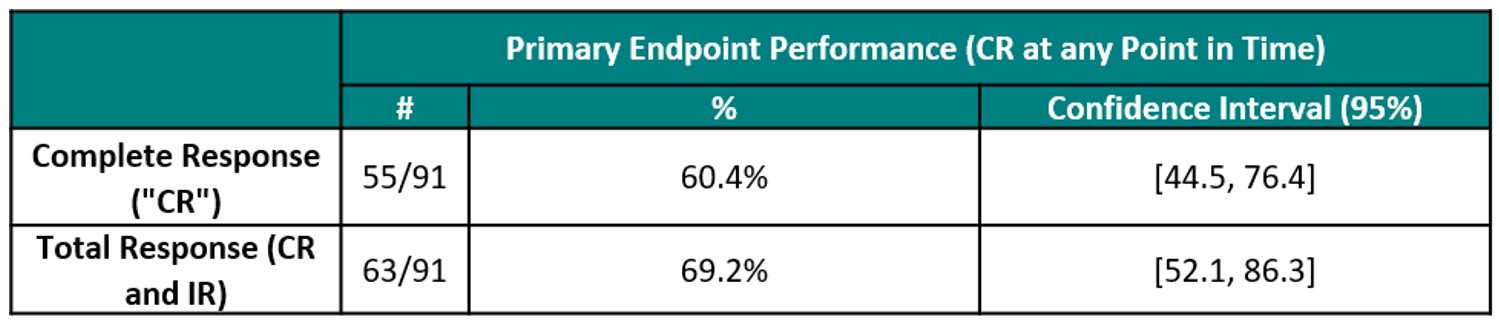
Table 1: Primary Endpoint Performance
To view an enhanced version of this graphic, please visit:
https://images.newsfilecorp.com/files/2786/326264_table1theralese.jpg
Note: Total Response ("TR") includes CR and Indeterminate Response ("IR"), defined as negative cystoscopy (no evidence of Urothelial Cell Carcinoma ("UCC") in the bladder) and positive / suspicious urine cytology (detection of cancer in the urine, without a negative confirmatory bladder biopsy, suggesting UCC in the renal system other than the bladder).
Secondary Endpoint Performance (Duration of CR - 12 Months)
The secondary endpoint evaluates the sustainability of CR at 12 months, after initial CR determination (450 days post-treatment). Among patients evaluable for durability of response,
The current median duration of response is 9 months (
The predicted median duration of response, according to Kaplan-Meier's analysis, is 12 months.

Table 2: Secondary Endpoint Performance
To view an enhanced version of this graphic, please visit:
https://images.newsfilecorp.com/files/2786/326264_fdb6592be46b3adf_002full.jpg
Tertiary Endpoint Performance (Safety)
The tertiary endpoint is defined as patients who have a Serious Adverse Event ("SAE") ≥ 4 directly caused by the Study Drug or Study Device, which did not resolve within 450 days.
Theralase® and the independent Data Safety Monitoring Board believe all SAEs reported to date are unrelated or unlikely related to the Study Drug or Study Device.
Note: A SAE is defined as any untoward medical occurrence that at any dose: Is serious or life-threatening, requires inpatient hospitalization or prolongation of existing hospitalization, results in persistent or significant disability/incapacity, is a congenital anomaly/birth defect or results in death.
Treatment Emergent Adverse Events ("TEAEs") were noted, but did not meet the SAE criteria. TEAEs included hematuria (
Cystectomy-free rate was
For Adverse Events ("AEs") reported there were:

Table 3: Tertiary Endpoint Performance
To view an enhanced version of this graphic, please visit:
https://images.newsfilecorp.com/files/2786/326264_fdb6592be46b3adf_004full.jpg
Duration of CR - Extended Time Points
Patients who have completed Study II were followed for up to 3 years after initial treatment at extended time points.

Table 4: Duration of CR at Extended Time Points
To view an enhanced version of this graphic, please visit:
https://images.newsfilecorp.com/files/2786/326264_fdb6592be46b3adf_005full.jpg
One patient demonstrated CR for 7 years, after one Study Procedure.
On Kaplan-Meier analysis, if CR is obtained, the long term estimated probability of remaining cancer free at 1, 2 and 3 years is
The interim clinical results support light-activated Ruvidar® as a potential bladder-preserving treatment option for patients diagnosed with BCG-Unresponsive NMIBC CIS, with or without papillary disease.
Regulatory Pathway, Commercialization Strategy and FDA Guidance
If approved by Health Canada and the FDA, the clinical data collected from Study II represents a transformative therapeutic option for patients diagnosed with BCG-Unresponsive NMIBC CIS, who would otherwise face radical cystectomy (surgical removal of the bladder).
The Theralase® Study Procedure has demonstrated a robust CR and sustained durability of that response, with the majority of patients receiving only a single Study Procedure (
Theralase® is currently analyzing and compiling the clinical data for a New Drug Submission to Health Canada and a New Drug Application to the United States Food and Drug Administration with marketing decisions anticipated in 2027.
In 2027, Theralase® will pursue licensing agreements of the bladder cancer technology for global marketing and distribution of light-activated Ruvidar®.
Cohort 2
Theralase®, in conjunction with Ferring Pharmaceutical, is enrolling patients into a combinational clinical study to investigate the safety and efficacy of combining light-activated Ruvidar® with Adstiladrin.
It is anticipated that the complementary mechanisms of action (Ruvidar® targets bladder cancer cells directly, Adstiladrin® targets health bladder cells to produce Interferon to stimulate the innate and adaptive immune system) will provide a strong additive effect in the treatment of patients being treated for BCG-Unresponsive NMIBC CIS.
In the Study Procedure, patients will be treated with Ruvidar® (1 hour of drug instillation, 1 hour of light activation), then at another visit, they will be instilled with Adstiladrin® (1 hour procedure), both in outpatient procedures. Under the clinical protocol, the patient may receive up to 4 treatments of Adstiladrin® in total.
The presiding uro-oncologist will have the option to deliver an additional re-induction Study Procedure, if the patient recurs.
The patient will be followed for 15 months after initial Study Procedure and up to 3 years for post-study follow-up.
Commercialization and Strategic Partnerships
In parallel with the finalization of Study II, Theralase® is pursuing commercialization opportunities and strategic partnerships to support the global marketing and distribution of Ruvidar®. The Company is interested in engaging in discussions with pharmaceutical companies regarding:
- Licensing arrangements for Ruvidar® in the treatment of BCG-Unresponsive NMIBC CIS in various geographic territories
- Collaborative clinical research initiatives focused on the application of light-activated Ruvidar® for broader NMIBC indications
- Collaborative clinical research combining Ruvidar®, with other FDA-approved drugs to enhance treatment efficacy
Product Stability and Logistics
Ruvidar® has demonstrated a shelf life of >10 years at room temperature, which supports both the long-term stability of the molecule and the practical logistics of clinical storage and distribution. This extended shelf life is expected to be a key differentiator in clinical and commercial settings, enabling medical facilities to store and deploy Ruvidar®, as needed, without significant cold chain and degradation concerns.
Expansion of the Oncology Pipeline - Rutherrin®
On September 15th, 2026, the Company commenced Good Laboratory Practice ("GLP") toxicology analysis of intravenously administered Rutherrin®. The program is designed to determine the Maximum Tolerated Dose and Human Equivalent Dose to provide starting and therapeutic doses for future human clinical studies. Completion is expected by the end of 2026, with results anticipated in early 2027.
Subject to receipt of toxicology reports and regulatory approval, the Company plans to advance Phase 0/I/II adaptive clinical development for glioblastoma multiforme, non-small cell lung cancer and muscle-invasive bladder cancer, followed by pancreatic cancer and colorectal cancer.
Phase 0 will evaluate tumour localization; Phase I/II will evaluate safety, dosing and therapeutic efficacy following multiple doses with radiation activation. Preclinical findings support further investigation, but do not establish human safety or efficacy.
Herpes Simplex Virus Type 1 ("HSV-1")
Theralase® continues preclinical development of topical Ruvidar® for HSV-1 lesions. Laboratory research demonstrated inhibition of HSV-1 replication at lower concentrations than acyclovir and additive / synergistic effects in combination experiments. Preclinical mouse model research supports further investigation of topical Ruvidar®. Human safety and efficacy remain to be established.
Roger DuMoulin-White, President and Chief Executive Officer of Theralase®, stated: "Throughout 2026, Theralase® has focused on strengthening its financial position, advancing its lead bladder cancer clinical program and expanding its therapeutic development pipeline. With patient enrollment completed in Study II, our priority in 2027 is the analysis and compilation of the clinical data of Study II required for regulatory submissions and successful marketing approval by Health Canada and the FDA, representing an important next step toward the potential commercialization of light-activated Ruvidar®. In parallel, our collaborative clinical development agreement with Ferring Pharmaceuticals and the completion of GLP toxicology for intravenously administered Rutherrin® provide opportunities to expand the clinical application of our energy-activated small molecule technology for numerous oncological conditions. With approximately
About Study II
Study II utilizes the therapeutic dose of the patented drug, Ruvidar® (TLD-1433), activated by the TLC-3200 Medical Laser System. Study II has enrolled and treated 95 BCG-Unresponsive NMIBC CIS (with or without resected Ta/T1) patients across 11 clinical study sites located in Canada and the United States.
About Adstiladrin
Adstiladrin® (nadofaragene firadenovec-vncg) is an FDA-approved intravesical non-replicating gene therapy for the treatment of adult patients with high-risk BCG-unresponsive NMIBC CIS with or without papillary tumors (±Ta/T1). It is a non-replicating adenovirus vector-based therapy containing the gene interferon alfa-2b, administered locally as a monotherapy by catheter directly into the bladder once every three months. The vector enters the cells of the bladder wall, releasing the active gene and causing the bladder's cell walls to secrete high and transient local expression of interferon alfa-2b protein, a naturally occurring protein the body uses to fight cancer. This approach essentially turns the bladder wall cells into interferon micro factories, enhancing the body's own natural defenses against the cancer.
Please click to see the full Prescribing Information.
About Theralase® Technologies Inc.
Theralase® is a clinical-stage pharmaceutical company dedicated to the research and development of energy-activated small molecules for the safe and effective destruction of cancer, bacteria and viruses.
Additional information is available at www.theralase.com and www.sedarplus.ca.
Neither TSX Venture Exchange nor its Regulation Services Provider (as that term is defined in the policies of the TSX Venture Exchange) accepts responsibility for the adequacy or accuracy of this release.
Forward-Looking Statements
This news release contains forward-looking statements and forward-looking information (collectively, "FLS") within the meaning of applicable Canadian securities laws. Such statements; include, but are not limited to statements regarding the Company's proposed development plans with respect to energy-activated small molecules and their drug formulations. FLS may be identified by the use of the words "may, "should", "will", "anticipates", "believes", "plans", "expects", "estimate", "potential for" and similar expressions; including, statements related to the current expectations of the Company's management regarding future research, development and commercialization of the Company's small molecules; their drug formulations; preclinical research; clinical studies and regulatory approvals.
These statements involve significant risks, uncertainties and assumptions; including, the ability of the Company to fund and secure regulatory approvals to successfully complete various clinical studies in a timely fashion and implement its development plans. Other risks to the Company include: successful commercialization of its energy-activated small molecules and drug formulations; access to sufficient capital to fund the Company's operations on terms that are commercially favorable to the Company or at all; the safety and effectiveness of the Company's energy-activated small molecules and formulations against the diseases tested in its clinical studies; the failure to comply with the terms of license agreements with third parties and as a result lose the right to use key intellectual property in its business; the ability to protect its intellectual property; the timing and success of submission, acceptance and approval of regulatory filings. Many of these factors that will determine actual results are beyond the Company's ability to control or predict.
Readers should not unduly rely on these FLS, which are not a guarantee of future performance. There can be no assurance that FLS will prove to be accurate as such FLS involve known and unknown risks, uncertainties and other factors, which may cause actual results or future events to differ materially from the FLS.
Although the FLS contained in the press release are based upon what management currently believes to be reasonable assumptions, the Company cannot assure prospective investors that actual results, performance or achievements will be consistent with these FLS.
All FLS are made as of the date hereof and are subject to change. Except as required by law, the Company assumes no obligation to update such FLS.
For investor information on the Company, please feel free to reach out Investor Inquiries - Theralase Technologies.
For More Information:
1.866.THE.LASE (843.5273)
416.699.LASE (5273)
www.theralase.com
Matthew Perraton
Investor Relations Manager, Ext. 229
mperraton@theralase.com

To view the source version of this press release, please visit https://www.newsfilecorp.com/release/326264
FAQ
AI-generated questions and answers. How Rhea-AI works. Not financial advice.