
Teako Completes Field Programs at the Tynset Copper-Zinc-Silver Project and Venna Copper-Cobalt-Zinc Project, Central Norway
Completion of extensive 2026 fieldwork at Tynset and Venna moves Teako’s Norwegian VMS projects closer to defining maiden drill targets.
Rhea-AI Summary
Teako Minerals (TMINF) has completed its 2026 field programs at the 100%-owned Tynset copper-zinc-silver and Venna copper-cobalt-zinc VMS projects in central Norway, advancing drill-target generation.
At Tynset, crews carried out detailed mapping and collected 115 rock chip samples and 106 handheld SDS hammer drill samples across priority targets, including Storbekken, Nonsvola and Vingelen. An induced polarization (IP) ground geophysical survey over the Storbekken Priority 1 target is expected to start in mid-October 2026. Combined IP, 2026 field and historical data are intended to define targets for a maiden diamond drill program currently anticipated between late Q4 2026 and Q1 2027.
At Venna, 180 new rock chip samples and 52 archived samples from Sandsve are being reviewed to finalize analysis. All samples will be sent to ALS in Sweden, with full datasets expected in about 6–8 weeks, and selected data will support two MSc research projects at NTNU.
Positive
- None.
Negative
- None.
AI-generated analysis. How Rhea-AI works. Not financial advice.




Vancouver, British Columbia--(Newsfile Corp. - September 16, 2026) - Teako Minerals Corp. (CSE: TMIN) (the "Company" or "Teako") is pleased to announce the completion of its 2026 field program at the Tynset copper-zinc-silver ("Cu-Zn-Ag") volcanogenic massive sulphide ("VMS") project (the "Tynset Project"). In addition to the Tynset program, the Company also deployed a field crew to the Venna copper-cobalt-zinc ("Cu-Co-Zn") VMS project (the "Venna Project") in order to complete additional fieldwork. Both the Tynset and Venna projects are
Follow-up work at the Tynset Project is expected to include the previously-announced ground geophysical survey (Induced Polarization, or "IP") (see Company News Release dated August 18, 2026) over the Storbekken Priority 1 target, starting mid-October, 2026. Data derived from the upcoming IP survey, together with datasets from both Teako's 2026 field program and historical records, will assist with prioritizing high-quality targets for a maiden diamond drill program which is currently expected between late Q4 2026 and Q1 2027.
Highlights
- Teako has completed both its 2026 field program at the Tynset Cu-Zn-Ag VMS Project and additional fieldwork at the Venna Cu-Co-Zn VMS Project. Both projects are
100% Teako owned and located in the highly-prospective VMS belts of central Norway. - At Tynset, 115 rock chip samples and 106 hand-held SDS hammer drill samples ("SDS samples") were collected across priority targets and are being prepared for imminent shipment to ALS Laboratories (or "ALS") in Sweden for analysis.
- At Venna, 180 rock chip samples were collected and are currently being reviewed and prioritized to determine the final analytical program.
- An IP survey over the Strobekken Priority 1 target on the Tynset Project is expected to commence in mid-October 2026, with the combined datasets and historical records intended to refine high-quality drill targets ahead of diamond drilling currently expected between late Q4 2026 and Q1 2027.
About the Tynset and Venna Field Programs
Investigations comprised detailed geological and structural mapping, together with systematic outcrop sampling for geochemical and spectral laboratory analysis. Alongside the refinement of the geological framework across both projects, the field programs aimed to characterize the style, intensity and spatial distribution of hydrothermal alteration and mineralization across priority target zones.
At Tynset, the field team investigated the Priority 1 Storbekken Target area, where the upcoming IP survey will be conducted, as well as conducting first-pass reconnaissance mapping and sampling of the recently added high-priority Nonsvola and Vingelen targets.
The Venna Program involved a large-scale lithogeochemical ("LGC") sampling campaign that involved the systematic collection of rock chips along traverses over > 9 km of strike on the Mostadmarka Ironworks Trend, as well as covering the Storslåtten Conductor Target and the newly established Central Tuffite Zone. Archived rock chip samples collected from the Sandsve Target area in 2025 and samples from the 2026 field program are currently being reviewed and prioritized to determine the final analytical program. When combined with the Phase 1 LGC data from 2025 (see Company Press Releases dated November 26, and December 8, 2025), the Company believes the results will enable a comprehensive Lithogeochemical assessment of the Venna area, guiding future exploration decisions for the project.
All samples taken across Tynset and Venna were entered into the Teako database prior to preparation for shipment to ALS Laboratories in Sweden. The analysis selected varies based on the rock type and purpose of each sample, and analysis times are expected to be around 6-8 weeks to receive the full suite of data.
The Tynset Project
At the Tynset Project, 112 rock chip samples were collected from outcrops and waste dumps over the planned IP survey lines (see Company Press Release dated August 18, 2026) (see Figure 1). The sampling program was undertaken in order to better assess the nature and prospectivity of the surface geology across the geophysical survey area. The lithogeochemical (four-acid digestion with ICP-MS finish) and spectral (Terraspec and Fourier Transform Infrared spectroscopy ("FTIR")) data expected from the lab will aid the selection and ranking of arising geophysical targets, using indications of prospective stratigraphy, mineralization and hydrothermal alteration to further de-risk the drilling of targets in the near future. In addition, 3 representative mineralized 'waste' samples were taken from the historical Vingelen Mine site (see Figure 1c), with the intention of better understanding the base and precious metal potential of this target area.
A pilot study was conducted as part of the field program using a handheld SDS hammer drill to collect a total of 106 pulverised outcrop samples ("SDS samples") across the target areas. Of these, 74 SDS samples were collected from Storbekken, 26 from Nonsvola and 6 from Vingelen. The SDS samples will also be submitted to ALS for spectral data collection. The study is a trial for a time- and cost-efficient methodology to acquire high-quality data that supports the mapping of vital geological features like hydrothermal alteration zones and volcanic stratigraphy. The pilot study had a particular focus on a package of quartz-sericite (± pyrite) schists which were interpreted to be hydrothermally altered felsic volcanics associated with the Svartåsvangen mineral occurrence (see Figure 1a), with the goal of quantifying the mineral assemblage and apparent intensity of this alteration to vector towards the prospective core of the system.
At Nonsvola, the 26 SDS samples were collected with a focus on similar quartz-sericite (± pyrite) lithologies, including a trend that was interpreted to be a potential feeder/stringer zone due to the presence of locally abundant rusty veinlets (see Figure 1b). The historic trial workings at Nonsvola were confirmed to be targeting a layer of massive pyrite with traces of chalcopyrite and sphalerite. The immediate proximity of the Nonsvola SDS samples to this mineralized horizon will help to establish the spectral and geochemical characteristics of proximal hydrothermal alteration zones, improving the Company's ability to identify proximal alteration zones at targets like Storbekken. This will be further augmented by the 6 SDS samples collected from host lithologies sampled from waste dumps at the historical Vingelen Mine, which were intended to be representative of different alteration styles that are likely spatially associated with the mineralized horizon(s) at the site.
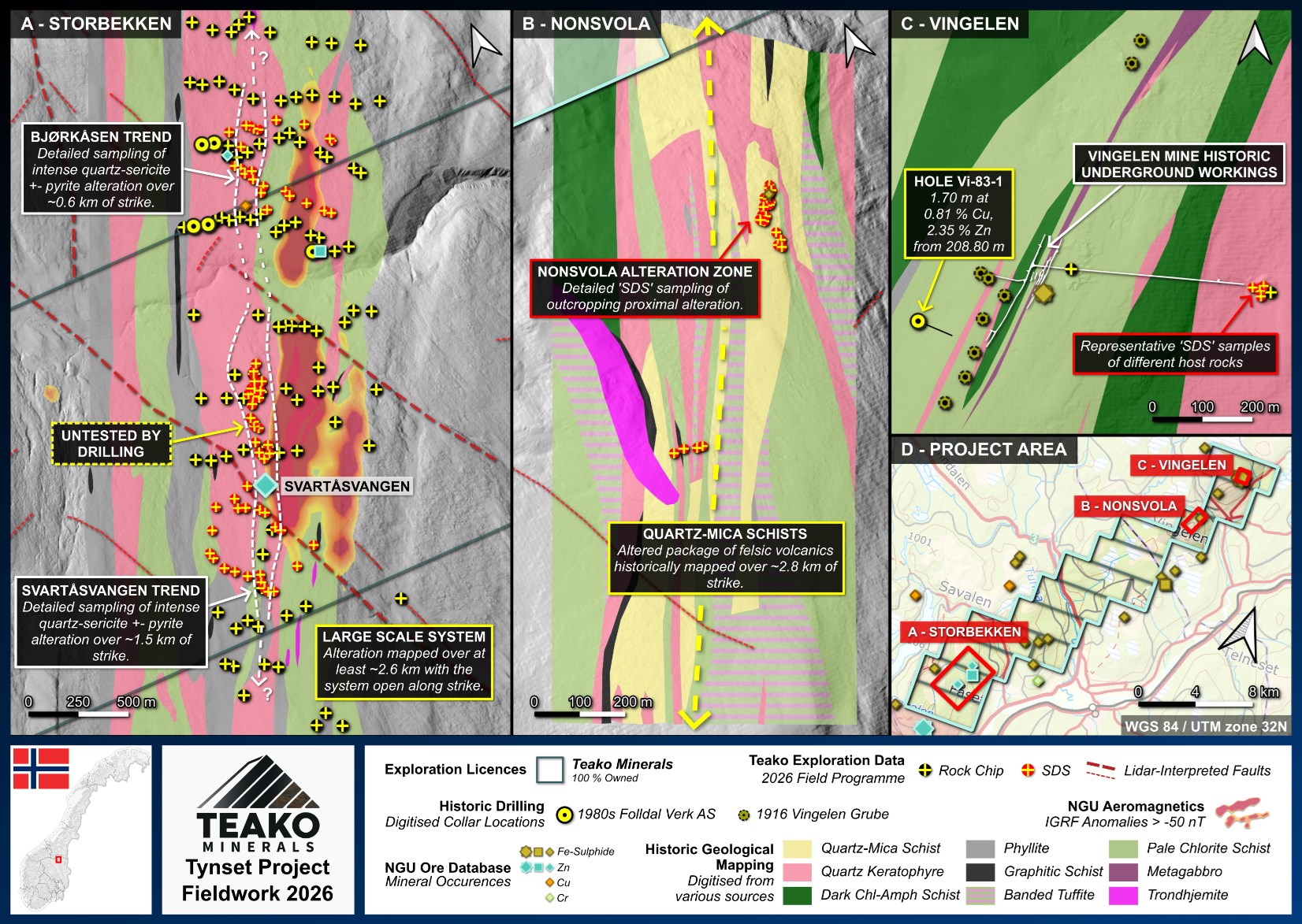
Figure 1: Overview maps of the targets investigated during the 2026 Tynset Field Programme, showing the coverage of rock chip and SDS sampling overlain onto detailed historical geological maps.
To view an enhanced version of this graphic, please visit:
https://images.newsfilecorp.com/files/8258/314569_e4ae05d294cf086f_003full.jpg
The Venna Project
At the Venna Project, a lithogeochemical sampling campaign (see Figure 2) was conducted to build upon the success the 2025 program. 180 rock chip samples were collected from key localities and systemically along traverses laid out across the Mostadmarka Ironworks Trend and Storslåtten targets identified during the 2025 program (see Company Press Releases dated November 26, and December 8, 2025).
A further 52 rock chip samples collected from the Sandsve Target area in 2025 have also been retrieved from storage and both batches are currently being reviewed and prioritized to determine the final analytical program.
Certain samples will be selected for complete characterisation, most of which were taken from Iron Formations, a key exhalative marker horizon that may help the Company vector towards promising Cu-Zn VMS target areas. The remaining samples will be analysed using the same lithogeochemical (four-acid digestion with ICP-MS finish) and spectral (Terraspec and FTIR) methods as the samples from Tynset, to screen Venna's most prospective target areas for promising indications of hydrothermal alteration that may have formed around a potential concealed Cu-Zn VMS system.
Key samples and assay data collected over the course of the three campaigns completed to date will also form the basis of two MSc-level research projects at Norges Teknisk-Naturvitenskapelige Universite ("NTNU") in Trondheim, which aim to assess the prospectivity of the Iron Formations across the Mostadmarka Ironworks Trend and the metallogenic potential of the host volcanic sequence of the Venna district.
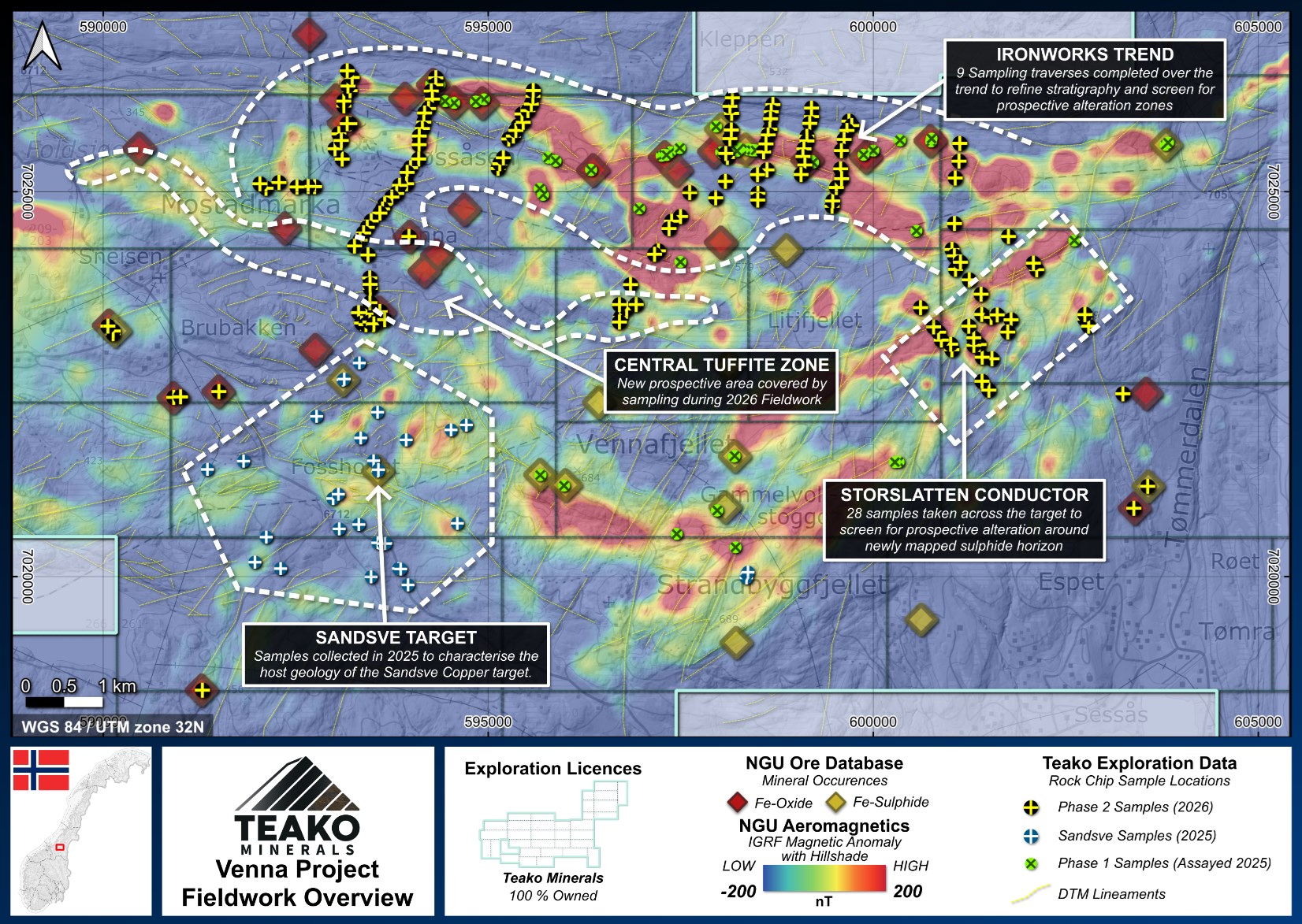
Figure 2: Overview map of showing the coverage of rock chip sampling completed to date across the Venna Project, overlain onto NGU Aeromagnetic data. Sampling is intended to guide a lithogeochemical assessment of exhalatives, stratigraphy and alteration, to highlight the most prospective areas for further investigation.
To view an enhanced version of this graphic, please visit:
https://images.newsfilecorp.com/files/8258/314569_e4ae05d294cf086f_005full.jpg
Qualified Persons and Disclosure Statement
The technical information presented in this news release has been prepared in accordance with Canadian regulatory requirements as set out in National Instrument 43-101 ("NI 43-101") Standards of Disclosure for Mineral Projects, and reviewed and approved by Eric Roth, a Non-Executive Director of Teako and a Qualified Person under NI 43-101. Mr. Roth holds a Ph.D. in Economic Geology from the University of Western Australia, is a Fellow of the Australian Institute of Mining and Metallurgy (AusIMM), and is a Fellow of the Society of Economic Geologists. Mr. Roth has over 35 years of experience in international minerals exploration and mining project evaluation.
About Teako Minerals Corp.
Teako Minerals Corp. is a Vancouver-based mineral exploration company focused on the acquisition, exploration and advancement of mineral projects in Norway, with its principal exploration focus on copper and zinc in massive sulfide systems. The Company's strategy combines advancing its main projects toward discovery with building a growing portfolio of partner-funded projects in which Teako retains upside exposure to potential future exploration success across a range of commodities. Through this integrated model, Teako seeks to create shareholder value while contributing to the exploration of minerals critically important to future supply chains.
Contact Information:
Sven Gollan - CEO
T: +1 (604)-871-4301
Email: sven.gollan@teakominerals.com
Forward-Looking Information:
This press release may include forward-looking information within the meaning of Canadian securities legislation, concerning the business of Teako. Forward-looking information is based on certain key expectations and assumptions made by the management of Teako. In some cases, you can identify forward-looking statements by the use of words such as "will," "may," "would," "expect," "intend," "plan," "seek," "anticipate," "believe," "estimate," "predict," "potential," "continue," "likely," "could" and variations of these terms and similar expressions, or the negative of these terms or similar expressions. Forward-looking statements in this press release include statements related to timing of laboratory analysis, the expected outcome of the field programs at the Tynset and Venna projects, the timing of the expected IP survey and maiden drill program at the Tynset project, and the Company's business plans and operations and other matters. Although Teako believes that the expectations and assumptions on which such forward-looking information is based are reasonable, undue reliance should not be placed on the forward-looking information because Teako can give no assurance that they will prove to be correct. Since forward-looking statements address future events and conditions, by their very nature, they involve inherent risks and uncertainties. Actual results could differ materially from those currently anticipated due to a number of factors and risks. These include but are not limited to, risks associated with the mineral exploration industry in general (e.g., operational risks in development, exploration and production; the uncertainty of mineral resource estimates; the uncertainty of estimates and projections relating to production, costs and expenses, and health, safety and environmental risks), constraint in the availability of services, commodity price and exchange rate fluctuations, changes in legislation impacting the mining industry, adverse weather conditions and uncertainties resulting from potential delays or changes in plans with respect to exploration or development projects or capital expenditures. These and other risks are set out in more detail in Teako's interim Management's Discussion and Analysis, for the period ended January 31, 2026.
All dollar figures included herein are presented in Canadian dollars, unless otherwise noted. Neither the CSE nor its market regulator accepts responsibility for the adequacy or accuracy of this press release.

To view the source version of this press release, please visit https://www.newsfilecorp.com/release/314569
FAQ
AI-generated questions and answers. How Rhea-AI works. Not financial advice.
What specific work was completed at the Tynset Project in 2026?
The Tynset 2026 program included detailed geological and structural mapping plus systematic outcrop sampling. Crews collected 112 rock chip samples from outcrops and waste dumps over planned IP survey lines and 3 representative mineralized waste samples from the historical Vingelen Mine. A pilot handheld SDS hammer drill study added 106 pulverised outcrop samples, with 74 from Storbekken, 26 from Nonsvola and 6 from Vingelen, targeting alteration and stratigraphy related to prospective VMS mineralization.
What did the 2026 Venna field program focus on?
The Venna program centred on a large-scale lithogeochemical sampling campaign. A total of 180 rock chip samples were taken from key localities and systematically along traverses covering more than 9 km of strike on the Mostadmarka Ironworks Trend, as well as the Storslåtten Conductor Target and the newly defined Central Tuffite Zone. An additional 52 rock chip samples collected from the Sandsve Target area in 2025 were retrieved from storage, with both new and archived samples under review to finalize the analytical program.
When are laboratory results expected from the Tynset and Venna samples, and where will they be analyzed?
All samples from Tynset and Venna are being prepared for shipment to ALS Laboratories in Sweden. The company expects full suites of lithogeochemical and spectral data in approximately 6–8 weeks, depending on the analysis type selected for each rock sample.
How will the upcoming IP survey and existing data be used at Tynset?
An IP survey over the Storbekken Priority 1 target at Tynset is expected to commence in mid-October 2026. Data from this survey, combined with the 2026 field program datasets and historical records, are intended to prioritize and refine high-quality drill targets ahead of a maiden diamond drill program currently expected between late Q4 2026 and Q1 2027.
What academic work will use data from the Venna Project?
Key samples and assay data from three Venna field campaigns will underpin two MSc-level research projects at Norges Teknisk-Naturvitenskapelige Universite (NTNU) in Trondheim. These projects aim to assess the prospectivity of Iron Formations along the Mostadmarka Ironworks Trend and evaluate the metallogenic potential of the Venna district’s host volcanic sequence.