
Thermo Fisher Scientific Expands Clinicians' Ability to Monitor Multiple Myeloma with First-of-Its-Kind FDA Clearance
Sentiment and the balance of points
Rhea-AI Sentiment reads the wording of the document, how positive or negative its language is on a 1 to 5 scale. The balance of points shown with the takes weighs what the document actually discloses, so the two can disagree, for example when a trial that missed its main goal is described in upbeat language.




Expanded use of the EXENT system* brings mass spectrometry-based testing beyond diagnosis to ongoing disease monitoring in the lab, providing clinicians with additional insights into disease status and treatment response
Key Facts:
- Thermo Fisher Scientific has received an expanded regulatory claim for its Immunoglobulin Isotypes (GAM) Assay for the EXENT™ Analyser kit, (GAM assay), bringing mass spectrometry-based monoclonal protein testing into the clinical laboratory for ongoing patient monitoring, as well as confirmatory diagnosis**.
- The expanded claim enables the EXENT system to be used as an aid in patient monitoring. Distinguishing disease-related signals from known treatment-related interference, providing clinicians with clearer insight into whether a patient with multiple myeloma or Waldenström's macroglobulinaemia is progressing or responding to treatment.
- The milestone builds on the EXENT system's global momentum, giving clinical laboratories and healthcare providers a single platform spanning the full patient journey from diagnosis through longitudinal monitoring.
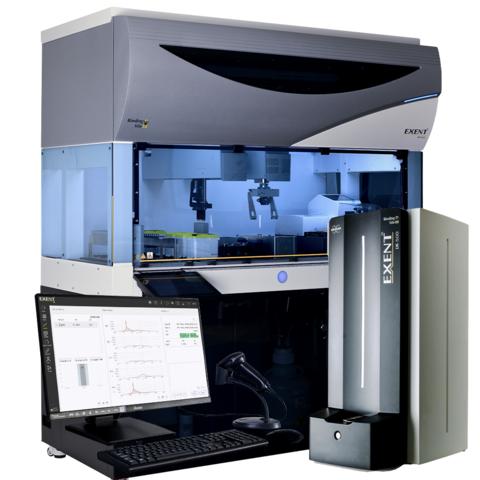
Over the last three years, the EXENT system has been used to test thousands of patients in 13 countries, expanding access to innovative testing technology and helping clinicians gain deeper insights into their patients’ disease. The expanded clearance addresses a critical challenge in managing these complex blood cancers: giving clinicians greater insight into how a patient's disease is changing and responding to treatment. By bringing sensitive, specific mass spectrometry-based testing directly into clinical laboratories, the EXENT system enables healthcare providers to monitor patients over time using a single platform, from initial diagnosis through ongoing disease management.
"For patients living with multiple myeloma or Waldenström's macroglobulinemia, understanding how their disease is responding to treatment is critical," said Stephen Harding, vice president and general manager, protein diagnostics, Thermo Fisher Scientific. "This expanded clearance brings the precision of mass spectrometry beyond diagnosis and into ongoing monitoring, giving clinicians greater insight into disease status and treatment response. It reflects our commitment to bringing innovative diagnostics into clinical practice to help physicians make more informed decisions and give patients greater confidence in their care."
Clinical Need and Technology
Multiple myeloma and Waldenström’s macroglobulinemia are both monoclonal gammopathies that require frequent, sensitive monitoring of M-protein levels to assess disease status, treatment response and detect potential relapse. Patients are typically monitored for M-protein levels throughout their lifetime following diagnosis. According to the National Cancer Institute, an estimated 36,000 new cases of multiple myeloma occurred in
Conventional methods may present challenges when M-protein concentrations are low or when treatment-related antibodies interfere with interpretation. Within its cleared intended use, the EXENT system uses mass spectrometry-based detection to identify and track M-proteins, helping clinicians assess disease status and treatment response over time. It also allows clinicians to track a patient’s disease as it evolves, including when the immune system is rebounding after therapy. Together, these limitations underscore an unmet clinical need for sensitive monitoring that can track M-proteins and help distinguish disease-related signals from known treatment-related interference.
The EXENT system is designed to address this need with mass spectrometry-based detection for routine use in clinical laboratories and requires no prior mass spectrometry expertise, allowing labs already using the EXENT system for diagnostic testing to extend the same workflow to ongoing patient monitoring. With enhanced sensitivity, objectivity and reproducibility, the technology helps provide clearer answers for clinicians to support better patient care.
About Thermo Fisher Scientific
Thermo Fisher Scientific Inc. is the world leader in serving science, with annual revenue over
*The EXENT™ system combines EXENT™ analyzer with the Immunoglobulin Isotypes (GAM) for the EXENT™ analyzer.
**For full details, consult the product labelling.
View source version on businesswire.com: https://www.businesswire.com/news/home/20261124848896/en/
Media Contact Information:
Sandy Pound
Thermo Fisher Scientific
Phone: 781-622-1223
E-mail: sandy.pound@thermofisher.com
Investor Contact Information:
Rafael Tejada
Thermo Fisher Scientific
Phone: 781-622-1356
E-mail: rafael.tejada@thermofisher.com
Source: Thermo Fisher Scientific Inc.