
STOCK TITAN

Trilogy Metals Announces Commencement of Permitting for High-Grade Arctic Copper-Zinc-Lead-Gold-Silver Project in Alaska

(Moderate)
(Neutral)
Tags

Trilogy Metals (NYSE: TMQ) announced Ambler Metals has commenced federal permitting for the Arctic Project by filing a Clean Water Act Section 404 application and plans to seek FAST-41 eligibility. A fully financed $35 million 2026 field program will start in May with 40–45 drill holes (~5,650 m).

An MRG economic study estimates up to 870 statewide jobs, ~$31.3 million in annual Alaska state taxes, and up to $3.4 million in annual transportation savings for Northwest Arctic communities.

Loading...
Loading translation...

Positive

  • Section 404 permit application initiated with USACE
  • $35 million fully financed 2026 field program
  • 40–45 drill holes planned targeting ~5,650 meters
  • MRG study: up to 870 statewide jobs supported
  • Estimated $31.3M in annual Alaska state taxes

Negative

  • Project outcomes depend on permitting timelines and final investment decision
  • Economic projections contingent on future metals price realizations

News Market Reaction – TMQ

+5.02%
11 alerts
+5.02% Session close to close
+3.8% Peak in 2 min
$830.31M Market Cap
0.1x Rel. Volume

In the Apr 22 session, TMQ gained 5.02%, reflecting a notable positive market reaction. Argus tracked a peak move of +3.8% during that session. Our momentum scanner triggered 11 alerts that day, indicating notable trading interest and price volatility.

Data tracked by StockTitan Argus on the day of publication.

Market Context

The stock moved +5.0% in the session following this news. A strong positive reaction aligns with the...
Analysis

The stock moved +5.0% in the session following this news. A strong positive reaction aligns with the company’s steady progression from federal support and budgeting toward concrete permitting milestones at Arctic. Investors have previously responded well to operational and strategic updates, while loss-heavy financials drew sharper selling. With an effective S-3ASR shelf and prior usage, any substantial rally could increase incentives for future equity issuance, making ongoing monitoring of financing actions and execution against the permitting plan important.

Key Figures

Ambler Metals 2026 budget: $35 million Arctic average grade: approximately 5% copper equivalent Drill holes planned: 40 to 45 drill holes +5 more
8 metrics
Ambler Metals 2026 budget $35 million Fully financed 2026 field campaign for Arctic and Bornite work
Arctic average grade approximately 5% copper equivalent Estimated grade for Arctic open-pittable copper deposit
Drill holes planned 40 to 45 drill holes 2026 field season at Arctic and district work
Arctic drilling length at least 5,650 meters Geotechnical and hydrogeological drilling to support mine design
Bornite copper output 1.9 billion pounds of copper Forecast over a 17-year mine life at Bornite
Bornite mine life 17-year mine life Forecast for Bornite copper-cobalt deposit
Jobs supported statewide up to 870 jobs Operations-phase total jobs from Arctic mine and related activity
Annual Alaska state revenue $31.3 million Estimated annual state taxes and fees from Arctic production

Historical Context

5 past events · Latest: Apr 02 (Positive)
Pattern 5 events
Date Event Sentiment 24h Move Catalyst
Apr 02 Q1 results & funding Positive +1.6% Reported Q1 loss but highlighted $47.8M cash and $35.6M federal strategic investment LOI.
Mar 27 AGM announcement Neutral -1.5% Set May 13, 2026 AGM date and voting details without operational changes.
Feb 23 JV team expansion Positive +2.6% Added senior leaders at Ambler Metals to support drilling, permitting, and investment decision.
Feb 17 FY25 results Negative -12.6% Reported $42.2M net loss despite outlining $35M JV budget and federal strategic support.
Jan 20 Advisory expansion Positive +4.0% Expanded advisory and leadership teams following prior U.S. federal investment announcement.

24h Move is the share-price change in the day after each event; other market factors may also have contributed.

Pattern Detected

Recent project and strategic updates have generally seen aligned price reactions, including positive responses to operational progress and a sharper selloff on loss-heavy year-end results.

Recent Company History

Over the last few months, Trilogy has steadily advanced the Upper Kobuk Mineral Projects. Key milestones include a $35M Ambler Metals 2026 budget and plans to submit mine permits in 2026 (Feb 17, 2026), followed by expanded leadership at Ambler Metals to drive drilling and permitting (Feb 23, 2026). Subsequent updates on U.S. federal strategic investment and Q1 2026 results (Apr 2, 2026) emphasized strong cash of $47.8M. Today’s permitting launch at Arctic fits this sequence of de‑risking and execution steps.

Key Terms

clean water act section 404 permit, fast-41, net smelter royalty, payment-in-lieu-of-tax, +2 more
6 terms
clean water act section 404 permit regulatory
"submitted an application for a Clean Water Act Section 404 permit with the U.S. Army"
A Clean Water Act Section 404 permit is a U.S. federal approval required to place dredged or fill material into rivers, lakes, wetlands or other waters, typically issued by the Army Corps of Engineers with oversight from the Environmental Protection Agency. Investors should care because the permit controls whether and how much development or infrastructure can occur on sensitive aquatic land, affecting project costs, timelines and legal risk—like needing an official green light before building across a protected area.
fast-41 regulatory
"request an eligibility review for coverage under the Title 41 of the Fixing America's Surface Transportation Act program ("FAST-41")"
A FAST-41 designation comes from a U.S. law that sets up a coordinated, time-lined review process for large federal infrastructure projects, aiming to reduce delays by having agencies work together and meet clear deadlines. For investors, it matters because projects with FAST-41 oversight are likelier to reach permits and construction on schedule, reducing the risk of costly hold-ups much like a traffic controller clearing lanes so a convoy can move without unexpected stops.
net smelter royalty financial
"NANA is entitled to a 1% net smelter royalty, expected to total approximately $85.7 million"
A net smelter royalty (NSR) is a contractual payment to the holder of mineral rights equal to a fixed percentage of the revenue from the sale of mined metals after they have been processed and basic costs like smelting and transport are deducted. Think of it as a toll on each shipment of metal: it reduces the operator’s take from production but provides the royalty holder with a steady, production-linked income stream that investors use to value both mines and royalty assets.
payment-in-lieu-of-tax financial
"expects to negotiate a payment-in-lieu-of-tax agreement with the NWAB, consistent"
A payment-in-lieu-of-tax (PILOT) is an agreement where a property owner or organization pays a negotiated fee to a government instead of the standard property tax. Think of it like agreeing to a fixed parking fee rather than paying a meter rate: it alters predictable costs and revenue that investors use to value a project, affects cash flow and tax exposure, and can change the financial attractiveness or risk for shareholders and creditors.
volcanogenic massive sulfide medical
"There are currently 30 known volcanogenic massive sulfide ("VMS") occurrences across"
A volcanogenic massive sulfide (VMS) deposit is a concentrated underground or seabed accumulation of metal-bearing minerals formed by ancient volcanic activity. Think of it like a naturally occurring treasure chest where copper, zinc, lead and often gold or silver are packed closely together, which can make extraction more efficient and valuable. Investors care because VMS deposits can underpin mining projects with high metal content and predictable geology, affecting a company’s potential revenue, capital needs and exploration appeal.
qualified person regulatory
"is a Qualified Person as defined by National Instrument 43-101 – Standard of"
A qualified person is someone with specialized knowledge, experience, and training in a particular field, allowing them to accurately assess and verify information or work. Their expertise helps ensure that reports, evaluations, or decisions are trustworthy and meet required standards. For investors, a qualified person provides confidence that the information they rely on is credible and properly validated.

AI-generated analysis. How Rhea-AI works. Not financial advice.

See more from StockTitan in Google Search and AI answers. Adds StockTitan as a preferred source · opens Google
Add on Google

Fully Funded Exploration and Development Field Program by Ambler Metals Anticipated to Commence in May

Independent Economic Impact Study Highlights Arctic's Substantial Benefits to Alaska and the Northwest Arctic Region

All amounts are in United States dollars unless otherwise stated.

VANCOUVER, BC, April 21, 2026 /PRNewswire/ - Trilogy Metals Inc. (NYSE American: TMQ) (TSX: TMQ) ("Trilogy Metals", "Trilogy" or the "Company") announced today that Ambler Metals LLC ("Ambler Metals"), its 50/50 joint venture with South32 Limited ("South32"), has commenced the permitting process for the Arctic Project (the "Arctic Project" or "Arctic"), part of the Upper Kobuk Mineral Projects ("UKMP") in northwestern Alaska's Ambler Mining District. Arctic is one of the highest-grade, undeveloped open-pittable copper deposits in the world, with an estimated average grade of approximately 5% copper equivalent1,2, bolstered by material precious metals by-product credits.

Ambler Metals has submitted an application for a Clean Water Act Section 404 permit with the U.S. Army Corps of Engineers ("USACE"), thereby initiating federal permitting for mine development and operations at Arctic. In addition to this application submission, Ambler Metals plans to request an eligibility review for coverage under the Title 41 of the Fixing America's Surface Transportation Act program ("FAST-41"), administered by the Federal Permitting Improvement Steering Council. FAST-41 coverage would provide a comprehensive, integrated permitting timetable and bring greater transparency to the project through the federal Permitting Dashboard.

Tony Giardini, President and CEO of Trilogy, commented: "Requiring a Section 404 permit from the USACE under the Clean Water Act streamlines the Arctic Project's federal permitting pathway. All other significant permits are issued at the state and local levels, concentrating federal review into a single, well-defined process while maintaining rigorous environmental oversight.

"By potentially leveraging the FAST-41 program, the Arctic Project benefits from a level of inter-agency coordination and timeline accountability that was historically unavailable to large-scale resource developments. This process transforms often fragmented federal reviews into a synchronized, transparent schedule, providing our stakeholders with a clear window into the permitting roadmap. For Trilogy, FAST-41 coverage means that achieving regulatory milestones is supported by a predictable and transparent path toward project financing and construction.

"An independent economic impact analysis prepared by McKinley Research Group ("MRG")3 confirms what we have long believed – the Arctic Project is a generational economic opportunity for Alaska and particularly for Northwest Arctic communities. The study estimates that Arctic mine construction and operations will support up to 870 jobs statewide, generate more than $31 million in annual state taxes and fees, and deliver meaningful revenue to NANA Regional Corporation through royalties and preferential shareholder employment. Perhaps most importantly, the Ambler Access Project road has the potential to reduce transportation costs for remote Alaska Native villages by up to $3.4 million per year, cutting heating fuel transportation costs by as much as 70% and reducing the cost of building a home in the Upper Kobuk region by nearly 40%. These are tangible, life-changing benefits for communities that face some of the highest costs of living in the United States.

"We are also excited to kick off the 2026 summer field season next month to conduct geotechnical and exploration drilling, along with general camp maintenance and capital improvements to support future programs. This field season is particularly important as it will allow Ambler Metals to carry out engineering, environmental, and technical work required to support a final investment decision to advance this critical minerals asset toward production.

"It's important to note that Arctic is just the first phase for this multi-generational American mining district. There are currently 30 known volcanogenic massive sulfide ("VMS") occurrences across this highly prospective and under-explored mineral belt. Arctic's strong cash-flow potential at spot metal prices will be the key to unlocking the district, and we fully expect exploration and development efforts to ramp up in the coming years across the UKMP, including at the high-grade Bornite copper-cobalt project ("Bornite"). The future looks extremely promising for one of the most strategic and mineral-rich districts in the United States."

Fully Financed Ambler Metals Field Program to Commence in May; Expected to Advance Arctic Towards Construction Decision and Prepare for Accelerated District-Wide Exploration in 2027

Ambler Metals is finalizing plans for the 2026 field season, and camp and drill mobilization by the end of May. The fully financed field campaign, part of Ambler Metals' $35-million 2026 budget, is expected to include 40 to 45 drill holes aimed at advancing final engineering plans for Arctic mine development. The program will also focus on re-establishing the exploration camp at the Bornite deposit, with the intention of ramping up exploration and development activities at the site in 2027, as well as commencing district-wide drill target assessments that will underpin future regional exploration programs across the mineral belt.

The drill campaign at Arctic is targeting at least 5,650 meters, with a focus on geotechnical and hydrogeological sites to underpin mine design and support permitting. Some of these drill holes will be extended to test deeper exploration targets that are located along the favourable Arctic mineral horizon. These exploration targets are within 3 to 4 kilometers (2 to 2.5 miles) of the Arctic deposit and include airborne electromagnetic (VTEM and ZTEM) anomalies that are potentially related to VMS mineralization.  

Field work at the Bornite camp will mainly focus on preparing the site for accelerated exploration and development activities in the coming years. Bornite is a carbonate-hosted copper-cobalt deposit approximately 25 kilometers (15 miles) southwest of the Arctic Project (see Figure 1), which is forecasted to produce 1.9 billion pounds of copper over a 17-year mine life4,5 and has the potential to extend copper mining activities to over 30 years. Bornite has characteristics similar to a series of districts and deposits, including the Mount Isa district in Australia, the Tynagh deposit in Ireland, the Kipushi deposit in the Democratic Republic of the Congo, and the Tsumeb deposit in Namibia.

Finally, the field program will include regional exploration work to advance known mineral occurrences and targets along the broader UKMP, with the intention of preparing targets for potential drilling in 2027. The mineral belt hosts numerous historic VMS mineral occurrences and electromagnetic anomalies that demonstrate high prospectivity for future discovery, which will be the focus of future regional exploration campaigns across the 100-kilometer-long (60-mile-long) VMS belt.
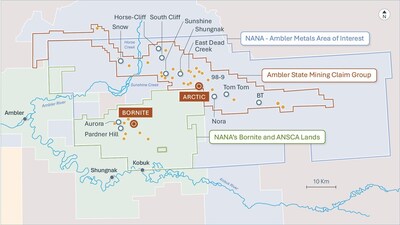
Figure 1: The Arctic and Bornite deposits within the Upper Kobuk Mineral Projects area that spans 190,929 hectares (471,796 acres). (CNW Group/Trilogy Metals Inc.)

Independent Economic Impact Study Highlights Arctic's Substantial Benefits to Alaska and the Northwest Arctic Region

An independent economic impact analysis prepared by MRG for Ambler Metals quantifies the broad economic contributions of developing the Arctic Project and establishing surface transportation access to the Ambler Mining District. The study draws on the Arctic Feasibility Study, regional socioeconomic data, and peer benchmarking against Teck Resources Limited's Red Dog Mine, which has operated on NANA lands in Northwest Alaska since 1989.

Key findings from the MRG study include:

  • Construction-phase employment and wages: Arctic mine construction is expected to directly support an annual average of 500 workers over a three-year period, with a peak workforce of approximately 650, and cumulative direct wages of approximately $160 million. Including indirect and induced multiplier effects, construction activity is estimated to support an average of 750 jobs annually and cumulative wages of approximately $220 million across Alaska.
  • Operations-phase employment and wages: Over the 13-year mine life as contemplated in the Arctic Feasibility Study, operations are expected to directly create approximately 430 jobs paying approximately $60.2 million in annual wages, and to support approximately 870 total jobs and approximately $89.8 million in annual wages statewide when indirect and induced effects are included.
  • NANA shareholder hires and royalties: Consistent with Red Dog Mine benchmarks, the Arctic mine is expected to employ approximately 230 NANA shareholders annually under a preferential hiring framework. Under the existing Exploration Agreement and Option to Lease, NANA is entitled to a 1% net smelter royalty, expected to total approximately $85.7 million over the mine life using Feasibility Study metal price assumptions. NANA also retains the option to acquire a 16% to 25% direct interest in Arctic, or alternatively to receive a 15% net proceeds royalty estimated at approximately $400 million to $570 million cumulatively over the mine's operating life.
  • Regional economic impacts: Within the Northwest Arctic Borough ("NWAB"), Arctic mine construction is expected to support an average of approximately 160 regional jobs and cumulative wages of approximately $50 million, and mine operations are expected to support approximately 160 regional jobs and approximately $20 million in annual wages across the 13-year mine life.
  • State and local government revenue: Arctic production is expected to generate approximately $31.3 million in annual Alaska state taxes and fees, including Alaska Mining License Tax and Alaska Corporate Net Income Tax. Ambler Metals expects to negotiate a payment-in-lieu-of-tax agreement with the NWAB, consistent with the existing Red Dog Mine framework, which currently provides approximately 80% of total Borough revenue.
  • Cost-of-living benefits for Alaska Native communities: Construction of the Ambler Access Project road, together with spur road connections, is estimated to deliver annual transportation cost savings of up to approximately $3.4 million across the Upper Kobuk and Koyukuk River communities of Ambler, Kobuk, Shungnak, Alatna, and Allakaket under a year-round gravel spur scenario. The MRG study estimates that surface access could reduce heating fuel transportation costs by approximately 70% per gallon and reduce material transportation costs on a typical single-family home in the Upper Kobuk region by approximately $287,000, a reduction of nearly 40% in total construction costs.

A copy of the full MRG economic impact report is available on the Ambler Metals website. The figures summarized above are presented as reported in the MRG study and reflect the Arctic Feasibility Study (January 20, 2023) assumptions; readers are cautioned that actual economic outcomes will depend on, among other things, permitting timelines, final investment decisions, and metals price realizations, and may differ materially from the estimates presented.

Qualified Persons

Richard Gosse, P.Geo., Vice President Exploration for Trilogy Metals Inc., is a Qualified Person as defined by National Instrument 43-101 – Standard of Disclosure for Mineral Projects and Subpart 1300 of Regulation S-K. Mr. Gosse has reviewed the technical information in this news release and approves the disclosure contained herein.

About Trilogy Metals

Trilogy Metals Inc. is a metal exploration and development company holding a 50 percent interest in Ambler Metals LLC, which has a 100 percent interest in the Upper Kobuk Mineral Projects ("UKMP") in northwestern Alaska. On December 19, 2019, South32, a globally diversified mining and metals company, exercised its option to form a 50/50 joint venture with Trilogy Metals. The UKMP is located within the Ambler Mining District which is one of the richest and most-prospective known copper-dominant districts in the world. It hosts polymetallic VMS deposits that contain copper, zinc, lead, gold and silver, and carbonate replacement deposits which have been found to host high-grade copper and cobalt mineralization. Exploration efforts have been focused on two deposits in the Ambler Mining District – the Arctic VMS deposit and the Bornite carbonate replacement deposit. Both deposits are located within a land package that spans approximately 190,929 hectares. Ambler Metals has an agreement with NANA Regional Corporation, Inc., an Alaska Native Corporation that provides a framework for the exploration and potential development of the Ambler Mining District in cooperation with local communities. Trilogy Metals' vision is to develop the Ambler Mining District into a premier North American copper producer while protecting and respecting subsistence livelihoods.

Cautionary Note Regarding Forward-Looking Statements

This news release includes certain "forward-looking information" and "forward-looking statements" (collectively "forward-looking statements") within the meaning of applicable Canadian and United States securities legislation, including the United States Private Securities Litigation Reform Act of 1995. All statements, other than statements of historical fact, included herein, including, without limitation, statements regarding the anticipated timing of permitting at Arctic; timing, commencement and planned undertakings of the 2026 field program; results of the 2026 field program; assumptions, predicted outcomes and results of the MRG study; anticipated economic and social benefits of the development of the Arctic; and perceived merit of the properties are forward-looking statements. Forward-looking statements are frequently, but not always, identified by words such as "expects", "anticipates", "believes", "intends", "estimates", "potential", "possible", and similar expressions, or statements that events, conditions, or results "will", "may", "could", or "should" occur or be achieved. Forward-looking statements involve various risks and uncertainties. There can be no assurance that such statements will prove to be accurate, and actual results and future events could differ materially from those anticipated in such statements. Important factors that could cause actual results to differ materially from the Company's expectations include the uncertainties involving the outcome of pending litigation, success of exploration activities, permitting timelines, requirements for additional capital, government regulation of mining operations, environmental risks, prices for energy inputs, labour, materials, supplies and services, uncertainties involved in the interpretation of drilling results and geological tests, unexpected cost increases and other risks and uncertainties disclosed in the Company's Annual Report on Form 10-K for the year ended November 30, 2025 filed with Canadian securities regulatory authorities and with the United States Securities and Exchange Commission and in other Company reports and documents filed with applicable securities regulatory authorities from time to time. The Company's forward-looking statements reflect the beliefs, opinions, and projections on the date the statements are made. The Company assumes no obligation to update the forward-looking statements or beliefs, opinions, projections, or other factors, should they change, except as required by law.


_______________________________________


1 Arctic Project NI 43-101 Technical Report and Feasibility Study (January 20, 2023) (the "Arctic Feasibility Study").


2 Copper equivalent grades are calculated using metal prices, recoveries, and payabilities and are based on Probable Mineral Reserves. Mineral Resources that are not Mineral Reserves do not have demonstrated economic viability. For a full list of the assumptions used to calculate the copper equivalent grade, please see the Arctic Feasibility Study.


3 AMBLER MINING DISTRICT Economic Impact Analysis, November 2024, prepared by McKinley Research Group, LLC.


4 Technical report entitled "NI 43- 101 Technical Report on the Preliminary Economic Assessment of the Bornite Project, Northwest Alaska, USA" with an effective date of January 15, 2025 (the "Bornite Report").


5 Mineral Resources for the Bornite Project are reported in accordance with NI 43-101 and consist solely of Inferred Mineral Resources (208.9 million tonnes grading 1.42% copper, containing approximately 6.5 billion pounds of copper). See the Bornite Report for additional information, including details with respect to grade, quantity and metal or mineral content.

Cision View original content to download multimedia:https://www.prnewswire.com/news-releases/trilogy-metals-announces-commencement-of-permitting-for-high-grade-arctic-copper-zinc-lead-gold-silver-project-in-alaska-302749268.html

SOURCE Trilogy Metals Inc.

FAQ

What permitting step did Trilogy Metals (TMQ) take for the Arctic Project on April 21, 2026?

The company filed a Clean Water Act Section 404 permit application with USACE to start federal review. According to the company, this initiates the federal permitting pathway and concentrates federal review into a single, defined process to support permitting transparency.

Will the Arctic Project seek FAST-41 coverage and what would that mean for TMQ permitting?

Ambler Metals plans to request FAST-41 eligibility to coordinate federal reviews and timelines. According to the company, FAST-41 would provide an integrated permitting timetable and dashboard transparency to improve inter-agency coordination and schedule predictability.

What are the key details of Ambler Metals' 2026 field program for TMQ's Arctic Project?

A fully financed $35 million program will begin in May with camp mobilization and drilling. According to the company, the campaign targets 40–45 holes (~5,650 m) focusing on geotechnical, hydrogeological, and deeper exploration targets near Arctic.

What economic impacts did the independent MRG study claim for TMQ's Arctic Project?

The study estimates up to 870 statewide jobs and ~$31.3 million in annual state taxes from Arctic production. According to the company, MRG also forecasts construction and operational wages, NANA royalties/options, and up to $3.4 million in annual community transport savings.

What is Trilogy Metals' forecast for the Bornite deposit near the Arctic Project (TMQ)?

Bornite is forecasted to produce about 1.9 billion pounds of copper over a 17-year mine life under feasibility assumptions. According to the company, Bornite could extend district copper mining activities and supports planned ramp-up of exploration and development.
