
Transition Metals Extends Geochemical Footprint of Haultain Gold System and Identifies New Large-Scale Exploration Targets at Gowganda Project, Ontario
New soil anomalies extend beyond previously tested areas, but their source and mineralization characteristics require further exploration.
Sentiment and the balance of points
Rhea-AI Sentiment reads the wording of the document, how positive or negative its language is on a 1 to 5 scale. The balance of points shown with the takes weighs what the document actually discloses, so the two can disagree, for example when a trial that missed its main goal is described in upbeat language.
Rhea-AI Summary
Transition Metals (TNTMF) reported soil survey results identifying new exploration targets at its wholly owned Gowganda Gold Project in Ontario.
The 2026 survey collected more than 1,300 samples across approximately 2.5 by 1.5 kilometres. Elevated gold, silver, arsenic and copper responses coincide with known mineralization and extend beneath cover beyond previously tested areas. The company said the results expanded the Haultain system's exploration footprint by approximately 1,200 metres.
The anomaly outlines are conceptual and do not establish mineralization continuity, grade or economic potential. Further surface work and drilling are required to evaluate them. Channel-sampling assays remain pending. Transition is combining the survey with geological, geophysical and drilling data to prioritize targets, with the objective of advancing the highest-priority targets toward a potential diamond drilling program in 2027.
Positive
- Minor pointThe company reports an exploration-footprint expansion of approximately 1,200 metres at the Haultain gold system.
- Minor pointNew anomalous trends extend beneath cover beyond areas tested by historical trenching and drilling.
- Minor pointGold, silver, arsenic and copper soil responses correlate with previously identified bedrock and surface gold mineralization.
- Minor point. Forward-looking: it has not happened yet and may not happen.Target ranking aims to advance priority targets toward a potential diamond drilling program in 2027.
Negative
- Minor pointConceptual anomaly outlines lack sufficient drilling or geological support to establish mineralization continuity, grade or geometry.
- Minor point. Forward-looking: it has not happened yet and may not happen.Additional sampling, trenching and drilling are required to determine the anomalies' source and potential significance.
- Minor point2026 channel-sampling assay results remain pending.
AI-generated analysis. How Rhea-AI works. Not financial advice.




Key Highlights:
- Recent MMI soil geochemical survey confirms new anomalous gold trend extensions beneath cover and beyond previously tested areas, highlighting large system scale targets for follow-up surface work and drilling.
- 1,300+ B-horizon soil samples collected across approximately 2.5 by 1.5 km.
- Elevated Au-Ag-As-Cu soil responses show strong spatial association with known gold mineralization.
Sudbury, Ontario--(Newsfile Corp. - October 7, 2026) - Transition Metals Corp. (TSXV: XTM) ("Transition" or the "Company") is pleased to report results from an extensive MMI soil geochemical survey at its
Company CEO Scott McLean stated: "The 2026 program at Gowganda has expanded the exploration footprint of the Haultain gold system by approximately 1,200 metres and highlighted several structural trends that are interpreted to control mineralization. We are integrating these new geochemical results with our geological, geophysical, and drilling datasets to refine specific drill targets for future exploration."
Haultain Gold System
The 2026 soil sampling program collected more than 1,300 B-horizon samples for analysis by SGS using its Mobile Metal Ion (MMI) methodology. Samples were collected at approximately 25-metre centres, along 100 -metre spaced lines, covering an approximate 2.5 by 1.5-kilometer area, focused around known bedrock mineralization areas and expanding outwards. MMI analysis measures concentrations of mobile metal ions that may migrate upward from deeper mineralized sources into near-surface materials such as soil, sand, and till. Anomalous concentrations of gold and associated pathfinder elements may therefore help identify exploration targets in areas where bedrock is covered.
Results from the 2026 soil survey show a strong spatial correlation between elevated concentrations of gold and associated pathfinder elements (including silver, arsenic, copper), and areas where previous work has identified gold mineralization in bedrock and at surface (Figure 1). The survey also identified elevated gold and pathfinder-element responses extending beneath cover along interpreted favourable structures. Several of these geochemical trends extend beyond areas tested by historical trenching and drilling and therefore represent new targets for follow-up exploration (Figure 2).
When integrated with previous drilling, mapping, and surface sampling, the 2026 soil geochemistry further supports the interpretation of a broad, structurally controlled gold-bearing hydrothermal system at the Gowganda Project and has elucidated a significant, large geochemical anomaly that requires drill testing. Additional surface sampling, mechanical trenching, and diamond drilling will be required to determine the source, nature, continuity, grade, and potential significance of mineralization associated with these newly discovered soil anomalies.
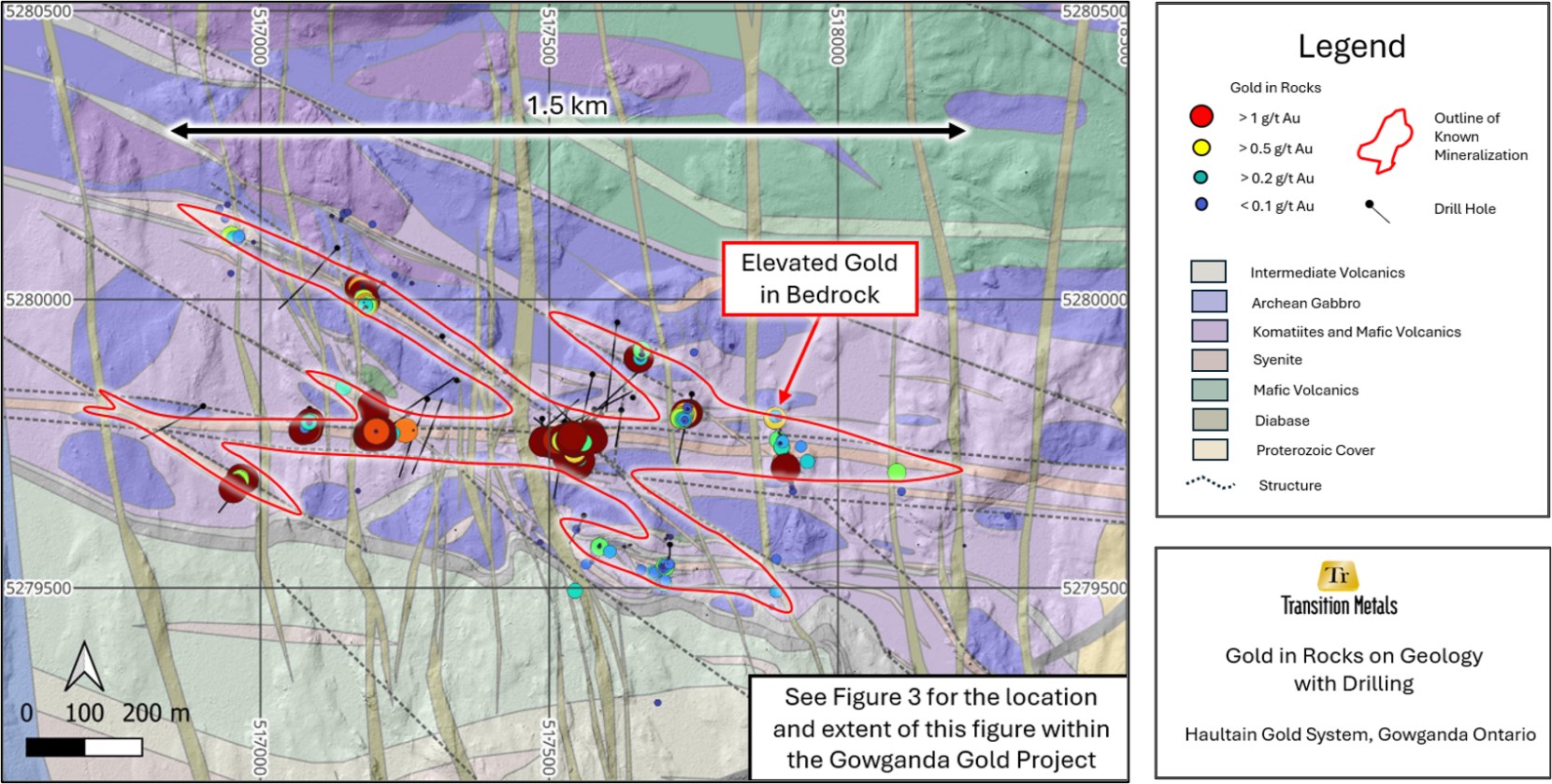
Figure 1: Elevated Gold in Bedrock on Backdrop of Geology and Structure with Drilling
To view an enhanced version of this graphic, please visit:
https://images.newsfilecorp.com/files/2766/317853_a80ef268848e0a3d_001full.jpg
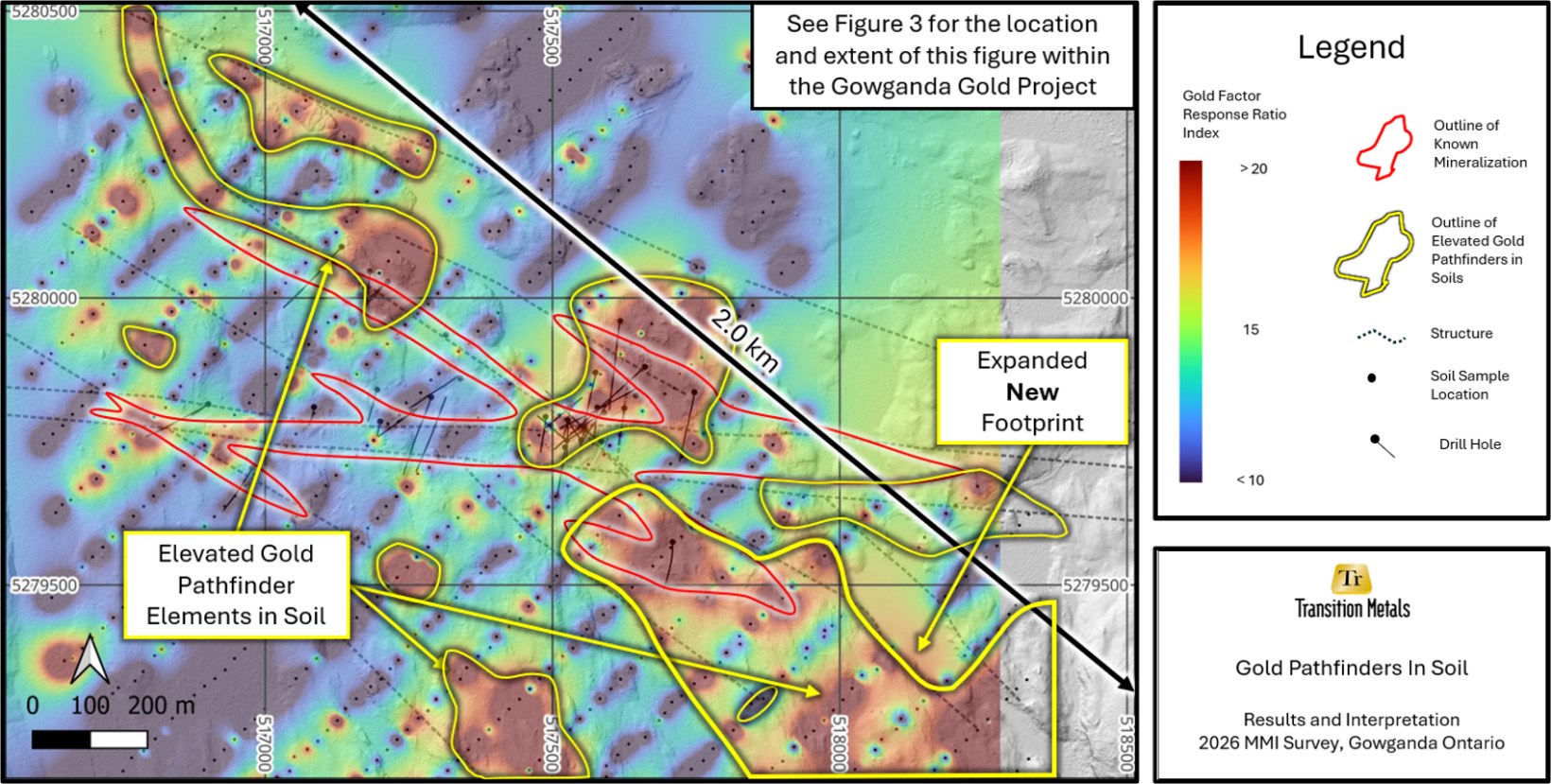
Figure 2: Elevated Gold Pathfinder Response Ratios and Location of MMI Soil Samples and Drilling
To view an enhanced version of this graphic, please visit:
https://images.newsfilecorp.com/files/2766/317853_a80ef268848e0a3d_002full.jpg
Note: The interpretive outlines shown in Figures 1 and 2 are conceptual in nature and are intended solely to highlight areas of elevated geochemical responses. The outlines are not supported by sufficient drilling or geological information to establish the presence, continuity, grade or geometry of mineralization and should not be interpreted as defining a mineral resource or indicating economic potential. Additional exploration is required to evaluate the geological significance of these anomalies.
Next Steps
The Company is integrating the 2026 MMI soil geochemistry with results from geological mapping, mechanical stripping, channel sampling, historical drilling and geophysical datasets to refine the geological and structural interpretation of the Haultain gold system and prioritize targets for follow-up exploration. Assay results from channel sampling completed during the 2026 field program remain pending and will be incorporated into this interpretation as they become available. Emphasis will be placed on evaluating anomalous gold and pathfinder element trends that extend beneath cover along interpreted favourable structures and beyond areas previously tested by surface work or drilling. The combined results will be used to rank priority targets and guide the design of follow-up exploration, including additional surface work where warranted, with the objective of advancing the highest-priority targets toward a potential diamond drilling program in 2027.
About the Gowganda Gold Project
The Gowganda Gold Project (Figure 3) is a road-accessible, district-scale property located beside the community of Gowganda, Ontario, along Highway 560, approximately 75 kilometres southwest of Kirkland Lake. The Project comprises a large, contiguous land package within the historic Gowganda Silver-Cobalt Camp in the Abitibi Greenstone Belt and benefits from established infrastructure and year-round access.
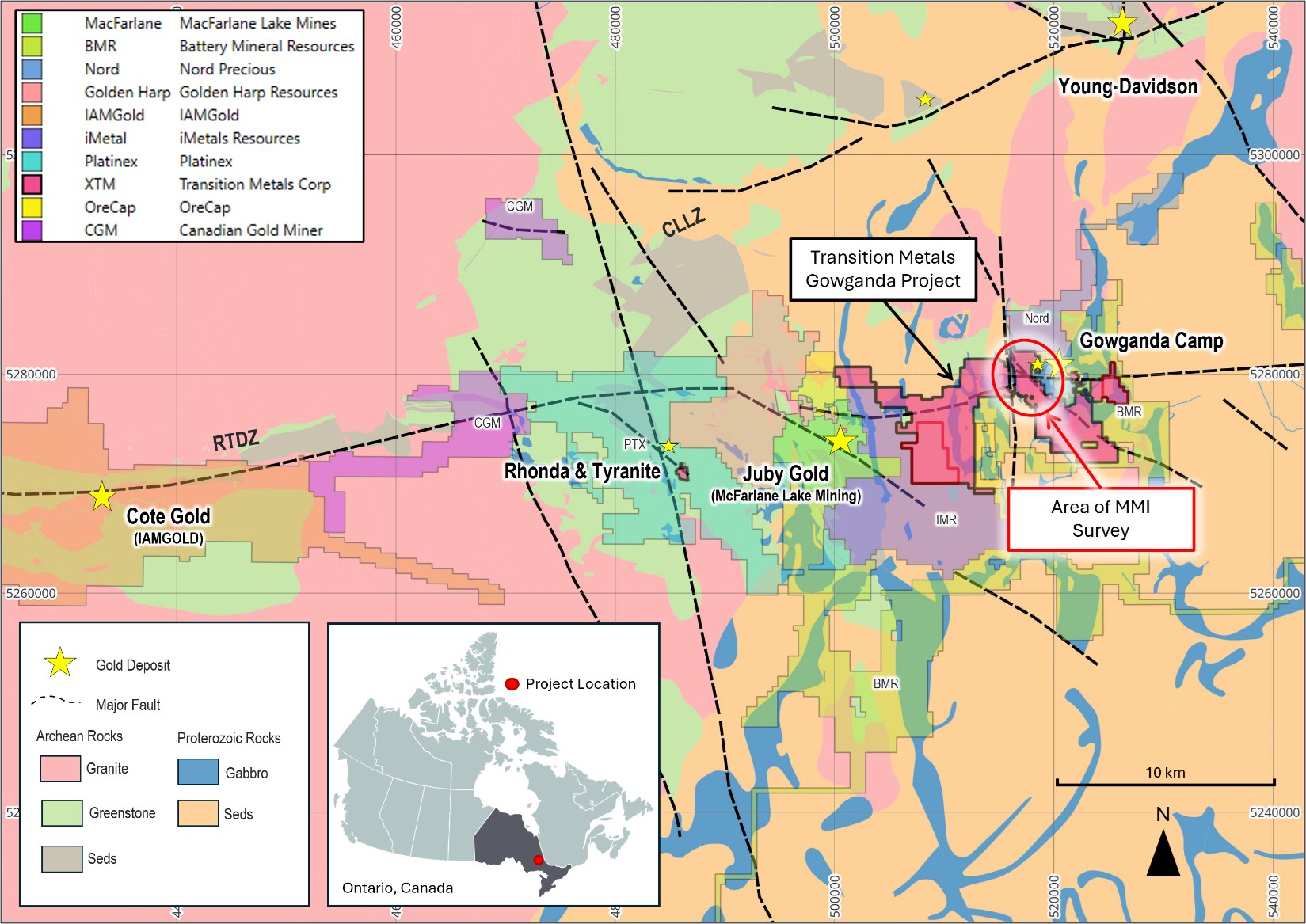
Figure 3: Property Location Sketch
To view an enhanced version of this graphic, please visit:
https://images.newsfilecorp.com/files/2766/317853_a80ef268848e0a3d_003full.jpg
The Project is located within approximately 100 kilometres of three producing gold mines: IAMGOLD Corporation's Côté Gold Mine, Alamos Gold Inc.'s Young-Davidson Mine, and Agnico Eagle Mines Limited's Macassa Mine. The Project is also located approximately 10 kilometres east of McFarlane Lake Mining Limited's Juby Project. The Company cautions that mineralization hosted on adjacent and/or nearby properties is not necessarily indicative of mineralization hosted on the Gowganda Project. Work to date on the project has included the completion of IP surveys, soil sampling, mapping, mechanical stripping and channel sampling, and 65 shallow drillholes totalling 8,741 metres targeting both Archean-hosted gold and silver-cobalt mineralization in overlying embayment rocks.
Previous drilling on the Gowganda Project returned notable gold intercepts, including 2.37 g/t Au over 7.06 metres, 82.5 g/t Au over 0.4 metres and 1.63 g/t Au over 11.52 metres (see news release dated April 6, 2017). Together with the surface and geochemical results, these intercepts support the interpretation of a structurally controlled gold system that remains open along strike and at depth. Further drilling is required to assess the continuity, geometry, and potential scale of the mineralized zones.
Approximately three kilometres east of the Haultain area, drilling completed on the Project by former partner, Battery Mineral Resources, returned high-grade silver-cobalt intervals, including 4.75 metres grading 1,475 g/t Ag, with 0.50 metres grading 13,948 g/t Ag and
Qualified Person
The technical elements of this news release have been approved by Mr. Benjamin Williams, P.Geo. (PGO), Exploration Manager of Transition Metals Corp., and a Qualified Person under National Instrument 43-101.
About Transition Metals Corp.
Transition Metals Corp. (TSXV: XTM) is a Canadian multi-commodity exploration company. Its award-winning team of geoscientists applies extensive exploration experience to generate and test new mineral exploration concepts, often in underexplored areas where properties can be acquired at an early stage. The Company advances selected projects independently and through joint ventures in which partners fund portions of higher-risk drilling and exploration, helping Transition conserve capital and limit shareholder dilution.
Further information is available at www.transitionmetalscorp.com or by contacting:
Scott McLean
President and CEO
Transition Metals Corp.
Tel: (705) 667-6178
Cautionary Note on Forward-Looking Information
Except for statements of historical fact contained herein, the information in this news release constitutes "forward-looking information" within the meaning of Canadian securities law. Such forward-looking information may be identified by words such as "plans", "proposes", "estimates", "intends", "expects", "believes", "may", "will" and include without limitation, statements regarding estimated capital and operating costs, expected production timeline, benefits of updated development plans, foreign exchange assumptions and regulatory approvals. There can be no assurance that such statements will prove to be accurate; actual results and future events could differ materially from such statements. Factors that could cause actual results to differ materially include, among others, metal prices, competition, risks inherent in the mining industry, and regulatory risks. Most of these factors are outside the control of the Company. Investors are cautioned not to put undue reliance on forward-looking information. Except as otherwise required by applicable securities statutes or regulation, the Company expressly disclaims any intent or obligation to update publicly forward-looking information, whether as a result of new information, future events, or otherwise.
Neither the TSX Venture Exchange nor its Regulation Services Provider (as that term is defined in the policies of the TSX Venture Exchange) accepts responsibility for the adequacy or accuracy of this release.

To view the source version of this press release, please visit https://www.newsfilecorp.com/release/317853
FAQ
AI-generated questions and answers. How Rhea-AI works. Not financial advice.
What did Transition Metals find in the 2026 Gowganda soil survey?
The survey identified new anomalous gold and associated element trends beneath cover and beyond previously tested areas. More than 1,300 samples were collected across approximately 2.5 by 1.5 kilometres. The company said the results expanded the Haultain exploration footprint by approximately 1,200 metres; they do not establish a mineral resource.
What are Transition Metals' next exploration steps at Gowganda?
Transition is integrating soil results with existing exploration data to rank targets, aiming toward a potential diamond drilling program in 2027. Pending channel-sampling assays will be incorporated when available. Additional surface work will be considered where warranted.
How did Transition Metals conduct the Gowganda soil survey?
Samples were collected at approximately 25-metre centres on 100-metre-spaced lines and analyzed by SGS using Mobile Metal Ion methodology. This method measures mobile metal ions that may migrate upward from deeper mineralized sources into near-surface material, helping identify possible exploration targets where bedrock is covered.