
Trinity Silver Reports Silver Grades of up to 82 g/t from Historical Nueva Chanarcillo Tailings
The 55 grams per tonne sample average does not estimate the grade of the entire tailings deposit.
Sentiment and the balance of points
Rhea-AI Sentiment reads the wording of the document, how positive or negative its language is on a 1 to 5 scale. The balance of points shown with the takes weighs what the document actually discloses, so the two can disagree, for example when a trial that missed its main goal is described in upbeat language.
Rhea-AI Summary
Trinity Silver (TOMXF) reported preliminary silver grades of up to 82 grams per tonne from historic tailings at Nueva Chañarcillo in Chile. The 39 primary samples ranged from 37 to 82 grams per tonne and averaged 55 grams per tonne. Sampling reached approximately 1.5 metres and did not establish full tailings thickness.
The company is evaluating a conceptual exploration target of approximately 135,000 to 270,000 tonnes grading 35 to 85 grams per tonne silver. This is not a mineral resource; recovery and economic viability remain unestablished. An excavator is on site, with bulk sampling scheduled for the week commencing October 19, 2026. Planned drilling, density measurements and metallurgical testing will assess quantity, grade distribution and silver recovery.
Positive
- Minor pointPreliminary silver assays averaged 55 grams per tonne across 39 primary samples, ranging from 37 to 82.
- Minor pointTrinity is evaluating a conceptual target containing approximately 152,000 to 738,000 ounces of silver before recovery allowances.
- Minor point. Forward-looking: it has not happened yet and may not happen.Bulk sampling is scheduled for the week commencing October 19, 2026, with an excavator on site.
- Minor point. Forward-looking: it has not happened yet and may not happen.Planned full-thickness drilling, sampling and density measurements will assess tailings quantity and grade distribution.
- Minor point. Forward-looking: it has not happened yet and may not happen.Planned metallurgical testing will assess silver recovery and potential processing options.
Negative
- Minor pointMetallurgical recovery and economic viability have not been established.
- Minor pointConceptual target assumptions for average thickness, dry bulk density and grade continuity remain unverified.
- Minor pointApproximately 1.5-metre sampling depth leaves deeper material and unsampled areas untested for representativeness.
- Minor pointSix of 39 primary samples lack recorded coordinates, limiting assessment of their spatial distribution.
AI-generated analysis. How Rhea-AI works. Not financial advice.


Vancouver, British Columbia--(Newsfile Corp. - October 19, 2026) - Trinity Silver Corp. (TSXV: TOM) (FSE: 5D5) ("Trinity" or the "Company") is pleased to report preliminary silver assay results from its initial tailings sampling programme at the Nueva Chañarcillo Silver Project ("Nueva Chañarcillo" or the "Project") in Chile's Atacama Region.
Highlights
Initial auger sampling returned silver grades of 37 to 82 g/t, averaging 55 g/t silver across 39 primary tailings samples.
An excavator is currently on site, with a test pit scheduled to be excavated this week to collect a bulk sample for metallurgical testing.
Follow up work will include systematic drilling and sampling to assess tailings thickness and grade distribution, together with density measurements and metallurgical testing to evaluate silver recovery.
Trinity undertook the initial programme to assess silver remaining in the historic tailings and determine whether the results warranted more detailed drilling and metallurgical investigation.
Samples were collected by auger drilling to a depth of approximately 1.5 metres. A single composite sample was collected over the entire drilled interval at each location, combining material from surface to the bottom of the hole. This approach provided an initial assessment of silver grades within the shallow tailings and a basis for planning further work.
The 39 primary samples returned silver grades ranging from 37 to 82 g/t, averaging 55 g/t silver. The encouraging results support advancing the investigation through deeper drilling, systematic sampling and metallurgical testing. The initial holes did not establish the full thickness of the tailings.
The results provide a basis for further investigation of silver remaining within the historic tailings, including assessment of deposit geometry and metallurgical characteristics.
Further Evaluation Planned
Following the encouraging initial results, Trinity is advancing a follow up programme to assess the scale and grade distribution of the tailings and investigate potential silver recovery.
An excavator is currently on site and is scheduled to excavate a pit during the week commencing 19 October 2026 to collect a bulk sample for metallurgical testing. The testwork will assess how effectively silver can be recovered and help identify potential processing options.
The planned programme also includes systematic drilling and sampling through the full tailings thickness to establish the base of the deposit and assess changes in silver grade across the site and with depth. Surveying and representative dry bulk density measurements will support a more reliable assessment of the quantity of material.
The results will guide subsequent evaluation of the tailings. Metallurgical recovery and economic viability have not yet been established.
Conceptual Tailings Exploration Target
The Company is evaluating a proposed conceptual exploration target of approximately 135,000 to 270,000 tonnes grading 35 to 85 g/t silver within the historic tailings deposit. This is equivalent to approximately 152,000 to 738,000 ounces of contained silver before any allowance for metallurgical recovery.
The potential quantity and grade of the exploration target are conceptual in nature. There has been insufficient exploration to define a mineral resource, and it is uncertain whether further exploration will result in the target being delineated as a mineral resource.
The proposed tonnage range is based on a tailings footprint of approximately 42,270 square metres (4.23 hectares), delineated using ArcGIS by the Company's geologist. The calculation assumes an average tailings thickness of two to four metres and a dry bulk density of 1.6 tonnes per cubic metre. Multiplying the mapped footprint by these assumed parameters produces approximately 135,000 to 270,000 tonnes, rounded.
The thickness range incorporates an initial two metre working assumption and subsequent field observations suggesting that exposed sections may approach four metres. These observations do not establish average thickness across the deposit. The basal surface has not been systematically delineated, and the density assumption requires confirmation through representative measurements.
The proposed silver grade range of 35 to 85 g/t is based on rounding outwards the observed sample grades of 37 to 82 g/t. Its application to the wider tailings deposit remains an assumption to be tested through further drilling and sampling.
The initial auger samples tested the upper approximately 1.5 metres of the tailings. Whether these results represent material at greater depth or in unsampled areas has not been established. The planned systematic drilling, sampling and density measurements will test the assumptions underlying the exploration target, which may change as further information becomes available.
No mineral resource or mineral reserve has been established for these tailings. Metallurgical recovery and economic viability have not been demonstrated.
Management Commentary
Thomas Wood, CEO of Trinity Silver, commented:
"The initial programme has returned encouraging silver grades and gives us a clear reason to advance our assessment of the tailings. With an excavator already on site, we plan to collect a bulk sample this week. We are also planning a further programme to better define the thickness and grade distribution of the material.
"Our next step is to establish how effectively the silver can be recovered and develop a better understanding of the scale of the opportunity. This work complements our broader silver exploration programme at Nueva Chañarcillo."
Preliminary Silver Assay Results
Table 1 presents the preliminary silver assay results for the 39 primary tailings samples. Each result represents a single composite collected over an approximately 1.5 metre auger hole.
Table 1: Preliminary silver assay results
| Sample ID | Silver (g/t) | Sample ID | Silver (g/t) |
| 0606701 | 49 | 0606722 | 37 |
| 0606702 | 57 | 0606723 | 48 |
| 0606703 | 50 | 0606724 | 42 |
| 0606704 | 48 | 0606725 | 57 |
| 0606705 | 82 | 0606726 | 67 |
| 0606706 | 68 | 0606727 | 55 |
| 0606707 | 63 | 0606728 | 50 |
| 0606708 | 57 | 0606729 | 63 |
| 0606709 | 67 | 0606731 | 68 |
| 0606710 | 56 | 0606732 | 57 |
| 0606711 | 58 | 0606733 | 40 |
| 0606713 | 49 | 0606734 | 46 |
| 0606714 | 62 | 0606735 | 64 |
| 0606715 | 58 | 0606736 | 41 |
| 0606716 | 72 | 0606737 | 62 |
| 0606717 | 66 | 0606738 | 51 |
| 0606718 | 41 | 0606739 | 53 |
| 0606719 | 39 | 0606741 | 43 |
| 0606720 | 43 | 0606742 | 76 |
| 0606721 | 39 |
The reported average of 55 g/t silver is the average of the 39 primary sample results, rounded to the nearest whole gram per tonne. It does not represent an estimate of the average grade of the entire tailings deposit.
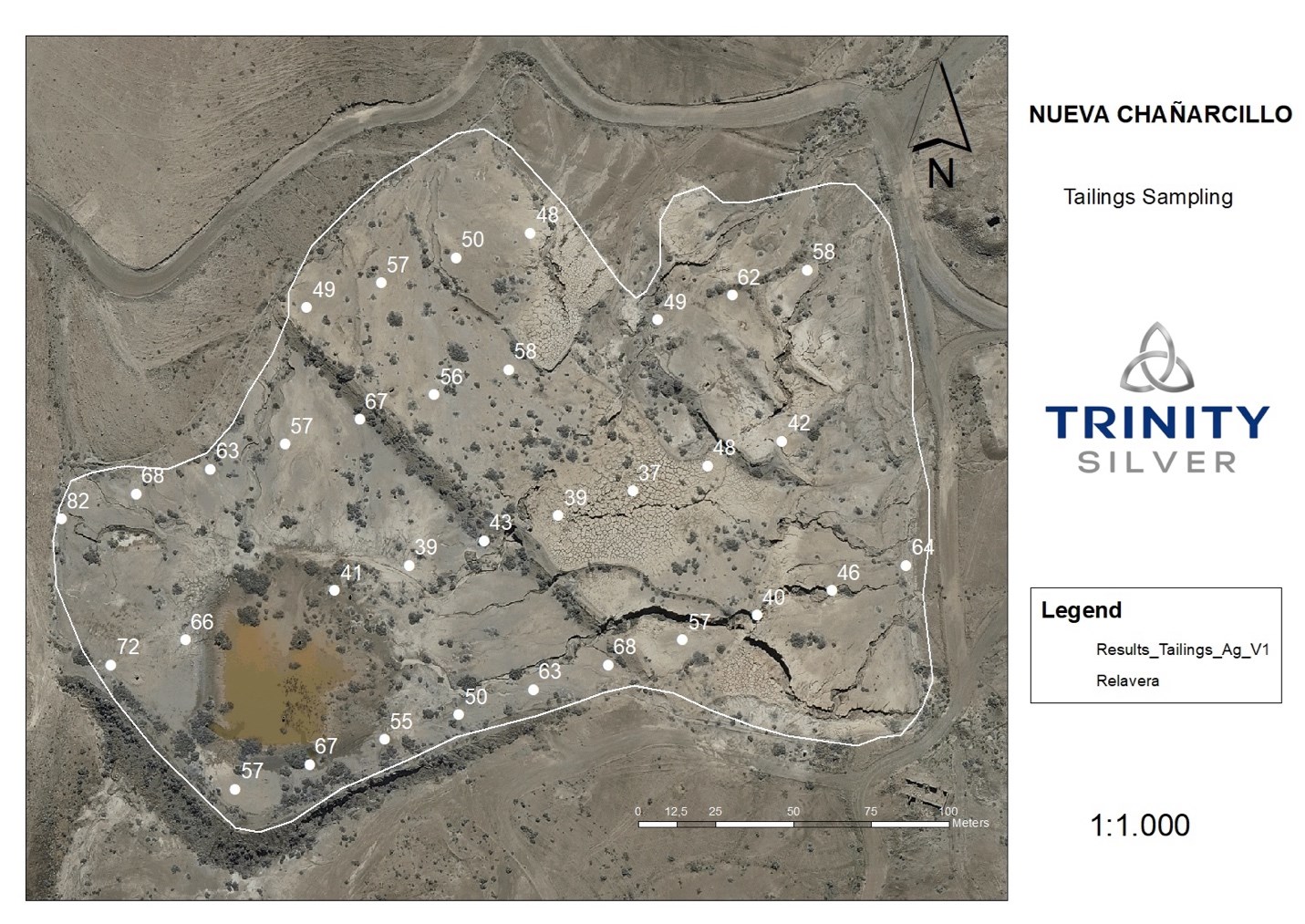
Map 1: Outlined historical tailings area showing sample points with sampled silver grade in g/t
To view an enhanced version of this graphic, please visit:
https://images.newsfilecorp.com/files/4933/319680_06741c4c544dc824_001full.jpg
Qualified Person
Enkhtuvshin Khishigsuren, P.Eng., a geological consultant to the Company and a Qualified Person as defined by National Instrument 43-101, Standards of Disclosure for Mineral Projects, has reviewed and approved the scientific and technical information contained in this news release.
The disclosure is based on preliminary laboratory results, the mapped tailings footprint and field observations. The unresolved sampling and estimation limitations are described above. The assumed average thickness, dry bulk density and grade continuity throughout the target volume have not been verified.
Sampling, Analysis and Data Limitations
The initial programme comprised 39 primary tailings samples collected by auger drilling to approximately 1.5 metres, with a single composite sample collected over the entire drilled interval at each location. The laboratory recorded received sample masses ranging from 5.5 to 15.0 kilograms for the 39 primary samples.
Samples were submitted to Andes Analytical Assay SpA ("3AAA"), a commercial laboratory engaged by Metales de Chile SpA, for preparation in Copiapó and analysis in Quilicura, Santiago, Chile. Silver was determined by four acid digestion followed by atomic absorption spectrometry, with a lower reporting limit of 2 g/t silver.
Quality control included blanks and duplicate samples, together with laboratory reference materials and repeat analyses. Control and duplicate results are excluded from the reported primary sample dataset and average grade.
Coordinates are available for 33 of the 39 primary sampling locations. The remaining six samples lack recorded coordinates, limiting assessment of their spatial distribution. The initial sampling tested shallow tailings only, and silver grades through the full deposit thickness remain to be established.
About Nueva Chañarcillo
Nueva Chañarcillo is located approximately 65 kilometres south of Copiapó in Chile's Atacama Region. Trinity is advancing the Project under the option arrangements announced on 10 August 2026. The tailings assessment forms part of the Company's evaluation of historical mine material and the Project's broader silver exploration potential.
About Trinity Silver Corp.
Trinity Silver Corp. is a Canadian mineral exploration company focused on advancing silver projects in South America. Its portfolio includes the historic Nueva Chañarcillo silver project and the El Nevado gold and silver project in Chile, together with Silver-1 in Ecuador. The Company aims to build shareholder value through discovery, disciplined capital allocation and the systematic advancement of its projects.
For further information:
Thomas Wood
Chief Executive Officer
twood@qcap.com.au
Cautionary Note Regarding Forward-Looking Information
This news release contains forward looking information within the meaning of applicable Canadian securities laws. Such information includes statements regarding the interpretation and significance of the preliminary tailings results; the proposed conceptual exploration target and its underlying assumptions; planned excavation and bulk sample collection during the week commencing 19 October 2026; systematic drilling and sampling through the full tailings thickness; surveying and dry bulk density measurements; metallurgical testing to assess silver recovery and potential processing options; and the scope, timing and objectives of further exploration and evaluation at Nueva Chañarcillo.
Forward-looking information reflects management's expectations as at the date of this release and is based on assumptions concerning the reliability of sampling and analytical information; the interpretation of tailings geometry, density and grade distribution; the availability of funding, equipment, contractors, technical personnel and laboratory capacity; suitable site conditions and continued access; the receipt and maintenance of necessary approvals; and the Company's ability to maintain its project and option rights.
Actual results, timing and outcomes may differ materially because of changes to preliminary assay results or interpretations; incomplete sampling records or location information; sampling bias or unrepresentative bulk samples; variations in tailings thickness, density, composition or silver grade; lower than anticipated metallurgical recovery; processing costs; equipment or contractor availability; laboratory delays; adverse site conditions; environmental or permitting restrictions; funding constraints; failure to satisfy option obligations; and other risks disclosed in the Company's filings available on SEDAR+.
The potential quantity and grade of the exploration target are conceptual in nature. There has been insufficient exploration to define a mineral resource, and it is uncertain whether further exploration will result in the target being delineated as a mineral resource. Further work may materially change the exploration target. No mineral resource or mineral reserve has been established for these tailings, and metallurgical recovery and economic viability have not been demonstrated.
There can be no assurance that the planned work will proceed within the anticipated timeframe or produce the expected results. Readers should not place undue reliance on forward looking information. Except as required by applicable law, the Company does not undertake to update or revise such information, whether as a result of new information, future events or otherwise.
Neither the TSX Venture Exchange nor its Regulation Services Provider (as that term is defined in the policies of the TSX Venture Exchange) accepts responsibility for the adequacy or accuracy of this release.

To view the source version of this press release, please visit https://www.newsfilecorp.com/release/319680
FAQ
AI-generated questions and answers. How Rhea-AI works. Not financial advice.
What silver grades did Trinity Silver report at Nueva Chañarcillo?
Trinity reported preliminary grades of 37 to 82 grams per tonne silver, averaging 55 grams per tonne across 39 primary tailings samples. Each sample combined material over an approximately 1.5-metre auger hole. The average is not an estimate of the grade of the entire tailings deposit.
What assumptions underpin Trinity Silver's Nueva Chañarcillo tailings exploration target?
The conceptual target uses a mapped footprint of approximately 42,270 square metres, assumed average thickness of two to four metres and assumed dry bulk density of 1.6 tonnes per cubic metre. The 35 to 85 grams per tonne silver range rounds the observed grades outward. Average thickness, density and grade continuity remain unverified.