
Outer Rim Exploration Detects Copper Mineralization Using OreScope Muon Imaging at Transatlantic Monitor Project
Transatlantic Mining (OTC:TRRGF) and Outer Rim Exploration completed a muon imaging survey at the Monitor Copper-Gold Project in Idaho, marking the first North American deployment of ORE's portable muon hodoscope for mining.
Sentiment and the balance of points
Rhea-AI Sentiment reads the wording of the document, how positive or negative its language is on a 1 to 5 scale. The balance of points shown with the takes weighs what the document actually discloses, so the two can disagree, for example when a trial that missed its main goal is described in upbeat language.
Rhea-AI Summary
Transatlantic Mining (OTC:TRRGF) and Outer Rim Exploration completed a muon imaging survey at the Monitor Copper-Gold Project in Idaho, marking the first North American deployment of ORE's portable muon hodoscope for mining.
The OreScope muon imaging detected the known chalcopyrite-bearing structure and highlighted multiple new high-density anomalies that may represent extensions of the copper mineralized system, supporting future drill targeting and mine planning.
Positive
- Successful muon imaging detection of known chalcopyrite-bearing copper structure underground
- Multiple new high-density anomalies identified as potential extensions of copper mineralization
- Quantitative density correlation r = 0.46 (p < 0.001) with geological model
- 3D density reconstruction generated from multiple detector placements
- First North American deployment of ORE's portable muon hodoscope for mining
- Imaging results may support optimised drill targeting and reduced exploration uncertainty
Negative
- None.
AI-generated analysis. How Rhea-AI works. Not financial advice.




Vancouver, British Columbia--(Newsfile Corp. - May 11, 2026) - Transatlantic Mining Corp. (TSXV: TCO) (the "Company") and Outer Rim Exploration (ORE) announce the successful completion of a muon imaging survey at the Monitor Copper-Gold Project in Idaho, marking the first North American deployment of ORE's portable muon hodoscope for mineral exploration.
The underground campaign successfully detected a density anomaly aligned with the known steeply dipping chalcopyrite-bearing structure and identified additional high-density targets that may represent extensions of the copper mineralized system using the "OreScope" TM Imaging technique.
The survey was designed to evaluate the continuity and potential extensions of the copper mineralization and to improve understanding of the subsurface structure. The modelling and imaging provide higher confidence on highly localized information to better optimise the drill targeting. ORE's muon imaging helps characterize the density structure and, in the future, could define new drill targets and then from the drilling itself. The results demonstrate that muon-derived density imaging can detect narrow mineralized structures and generate exploration targets from an underground deployment position.
Successful Detection of Known Copper Mineralization
The underground deployment produced density contrast maps revealing a coherent high-density feature aligned with the known chalcopyrite vein. The anomaly's location, orientation, and inferred dip are consistent with the geological ground-truth model.
Quantitative comparison between measured and hypothesized densities yields a correlation coefficient of r = 0.46 (p < 0.001), indicating a statistically significant agreement.
The inferred dip of the anomaly is consistent with the approximate 80° dip indicated by geological mapping in the adit, supporting the interpretation that the detected feature corresponds to the known copper-bearing structure.
"These maiden muon trial results are highly encouraging," said Bernie Sostak, CEO of Transatlantic Mining. "The imaging survey identified a density anomaly consistent with our known chalcopyrite mineralization and highlighted additional areas that may represent extensions of the known system. This provides valuable information to guide and target follow-up exploration and drilling."
New Exploration Targets Identified
In addition to confirming the known vein, the survey identified multiple high-density anomalies outside the modeled extent of the mineralization.
These include:
- A prominent ~3-sigma density anomaly (~2.95 g/cm³) adjacent to the known vein
- Additional ~2-sigma anomalies (~2.7 g/cm³) spatially clustered near the target zone
- Independent high-density features observed across multiple viewing angles
These anomalies may represent extensions of the mineralized system given that there are no drillholes in the vicinity of the Adit, again to provide targets for future drilling campaigns.
3D Density Model Generated
Data from multiple detector placements were combined to generate a 3D density reconstruction of the surveyed volume. The model highlights zones of elevated density consistent with both the known mineralization and newly identified anomalies.
Maiden North American Deployment
The campaign represents the first North American deployment of ORE's portable muon hodoscope for mining applications. The detector was deployed underground in a battery-powered, passive configuration, operating continuously over multiple weeks.
The system was used to evaluate mineralization continuity and characterize subsurface density variations without drilling or active radiation sources.
Exploration and Mine Planning Impact
By imaging both mineralized zones and surrounding density variations, the survey provides insights into orebody geometry and potential extensions of copper mineralization. These results may support future drill targeting, mine planning, and reduction of exploration uncertainty.
"The value of this technology is that it helps us see beyond isolated drill-hole data," said Sostak. "At Monitor, ORE's muon imaging provided a new view of the density structure between known points, highlighted potential extensions of the mineralized system, and gave us actionable targets for follow-up drilling. This can translate directly into optimised targeting, fewer wasted meters, and additional exploration decisions."
Exploration Implications
The successful detection of the known chalcopyrite vein, together with identification of additional density anomalies, supports the use of muon imaging as a complementary exploration method for targeting dense sulfide mineralization.
Further deployments may refine the geometry and continuity of the identified targets and expand coverage beyond the initial survey area.
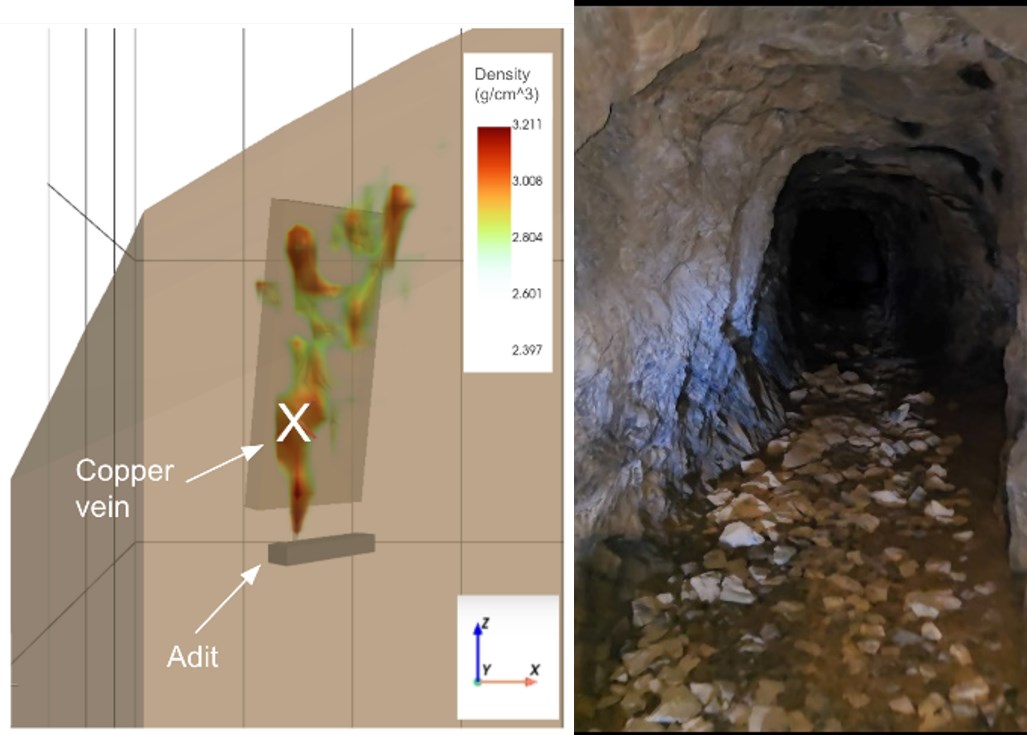
ORE Modelled 3d density prediction (left) and Anvil Adit (right) in Idaho
To view an enhanced version of this graphic, please visit:
https://images.newsfilecorp.com/files/4652/296869_f2cd391ee431d8c1_001full.jpg
About Transatlantic Mining Corp.
Transatlantic Mining Corp. is focused on advancing high-grade copper and gold assets in the United States, including the Monitor Copper-Gold Project in Idaho.
About Outer Rim Exploration
Outer Rim Exploration develops muon imaging technology for subsurface density mapping in mineral exploration, mining, and geotechnical applications. The company's portable, battery-powered hodoscope systems enable passive imaging of mineralized structures and voids from underground or surface deployments.
Media Contact
| Transatlantic Mining Corporation Elaine Einarson Investor Relations eeinarson@transatlanticminingcorp.com www.Transatlanticminingcorp.com | Outer Rim Exploration Inc Jeremy Anderson CEO support@ore.space www.outerrimexploration.com |
About Transatlantic Mining Corp.
Transatlantic Mining (TSX-V: TCO) is an emerging precious and base metal explorer. The Company has a focus on converting projects into mines within stable mining jurisdictions. The Company currently has property interests including an
ON BEHALF OF THE BOARD OF DIRECTORS
" Bernie Sostak"
For more information contact
eeinarson@transatlanticminingcorp.com
604-614-8469
Neither the TSX Venture Exchange nor its Regulation Services Provider (as that term is defined in the policies of the TSX Venture Exchange) accepts responsibility for the adequacy or accuracy of this release

To view the source version of this press release, please visit https://www.newsfilecorp.com/release/296869
FAQ
AI-generated questions and answers. How Rhea-AI works. Not financial advice.