
TappAlpha Adds S&P 500® Naming to TSPY and Reduces Costs Through VOO Transition
TappAlpha (NASDAQ:TSPY) announced enhancements to its flagship ETF, including adding S&P 500 naming via a licensing agreement and lowering underlying fund costs by transitioning to the Vanguard S&P 500 ETF (VOO).
Sentiment and the balance of points
Rhea-AI Sentiment reads the wording of the document, how positive or negative its language is on a 1 to 5 scale. The balance of points shown with the takes weighs what the document actually discloses, so the two can disagree, for example when a trial that missed its main goal is described in upbeat language.
Rhea-AI Summary
TappAlpha (NASDAQ:TSPY) announced enhancements to its flagship ETF, including adding S&P 500 naming via a licensing agreement and lowering underlying fund costs by transitioning to the Vanguard S&P 500 ETF (VOO).
The fund keeps its TSPY ticker, core strategy, daily covered call income, and tax-efficient profile.
Positive
- S&P 500 naming added through S&P Dow Jones Indices licensing
- Fund renamed to TappAlpha S&P 500 Growth and Daily Income ETF
- Transition to VOO lowers underlying costs by about 6.45 bps annually
- Ticker TSPY, investment strategy, and options income overlay remain unchanged
- Maintains daily covered call income and monthly distribution framework
- No change to CUSIP or shareholder account details
Negative
- None.
Details
News Market Reaction – TSPY
On Jun 2, the day this news came out, TSPY closed 1.22% below the previous close.
Data tracked by StockTitan Argus for the Jun 2 session.
Key Figures
- Cost reduction
- 6.45 basis points annually
- Underlying fund costs reduced via transition to Vanguard S&P 500 ETF
Historical Context
-
TSPY reported surpassing $500M AUM, doubling assets in four months.
-
AUM surpassed $250M three months after reaching $100M, reflecting rapid growth.
-
Launch of T² Lift™ Series ETFs offering 30% additional exposure to core strategies.
24h Move is the share-price change in the day after each event; other market factors may also have contributed.
Key Terms
s&p 500 financial
etf financial
expense ratio financial
basis points financial
covered call financial
cusip regulatory
AI-generated analysis. How Rhea-AI works. Not financial advice.




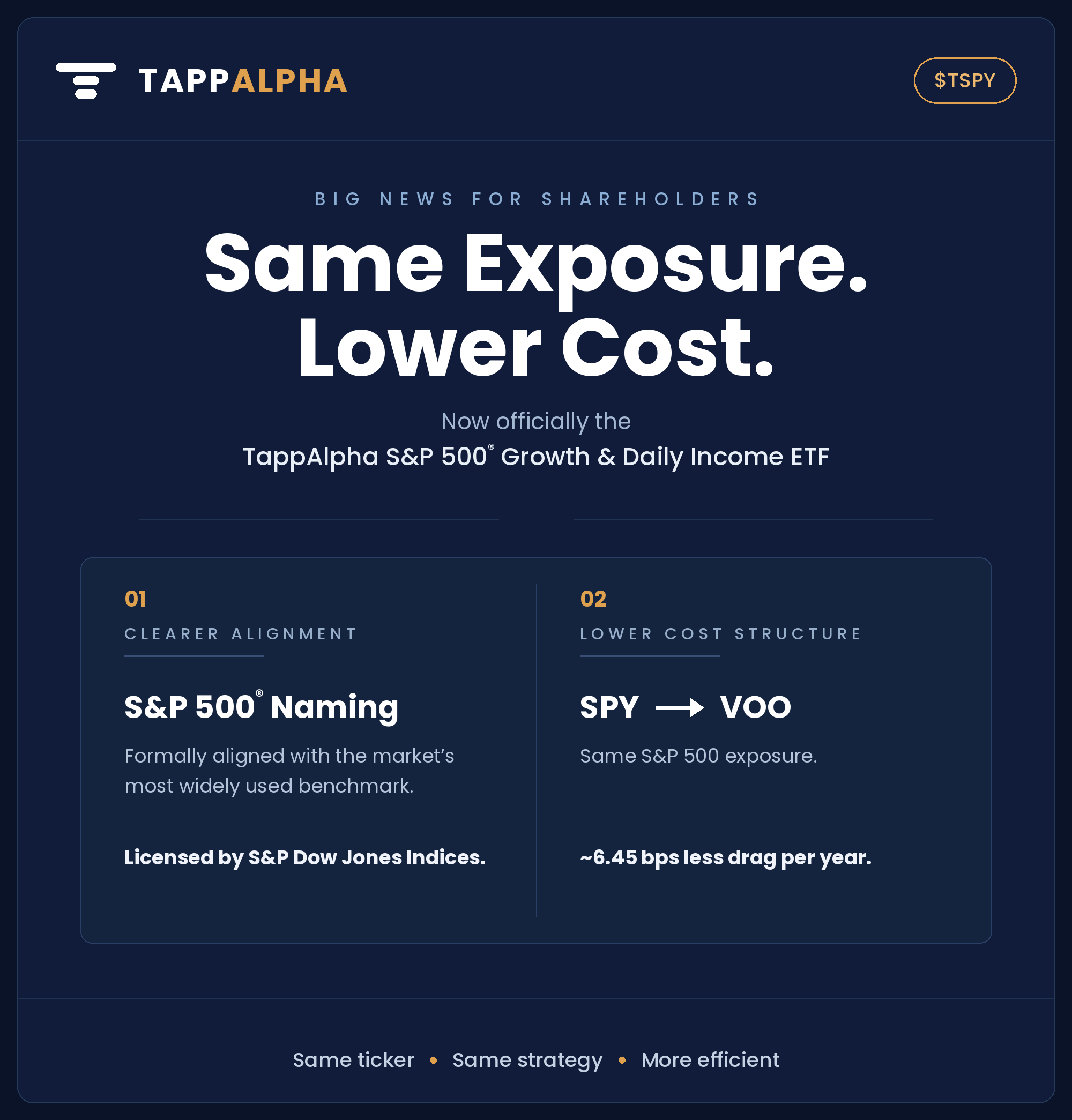
SEATTLE, June 02, 2026 (GLOBE NEWSWIRE) -- TappAlpha today announced two enhancements to its flagship ETF, TSPY: the addition of S&P 500® naming through a licensing agreement with S&P Dow Jones Indices, and a reduction in underlying fund costs through a transition to the Vanguard S&P 500 ETF.
The fund will be renamed the TappAlpha S&P 500 Growth and Daily Income ETF, while maintaining its ticker (TSPY), investment strategy, and options-based income strategy.
S&P 500® Naming: Clearer Alignment with the Market Benchmark
Through its licensing agreement with S&P Dow Jones Indices, TSPY now formally references the S&P 500® Index — the benchmark most widely used by investors to measure U.S. equity exposure.
For shareholders, this provides clearer alignment between the fund’s positioning and the benchmark it is designed to track and enhance.
“The S&P 500 is the foundation of many portfolios,” said Si Katara, Founder and CEO of TappAlpha. “This update brings added clarity to how TSPY is positioned — combining that core exposure with a disciplined income overlay.”
Transition to VOO: Lower Costs, Same Exposure
TSPY will also transition its underlying exposure from the SPDR S&P 500 ETF Trust to the Vanguard S&P 500 ETF. Both ETFs track the S&P 500® Index, but VOO carries a lower expense ratio.
This change reduces underlying costs by approximately 6.45 basis points annually, improving net outcomes for shareholders over time.
“When we can deliver the same exposure more efficiently, it’s an easy decision — those benefits should flow through to our shareholders,” Katara added.
What Remains Unchanged
TSPY’s core structure and strategy remain intact:
- Ticker: TSPY
- S&P 500® equity exposure
- Daily covered call income strategy
- Monthly distribution framework
- Tax-efficient profile
- No change to CUSIP or shareholder account details
For more information on TappAlpha ETFs, visit TappAlphaFunds.com.
About TappAlpha
TappAlpha builds Growth + Income ETFs designed to help investors stay invested while generating income. Through disciplined, rules-based strategies on core market exposures, the firm focuses on delivering practical outcomes for advisors and long-term investors.
Disclosures
Investors should carefully consider the investment objectives, risks, charges and expenses of the ETFs identified on this site. This and other important information about the Fund are contained in the prospectus, which can be obtained by visiting tappalphafunds.com or by calling (844) 403-2888. The prospectus should be read carefully before investing.
Investing in securities involves risk, including the potential loss of principal. You could lose money by investing in the Fund and the Fund may not achieve its investment objectives.
ETFs are subject to additional risks that do not apply to conventional mutual funds, including the risks that the market price of an ETF’s shares may trade at a premium or discount to its net asset value, an active secondary trading market may not develop or be maintained, or trading may be halted by the exchange in which they trade, which may impact a Fund’s ability to sell its shares. Shares of any ETF are bought and sold at market price (not NAV) and are not individually redeemed from the Fund. Brokerage commissions will reduce returns.
The SPDR® S&P 500® ETF Trust. The SPDR® S&P 500® ETF Trust seeks to provide investment results that, before expenses, correspond generally to the price and yield performance of the S&P 500® Index (the “Index”).
The S&P 500® Index. The S&P 500® Index is a widely recognized benchmark index that tracks the performance of 500 of the largest U.S.- based companies listed on the New York Stock Exchange or Nasdaq. These companies represent approximately
The Fund invests in options contracts that are based on the value of the Index, including SPX and XSP options for TSPY and XND and NQX options for TDAQ. This subjects the Fund to certain of the same risks as if it owned shares of companies that comprised the Index, even though it does not own shares of companies in the Index. The Fund will have exposure to declines in the Index. The Fund is subject to potential losses if the Index loses value, which may not be offset by income received by the Fund. To the extent that the Fund invests in other ETFs or investment companies, the value of an investment in the Fund is based on the performance of the underlying funds in which the Fund invests and the allocation of its assets among those ETFs or investment companies. The Fund may incur high portfolio turnover to manage the Fund’s investment exposure. The Fund is classified as “non-diversified” under the 1940 Act.
As of the date of this prospectus, the Fund has no operating history and currently has fewer assets than larger funds. Like other new funds, large inflows and outflows may impact the Fund’s market exposure for limited periods of time. This impact may be positive or negative, depending on the direction of market movement during the period affected.
Due to the short time until their expiration, 0DTE options are more sensitive to sudden price movements and market volatility than options with more time until expiration. Because of this, the timing of trades utilizing 0DTE options becomes more critical.
Even a slight delay in the execution of 0DTE trades can significantly impact the outcome of the trade. 0DTE options may also suffer from low liquidity, making it more difficult for the Fund to enter into its positions each morning at desired prices. The bid-ask spreads on 0DTE options can be wider than with traditional options, increasing the Fund's transaction costs and negatively affecting its returns. These risks may negatively impact the performance of the fund.
While the adviser intends to manage the Fund in a tax-efficient manner, there can be no assurance that it will be able to do so. Prospective investors should not invest in the Fund with an expectation that they will realize any tax benefits. Nothing in this communication constitutes tax advice. Investors are urged and advised to consult their own tax adviser with respect to the tax consequences of an investment in a Fund.
Distributor: Foreside Fund Services, LLC
For Media Inquires:
Contact TappAlpha
info@tappalpha.com
A photo accompanying this announcement is available at https://www.globenewswire.com/NewsRoom/AttachmentNg/73787ab0-9851-4ccd-91a6-2a2e9ef47c92

FAQ
AI-generated questions and answers. How Rhea-AI works. Not financial advice.