
U.S. GOLD CORP. DELIVERS ROBUST FEASIBILITY STUDY FOR CK GOLD PROJECT HIGHLIGHTING ATTRACTIVE ECONOMICS AND DETAILING RELATIVE LOW DEVELOPMENT RISK
U.S. Gold Corp (NASDAQ: USAU) released a Feasibility Study for the CK Gold Project (March 31, 2026) showing an after-tax NPV5% of $632M and a 27% IRR at base-case prices, and $1.30B NPV with 45% IRR at recent spot prices.
Sentiment and the balance of points
Rhea-AI Sentiment reads the wording of the document, how positive or negative its language is on a 1 to 5 scale. The balance of points shown with the takes weighs what the document actually discloses, so the two can disagree, for example when a trial that missed its main goal is described in upbeat language.
Rhea-AI Summary
U.S. Gold Corp (NASDAQ: USAU) released a Feasibility Study for the CK Gold Project (March 31, 2026) showing an after-tax NPV5% of $632M and a 27% IRR at base-case prices, and $1.30B NPV with 45% IRR at recent spot prices. The fully permitted, 11-year open-pit plan targets 931 koz AuEq production with average LOM sales of 85 koz AuEq and initial capex of $394M. The study highlights low strip ratio (0.89:1), average LOM co-product AISC of $1,814/oz AuEq, strong early free cash flow, and local permitting and community support.
Positive
- After-tax NPV5% of $632M at base-case prices
- After-tax IRR of 27% (base case) and 45% at spot prices
- Payback period of 2.5 years (base case)
- Fully permitted to begin construction with $5M reclamation bond
- Strong production: 931 koz AuEq over 11 years (85 koz AuEq average)
- Manageable initial capex of $394M (includes $47M contingency)
Negative
- LOM co-product AISC of $1,814/oz AuEq (moderate cost exposure)
- Relatively short initial mine life of 11 years in the base-plan
- Required initial capital of $394M before financing is secured
- Reclamation liability of $27M (LOM estimate)
Details
News Market Reaction – USAU
On Mar 31, the day this news came out, USAU closed 8.50% above the previous close.
Data tracked by StockTitan Argus for the Mar 31 session.
Key Figures
- After-tax NPV5% (base)
- $632M
- CK Gold Project FS, base metal prices
- After-tax IRR (base)
- 27%
- CK Gold Project FS, base metal prices
- After-tax NPV5% (spot)
- $1.30B
- CK Gold Project FS, recent spot metal prices
- Initial capital cost
- $394M
- CK Gold Project initial capex incl. contingency
- Year 2–8 avg FCF
- $160M
- Average after-tax free cash flow, years 2–8
- Mine life
- 11 years
- Operating mine life in feasibility study
- Total AuEq production
- 931 koz AuEq
- Total payable gold-equivalent over mine life
- LOM AISC (AuEq)
- $1,814/oz AuEq
- Life-of-mine all-in sustaining cost, co-product basis
Historical Context
-
Participation in Lytham Partners investor summit webcast to reach new investors.
-
Addition to GDXJ ETF as part of quarterly rebalance for junior gold miners.
-
Corporate presentation and Q&A at Emerging Growth Conference to highlight strategy.
-
$31.2M equity financing to fund CK Gold Project development and exploration.
-
Participation in Mines & Money Resourcing Tomorrow conference in London.
24h Move is the share-price change in the day after each event; other market factors may also have contributed.
Key Terms
net present value financial
internal rate of return financial
all-in sustaining cost financial
net smelter return financial
ordinary kriging technical
S-K 1300 regulatory
technical report summary regulatory
all-in sustaining cost (AISC) financial
AI-generated analysis. How Rhea-AI works. Not financial advice.




- Solid Project returns: After-tax net present value ("NPV")
5% of$632 million 27% after-tax internal rate of return ("IRR") using base case metal prices of$3,250 $4.50 $40 $1.30 billion 45% after-tax IRR using recent spot metal prices of$4,500 $5.50 $70 - Fully permitted: All required permits to begin construction are in-hand.
$5M - Initial 11-yr mine-life: Current fully permitted mine plan focused on 1.6 million1 ("Moz") of contained gold equivalent ("AuEq") ounces, as stated in Mineral Reserves.
- Attractive production profile focused on early higher grades: After 1 year of ramp up, average sales of 102 thousand ounces ("koz") AuEq from year 2 to 8, with average life of mine ("LOM") sales of 85 koz AuEq at total cash costs of
$1,748 - Simple, robust, financeable Project: Total initial capital cost of
$394 $28 $47 million $35 - Competitive Project metrics3: Base case post tax NPV-to-capex ratio of 1.6 and payback of 2.5 years; spot price NPV-to-capex ratio and payback improve to 3.3 and 1.6 years, respectively.
- Strong free cash-flow profile in early years2: Excellent profitability after initial ramp up at beginning of mine life; Year 2-8 average after-tax free cash flow of
$160 - Simple, compact Project layout and processing: ~80-acre open pit is the source of ore and waste rock to mine facilities all within a 1.5-mile haul. The ore is fed to a primary crusher or low-grade stockpile. Primary crushed ore is ground in a semi-autogenous grinding (SAG) - ball mill comminution circuit prior to flotation, regrind of rougher concentrate before final flotation to produce a clean gold rich copper concentrate. Dry-stack tailings enhance the most efficient use of water.
- Significant benefits to State and local communities: Excellent local support for Project development built upon years of engagement and
2.1% royalty payments earmarked for grades K-12 education; an average of 198 direct permanent jobs are expected to be created at CK. - No cultural impacts revealed: The surrounding land was settled as the railroad developed 3-miles to the south of the Project in the 1860's. The State mineral and surface leases are surrounded by ranch land currently operated by the fifth generation of the original owners. Archaeological surveys have identified no significant artifacts or sites in the Project area.
- Significant scarcity value: CK is one of the few fully permitted large-scale precious metals projects in the
U.S. at the Feasibility Study level and is actively being advanced. - Visibility on short and long-term growth: Significant measured and indicated resource material has been excluded from the initial mine plan to avoid impacting a dry drainage channel. With known resources at depth, mine expansion at depth and along strike will be the focus of future plans and expansion to the permitted activity; CK is one of the few permitted undeveloped gold and copper resources in the
U.S. with a discernable pathway to expansion. - Aggregate Potential: Additional revenue from aggregate production has largely been excluded from the feasibility study. Anticipate increased aggregate sales into the Rocky Mountain region as the gold and copper mine progresses.
- Reclamation Savings: Potential to reduce reclamation costs as the city and state consider the use of the ultimate pit as recreation and water reservoir.
- Excellent timing: With the FS now complete and full permits in hand, the Project is positioned to advance in a current gold–copper-silver price environment that is one of the strongest in history, supported by favorable
U.S. sentiment toward domestic production and mineral security tailwinds.
(1) Gold equivalent calculated using mineral reserve reporting criteria metal prices:$2,100 $4.10 $27
(2) See Cautionary Note Regarding Non-GAAP Financial Measures.
(3) NPV-to-capex ratio calculated as after-tax Project NPV5% divided by total initial capital cost.
George Bee, President, CEO and Director of US Gold commented: "The Feasibility Study is the culmination of 5-years of work to engineer and permit a
The feasibility-level engineering, metallurgy, and capital and operating costing have been conducted with a view to continuing into a smooth transition to detailed engineering and Project execution once Project financing is secured. With permits already in place, delivery of the FS allows interested parties to assess the Project from a number of avenues for Project financing including debt, equity, off-take and other vehicles to secure the initial capital. With a manageable capex quantum, relatively low execution risk, advancing CK provides the Company with the ability to generate long-term value for our shareholders, the State or
US Gold will host a conference call and webcast to discuss the FS on Wednesday, April 1, 2026 at 4:00 PM Eastern Time / 1:00 PM Pacific Time, featuring a presentation from the senior management team and a live Q&A session. A recording will be available on US Gold's corporate website. To register for the webcast, please use the following link (call details are listed below): US Gold Feasibility Study Webcast
Feasibility Study Summary
The FS confirms robust economics for a low-cost, large-scale, conventional open pit feeding a simple copper-gold concentrator process plant, with competitive operating costs and high rate of return. The FS outlines total production of: 931 koz AuEq over an 11-year operating mine life (followed by two years of closure), resulting in an average LOM annual production profile of 85 koz AuEq per annum at an AISC of
The Company retained Halyard-Micon International, Inc. ("Halyard") as lead engineer, along with other engineering consultants, to complete the FS and prepare a technical report summary in accordance with U.S. Securities and Exchange Commission's Regulation S-K, Subpart 1300 disclosure requirements for registrants with material mining operations ("S-K 1300"). The FS is derived from updated mineral resource estimate effective December 12, 2025. The effective date of the FS is March 30, 2026, and a technical report summary prepared in accordance with S-K 1300 will be available on the Company's website and will be filed with the Company's next Annual Report on Form 10-K to be filed with the
CK Feasibility Study Highlights1
Mining | |
Total Tonnage Mined (k ton) | 140,597 |
Total Tonnage Moved (includes stockpile and waste rehandle) | 163,546 |
Total Ore Mined (k ton) | 74,527 |
Strip Ratio (Waste: Ore) | 0.89 |
Operating Mine Life (years) | 11 |
Contained | |
Contained Gold (koz Au) | 1,015 |
Contained Copper (lbs Cu) | 259,880 |
Contained Silver (koz Ag) | 3,031 |
Contained Gold Equivalent (Moz AuEq) | 1.4 |
Production | |
Plant Metal Recovery | |
LOM Average Gold Recovery (%) | 71.5 % |
LOM Average Copper Recovery (%) | 80.6 % |
LOM Average Silver Recovery (%) | 68.7 % |
Payable Metals | |
LOM Gold Payable (koz Au) | .2 |
LOM Copper Payable (klbs) | 186,726 |
LOM Silver Payable (koz Ag) | 1,874 |
LOM Gold Equivalent Payable (koz AuEq) | 931 |
Avg. Annual Gold Payable (koz Au) - Yr 1 to Yr 11 | 64.3 |
Avg. Annual Copper Payable (Mlbs) - Yr 1 to Yr 11 | 17 |
Avg. Annual Silver Payable (koz Ag) - Yr 1 to Yr 11 | 170 |
Avg. Annual Gold Equivalent Payable (koz AuEq) - Yr 1 to Yr 11 | 85 |
Avg. Annual Gold Payable (koz Au) - Yr 2 to Yr 8 | 77 |
Avg. Annual Copper Payable (Mlbs) - Yr 2 to Yr 8 | 21 |
Avg. Annual Silver Payable (koz Ag) - Yr 2 to Yr 8 | 189 |
Avg. Annual Gold Equivalent Payable (koz AuEq) - Yr 2 to Yr 8 | 102 |
Costs per Ton | |
Mining Costs ($/t mined total) | 3.88 |
Mining Costs ($/t processed) | 7.33 |
Processing Costs – including tailings placement ($/t processed) | 9.59 |
G&A Costs ($/t processed) | 1.54 |
Total Site Operating Cost ($/t processed) | 18.46 |
LOM Total Cash Cost, net-of-copper-silver-by-product ($/oz Au)2 | 1,007 |
LOM Total Cash Cost, co-product ($/oz AuEq)2 | 1,748 |
LOM AISC, net-of-copper-silver by-product ($/oz Au)2 | 1,094 |
LOM AISC, co-product ($/oz AuEq)2 | 1,814 |
Capital Expenditure (incl. Contingency) | |
Initial Capital – incl. Contingency ($M)3 | 394 |
Pre-production Owners Costs ($M) | 28 |
Sustaining Capital – incl. Contingency ($M) | 35 |
Reclamation Cost ($M) | 27 |
Base Case Metal Price Assumptions | |
Gold Price ($/oz) | 3,250 |
Copper Price ($/lb) | 4.50 |
Silver Price ($/oz) | 40.00 |
Base Case Project Economics | |
After-Tax IRR (%) | 27 |
After-Tax NPV5% ($M) | 632 |
Payback Period (years) | 2.5 |
Average Annual Operating Net Free Cash Flow ($M)2 – Yr 1 to Yr 11 | 124 |
LOM Total Net Free Cash Flow ($M) (including capital investment and closure) | 967 |
(1) | Gold equivalent calculated using net smelter return ("NSR") value of payable metals at base case metal prices: | |
(2) | See Cautionary Note Regarding Non-GAAP Financial Measures. | |
(3) | Assumes contractor mining. | |
Average Process Recovery | Gold | Silver | Copper | |
Oxide Ore ( | 67.0 % | 60.0 % | 25.0 % | |
Mixed Ore ( | 67.0 % | 70.0 % | 73.0 % | |
Sulfide Ore ( | 73.0 % | 70.0 % | 91.0 % |
CK Gold Project Production and Operating Cost Profile1,2
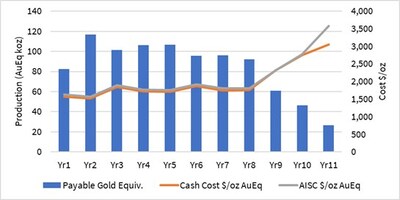
(1) | Gold equivalent calculated using NSR value of payable metals at base case metal prices: | |
(2) | See Cautionary Note Regarding Non-GAAP Financial Measures. |
CK Gold Project After-tax Cash Flow Profile (base case)1,2
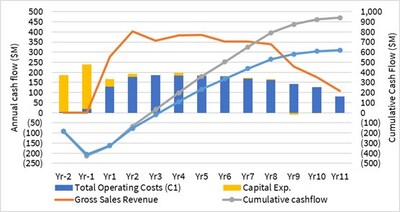
(1) | Cash flow profile shown using base case metal prices: | |
(2) | See Cautionary Note Regarding Non-GAAP Financial Measures. |
CK Gold Project After-Tax NPV, IRR and Payback Sensitivity Table
Gold Price US$/oz | Pre-tax | After Tax | Payback (years) | ||
NPV | IRR | NPV | IRR | ||
1,500 | (126) | 0.0 % | (147) | 0.0 % | 15.8 |
2,000 | 127 | 10.2 % | 98 | 8.5 % | 5.6 |
2,500 | 380 | 19.2 % | 320 | 16.8 % | 3.8 |
3,000 | 633 | 27.1 % | 528 | 23.8 % | 2.9 |
(Base Case) 3,250 | 759 | 30.7 % | 632 | 27.0 % | 2.5 |
3,500 | 886 | 34.3 % | 737 | 30.2 % | 2.2 |
4,000 | 1,139 | 41.0 % | 946 | 36.3 % | 1.8 |
4,500 | 1,392 | 47.4 % | 1,155 | 42.0 % | 1.6 |
5,000 | 1,645 | 53.5 % | 1,363 | 47.4 % | 1.4 |
5,500 | 1,898 | 59.4 % | 1,569 | 52.5 % | 1.3 |
6,000 | 2,151 | 65.0 % | 1,774 | 57.5 % | 1.1 |
Property Description, Location and Access
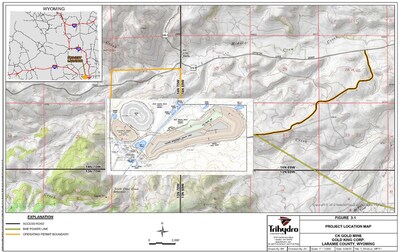
The Project, within the historic Silver Crown mining district, is located within southeastern Wyoming in Laramie County approximately 20 miles west of
CK Gold Project Location Map
Mineral Resource Estimate
The current mineral resource estimate for gold, copper, and silver at the Project was previously disclosed in the S-K 1300 Technical Report Summary for the Project, dated February 10, 2025, which was filed on a Form 8-K dated February 14, 2025. The supporting drillhole database incorporates data from all US Gold drilling programs, comprising 59 drillholes totaling 60,132 ft, as well as drilling completed by previous operators. US Gold drilling spans four programs: two holes totaling 2,030 ft in 2017; eight holes totaling 8,090 ft in 2018; 25 holes totaling 20,449 ft in 2020; and 24 holes totaling 29,562 ft in 2021.
For the current FS, Mark Shutty, CPG, MAIG, utilized Leapfrog Geo/Edge software (version 2024.1) to construct and update the geological models of the CK deposit. The constraining pit shell and in-pit resource reporting were completed using MinePlan (version 16.5), incorporating updated metal prices, operating cost parameters, and metallurgical recovery assumptions, with the underlying geological and grade model otherwise unchanged from the prior estimate.
The mineral resource estimate was developed using the following standard procedures:
- Import of topographic data to establish a digital terrain model of current surface conditions.
- Import and validation of drillhole interval datasets using Leapfrog Geo tools, including review of assay, survey, and density data.
- Construction of implicit three-dimensional geological and mineralized domain models using Leapfrog Geo, interpretation of oxidation state based on visual and geochemical logging, and assignment of bulk density values by domain.
- Evaluation and modeling of experimental variograms aligned with observed mineralization trends, establishing anisotropic ranges of sample influence for grade estimation.
- A 3D model with 20 ft x 20 ft x 30 ft block dimensions was defined to accommodate the CK deposit and optimization pit shell while facilitating the use of a 30' bench height mining unit.
- Estimation and validation of gold, copper, and silver grades within the three-dimensional block model using Ordinary Kriging.
- Classification of mineral resources into confidence categories (measured, indicated, and inferred) based on drill spacing, geological continuity, and estimation quality metrics.
- Application of economic and geometric constraints for resource reporting within an optimized pit shell, as described in the accompanying footnotes.
Beginning in 2020, US Gold facilitated the relogging of all available legacy drill core to ensure consistent interpretation of rock types across the 2020 and 2021 drilling programs. US Gold's geologic datasets were used to evaluate samples and construct three-dimensional geological models in Leapfrog Geo. The primary lithologic model includes Proterozoic granodiorite with varying intensities of potassic alteration and mylonitic fabrics. Mafic dikes, younger pegmatites, and undifferentiated veins represent smaller volumes within the mineralized granodiorite domain. Mafic dike bodies were constructed in Leapfrog Geo as discrete volumes; pegmatites and veins were not modeled separately and were assigned the host rock type, as drilling density is insufficient to model either as throughgoing features. Unmineralized domains were also modeled, including a metasediment unit east of the Copper King Fault and overlying Quaternary cover.
Metallurgical testing of mineralized rock indicates that sulfide recovery is a function of oxidation state. During core logging, geologists visually estimated the oxidation state and categorized it as either oxide, mixed, or sulfide. The oxidation boundary contacts were modeled in Leapfrog Geo to encompass logged oxidation intervals and modeled structures, resulting in a series of surfaces used to code the block model.
Raw gold, copper, and silver assays were evaluated within the resource drillhole database with histogram and probability plots to identify statistical outliers. These data are generally reflective of a single sample population with few outliers. Outliers were examined to ensure they were not the result of a database transcription error and were geologically reasonable; the location of high-grade samples with respect to nearby samples, lithology, and oxidation was reviewed ahead of establishing capping thresholds, which generally occur at distribution changes noted in the individual metal probability plots. Au is capped at 0.32 oz/t, Cu is capped at 3.0 % and Ag is capped at 0.58 oz/t resulting in a metal reduction of
Section showing blocks >0.2 g/t (>0.006 oz/t) AuEq with Nested Resource and Reserve Pit

Mineral Resources Statement - Inclusive of Reserves
Mass | Gold (Au) | Copper (Cu) | Silver (Ag) | Au Equivalent | |||||
Tons | Oz | oz/st | lbs | % | Oz (000's) | oz/st | Oz | oz/st | |
Measured (M) | 39,914 | 627 | 0.0157 | 144 | 0.18 | 1,862 | 0.0467 | 879 | 0.0220 |
Indicated (I) | 58,585 | 582 | 0.0099 | 177 | 0.15 | 2,178 | 0.0372 | 911 | 0.0156 |
M + I | 98,499 | 1,209 | 0.0123 | 322 | 0.16 | 4,040 | 0.0410 | 1,790 | 0.0182 |
Inferred | 47,088 | 407 | 0.009 | 142 | 0.15 | 1,436 | 0.0300 | 677 | 0.0140 |
1. | Mineral resources are estimated using Ordinary Kriging, constrained by geological domains based on lithology and mineralization controls. The underlying datasets supporting the resource estimate, including drill hole surveys, assay data, and density measurements, have been reviewed, validated, and verified by the Qualified Person. Database corrections made since the Preliminary Feasibility Study, including downhole survey corrections, were confirmed as non-material through sensitivity analysis; the pre-1997 assay quality assessment is addressed in Section 9 of the Technical Report Summary. | |||||||||||||
2. | Mineral resources are reported in short tons within an optimized pit shell, using AuEq cutoff grades of 0.22 g/t (0.00642 oz/st) for oxide material, 0.21 g/t (0.00613 oz/st) for mixed material, and 0.20 g/t (0.00583 oz/st) for sulfide material. No dilution or mining recovery factors have been applied. Resources are reported inclusive of mineral reserves; resources exclusive of reserves are summarized below. | |||||||||||||
3. | AuEq grades were calculated using long-term consensus metal prices of | |||||||||||||
Metal | Oxide | Mixed | Sulfide | |||||||||||
Au | 67 % | 70 % | 73 % | |||||||||||
Cu | 22 % | 75 % | 90 % | |||||||||||
Ag | 55 % | 65 % | 72 % | |||||||||||
Smelter payability factors of | ||||||||||||||
4. | The optimized pit shell was generated using the Lerchs-Grossmann method incorporating metal prices of | |||||||||||||
5. | Metal prices of | |||||||||||||
6. | There are no known legal, political, environmental, social, or permitting factors that would materially affect the reported mineral resource estimate. | |||||||||||||
7. | Mineral resources are classified in accordance with the definitions set forth in S-K 1300. Mineral resources are reported inclusive of mineral reserves. Mineral resources that are not mineral reserves have not demonstrated economic viability. | |||||||||||||
8. | Mineral resources are reported within the company's mineral tenure holdings, which include Lease #0-40828 and Lease #0-40858, as described in Section 3 of the TSR[2]. There are no known encumbrances, liens, or third-party interests that would materially affect the company's ability to develop the mineral resources reported herein. | |||||||||||||
9. | Rounding of reported figures may result in minor apparent discrepancies in totals of tonnage, grade, and contained metal. | |||||||||||||
10. | There is no certainty that all or any part of the mineral resources will be converted into mineral reserves. The estimate of mineral resources may be materially affected by environmental, permitting, legal, marketing, or other relevant issues. | |||||||||||||
11. | Mineral resources are reported on a | |||||||||||||
12. | The effective date of this mineral resource is December 12, 2025 | |||||||||||||
Mineral Resources Statement - Exclusive of Reserves
Mass | Gold | Copper | Silver | Au | |||||
Tons | Oz | opt | lbs | % | Oz | opt | Oz | opt | |
Measured (M) within Resource Pit | 5,124 | 38 | 0.0070 | 13 | 0.12 | 278 | 0.0540 | 64 | 0.0130 |
Measured (M) within Reserve Pit | 6,128 | 43 | 0.0070 | 15 | 0.12 | 314 | 0.0510 | 71 | 0.0120 |
(M) within Resource Pit Shell | 11,252 | 81 | 0.0070 | 27 | 0.12 | 592 | 0.0530 | 135 | 0.0120 |
Indicated (I) within Resource Pit | 15,602 | 137 | 0.0090 | 42 | 0.13 | 610 | 0.0390 | 220 | 0.0140 |
Indicated (I) within Reserve Pit | 17,786 | 146 | 0.0080 | 46 | 0.13 | 681 | 0.0380 | 235 | 0.0130 |
(I) within Resource Pit Shell | 33,388 | 283 | 0.0080 | 88 | 0.13 | 1,292 | 0.0390 | 455 | 0.0140 |
(M + I) within Resource Pit Shell | 44,640 | 364 | 0.0080 | 115 | 0.13 | 1,884 | 0.0420 | 590 | 0.0130 |
Inferred within Resource Pit Shell | 47,088 | 407 | 0.0090 | 142 | 0.15 | 1,436 | 0.0300 | 677 | 0.0140 |
1. | Mineral resources exclusive of mineral reserves are reported within an optimized resource pit shell constrained by AuEq cutoff grades of 0.22 g/t (oxide), 0.21 g/t (transitional), and 0.20 g/t (sulfide). Resources are classified in accordance with S-K 1300. Mineral resources that are not mineral reserves have not demonstrated economic viability. The M+I total of 40,497 kt containing 364 koz Au and 590 koz AuEq represents the S-K 1300 reportable exclusive-of-reserves figure; the sub-classifications presented in this table are provided for additional transparency. Mineral resources are reported on a | |
2. | The mineral resource estimate underlying this table was prepared using the methodology described in the Mineral Resource Statement footnotes (above) Footnote 1). | |
3. | To delineate mineral resources residing within the reserve pit shell that do not qualify as mineral reserves, M+I mineral resources within the reserve pit shell were identified using proxy AuEq cutoff grades of 0.275 g/t (oxide), 0.265 g/t (transitional), and 0.255 g/t (sulfide). These proxy cutoffs were derived from the reserve economic parameters detailed in Section 12 of the TSR, including metal prices of | |
4. | Mineral resources reported as "within Resource Pit Shell, external to Reserve Pit Shell" represent M+I and Inferred resources that fall outside the reserve pit shell footprint but within the resource pit shell. These resources are constrained by the resource pit shell optimization described in Section 11 of the TSR and are not captured within the reserve mine plan. All Inferred resources are reported within the resource pit shell and entirely external to the reserve pit shell. | |
5. | AuEq grades and contained AuEq ounces are calculated using the resource metal prices, NSR royalty, and domain-specific metallurgical recoveries described in the Mineral Resource Statement footnotes (above). AuEq conversion factors reflect mill recovery to concentrate and differ from the reserve AuEq basis, which additionally incorporates smelter payability factors. Grades are reported as tonnage-weighted averages derived from contained metal and reported tonnage. | |
6. | Copper is reported in millions of pounds of contained metal. Copper grade is reported as percent (%Cu) of the in-situ material. | |
7. | Rounding of reported figures may result in minor apparent discrepancies in stated totals of tonnage, grade, and contained metal. | |
8. | There is no certainty that all or any part of the mineral resources reported herein will be converted into mineral reserves. The estimate of mineral resources may be materially affected by environmental, permitting, legal, marketing, or other relevant issues. Inferred mineral resources have a lower level of confidence than Measured or Indicated resources and must not be converted directly to mineral reserves. | |
9. | The effective date of this mineral resource is December 12, 2025 |
Mineral Reserve Estimate
As part of the 2021 Preliminary Feasibility Study study, an economic pit-limit analysis was performed using Vulcan's Pit Optimizer software, which uses the Lerchs–Grossmann algorithm to determine an economic excavation limit.
The pit optimization process considered only M+I resources; inferred resources were excluded from the economic evaluation in accordance with NI–43–101 guidance. Metal prices applied in the 2021 optimization were based on a weighted long–term forecast incorporating a three–year trailing average.
The economic excavation limit (pit shell) generated from the 2021 optimization was used to guide the development of the 2024 Preliminary Feasibility Study final pit design. The 2024 Preliminary Feasibility Study design subsequently served as the foundation for the 2026 Feasibility Study pit design.
The 2021 pit optimization was revalidated through an additional optimization run completed using updated 2026 cost parameters reflecting current-year economic conditions. This supplementary analysis confirms continuity and provides a robust basis for the 2026 Feasibility Study pit design. The updated optimization demonstrates strong economic performance that exceeds the results of the 2021 pit shell used to guide the 2026 Feasibility Study design. Ultimate pit limits remain primarily constrained by the available onsite waste storage capacity.
The final pit design establishes the physical boundary for the conversion of mineral resources to mineral reserves. M+I resources located within the final pit limits may be converted to mineral reserves, subject to applicable modifying factors, including resource classification and cut–off grade criteria. Additional details regarding the mine design are provided in Section 13 of the TSR.
The value per ton ("VPT") "milling cut-off value" calculation for all areas was completed as follows:
- • VPT = (Block Revenue – Process Cost – Tailings Costs -Rehandle Cost- G&A Cost)/Resource Tons
- • Where:
- Block Revenue = Resource tons x grades x Recovery x Net Price for each metal
- Resource tons and grades are adjusted for mine dilution and ore loss
- Process Cost = Resource tons x Process Cost per ton
- Tailing Cost = Resource tons x Tailings Cost per ton
- Rehandle Cost = Resource tons x Rehandle Cost per ton
- G&A Cost = Resource tons x G&A Cost per ton
This calculation is sometimes called the "milling cut-off value" because the mining cost is not considered. The mining cut-off uses a similar calculation but includes the mining cost. The mining cut-off is used to determine the boundary of an economic pit shell, and the milling cut-off has been used in this case to determine the reserves contained within that same shell. For the reserves, the block was considered mill feed if the VPT was equal to or greater than a value of
The VPT calculation was carried out with more up-to-date input parameters that were updated as part of the 2026 Feasibility Study. The parameters used for the VPT calculation are presented below.
VPT Calculation Input Parameters | ||
Gold Price | $/oz | 2100.00 |
Copper Price | $/lb | 4.10 |
Silver Price | $/oz | 27.00 |
NSR Royalty* | % | 2.1 |
Concentrate Smelting & Transport — Oxide | $/lb Cu recovered | 0.29 |
Concentrate Smelting & Transport — Mixed | $/lb Cu recovered | 0.32 |
Concentrate Smelting & Transport — Sulfide | $/lb Cu recovered | 0.37 |
Cu Refining Charge | $/lb Cu | 0.07 |
Au Refining Charge | $/oz | 5.00 |
Ag Refining Charge | $/oz | 0.45 |
Oxide—Cu Recovery (> | % | 25 |
Oxide—Au Recovery (>0.3gpt & <1.3 gpt) | % | 67 |
Oxide—Ag Recovery (<0.4 gpt) | % | 50 |
Oxide—Ag Recovery (>0.4 gpt) | % | 60 |
Mixed—Cu Recovery | % | 72.5 |
Mixed—Au Recovery ( <1.0 gpt) | % | 67 |
Mixed—Au Recovery (>1.0 gpt) | % | 70 |
Mixed—Ag Recovery | % | 70 |
Sulfide—Cu Recovery ( < | % | 85 |
Sulfide—Cu Recovery (> | % | 91 |
Sulfide—Cu Recovery (> | % | 92 |
Sulfide—Au Recovery (>0.4gpt) | % | 70 |
Sulfide—Au Recovery (>0.4gpt & <0.65 gpt) | % | 72 |
Sulfide—Au Recovery (>0.65gpt) | % | 75 |
Sulfide—Ag Recovery | % | 70 |
Smelter Payable — %Cu | % | 97 |
Smelter Payable —Au oz/st | % | 98 |
Smelter Payable — Ag oz/st | % | 95 |
Concentrate Grade %Cu — Oxide | % | 23 |
Concentrate Grade %Cu — Mixed | % | 21 |
Concentrate Grade %Cu — Sulphide | % | 18 |
Process Cost | $/st processed | 7 |
Tailings Cost | $/st processed | 1.65 |
Site-Wide General & Administrative Cost | $/st processed | 1.50 |
Rehandling cost | $/t | 1.00 |
The block model used for mineral reserve estimation employs a block size of 20 ft × 20 ft × 30 ft. This block dimension is comparable to, or larger than, the selective mining unit achievable with the planned loading equipment (CAT 992 or similar). As a result, no dilution is expected to arise from discrepancies between block model dimensions and operational mining selectivity.
Mineralization is disseminated, with grades transitioning gradually across the orebody. While some dilution will occur during mining, the majority of adjacent material exhibits grades like the ore being extracted. In these cases, dilution is considered negligible.
Material dilution of significance is expected only at contacts between ore blocks and adjacent blocks with materially lower grades. For the purposes of reserve estimation, blocks with a value per ton more than
Ore loss is expected to occur in areas with isolated ore blocks. In operations these areas are often reclassified as waste to guarantee productivity. The CK Au mineralization does not have many of these isolated ore blocks.
A bench–by–bench inventory identified that only
In addition to the ore loss associated with isolated blocks, an allowance was included to account for operational inefficiencies and human error.
CK Au mineral reserves are given in Table 12.5. Mohsin Hashmi P.Eng, is the QP responsible for the mineral reserves statement. Mineral reserves are reported inside a detailed pit design using suitable parameters for the site, which was guided by the 2021 pit optimization.
Mineral Reserve Statement | |||||||||
Mass | Gold (Au) | Copper (Cu) | Silver (Ag) | Au Equivalent (AuEq) | |||||
Tons (Mst) | Oz (000s) | oz/st | M lb | % | Oz (000s) | oz/st | Oz (000s) | oz/st | |
Proven (P1) | 33.8 | 582 | 0.017 | 129 | 0.191 | 1,542 | 0.046 | 872 | 0.026 |
Probable (P2) | 40.8 | 433 | 0.011 | 130 | 0.160 | 1,489 | 0.037 | 726 | 0.018 |
P1 + P2 | 74.5 | 1,015 | 0.014 | 260 | 0.174 | 3,032 | 0.041 | 1,598 | 0.021 |
1. | Reserves tabulated above a "milling cut-off value" per ton (see text). | |
2. | Dilution of | |
3. | Ore loss of | |
4. | AuEq values calculated assuming gold price of 2100$/oz, silver price of 27 $/oz, copper price of 4.10 $/lb and metallurgical recovery ranges of 67 | |
5. | Totals may not sum due to rounding. | |
6. | The mineral reserve effective date is March 30, 2026 |
Production Profile
The contemplated operation in the FS spans 11 years, comprising one year of construction (Year -1), 9 years of active mining and gold-copper-silver processing operations, and two years of low-grade processing from stockpile.
The first three months of the production period focuses on establishing "bedding-down" the plant with lower grade material followed by the remainder of the McNulty ramp up to full name plate plant production at 20,000 short tons per day.
Mining will advance ahead of plant feed rates so that lower grade ore can be accumulated in an ore stockpile and better grade preferentially processed to improve early revenue. Under the current plan, mining will cease and the accumulated low-grade stockpile will be processed until the stockpile is depleted. Tailings will be used to partially backfill the exhausted open pit as part of the closure plan. While this scenario forms the currently permitted activity, it is fully anticipated that the open pit will continue under a permit update and revision, allowing the remaining resource and potential future expansions to the resource to be mined, extending the mine life. Once in production, drilling and further resource definition is contemplated, allowing the mine expansion to be engineered and permits to be sought to realize the full potential of the resource. These activities can commence as soon as year one and there will be approximately 6 years to complete the work to extend the mine life to the next economic limit.
CK Gold Project Production Breakdown by Year
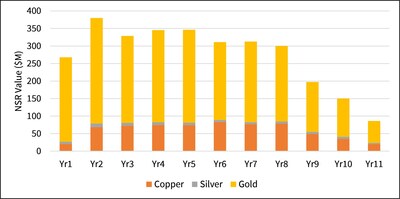
CK Gold Project Revenue Breakdown by Metal
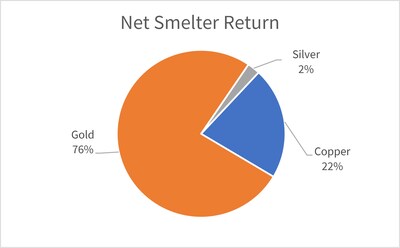
Mining
Mining is contemplated as a conventional open-pit operation using truck-and-shovel methods, focused on delivering higher grade AuEq production from the deposit early in the Project using a stockpiling strategy, before transitioning to complete the processing of the low-grade ore accumulated. The mine plan schedules 163 million tons ("Mt") of total material movement including rehandle of low-grade stockpile and waste for Tailings Management Facility (TMF) capping over the 13-year active mine life. Ex pit ore totals 74.527 Mt of ore with an average grade of 0.014 opt Au,
Material movement is sequenced in four internal open pit phases allowing early presentation of better grade material in association with the stockpile strategy. The phased approach allows time for adjustments to be made for the final pit wall for both final geotechnical slope angles as well as formulation of pit expansions to recover the remaining resource and any additional resources added to the current inventory.
Mining assumptions are developed from first principles, including drill penetration rates, powder factors, cycle times, equipment availabilities, and original equipment manufacturer validated haulage models. The fleet includes up to 18 haul trucks and a matched loading fleet of excavators and shovels sized to maintain efficient dig-and-haul cycles. Waste placement and backfilling strategies minimize external dump requirements and align with closure objectives. Overall, the mining plan reflects an executable, low-risk approach that supports strong economics, operational flexibility, and a smooth transition into reclamation activities in the later years of the Project.
CK Gold Project Mining Profile
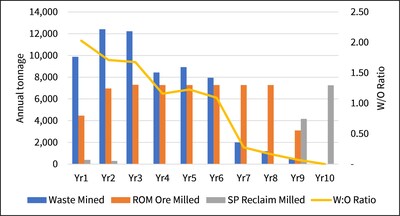
Processing and Recovery
Project mineralization is amenable to simple froth flotation. The Project has completed extensive metallurgical testing and the circuit consists of primary crushing, semi-autogenous and ball mill grinding to p80 90 microns, followed by initial rougher flotation. The company tested and adopted Jameson cell flotation technology which improved metal recovery and results in a smaller plant footprint when compared to conventional flotation. The rougher/scavenger concentrate will be reground to p80 25 microns before cleaner flotation in smaller Jameson cell units. Concentrate will be filter pressed and shipped to a smelter for metal extraction while the tailings will be filtered and stacked in a tailings management facility, employing mine waste to buttress and cap the tailings prior to reclamation.
The tailings management facility will require approximately half of the mine waste to stabilize and cap the tailings prior to reclamation, leaving 35 million tons of waste in waste rock storage facilities. Some of the waste rock will be crushed and used for start-up and ongoing construction activities on site. The remaining waste has been aggregate quality tested and found to be an excellent source of rock aggregate and rail ballast. It is anticipated that up to 1 million tons of waste rock can be sold annually to the surrounding market once the mine is in operation and continuing during the reclamation period.
CK Gold Project Annual Concentrate Production Schedule
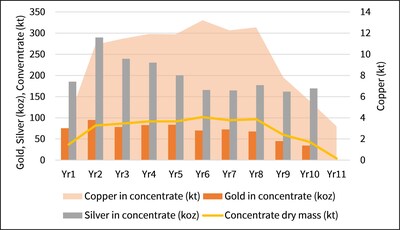
CK Gold Project Processing Summary
Mining | Ore Milled | Copper Grade %Cu | Gold Grade Au oz/t | Silver Grade Ag oz/t |
HG oxide | 3,646 | 0.22 % | 0.024 | 0.063 |
HG mixed | 6,096 | 0.20 % | 0.018 | 0.049 |
HG sulfide | 46,732 | 0.19 % | 0.015 | 0.040 |
LG oxide | 305 | 0.13 % | 0.009 | 0.052 |
LG mixed | 728 | 0.12 % | 0.007 | 0.042 |
LG sulfide | 723 | 0.11 % | 0.006 | 0.045 |
SP reclaim | 16,296 | 0.12 % | 0.007 | 0.035 |
Total Milled | 74,527 | 0.17 % | 0.014 | 0.041 |
Content (lb, oz x1000) | 259,880 | 1,015 | 3,030 | |
Recovery (%) | 80.6 % | 71.5 % | 68.7 % | |
Recov'd (lb, oz x1000) | 209,520 | 725 | 2,082 | |
Payability (%) | 89.1 % | 97.5 % | 90.0 % | |
Payable (lb, oz x1000) | 186,726 | 707 | 1,874 |
Power and Infrastructure
The Project infrastructure benefits from the Project's location, helping to minimize initial capital, while maintaining reliability and certainty around the construction schedule.
The Project sits twenty miles to the west of
General Facilities Arrangement
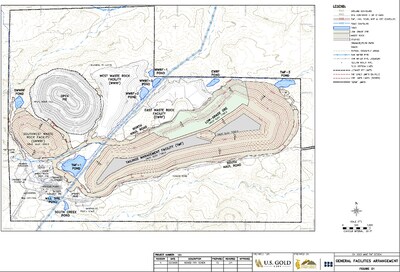
The Project will require up to approximately 30 megawatts ("MW") of power to be supplied to the site by Black Hills Energy along a 115 ("kV") transmission line and distributed throughout the site via a new substation and 13.8 kV power distribution network. A 1 MW backup generator is planned to be installed for back-up or emergency power. The power line extending to the Project will be built by Black Hills Energy and the cost amortized as a minimum demand charge along with the consumption charges.
Water will be supplied to the mine under contract from the
On-site facilities are limited to those which are necessary for light equipment repair, basic warehousing, concentrate dispatch, weigh bridge and site supervision. A semi-permanent truck shelter-workshop has been planned on a concrete pad service area that includes power, water, truck wash and fuel island. The administration personnel at site will be minimal since the Project is 20-miles from the city of
Assay prep lab will be on site for blasthole sample preparation and a
Operating Costs
Mine operating costs were estimated through first principles and supplier quotes. Where possible, first principal assumptions and costs of units were traded off to one of seven mine bidders for all material movement and earthworks. This was calculated using estimated hourly costs of equipment and personnel against the anticipated hours of work for each. The equipment hourly costs were estimated for fuel, oil and lubrication, tires, under-carriage, repair and maintenance costs, and special wear items. First principal assumptions and the cost of mine personnel and consumables were benchmarked against costs provided by mining contractors. The superior contractor budget estimate was selected.
Process operating costs were developed by Halyard from first principles to determine unit consumptions of materials, supplies, power and personnel, and the estimated cost of unit for these was estimated from supplier quotes and industry benchmarks. The cost of materials, supplies, power and labor were benchmarked against industry norms in the area.
Labor G&A costs were estimated based on personnel requirements for administrative, accounting, safety and security, and environmental departments to support mining and processing activities. Costs are also included for legal, land, permit bonding and power. G&A costs were benchmarked against norms in the
CK Gold Project Operating Cost Breakdown (Excluding Aggregate Production)
LOM Operating Costs (US$/ton) | Mined | Processed |
Mining | ||
Processing (including placement of tailings) | ||
G&A | ||
Total Site Costs | ||
Project Royalties
As a condition of our state mineral leases with the
Capital Cost Estimates
Capital cost estimates emphasize constructability, vendor-supported pricing, and execution sequencing aligned with the planned development schedule.
Mining initial and sustaining capital estimates were prepared by Halyard. Estimates assume owner-operated mining equipment and are based on the equipment and facilities required to achieve the production schedule. Capital costs are based on estimation guides, quotations from equipment vendors and recent quoted costs for new equipment.
The process and infrastructure capital costs were developed by Halyard and Tierra Group International for initial and sustaining capital. The capital costs for each phase are comprised of direct costs and indirect costs. The direct costs were developed from labor, materials, plant equipment, sub-contracts, and construction equipment. Indirect costs were applied to the direct costs to account for items, such as, construction support, engineering, procurement and construction management, vendor support during specialty construction and commissioning, spare parts, contingency, owner's costs, freight and taxes. Capital costs were estimated based on 2026 U.S. dollars and are presented with no escalation.
CK Gold Project Capital Cost Breakdown
Capital Cost Breakdown | Initial Capital | Sustaining | Reclamation & | Total LOM |
Capital Costs | ||||
Mining1 | 5,550 | 1,304 | 6,804 | |
Processing | 219,194 | 20,275 | 239,469 | |
Infrastructure | 43,011 | 12,946 | 47,957 | |
Indirects | 80,166 | 80,166 | ||
Contingency | 46,514 | 46,514 | ||
Capex Sub-Total | ||||
Other Capital | ||||
Owners' Costs2 | 21,959 | 21,959 | ||
Construction Insurance | 1,958 | 1,958 | ||
Mining/Mobilization | 4,085 | 4,085 | ||
Reclamation – Site3 | 21,055 | 21,055 | ||
Cash Collateral (bonding) | 5,941 | 5,941 | ||
Total Other Capital | 26,995 | |||
TOTAL CAPITAL |
(1) | Assumes contractor mining fleet | |
(2) | Owner's Costs are expensed | |
(3) | Closure & reclamation cost net of residual value |
Environmental and Permitting
The Project is supported by strong environmental support from a local
From the outset the approach has been to keep the Project simple and employ best practices to respect the environment and local community. This resulted in opting for dry-stack tailings placement to conserve and recycle as much water as possible. While the geochemical testing suggests that ore, waste and tailings will not generate acidic drainage, facilities will be isolated from the land surface by a liner as necessary to provide additional assurance that there will not be future occurrences. CK is a robust mine operation that is protective of water resources, air quality, cultural resources, wildlife and vegetation, and post-mine land use.
Stakeholder and Community Engagement
Since the decision to pursue the Project in September 2020, the Company has operated with dedicated budget and personnel to engage proactively with the communities, and other stakeholders with ties to the affected area. With consistent frequency the Project approaches state permitting agencies and coordinates with Federal agencies with jurisdiction in the area (primarily US Corp of Army Engineers). The Company has worked to build lasting relationships with a wide range of stakeholders, including nearby residents and community members, non-governmental organizations and various levels of government representatives. This approach reflects a deep Company-wide commitment to a high standard of social performance, achieved by acting transparently and building mutual respect and shared value.
Stakeholder engagement is guided by an Environmental and Social Management System ("ESMS"), a Project site-specific plan that is updated annually to guide the activities, goals, and strategies for stakeholder engagement in a tailored manner that reflects the unique requirements of each region, individual stakeholder context, and cultural settings surrounding CK. The ESMS management approach specifically addresses the Company's stakeholder engagement, public communication, community involvement & investment, and monitoring & reporting – including social impact risks assessments, grievance procedures, materiality, and metric tracking. The company has advanced the ESMS with a view to complying with Equator Principles standards and has been the subject of two independent assessments by Digbee Ltd. ("Digbee"), a leading ESG disclosure platform for the extractive mining industry. The Digbee assessment is an independent assessment drawing from worldwide norms and CK was assessed an "A" rating in the recent 2026 assessment.
Exploration Potential and Upside at CK Gold Project
Beyond the FS mine plan, CK offers substantial longer-term upside and strategic optionality. The FS includes an updated mineral resource statement that includes mineral resources, which are currently excluded from the Project's mineral reserves and economic analysis. This has been a purposeful decision to limit the pit so as not to cross a dry drainage to the northwest of the current pit boundary which would have necessitated involvement of the U. S. Army Corp of Engineers. Future processing and development is an economic continuation to the existing plans but will involve additional permitting after Project expansion planning and investigation through additional drilling, and permit presentation. This can be accomplished during the early years of operation for a seamless transition into the additional resources. In addition, CK sits in the historic Silver Crown Mining District and while there are old workings within the surrounding area the company is at the early stages of investigating potential beyond the current resources, known to continue at depth and along strike. The Project layout and infrastructure contemplated in the FS also provide flexibility for potential future throughput expansion for the deeper resources, allowing US Gold to pursue disciplined growth opportunities while maintaining a simplified, low-risk development pathway.
Next Steps and Opportunities
With the FS complete, the Company is advancing to Project financing and shortly thereafter detailed engineering. Near-term priorities include securing major equipment specifications to allow detailed engineering and execution planning. The initial portion of the access road has been constructed, and the company is looking at the remaining access to the pit with an objective of quarrying from the pit the necessary aggregate ready for construction.
The company has purchased 10-acres in an industrial park to the west of
No Production Decision: The Company has not made a production decision for the Project. A decision to proceed with construction will only be made following the completion and review of detailed engineering, approval by the Board of Directors, and securing financing arrangements.
CK Feasibility Study Conference Call & Webcast
US Gold will host a webcast on Wednesday, April 1, 2026, at 4:00 PM Eastern Time / 1:00 PM Pacific Time, to discuss the CK FS. The link to the webcast is: US Gold Feasibility Study Webcast webcast are included below.
About U.S. Gold Corp.
U.S. Gold Corp. is a publicly traded,
For additional information, please contact:
U.S. Gold Corp.
Investor Relations
+1 800 557 4550
ir@usgoldcorp.com
www.usgoldcorp.com
Technical Information and Technical Report Filing
The FS and other scientific and technical information contained in this news release were prepared in accordance with the
Responsible Company | QP Individual(s) | Responsible Section |
Drift Geo | Mark C. Shutty, CPG, | 8, 9, 11, |
Halyard Micon | Various | 1, 2, 4, 5, 12, 13, 14, 15, 16, 18, 19,22, 23, 24 |
Tierra Group | Various | 10, |
U.S. Gold Corp | Kevin Francis, SME-RM, VP, | 3, 6, 7, 17, 20, 21, 25 |
All are independent QPs of the registrant, except for Kevin Francis, as defined under S-K 1300.
Kevin Francis, V.P. Exploration and Technical Services of the Company, who is a QP as defined under S-K 1300, has reviewed and approved the scientific and technical information disclosed in this news release.
A TRS prepared in accordance with S-K 1300 for the CK Gold Project will be filed on a Form 8-K. Readers are encouraged to read the technical report in its entirety, including all qualifications, assumptions, exclusions and risks that relate to the Mineral Resource and Mineral Reserve estimates and the PFS.
The Mineral Resource and Mineral Reserve estimates discussed in this news release are classified in accordance with the disclosure requirement of
Forward Looking Statements
Certain information set forth in this news release contains "forward-looking statements" and "forward-looking information" within the meaning of applicable Canadian securities legislation and in applicable
Forward-looking statements are based on a number of factors and assumptions made by management and considered reasonable at the time such statement was made. Assumptions and factors include: the Company's ability to complete its planned exploration and development programs; the absence of adverse conditions at the Project and the Company's mineral properties; satisfying ongoing covenants under the Company's loan facilities; no unforeseen operational delays; no material delays in obtaining necessary permits; results of independent engineer technical reviews; the possibility of cost overruns and unanticipated costs and expenses; the price of gold remaining at levels that continue to render the Project and the Company's mineral properties economic; the Company's ability to continue raising necessary capital to finance operations; and the ability to realize on the mineral resource and reserve estimates. Forward-looking statements necessarily involve known and unknown risks and uncertainties, which may cause actual performance and financial results in future periods to differ materially from any projections of future performance or result expressed or implied by such forward-looking statements. These risks and uncertainties include, but are not limited to: general business, economic and competitive uncertainties; the actual results of current and future exploration activities; conclusions of economic evaluations; meeting various expected cost estimates; benefits of certain technology usage; changes in Project parameters and/or economic assessments as plans continue to be refined; future prices of metals; possible variations of mineral grade or recovery rates; the risk that actual costs may exceed estimated costs; geological, mining and exploration technical problems; failure of plant, equipment or processes to operate as anticipated; accidents, labor disputes and other risks of the mining industry; delays in obtaining governmental approvals or financing; risks related to local communities; the speculative nature of mineral exploration and development (including the risks of obtaining necessary licenses, permits and approvals from government authorities); title to properties; and other factors beyond the Company's control and as well as those factors included herein and elsewhere in the Company's public disclosure. Although the Company has attempted to identify important factors that could cause actual actions, events or results to differ materially from those described in the forward-looking statements, there may be other factors that cause actions, events or results not to be as anticipated, estimated or intended. Readers are advised to study and consider risk factors disclosed in the Company's Annual Report on Form 10-K, as amended, for the fiscal year ended April 30, 2025, available on the EDGAR profile for the Company at www.sec.gov.
Investors are cautioned not to put undue reliance on forward-looking statements. The forward-looking statements contained herein are made as of the date of this news release and, accordingly, are subject to change after such date. The Company disclaims any intent or obligation to update publicly or otherwise revise any forward-looking statements or the foregoing list of assumptions or factors, whether as a result of new information, future events or otherwise, except in accordance with applicable securities laws. Investors are urged to read the Company's filings with
Cautionary Note Regarding Non-GAAP Financial Measures
Alternative performance measures in this news release such as "cash cost", "AISC" and "free cash flow" are furnished to provide additional information. These non-GAAP performance measures are included in this news release because these statistics are used as key performance measures that management uses to monitor and assess performance of the Project, and to plan and assess the overall effectiveness and efficiency of mining operations. These performance measures do not have a standardized meaning within the accounting principles generally accepted in the Unites States of America ("GAAP") and, therefore, amounts presented may not be comparable to similar data presented by other mining companies. These performance measures should not be considered in isolation as a substitute for measures of performance in accordance with GAAP.
Total Cash Costs
Total cash costs include site operating costs (mining, processing, site G&A), refinery costs and royalties, but exclude head office G&A and exploration expenses. While there is no standardized meaning of the measure across the industry, the Company believes that this measure is useful to external users in assessing operating performance.
All-In Sustaining Cost
Site level AISC includes total cash costs and sustaining and expansion capital, but excludes head office G&A and exploration expenses. The Company believes that this measure is useful to external users in assessing operating performance and the Company's ability to generate free cash flow from potential operations.
Free Cash Flow
Free cash flows are revenues net of operating costs, royalties, capital expenditures and cash taxes. The Company believes that this measure is useful to the external users in assessing the Company's ability to generate cash flows from the Project.

 View original content to download multimedia:https://www.prnewswire.com/news-releases/us-gold-corp-delivers-robust-feasibility-study-for-ck-gold-project-highlighting-attractive-economics-and-detailing-relative-low-development-risk-302729385.html
SOURCE U.S. Gold Corp.
FAQ
AI-generated questions and answers. How Rhea-AI works. Not financial advice.