
U.S. GoldMining Expands Pipeline of High-Priority Targets With 2026 Surface Exploration Program at its Whistler Gold-Copper Project, Alaska
The field program also collected samples to study the age of host intrusions and mineral alteration at Long Lake Hills.
Rhea-AI Summary
U.S. GoldMining (USGO) completed a surface exploration program at its Whistler gold-copper project in Alaska. Mapping and sampling identified new outcrops of porphyry-style mineralization near the Whistler deposit. At Muddy Creek, crews mapped quartz-vein zones 1.7 miles west of zones first identified in 2025. Mapping at Island Mountain indicated a potential extension northwest of its existing resource.
The company submitted 58 rock grab samples for gold, copper and multi-element assays; results are pending. A separate, recently completed drilling program covered 7,493 meters across 10 targets. Whistler’s existing resource inventory comprises 5.41 million gold-equivalent ounces of indicated resources and 4.97 million of inferred resources.
Key Figures
- Rock grab samples
- 58 samples
- Collected for gold, copper, and multi-element assays; results pending
- Geochronological samples
- 12 samples
- Collected to assess host intrusion ages and potential fertile magmatic suites
- Hyperspectral samples
- 68 samples
- Collected at Long Lake Hills to characterize mineral alteration
- Indicated resources
- 5.41 Moz AuEq
- Existing resource inventory across Whistler, Raintree West, and Island Mountain
- Inferred resources
- 4.97 Moz AuEq
- Existing resource inventory across Whistler, Raintree West, and Island Mountain
Historical Context
-
Completed 7,493-meter drilling across 10 Whistler Orbit targets ahead of assays.
24h Move is the share-price change in the day after each event; other market factors may also have contributed.
Key Terms
hyperspectral analysis technical
geochronological samples technical
inferred mineral resources regulatory
ni 43-101 regulatory
s-k 1300 regulatory
AI-generated analysis. How Rhea-AI works. Not financial advice.




Highlights:
- Expands the District-Scale Target Pipeline: Prospecting, geological mapping, and rock chip sampling were completed with the aim of adding prospects to the existing robust pipeline of exploration targets across the Whistler Project. Field observations indicate potential extensions to the known gold-copper porphyry mineral systems at Whistler-Raintree (the 'Whistler Orbit') and Island Mountain, while further defining target areas within the emerging Muddy Creek intrusion-related gold system.
- Whistler Orbit Footprint Expanded: Geologists identified and sampled new outcrop zones of gold-copper porphyry-style mineralization featuring porphyritic intrusions, phyllic and potassic alteration, and diagnostic quartz-sulfide veining, associated with historical elevated gold and copper rock grab samples.
- Island Mountain Anomalies Extended: Reconnaissance mapping over zones of historical elevated gold and copper rock grab samples indicates targets to support potential resource expansion to the northwest of the existing drill-delineated mineral resource, in addition to identification of untested geochemical and geophysical anomalies outside of the known resource.
- Muddy Creek Drill Vectors Defined: Mapping and prospecting programs built upon the 2025 field campaign, sharpening vectors toward future drill targets. Work focused on areas with higher tenor gold (+/- antimony) in historical rock grab samples, and high-density quartz veining along contact zones between the host granodiorite intrusion and sedimentary country rocks – a classic setting for intrusion-related gold mineralization.
- Growth Potential: Surface exploration is designed to delineate high-priority targets for future drill testing with the goal of ultimately expanding the Whistler Project's existing mineral resource inventory, which currently comprises 5.41 Moz AuEq of indicated resources and 4.97 Moz AuEq of inferred resources across the Whistler, Raintree West, and Island Mountain deposits. See "Technical Information" below for further information.
- Surface Assays Pending: The Company submitted 58 rock grab samples for gold, copper, and multi-element assaying to characterize grade distribution, mineralogical associations and geological context. Assay results are subject to laboratory turnaround times.
Tim Smith, Chief Executive Officer of U.S. GoldMining, commented: "Our 2026 surface exploration program has demonstrated the prospectivity and expanding scale of the mineral systems across the Whistler Project. Our geological teams made exciting progress, including identifying and sampling new outcrop zones of gold-copper porphyry-style mineralization, that builds confidence in our extensive pipeline of exploration targets, expanding our known footprints at the Whistler Orbit, Island Mountain, and Muddy Creek. We look forward to providing updates on the Program as rock grab and drill core assay results are received over the coming months. This data will support additional future exploration and drilling campaigns as we follow up on high-priority targets with the goal of identifying new gold and copper discoveries."
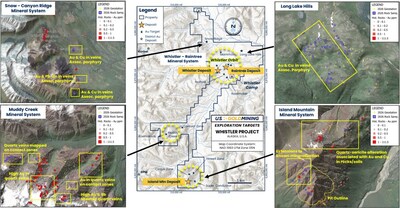
2026 Surface Exploration Program
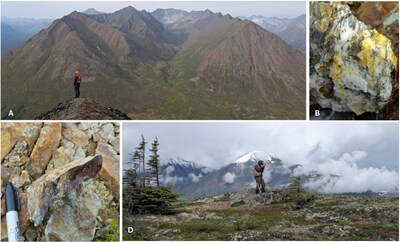
In addition to the 7,493-meter diamond core program targeting gold-copper porphyry mineralization under glacial till cover at the Whistler Orbit, the objective of the 2026 summer field season was to advance the Company's knowledge of the geological controls on areas of known outcropping Au + Cu ± Ag ± Sb mineralization identified from past exploration campaigns, including follow-up of historical rock grab sampling. Over the course of the 2026 field season, reconnaissance geological mapping, prospecting and rock grab sampling were completed at two areas north of the Whistler Orbit (also referred to as the Whistler-Raintree mineral system) and at the Island Mountain and Muddy Creek mineral systems.
In total, 58 rock grab samples were collected to characterize gold-copper abundance and mineralogical/geological associations. In addition, 12 geochronological samples were collected to help categorize the relative age of host intrusions and to define fertile magmatic suites for potential Au-Cu mineralization. Also, 68 samples were collected at the Long Lake Hills prospect area for hyperspectral analysis which helps to characterize subtle mineral alteration species associated with porphyry mineralization.
Whistler Orbit Extensions
Several prospects in the Snow-Canyon Ridge area, located over a broad area 2 to 5 miles north of the Whistler gold-copper deposit, were visited to locate numerous high grade Au rock grabs identified in historical sampling (up to 26.9 g/t Au and
Moderately elevated historical Cu and Au rock grab samples (up to
The Long Lake Hills and Snow–Canyon Ridge prospects are being examined for their potential to extend the 'Whistler Orbit', a classic porphyry cluster, up to 2 to 5 miles towards the northeast and north, respectively. Pending receipt of assays, additional systematic mapping, prospecting, and sampling, and potentially geophysical survey extensions and drilling, will be assessed.
Muddy Creek
Located approximately 10 miles southwest of the Whistler gold-copper deposit, the 2026 field work at Muddy Creek aimed to verify and expand upon historical and 2025 field campaigns (see news releases dated June 16, 2025, August 27, 2025, and October 13, 2025). The 2025 field campaigns identified new zones of increased quartz vein density hosted in altered volcano-sedimentary rocks peripheral to a large granodiorite intrusion (the 'contact zone'). Mapping and prospecting completed during 2026 field work identified new high-density quartz vein zones along the contact zone, located 1.7 miles to the west from where high-density quartz veining was first identified in 2025, which greatly expands the extent of the mineral system mapped to date. The geological context, sheeted quartz veining, and elemental association of Au with As, Bi, and Sb are key diagnostic features of intrusion-related gold systems (e.g. Kinross Gold Corporation's Fort Knox gold mine and Snowline Gold Corp.'s Valley gold deposit).
Numerous high-grade Au rock grabs have been collected historically over the prospect area, up to a peak assay of 111.5 g/t Au. The average gold value from 285 rocks collected historically over the Muddy Creek prospect is 3.03 g/t Au. Many of the rock samples collected are selective, comprising rock grab samples from narrow mineralized structures that occur throughout the prospect area, and while they are not representative of the potential bulk grade of the mineral system, their widespread distribution and high tenor, we believe, broadly confirms a large area of potential bedrock mineralization.
Pending additional positive assays from the 2026 rock grab sampling program, work will continue to focus on areas of high-density quartz veining along contact zones between the host granodiorite intrusion and surrounding country rocks – a classic setting for intrusion-related gold mineralization.
Island Mountain
The Island Mountain mineral system is located 15 miles south of the Whistler gold-copper deposit. It comprises a gold-copper porphyry system associated with Late Cretaceous diorite and monzonite intrusions similar to the Whistler deposit but differs from the Whistler mineral system in that Island Mountain is more akin to the reduced sub-class of porphyry copper-gold deposits. The currently drill-delineated gold and copper resource estimate is hosted within the 'Breccia Zone', comprising intense sodic-calcic alteration and pyrrhotite mineralization within a diorite to monzonitic intrusive complex.
Reconnaissance mapping over zones of historical elevated gold and copper rock grab samples (up to 17.25 g/t Au) indicates potential to expand the footprint of the Breccia Zone mineralization to the northwest of the existing drill-delineated mineral resource. Mapping also evaluated gold-copper geochemical anomalies (peaking at 4.86 g/t Au, see Figure 1) located approximately 1 to 2 miles north of the Breccia Zone, and identified several untested geophysical anomalies, potentially expanding the search radius for new discoveries, which we believe will be a focus of future field campaigns in 2027.
Technical Information
For further information regarding the Whistler Project, including the mineral resource estimate disclosed herein, please see the technical report summary titled "Whistler Gold-Copper Project, S-K 1300 Technical Report Summary and Initial Assessment with Economic Analysis,
Mineral resources are not mineral reserves and do not have demonstrated economic viability. There is no certainty that all or any part of the mineral resources estimated for the Whistler Project will be converted into mineral reserves. Inferred mineral resources are subject to greater uncertainty than indicated mineral resources and it cannot be assumed that all or any part of an inferred mineral resource will be upgraded to a higher category.
Gold-equivalent ("AuEq") figures reported in this news release are based on the gold and copper grades, metal prices, and metallurgical recovery assumptions set out in the S-K 1300 Report and the NI 43-101 Report. Readers are referred to those reports for the individual metal grades, assumed metal prices, recovery assumptions, and the formula used to derive the reported AuEq figures.
Tim Smith, P.Geo., Chief Executive Officer of the Company, has supervised the preparation of this news release and has reviewed the additional scientific and technical information contained herein. Mr. Smith is a qualified person as defined under NI 43-101 and S-K 1300.
About U.S. GoldMining Inc.
U.S. GoldMining Inc. is an exploration and development company focused on advancing the
Visit www.usgoldmining.us for more information.
Forward-Looking Statements
Except for the statements of historical fact contained herein, the information presented in this news release constitutes "forward-looking statements" within the meaning of the United States federal securities laws and "forward-looking information" within the meaning of applicable Canadian securities laws (collectively, "forward-looking statements"). Such statements include statements with regard to the Company's plans and expectations regarding the Whistler Project, future work programs, the potential to expand exploration targets and mineralization and its future exploration and development potential, and expectations regarding future exploration plans. Words such as "expects", "anticipates", "plans", estimates" and "intends" or similar expressions are intended to identify forward-looking statements. Forward-looking statements are based on U.S. GoldMining's current expectations and are subject to inherent uncertainties, risks and assumptions that are difficult to predict and involve known and unknown risks, uncertainties and other factors, which may cause the actual results, performance or achievements of the Company to be materially different from any future results, performance or achievements expressed or implied by such forward-looking statements. Such risks and other factors include, among others, fluctuating commodity prices, risks inherent with mineral resource estimation generally, economic risks, changing economic factors, variations in the underlying assumptions associated with the estimation or realization of mineral resources, the availability of capital to fund programs and future development work, accidents, labor disputes and other risks of the mining industry including, without limitation, those associated with the environment, delays in obtaining governmental approvals or permits, title disputes other risks inherent in the exploration and development of mineral properties and the other risk factors set forth in the Company's filings with the U.S. Securities and Exchange Commission at www.sec.gov and Canadian Securities Administrators at www.sedarplus.ca. Although the Company has attempted to identify important factors that could cause actual actions, events or results to differ materially from those described in forward-looking statements, there may be other factors that cause actions, events or results not to be as anticipated, estimated or intended. Accordingly, readers should not place undue reliance on forward-looking statements contained in this news release. Forward-looking statements contained in this news release are made as of this date, and U.S. GoldMining does not undertake any duty to update such information except as required under applicable law.

 View original content to download multimedia:https://www.prnewswire.com/news-releases/us-goldmining-expands-pipeline-of-high-priority-targets-with-2026-surface-exploration-program-at-its-whistler-gold-copper-project-alaska-302890988.html
SOURCE U.S GoldMining Inc.
FAQ
AI-generated questions and answers. How Rhea-AI works. Not financial advice.
Are U.S. GoldMining’s historical Muddy Creek rock samples representative of the deposit’s grade?
No. Many historical rock grab samples at Muddy Creek were selectively taken from narrow mineralized structures and are not representative of the potential bulk grade. The 285 historical rock samples averaged 3.03 grams of gold per tonne.
What other samples did U.S. GoldMining collect during its Whistler surface program?
The program collected 12 samples to help determine the relative age of host intrusions and 68 samples at Long Lake Hills for hyperspectral analysis, which is used to characterize subtle mineral alteration.