
Academy Asset Managements’ VETZ ETF Surpasses $100 Million in Assets Under Management, Advancing Investment Opportunities Supporting Veterans
Academy Asset Management (NYSE Arca: VETZ) announced that the Academy Veteran Bond ETF surpassed $100 million in assets under management on April 22, 2026.




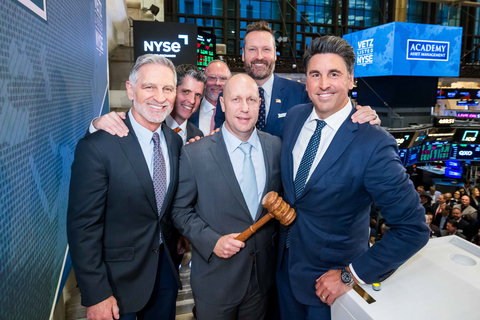
Academy Asset Management: (From L to R: Phil McConkey, Anthony Graham, Randy Lauer, Seth Rosenthal, Spencer Wilcox, Chance Mims)
The AUM milestone comes at a critical time, as housing affordability has remained one of the most pressing financial challenges facing
Leading with performance, VETZ continues to beat the mortgage index and products with similar investment objectives in the mortgage space, while also delivering tangible, reportable, and observable impact to the active duty servicemember and veteran community.
The performance data quoted represents past performance. Past performance does not guarantee future results. The investment return and principal value of an investment will fluctuate so that an investor’s shares, when sold or redeemed, may be worth more or less than their original cost and current performance may be lower or higher than the performance quoted. Performance current to the most recent month-end can be obtained by calling (866) 631-0504.
View standardized performance at www.academyetfs.com.
“Reaching
“Crossing this key threshold reflects the consistency of the strategy and investor confidence in our approach. We’re grateful to our investors for the opportunity to deliver competitive performance while supporting the veteran community in a measurable way,” stated Academy Asset Management’s CIO Seth Rosenthal.
“This milestone reinforces that investors are looking beyond traditional benchmarks. They want exposure to strategies that are grounded in real economic needs, like housing, while also supporting communities such as veterans who have served our country,” stated Phil McConkey, Vice Chairman of Academy Securities.
VETZ
About Academy Asset Management (AAM):
Academy Asset Management is the nation’s first post-9/11 veteran-owned and operated institutional asset manager, specializing in fixed-income funds and separately managed accounts. Our leadership and team members bring rigorous military training combined with deep expertise in global capital markets. Mission-driven and guided by a strong ethical foundation, we operate with a high degree of accountability and a relentless focus on our clients’ success. Academy Asset Management is an SEC registered investment adviser, certified Disabled Veteran Business Enterprise (DVBE), and Service-Disabled Veteran Owned Business (SDVOB) and has offices in
Investors should consider the investment objectives, risks, charges and expenses carefully before investing. For a prospectus or summary prospectus with this and other information about the Fund, please call (866) 631-0504 or visit our website at www.academyassetmanagement.com. Read the prospectus or summary prospectus carefully before investing.
Investing involves risk. Principal loss is possible.
Agency Small Business Loan & MBS Risk. There is uncertainty as to the current status of many obligations of Fannie Mae or Freddie Mac and other agencies that are placed under conservatorship of the
Fixed income Securities Risk. Typically, the value of fixed income securities changes inversely with prevailing interest rates.
Non-Agency MBS Risk. Non-agency MBS are subject to heightened risks as compared to agency MBS, including that non-agency MBS are not subject to the same underwriting requirements for the underlying mortgages that are applicable to those MBS that have a government or government-sponsored entity guarantee.
Non-Agency MBS Risk. Non-agency MBS are subject to heightened risks as compared to agency MBS, including that non-agency MBS are not subject to the same underwriting requirements for the underlying mortgages that are applicable to those MBS that have a government or government-sponsored entity guarantee.
Prepayment Risk and Extension Risk. Many issuers have a right to prepay their fixed income securities.
Repurchase Agreement Risk. Repurchase agreements may be viewed as loans made by the Fund that are collateralized by the securities subject to repurchase.
TBA Transactions Risk. The Fund may enter into TBA transactions for MBS.
New Fund Risk. As a new fund, there can be no assurance that the Fund will grow or maintain an economically viable size.
Investment grade is a rating of fixed-income bonds, bills, and notes by credit rating agencies like Standard and Poor’s (S&P), Fitch, and Moody’s, which signifies a low risk of default. The rating determines the creditworthiness of companies based on their financial strengths and structure, past data, and growth potential. Companies with good levels of debt, debt repayment, good earning potential, and growth will have good credit ratings.
Mortgage-backed securities (MBS) are investment products similar to bonds. Each MBS consists of a bundle of home loans and other real estate debt bought from the banks that issued them. Investors in mortgage-backed securities receive periodic payments similar to bond coupon payments.
Bloomberg US Aggregate Bond Index This index (the “Agg”) represents securities that are SEC registered, taxable and
Bloomberg US Mortgage-Backed Securities (MBS) Index: This index measures the performance of investment grade, fixed-rate, mortgage-backed, pass-through securities of the government-sponsored enterprises (GSEs): Federal Home Loan Mortgage Corp. (Freddie Mac), Federal National Mortgage Association (Fannie Mae) and Government National Mortgage Association (Ginnie Mae).
VETZ is distributed by Foreside Fund Services, LLC. Foreside is not related to Academy.
View source version on businesswire.com: https://www.businesswire.com/news/home/20260421465919/en/
Academy Asset Management
Michael Boyd, 646-736-3995
Chief Compliance Officer
mboyd@academyalpha.com
Source: Academy Asset Management