
STOCK TITAN

VIAVI Introduces GNSS-Disciplined Oscillator for Precision Timing in Size, Weight and Power-Constrained Platforms

(Neutral)
(Neutral)
Tags

VIAVI (NASDAQ: VIAV) launched the µPNT GDO-1000, a GNSS-disciplined oscillator in an M.2 B-key form factor measuring 22mm x 42mm and under 4 grams. It targets SWaP-constrained defense, unmanned, airborne, data center and communications platforms needing precise, resilient timing.

The GDO-1000 combines dual-frequency L1/L5 GNSS, MEMS-based microsecond-class 24-hour holdover, patented AI/ML compensation, low power near half a watt, multiple 1PPS/10MHz I/O and external disciplining options to approach atomic-class timing performance in a compact module.

Loading...
Loading translation...

Positive

  • None.

Negative

  • None.

News Market Reaction – VIAV

-2.20%
65 alerts
-2.20% Session close to close
+14.0% Peak in 25 hr 25 min
$13.07B Market Cap
0.4x Rel. Volume

In the Jun 1 session, VIAV declined 2.20%, reflecting a moderate negative market reaction. Argus tracked a peak move of +14.0% during that session. Our momentum scanner triggered 65 alerts that day, indicating high trading interest and price volatility.

Data tracked by StockTitan Argus on the day of publication.

Market Context

This announcement showcases VIAVI’s push into compact, low-power precision timing via the µPNT GDO-1...
Analysis

This announcement showcases VIAVI’s push into compact, low-power precision timing via the µPNT GDO-1000, featuring dual-frequency L1/L5 GNSS and 24-hour microsecond-class holdover in a 22mm x 42mm module. It follows recent strong Q3 FY26 results and new test-platform launches, highlighting ongoing product diversification into defense, unmanned systems and data centers. Investors may watch adoption in these niches and how this complements the company’s broader capital-raising and R&D strategy.

Key Figures

Holdover performance: 24-hour microsecond-class holdover Module dimensions: 22mm x 42mm Module weight: <4 grams +5 more
8 metrics
Holdover performance 24-hour microsecond-class holdover µPNT GDO-1000 timing stability in compromised GNSS conditions
Module dimensions 22mm x 42mm M.2 B-key form factor footprint of GDO-1000
Module weight <4 grams Ultra-compact GNSS-disciplined oscillator package weight
Power draw Approximately 0.5 watts Power consumption of GDO-1000 in operation
GNSS bands Dual-frequency L1/L5 Reception capabilities for resilient GNSS timing
Reference frequency 10 MHz Low-phase-noise 10MHz coaxial I/O for system integration
Booth number 407 GDO-1000 display at 2026 Joint Navigation Conference
Conference dates June 1–4, 2026 Joint Navigation Conference timing for product showcase

Historical Context

5 past events · Latest: May 19 (Negative)
Pattern 5 events
Date Event Sentiment 24h Move Catalyst
May 19 Equity offering priced Negative -1.2% Pricing of 11,111,111-share offering at $45 to repay Term Loan B.
May 19 Equity offering planned Negative -1.2% Announcement of proposed ~$500M common stock offering for debt repayment.
May 05 AI test appliance Positive +2.8% Launch of CyberFlood CF1000 platform for multi-terabit and AI validation.
Apr 29 Earnings beat, guidance Positive +15.1% Q3 FY26 revenue and margins up strongly with Q4 guidance provided.
Apr 27 PCIe 7.0 investment Positive -5.9% Investment in Xgig PCIe 7.0 protocol analysis platform and Devcon showcase.

24h Move is the share-price change in the day after each event; other market factors may also have contributed.

Pattern Detected

Positive earnings and product news have generally seen aligned positive reactions, while financing actions and some investment announcements have produced either modest declines or divergence.

Recent Company History

Over the last few months, VIAVI has combined strong operating execution with active capital markets activity and product expansion. Q3 FY26 results on Apr 29 showed sharply higher revenue and margins, with a 15.09% price gain. New test platforms and AI-focused products have also driven positive reactions, though an April PCIe 7.0 investment saw a -5.93% move. The May common stock offering around $500 million led to modest declines, contrasting with stronger responses to operational and product catalysts, providing context for today’s timing-module launch.

Key Terms

gnss-disciplined oscillator, m.2 b-key form factor, micro-electro-mechanical systems (mems) oscillator, oven controlled crystal oscillators (ocxos), +3 more
7 terms
gnss-disciplined oscillator technical
"launch of the µPNT GDO-1000, a new GNSS-disciplined oscillator built..."
A GNSS-disciplined oscillator is a precise electronic clock that runs on its own but is regularly corrected by signals from global navigation satellite systems (like GPS) to keep time accurate. For investors, it matters because accurate, traceable timekeeping is critical in industries such as finance, telecom, and utilities for synchronized systems, regulatory timestamping, and low-latency trading; think of it as a wristwatch that self-adjusts using a satellite signal to avoid costly timing errors.
m.2 b-key form factor technical
"GNSS-disciplined oscillator built in the M.2 B-key form factor."
An M.2 B-key form factor is a small, standardized physical connector and slot used on modern laptops and circuit boards to add components such as solid‑state drives, cellular or Wi‑Fi modules. Think of it like a shaped plug that only fits compatible sockets: the B‑key determines which types of drives and interfaces will work. Investors care because this design affects product compatibility, upgrade options, manufacturing costs and component supply choices that influence device performance and margins.
micro-electro-mechanical systems (mems) oscillator technical
"The Micro-Electro-Mechanical Systems (MEMS) oscillator delivers better..."
A micro-electro-mechanical systems (MEMS) oscillator is a tiny mechanical device, no larger than a grain of sand, that vibrates at a steady rate to create precise timing or frequency signals—think of it as a miniature tuning fork used inside electronics. Investors care because these components affect product performance, power use and manufacturing cost across mobile devices, networking gear and sensors; improvements or shortages can influence revenue, margins and supply-chain risk for firms that use or make them.
oven controlled crystal oscillators (ocxos) technical
"than traditional quartz Oven Controlled Crystal Oscillators (OCXOs)..."
A temperature-stabilized electronic clock that keeps a device’s timing signal extremely steady by enclosing the oscillator in a small, heated chamber. Like a thermostat that prevents a clock from running fast or slow as the weather changes, an OCXO delivers very low timing drift and phase noise compared with ordinary oscillators. Investors care because OCXOs are critical components in telecom networks, satellite systems and precision instruments, so demand, cost and supply affect product performance, margins and revenue for vendors serving those markets.
allan deviation technical
"with sustained phase noise and Allan Deviation performance under vibration..."
A statistical measure that shows how the variability of a time series (like prices or rates) changes when you average observations over different time windows; it is the square-root form of Allan variance. Think of it like testing how shaky a camera image gets at different exposure lengths: short windows reveal fast jitter, long windows reveal slow drift. For investors, it helps distinguish fleeting noise from persistent trends, improving risk estimates, horizon choices and algorithm calibration.
1pps technical
"Accepts an external 1PPS input, allowing it to be disciplined by M-Code GPS..."
1pps means one percentage point, the simple difference between two percentage figures — for example, moving from 3% to 4% is a 1 percentage point change (1pps). Investors watch percentage-point moves in interest rates, profit margins, yield, or growth because even a single-point shift can noticeably change expected cash flows, risk and valuation; think of it as a single-step change in the slope of a hill that alters how steep the climb becomes.
m-code gps technical
"allowing it to be disciplined by M-Code GPS, alternative navigation sources..."
M-code GPS is a hardened, encrypted radio signal used by military receivers to get positioning and timing information that’s much harder to jam or spoof than civilian GPS signals. For investors, M-code matters because upgrading satellites, chips, receivers, and secure infrastructure to support it creates steady demand and contract opportunities for companies in defense hardware, navigation chips, and secure communications—similar to replacing shared road signs with a private, tamper-resistant lane.

AI-generated analysis. How Rhea-AI works. Not financial advice.

See more from StockTitan in Google Search and AI answers. Adds StockTitan as a preferred source · opens Google
Add on Google
  • µPNT GDO-1000 is the smallest, lowest-power package for precision timing with microsecond-class 24-hour holdover from a MEMS-based oscillator
  • Ultra-compact design – no larger than a postage stamp and weighing under 4 grams
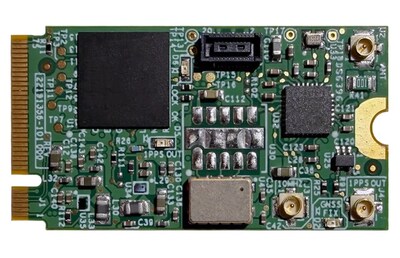
CHANDLER, Ariz., June 1, 2026  /PRNewswire/ -- VIAVI Solutions Inc. (VIAVI) (NASDAQ: VIAV) has announced the launch of the µPNT GDO-1000, a new GNSS-disciplined oscillator built in the M.2 B-key form factor. Measuring just 22mm x 42mm, the size of a postage stamp, and weighing less than 4 grams, the GDO-1000 is designed for platforms requiring accurate timing in places where traditional timing modules do not fit or are too power-hungry, including defense and airborne platforms, unmanned systems, data center cards and communications equipment.

GNSS interference has become a persistent and ongoing operational concern. Dual-frequency L1/L5 reception is increasingly specified in defense and critical infrastructure procurements as a baseline requirement. Demand for compact, low-power precision timing continues to grow across multiple markets, especially as warfighters and unmanned platforms limit payload to stay agile, and customers who designed in chip-scale atomic clocks (CSACs) face cost and lead-time pressure.

The µPNT GDO-1000 addresses these challenges through a unique combination of capabilities:

  • Dual-frequency L1/L5 GNSS reception with microsecond-class 24-hour holdover, enabling precise, resilient timing in compromised conditions
  • The M.2 B-key form factor drops into modern compute platforms, time appliance cards and embedded systems without custom mechanical design, all while drawing approximately half a watt
  • Patented AI and ML algorithms developed by the Jackson Labs team, now part of VIAVI, predict and compensate for oscillator behavior across environmental conditions
  • The Micro-Electro-Mechanical Systems (MEMS) oscillator delivers better thermal stability across the full military temperature range than traditional quartz Oven Controlled Crystal Oscillators (OCXOs), with sustained phase noise and Allan Deviation performance under vibration and shock
  • Accepts an external 1PPS input, allowing it to be disciplined by M-Code GPS, alternative navigation sources, or other external references without hardware modification
  • Multiple 1PPS and low-phase-noise 10MHz coaxial inputs and outputs for system integration flexibility, despite its miniature size

"Until now, customers needing reliable timing in compact systems have had to choose between two suboptimal options. CSACs are expensive and supply-constrained. Full-size OCXO-based timing solutions are too large and power-hungry for many modern platforms," said Doug Russell, Senior Vice President and General Manager, Aerospace & Defense, VIAVI. "The GDO-1000 offers a new path that doesn't force customers to compromise. Its holdover performance approaches what customers expect from atomic-class clocks, in a module that fits on a standard M.2 slot and draws approximately half a watt."

The GDO-1000 will be on display at VIAVI Booth 407 at the 2026 Joint Navigation Conference from June 1-4 at the Northern Kentucky Convention Center. As part of the event technical program, Lisa Perdue and Nino De Falcis of VIAVI will speak about a New Cesium-Less ePRTC Solution to Provide Timing for Homeland Critical Infrastructure.

About VIAVI PNT
VIAVI Solutions delivers a breakthrough solution for GPS/GNSS-denied environments, combining resilient timing from Jackson Labs with precision navigation from Inertial Labs. Backed by advanced sensor fusion, this combination of GNSS transcoding with exceptional holdover and precision dead reckoning provides unmatched reliability, security and effortless operation when it matters most.

About VIAVI
VIAVI (NASDAQ: VIAV) is a global leader in test and measurement and optical technologies. Our test, monitoring, assurance, and resilient position, navigation and timing solutions enable and secure critical infrastructure ranging from data center ecosystems and communication networks to military, aerospace, railway and first responder communications. In addition, we develop and advance technologies used in high-volume optical applications across anti-counterfeiting, consumer electronics, aerospace, industrial and automotive end markets.

Learn more about VIAVI at www.viavisolutions.com. Follow us on VIAVI Perspectives, LinkedIn and YouTube.

Media Inquiries:
Grand Bridges
Emma Jenkins
emma@grandbridges.com 
+1 415 800 4529


Cision View original content to download multimedia:https://www.prnewswire.com/news-releases/viavi-introduces-gnss-disciplined-oscillator-for-precision-timing-in-size-weight-and-power-constrained-platforms-302786904.html

SOURCE VIAVI Solutions

FAQ

What is the VIAVI (NASDAQ: VIAV) \\/PNT GDO-1000 GNSS-disciplined oscillator launched in June 2026?

The µPNT GDO-1000 is a compact GNSS-disciplined oscillator in an M.2 B-key module designed for precision timing. According to VIAVI, it offers dual-frequency L1\\/L5 reception, microsecond-class 24-hour holdover, MEMS technology and low power consumption for space- and power-limited platforms.

What are the key size, weight and power specifications of the VIAVI VIAV µPNT GDO-1000?

The µPNT GDO-1000 measures 22mm x 42mm, about a postage stamp, and weighs under 4 grams. According to VIAVI, it draws approximately half a watt, making it suitable for SWaP-constrained defense, unmanned systems, airborne platforms and dense data center or communications cards.

How does the VIAVI µPNT GDO-1000 improve timing resilience for defense and critical infrastructure applications (NASDAQ: VIAV)?

The µPNT GDO-1000 supports dual-frequency L1\\/L5 GNSS and microsecond-class 24-hour holdover to maintain precise timing. According to VIAVI, MEMS hardware plus AI\\/ML algorithms help compensate environmental effects, improving resilience where GNSS is compromised and payload, power or space are tightly constrained.

How does the VIAVI µPNT GDO-1000 compare with CSAC and OCXO timing solutions for VIAV customers?

The µPNT GDO-1000 is positioned between costly, supply-constrained CSACs and larger, power-hungry OCXO modules. According to VIAVI, its holdover performance approaches atomic-class clocks while fitting a standard M.2 slot and consuming roughly half a watt, easing integration in compact platforms.

What integration options does the VIAVI VIAV µPNT GDO-1000 provide for system designers?

The µPNT GDO-1000 uses an M.2 B-key form factor that drops into modern compute and timing cards. According to VIAVI, it supports external 1PPS disciplining, multiple 1PPS and low-phase-noise 10MHz coaxial inputs and outputs, enabling flexible system-level timing architectures.

Where and when will VIAVI showcase the µPNT GDO-1000 GNSS-disciplined oscillator in 2026?

VIAVI plans to display the µPNT GDO-1000 at Booth 407 during the 2026 Joint Navigation Conference. According to VIAVI, the event runs June 1–4 at the Northern Kentucky Convention Center, where company experts will also discuss a cesium-less ePRTC timing solution.
