
Valor Gold Defines Non-Refractory Exploration Targets at Courageous Lake
Valor refines five non-refractory gold targets at Courageous Lake and plans 12,000 m of drilling to upgrade the Walsh Lake resource.
Rhea-AI Summary
Valor Gold (VLGDF) has refined multiple drill targets along the Tundra‑Salmita trend at the Courageous Lake project after a summer core relogging and resampling program, defining five priority areas focused on non‑refractory gold systems.
The initial priority is upgrading the Walsh Lake deposit from inferred to measured and indicated resources. Walsh Lake currently hosts an inferred mineral resource of 4.1 million tonnes grading 4.2 g/t gold for 550 koz over a 1 km strike to about 300 m depth, based on approximately 16,600 m of diamond drilling. Valor anticipates a further 12,000 m of drilling and plans a substantial diamond drill program in early 2027. Additional upside is being pursued through depth and strike extensions at Walsh Lake, the Olsen and Marsh Pond targets, and renewed baseline environmental monitoring at Courageous Lake.
Positive
- Walsh Lake inferred resource 4.1 Mt at 4.2 g/t Au containing 550 koz
- Existing drilling about 16,600 m already defining the Walsh Lake resource
- Planned drilling a further 12,000 m targeted to achieve measured and indicated resources
- High-grade intercept 21.2 m at 8.16 g/t Au in hole CL-210 at 330 m true depth
- Additional targets mineralization defined over 200 m at Olsen and 220 m at Marsh Pond
- Baseline work environmental monitoring reinitiated, including wildlife, hydrology, meteorology and fisheries studies
Negative
- Resource status Walsh Lake currently classified only as inferred mineral resources
- Economic caution inferred resources are too speculative to be treated as mineral reserves
- PEA limitation mine plan includes inferred resources and does not demonstrate economic viability
News Explained
Walsh Lake remains an inferred resource, so early-2027 drilling is needed before economic integration into a mine plan.
After a summer field program, Valor Gold has defined five priority areas at Courageous Lake; the current state is exploration planning, not mine development. The company expects substantial diamond drilling in
The company says the non-refractory targets could improve project economics, but the release also says Walsh Lake's inferred resource is too speculative for economic considerations to be applied and that resources in the PEA mine plan are not reserves with demonstrated economic viability.
For scale and geological context, the release points to the historic non-refractory Salmita and Tundra mines, which operated at 25 g/t and 19 g/t and produced approximately 280 Koz of gold; prior Olsen drilling included 40.4m grading 3.04 g/t gold.
The material resolution point is whether the planned 12,000m Walsh Lake program can support conversion to measured and indicated resources and give the updated prefeasibility study a basis for possible mine-plan integration.
AI-generated analysis. How Rhea-AI works. Not financial advice.




Toronto, Ontario--(Newsfile Corp. - September 17, 2026) - Valor Gold Corp. (TSX: VGC) (OTCQB: VLGDF) ("Valor" or the "Company") is pleased to announce that it has refined several drill targets along the Tundra-Salmita trend following a summer field program of core relogging and resampling. Based on this review, Valor has defined five priority areas for targeting non-refractory gold systems that could significantly improve project economics.
Mark Ashley, CEO of Valor, commented, "Expanding and integrating the Walsh Lake deposit into the mine plan could have significant implications for the Courageous Lake project. Walsh Lake is a near surface, non-refractory deposit and therefore could enhance project economics by sequencing its development early in the mine plan. We are beginning to understand the structural controls on mineralization, providing us with several opportunities for expansion of the currently defined mineralized footprint as well as refining our domains for resource estimation. We are looking forward to drill testing Walsh Lake with a substantial diamond drill program in early 2027."
Infill drilling at Walsh Lake
Valor's initial priority will be to drill the Walsh Lake deposit to a measured and indicated resource. The deposit is currently delineated as an inferred mineral resource of 4.1 million tonnes grading 4.2 g/t gold containing 550 Koz gold. Mineralization is defined over a 1km strike length and to around 300m in depth. The Walsh Lake deposit is currently drilled at a drill spacing of 50m with approximately 16,600m of diamond drilling defining the resource. Valor Gold anticipates a further 12,000m will be required to attain sufficient pierce points to delineate measured and indicated resources with the goal of integrating this deposit into an updated prefeasibility study.
Depth Extension at Walsh Lake
Detailed relogging has resulted in a refined structural interpretation at the Walsh Lake deposit. There appears to be strong structural and lithological controls on gold mineralization. Mineralization occurs in sheared rocks at the contact between greywackes and mafic volcanics. Gold occurs on the fracture surfaces or on margins of coarse-grained arsenopyrite adjacent to and within quartz veins. A syn-mineral fold in the centre of the deposit focuses the best intercepts at Walsh Lake; the deepest holes along this hinge (hole CL-210) zone assayed 21.2m of 8.16 g/t Au at 448m (330m true depth). Figure 1 outlines a long section through this hinge, indicating the down dip extension of this system is open at depth to the northwest. Follow up of these intercepts at depth will be an additional priority of the 2027 drill program.
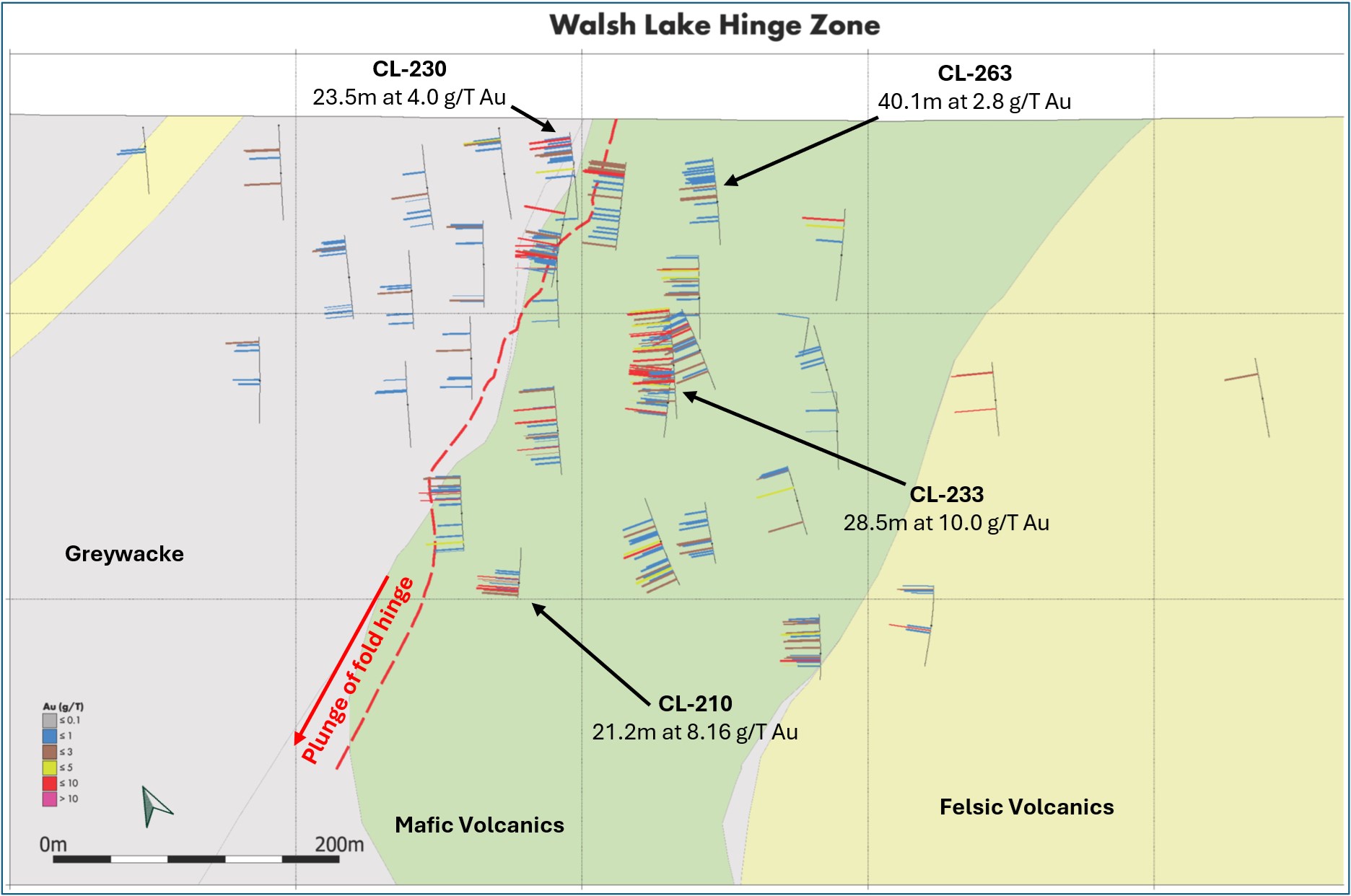
Figure 1 Walsh Lake hinge zone cross section
To view an enhanced version of this graphic, please visit:
https://images.newsfilecorp.com/files/12455/314664_9ac85e6284a549b9_001full.jpg
Strike Extension at Walsh Lake
The Walsh Lake deposit also is open to the south. Walsh Lake is currently defined over a 1km strike length. However, previous drilling campaigns at the deposit have indicated mineralization may extend a further 300m. The prospective stratigraphic contact at Walsh Lake extends South to the Saucer Lake target, a further 500m. Figure 2 shows the currently defined extents of mineralisation at Walsh Lake and the previous drilling indicating mineralization that occurs to the south but is not yet captured in the resource.
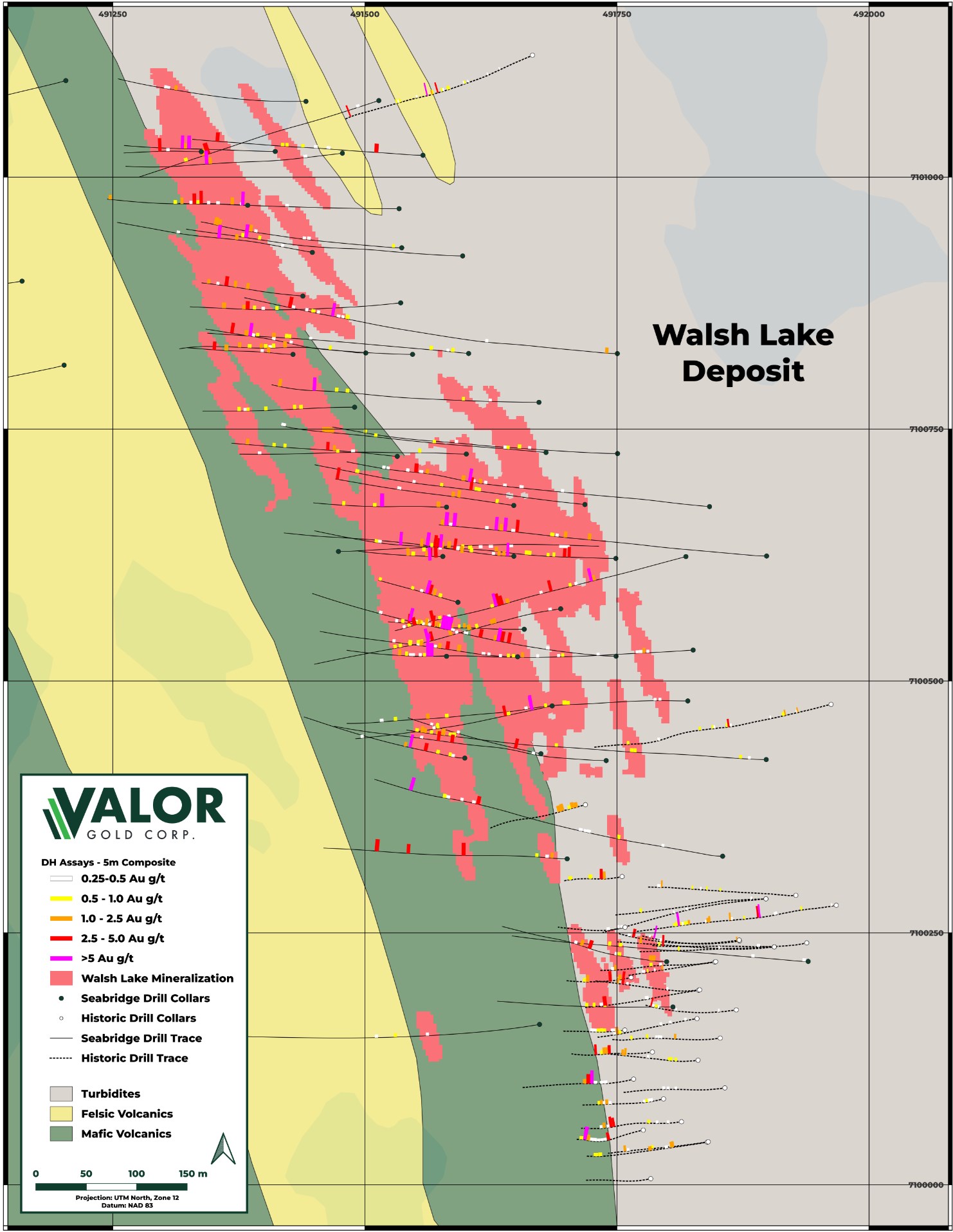
Figure 2 Walsh Lake Plan Map
To view an enhanced version of this graphic, please visit:
https://images.newsfilecorp.com/files/12455/314664_9ac85e6284a549b9_002full.jpg
Olsen and Marsh Pond Targets
Drilling in the 1980s and subsequent follow up by Seabridge Gold Inc. ("Seabridge") has defined two further opportunities that appear to be like the Walsh Lake deposit (Figure 3). Exploration in the 1980s was focused on finding deposits like the Salmita Mine and the Tundra Mine. These mines were non-refractory, operated at 25 g/t and 19 g/t, and produced approximately 280 Koz of gold. This exploration focused exclusively on narrow, high-grade veins and resultantly any intercepts below 8 g/t gold were considered below cut-off grade. Seabridge tested several of these targets in 2018 with results such as 40.4m of 3.04 g/t gold from 43.8m in hole CL-286 at Olsen (see Seabridge's news release dated May 9, 2018).
At Olsen, previous drilling has defined a mineralized strike length of 200m. Mineralization occurs within greywacke sedimentary rocks with moderate intensity silica and sericite alteration envelope. Throughout this alteration envelope there is in rhombic arsenopyrite adjacent to a broad array of thin and planar quartz veins.
At Marsh Pond, mineralisation occurs at the contact between felsic volcanic and sedimentary rock believed to be the southern extension of the Salmita mine. Previous drilling has defined mineralization over a strike length of 220m. At this contact, there is an intense, silicified zone with quartz-sulphide veining containing rhombic arsenopyrite crystals.
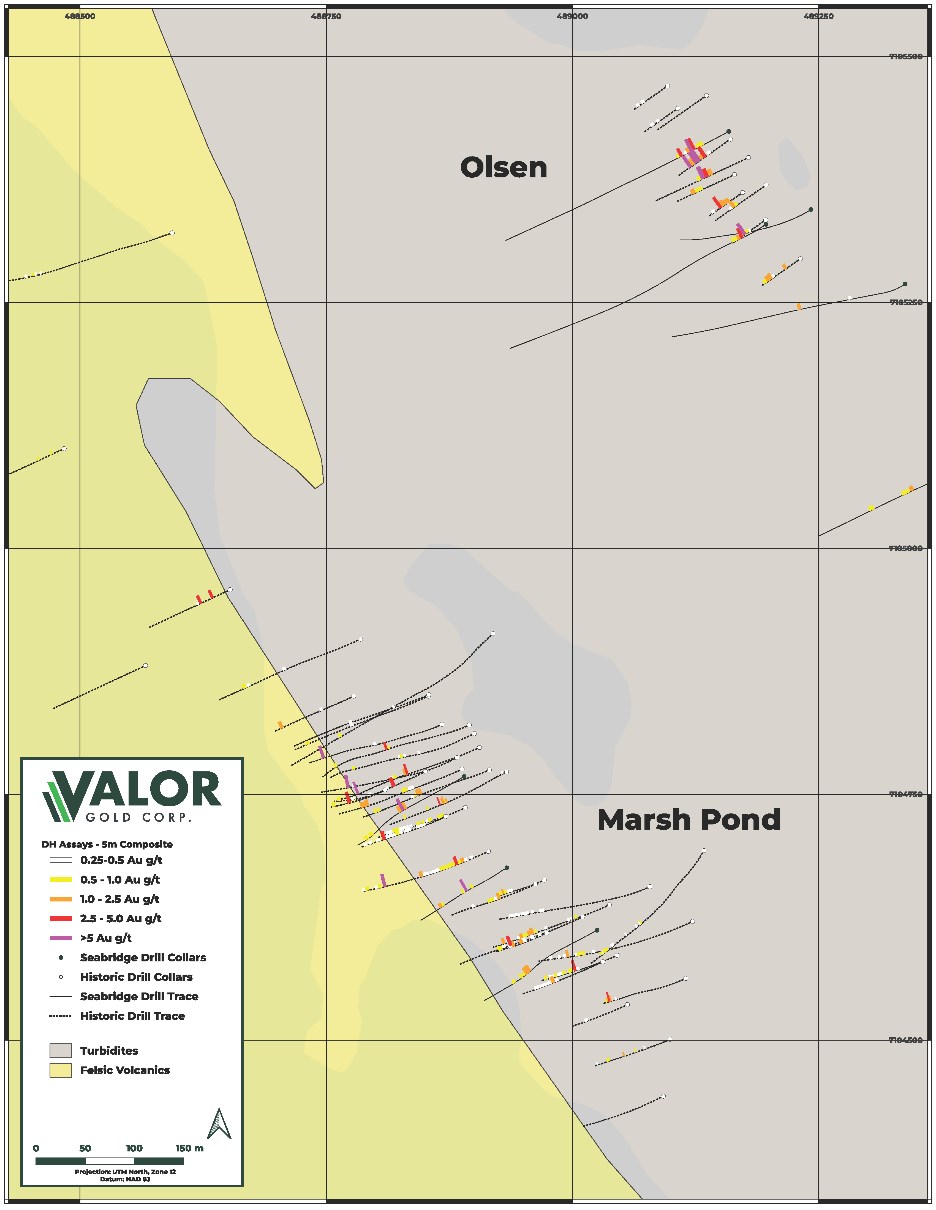
Figure 3 Olsen and Marsh Pond Targets
To view an enhanced version of this graphic, please visit:
https://images.newsfilecorp.com/files/12455/314664_9ac85e6284a549b9_003full.jpg
Baseline Environmental Studies
Valor has also reinitiated baseline environmental monitoring at Courageous Lake. This work included a wildlife monitoring program with cameras stationed across the property, hydrology monitoring, meteorology and fisheries work. This work will inform Valor's understanding of baseline data at the project that is required for environmental assessment.
Scientific and Technical Information
The most recent technical report on the Courageous Lake Project is entitled "Courageous Lake Pre-feasibility Study and Preliminary Economic Assessment, NI 43-101 Technical Report, Yellowknife, Northwest Territories, Canada" dated March 23, 2026, with an effective date of January 5, 2024 (the "Technical Report"). Readers are directed to the Technical Report for disclosure of QA/QC procedures, methodology and data verification undertaken with respect to the exploration information contained in this news release.
Inferred mineral resources are considered too speculative geologically to have the economic considerations applied to them that would enable them to be categorized as mineral reserves, and there is no certainty that the results of the Company's Preliminary Economic Assessment (PEA) will be realized. Mineral resources in the PEA mine plan are not mineral reserves and do not have demonstrated economic viability. The PEA evaluates a conceptual expansion beyond the pre-feasibility study pit and includes inferred mineral resources. See the PEA for relevant assumptions, parameters, and risks.
The contents of this release have been reviewed and approved by Marcus Adam, P.Geo, Vice President Exploration of the Company and a qualified person under National Instrument 43-101.
About Valor Gold Corp
Valor is a Canadian gold exploration and development company formed through the strategic spin-out of the Courageous Lake Gold Project in the Northwest Territories. The Company's mandate is to focus technical and financial resources on advancing a large-scale gold system through disciplined exploration, resource expansion, and staged development planning. For further information about the Company, please visit Valor's website at www.valorgold.ca.
On behalf of the Board of Directors
"Mark Ashley"
Chief Executive Officer and Director
For further information, please contact:
Tel: (647) 775-8803
Email: info@valorgold.ca
Neither the TSX nor the OTC Markets nor their regulation services providers have reviewed or accept responsibility for the accuracy or adequacy of this release.
FORWARD-LOOKING STATEMENTS
This news release contains "forward-looking information" and "forward-looking statements" within the meaning of applicable securities laws (collectively, "forward-looking statements"). All statements in this release that address events, conditions, or developments that the Company expects or anticipates will or may occur in the future are forward-looking statements. Forward-looking statements are often, but not always, identified by the use of words such as "expects," "anticipates," "believes," "estimates," "plans," "intends," "potential," "projects," "targets," "may," "could," "would," "might," and similar expressions. Forward-looking statements in this release include, but are not limited to, statements regarding the planned diamond drill program at the Walsh Lake deposit in early 2027, including the estimated 12,000 metres of additional drilling; the goal of delineating measured and indicated mineral resources at Walsh Lake and integrating the deposit into an updated prefeasibility study; the potential for expansion of the currently defined mineralised footprint at Walsh Lake, including depth and strike extensions; the potential for non-refractory gold systems at Walsh Lake, Olsen, and Marsh Pond to improve project economics; the characterisation of the Olsen and Marsh Pond targets as opportunities that appear to be analogous to Walsh Lake; and the expectation that baseline environmental monitoring work will inform the Company's understanding of data required for environmental assessment.
Forward-looking statements are based on the beliefs, expectations, and assumptions of management at the time such statements are made, including, without limitation, assumptions that the Company will be able to obtain the financing necessary to fund the planned drill program and ongoing exploration activities; the Company will receive all necessary permits and approvals required for its planned exploration and development activities; the geological interpretations and structural models underlying the exploration targets are accurate; mineral resource estimates will be confirmed or improved by further drilling; economic conditions and gold prices will remain favourable for continued development; key personnel and contractors will be available as required; and there will be no material adverse change in the regulatory environment. Although management considers these assumptions to be reasonable, they are inherently subject to significant business, economic, competitive, regulatory, and other risks and uncertainties.
Forward-looking statements are subject to numerous risks, including, but not limited to, uncertainty in the interpretation of geological data and the results of drill programs; the risk that further exploration or drilling may not confirm existing resource estimates or expand the mineralised zones as anticipated; the risk that mineral resources may not be converted to mineral reserves; fluctuations in gold prices and currency exchange rates; the Company's ability to obtain the necessary financing to fund exploration and development activities; risks associated with environmental assessment and permitting processes, including the risk of delays or refusals; regulatory and political risks; and general market and economic conditions. These risks, as well as other factors, may cause actual results, performance, or achievements to differ materially from those expressed or implied in the forward-looking statements.
Readers are cautioned not to place undue reliance on forward-looking statements. The Company undertakes no obligation to update or revise any forward-looking statements contained herein, except as required by applicable law. Forward-looking statements in this news release represent management's best judgment based on information available as of the date hereof; however, no forward-looking statement can be guaranteed, and actual outcomes may differ materially.

To view the source version of this press release, please visit https://www.newsfilecorp.com/release/314664
FAQ
AI-generated questions and answers. How Rhea-AI works. Not financial advice.
What is Valor Gold’s immediate exploration objective at Walsh Lake?
Valor’s initial priority is to drill the Walsh Lake deposit to achieve a measured and indicated resource classification. The company aims to obtain sufficient pierce points through an additional 12,000 m of drilling so the deposit can be integrated into an updated prefeasibility study mine plan.
How extensive is the current drilling and mineralization at Walsh Lake?
Walsh Lake mineralization is defined over a 1 km strike length and to around 300 m in depth. The resource is based on approximately 16,600 m of diamond drilling, completed on a 50 m drill spacing.
Where is mineralization at Walsh Lake open for potential expansion?
At Walsh Lake, the down‑dip extension along a syn‑mineral fold hinge is open at depth to the northwest, and the deposit is also open to the south. Previous drilling indicates mineralization may extend a further 300 m along strike toward the Saucer Lake target, which lies an additional 500 m along the same stratigraphic contact.
What styles of mineralization are observed at Olsen and Marsh Pond?
At Olsen, mineralization occurs in greywacke sedimentary rocks with moderate silica and sericite alteration containing rhombic arsenopyrite adjacent to thin, planar quartz veins over a 200 m strike. At Marsh Pond, mineralization occurs at the contact between felsic volcanic and sedimentary rocks, interpreted as the southern extension of the Salmita mine, within an intense silicified zone with quartz‑sulphide veining and rhombic arsenopyrite over a 220 m strike.
What baseline environmental studies has Valor restarted at Courageous Lake?
Valor has reinitiated baseline environmental monitoring that includes a wildlife monitoring program using cameras across the property, as well as hydrology, meteorology and fisheries work. These datasets are intended to support the environmental assessment process for the project.
Who is the qualified person responsible for the technical content of this release?
The contents of the release have been reviewed and approved by Marcus Adam, P.Geo, Vice President Exploration of the company, who is a qualified person under National Instrument 43‑101.
What technical report currently covers the Courageous Lake project?
The most recent technical report is titled “Courageous Lake Pre‑feasibility Study and Preliminary Economic Assessment, NI 43‑101 Technical Report, Yellowknife, Northwest Territories, Canada,” dated March 23, 2026, with an effective date of January 5, 2024.