
Viscount Mining Reports Antimony and Tellurium Geochemical Results at Cherry Creek, Nevada - Both Included on the 2025 U.S. Critical Minerals List
Viscount Mining (VLMGF) reported results from a comprehensive geochemical review at its Cherry Creek Project in Nevada, identifying broad anomalies in antimony and tellurium, both on the U.S. 2025 Critical Minerals List.
Sentiment and the balance of points
Rhea-AI Sentiment reads the wording of the document, how positive or negative its language is on a 1 to 5 scale. The balance of points shown with the takes weighs what the document actually discloses, so the two can disagree, for example when a trial that missed its main goal is described in upbeat language.
Rhea-AI Summary
Viscount Mining (VLMGF) reported results from a comprehensive geochemical review at its Cherry Creek Project in Nevada, identifying broad anomalies in antimony and tellurium, both on the U.S. 2025 Critical Minerals List.
The review compiled more than 1,965 rock and 4,593 soil samples. For antimony, 106 rock samples returned 100–10,000 ppm and another 534 ran 15–100 ppm, outlining a linear corridor where gold in rock reaches 48.6 g/t. Soil and stream-sediment data define a large surface antimony anomaly. For tellurium, 13 rock samples exceeded 4 ppm with a peak of 56.8 ppm, plus additional anomalous rock and soil results. The tellurium anomaly follows the Exchequer Fault, where bismuth reaches 1,710 ppm and the Au-Bi-Te target is currently ranked the third drill priority. Viscount is integrating these data to refine drill targeting at Cherry Creek.
Positive
- Antimony rock samples include 106 samples grading 100–10,000 ppm at Cherry Creek.
- Additional 534 rock samples carry 15–100 ppm antimony, defining a broad halo around higher-grade values.
- Gold values along the antimony corridor reach 48.6 g/t in rock samples.
- Tellurium rock samples include 13 above 4 ppm, peaking at 56.8 ppm, plus multiple additional anomalous samples.
- Bismuth values along the Exchequer Fault reach 1,710 ppm, supporting an Au-Bi-Te drill target ranked third on the property.
- Antimony market backdrop includes prices rising from ~US$5,500/t in 2023 to US$59,750/t in July 2025 and nearly US$400 million in related U.S. defense and supply-chain commitments.
Negative
- Historical geochemical data used in the compilation have not all been independently verified by the company.
- Rock chip and grab samples are selective and may not represent overall mineralization on the property.
- Geochemical anomalies are stated as not necessarily indicative of an economic mineral deposit.
Details
News Market Reaction – VLMGF
On Sep 10, the day this news came out, VLMGF closed 8.16% above the previous close.
Data tracked by StockTitan Argus for the Sep 10 session.
AI-generated analysis. How Rhea-AI works. Not financial advice.




Vancouver, British Columbia--(Newsfile Corp. - September 10, 2026) - Viscount Mining Corp. (TSXV: VML) (OTCQX: VLMGF) ("Viscount" or the "Company") reports results of a comprehensive geochemical review of its Cherry Creek Project in White Pine County, Nevada. The review — covering rock, soil, and stream sediment samples across thousands of data points — identified a broad geochemical anomaly in antimony (Sb) and tellurium (Te), both of which are classified by the U.S. Government as critical minerals. The two elements occur within the Cherry Creek dataset and are being incorporated into the Company's ongoing geological interpretation and exploration targeting.
Antimony and tellurium are both on the official 2025 U.S. Government Critical Minerals List. China controls the majority of global supply of both metals and has imposed export bans and licensing restrictions affecting international supply. During this period, antimony prices increased from roughly US
ANTIMONY AT CHERRY CREEK: GEOCHEMICAL RESULTS
At Cherry Creek, antimony is one of the elements showing the more elevated values across the compiled dataset. Results from more than 1,965 rock samples and 4,593 soil samples include:
Rock samples: 106 rock samples returning 100 to 10,000 parts per million (ppm) antimony — results that the Company interprets as consistent with primary stibnite mineralization in the sampled rock, rather than only trace antimony
An additional 534 rock samples between 15 and 100 ppm antimony, defining a broad surrounding halo
Soil samples: 42 soil samples returning 10 to 351 ppm antimony, and over 1,800 additional soil samples above background — outlining an antimony anomaly over a broad area at surface
Stream sediment: Stream sediment antimony peaking at 4.83 ppm, showing antimony enrichment across multiple drainages
The geological interpretation considers both the peak values and their spatial distribution. The highest antimony rock samples form a linear trend along the main east-west structural corridor through the centre of the property. At concentrations of 1,000 to 10,000 ppm, the Company interprets the antimony values as consistent with stibnite mineralization rather than only a trace pathfinder response. Gold values in rock samples from the same corridor reach 48.6 grams per tonne (g/t), with several multi-gram samples occurring with the higher antimony values. This spatial association is being evaluated as a stibnite-gold vein exploration target, a deposit style known elsewhere in Nevada.
TELLURIUM: A SECOND CRITICAL MINERAL IN THE CHERRY CREEK DATASET
Tellurium is less well-known than antimony but is also included on the 2025 Critical Minerals List. The U.S. Government added tellurium to the list because of its role in defense technologies and the concentration of global supply in China. Tellurium is used in thermoelectric devices, infrared optics, solar thin-film panels, and precision defense electronics. At Cherry Creek, the compiled geochemical data includes tellurium values above cited background levels, adding another element for follow-up in the Company's exploration program.
At Cherry Creek, the Company's recently completed geochemical review — which integrated a new tellurium dataset for the first time — returned the following results:
Rock samples: 13 rock samples exceeding 4 ppm tellurium, with a peak of 56.8 ppm — values above cited background levels in unmineralized terrain (typically below 0.1 ppm)
An additional 33 rock samples in the 1-4 ppm range, and 34 more between 0.5 and 1 ppm — an additional set of anomalous results
Soil samples: 13 soil samples above 0.26 ppm, peaking at 1.4 ppm — supporting an interpretation of a bedrock-related tellurium source rather than isolated outcrop
Elevated tellurium in this context is geologically relevant because tellurium can be associated with gold-bismuth-telluride mineralization — a style in which gold may occur in telluride minerals rather than only as free gold. Known examples of telluride systems include Cripple Creek, Colorado and Goldfield, Nevada. At Cherry Creek, the tellurium anomaly is spatially concentrated along the Exchequer Fault, a northeast-trending structure that connects the eastern magnetic high — interpreted by the Company as a buried intrusive body that may have contributed heat and fluids to the system — to the central property. Bismuth, another indicator element, is also elevated along the same corridor, with rock values reaching 1,710 ppm. The Company's geological consultants currently rank the Exchequer Fault Au-Bi-Te target as the third drill priority on the property, based in part on this tellurium data.
NEVADA CONTEXT: REGIONAL ANTIMONY-GOLD ACTIVITY
Cherry Creek is not the only Nevada project with current antimony-gold activity. NevGold Corp TSX-V: NAU, OTC: NAUFF whose Limousine Butte Project is in White Pine County, Nevada — approximately 10 kilometres to the southwest — is actively advancing a near-surface oxide antimony-gold deposit toward a maiden mineral resource estimate and is targeting initial antimony production by 2027. NevGold's progress provides a recent regional reference point for antimony-gold exploration and development activity in Nevada.
Cherry Creek is geologically distinct from Limousine Butte. Where NevGold's Limousine Butte is primarily an oxide antimony-gold system, Cherry Creek is interpreted as a structurally controlled polymetallic hydrothermal system — with the antimony-gold signature occurring within a broader geochemical dataset that also includes silver to 8,710 ppm in rocks, tungsten to 10,000 ppm, copper to 33,900 ppm, and the newly compiled tellurium results. The system is geologically complex and remains substantially unexplored by modern drilling.
WHAT'S NEXT
Viscount is integrating the newly compiled antimony and tellurium data with existing geological, geochemical and geophysical datasets to refine and prioritize drill targets at Cherry Creek. Particular attention is being directed toward the structurally controlled antimony-gold corridor and the Exchequer Fault gold-bismuth-tellurium target. The Company will provide additional information regarding the next phase of exploration at Cherry Creek as plans are finalized.
ABOUT THE CHERRY CREEK PROJECT
The Cherry Creek Project is a consolidated mineral property in White Pine County, Nevada, covering a large block of ground in the eastern Great Basin. The Company interprets the property as a telescoped multi-commodity hydrothermal system, formed above a buried granitic intrusion that may have driven fluids through a series of fault corridors and carbonate host rocks. Peak geochemical values across the dataset include silver to 8,710 ppm, tungsten to 10,000 ppm, copper to 33,900 ppm, gold to 48.6 g/t, antimony to 10,000 ppm, and tellurium to 56.8 ppm. These results are being used to evaluate several possible deposit styles within the property: carbonate-replacement and skarn (tungsten-copper-silver-lead-zinc), epithermal and stibnite-gold vein (antimony-gold-silver), and gold-bismuth-telluride (gold-tellurium-bismuth).
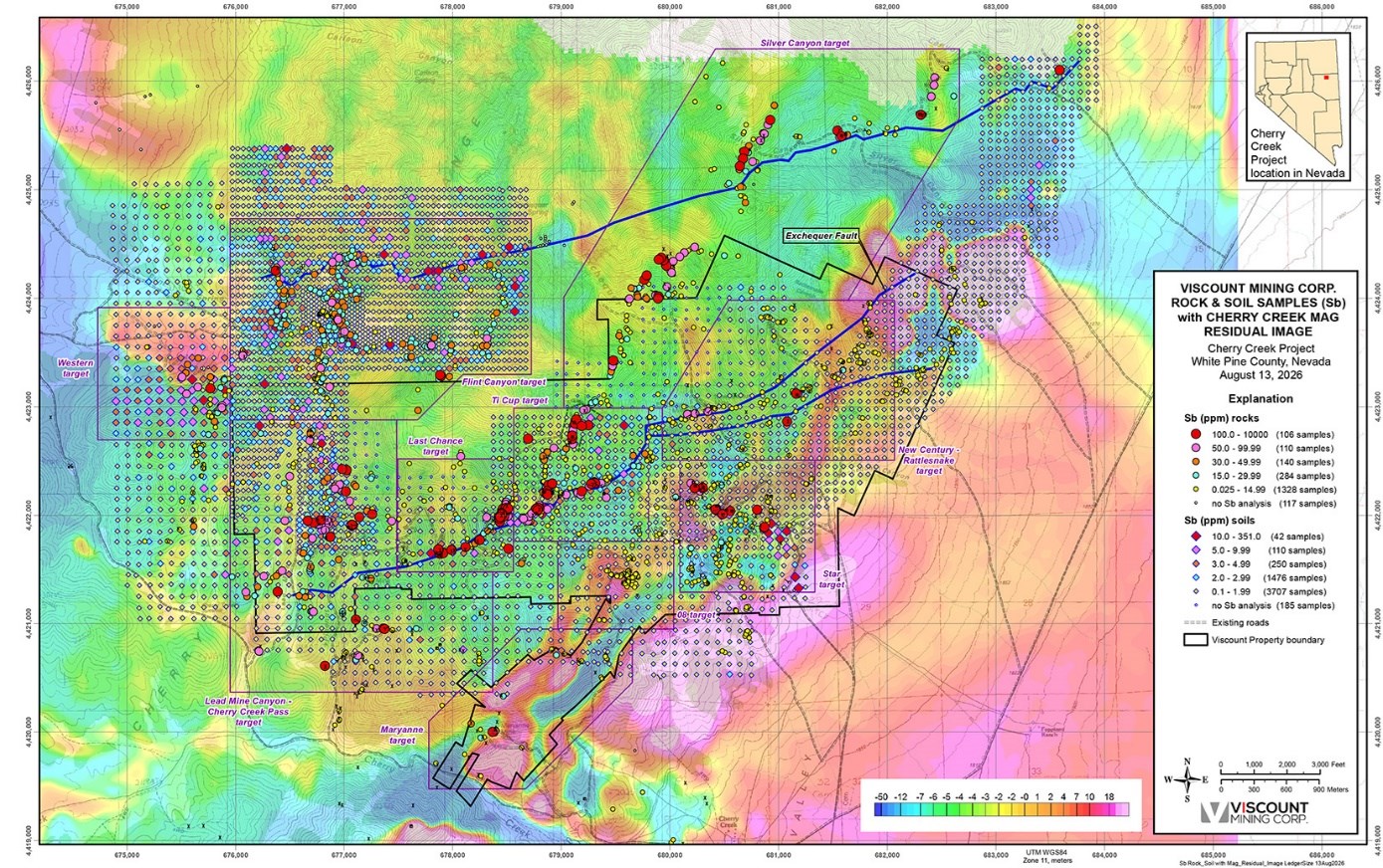
Figure 1: Cherry Creek Project – Antimony (Sb) in Rock and Soil Samples overlaid on Cherry Creek Magnetic Residual Image
White Pine County, Nevada | UTM WGS84 Zone 11 | August 13, 2026
To view an enhanced version of this graphic, please visit:
https://images.newsfilecorp.com/files/2736/313688_0c8566f91404ebbe_002full.jpg
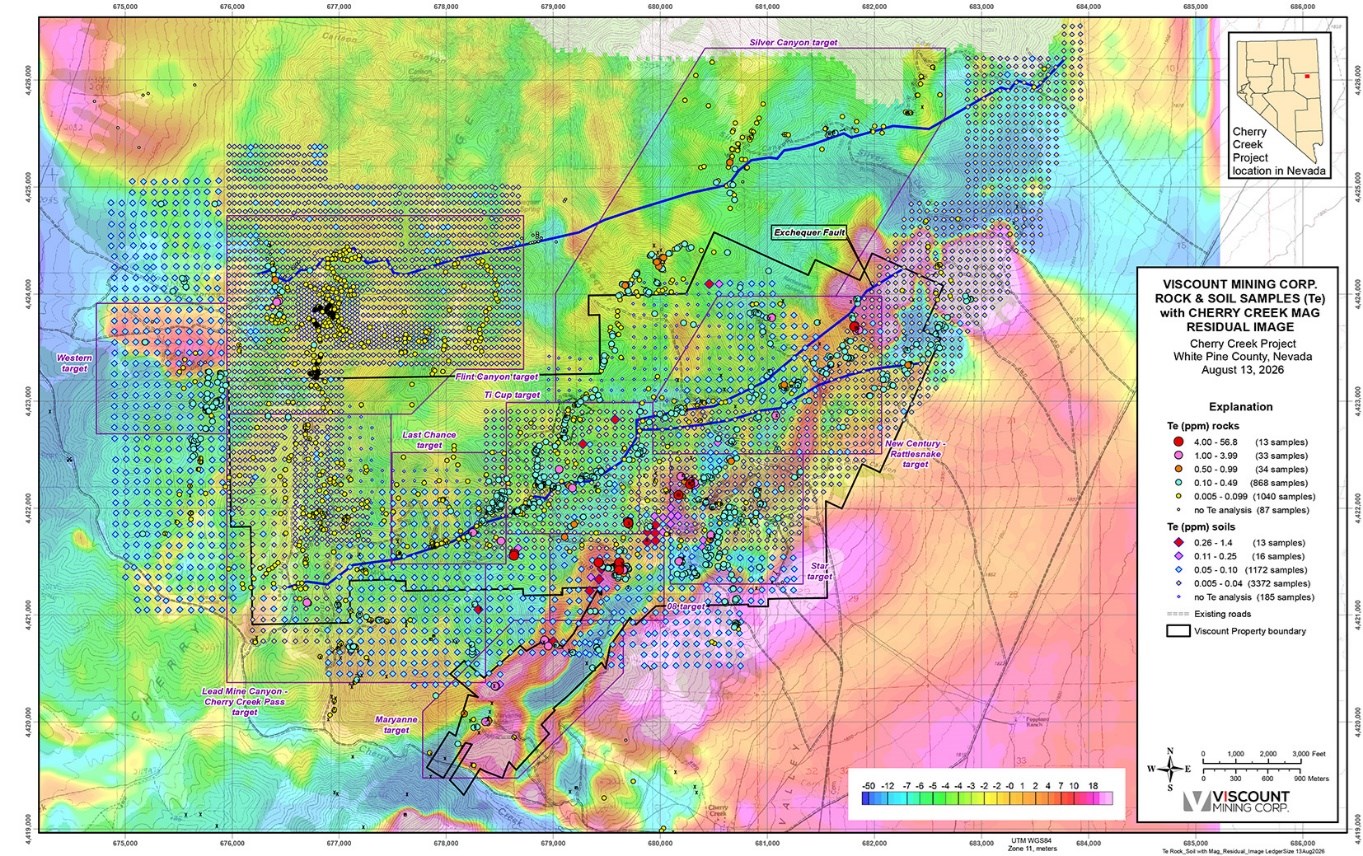
Figure 2: Cherry Creek Project – Tellurium (Te) in Rock and Soil Samples overlaid on Cherry Creek Magnetic Residual Image
White Pine County, Nevada | UTM WGS84 Zone 11 | August 13, 2026
To view an enhanced version of this graphic, please visit:
https://images.newsfilecorp.com/files/2736/313688_0c8566f91404ebbe_003full.jpg
QUALIFIED PERSON
The scientific and technical information contained in this news release has been reviewed and approved by Harald Hoegberg CPG, an independent consulting geologist who is a "Qualified Person" (QP) as such term is defined under National Instrument 43-101 – Standards of Disclosure for Mineral Projects ("NI 43-101").
The geochemical compilation referenced in this release is based on historical data collected by prior operators and data generated under the Company's exploration programs. All sampling conducted by the Company employed industry-standard procedures, including the insertion of certified reference materials, blanks, and duplicates. The Company has not independently verified all historical data referenced in this release; historical data is presented for geological context only. Readers are cautioned that rock chip and grab samples are selective by nature and may not be representative of the mineralization hosted on the property. Geochemical anomalies are not necessarily indicative of the presence of an economic mineral deposit.
About Viscount Mining (TSXV: VML) (OTCQX: VLMGF)
Viscount Mining Corp. is a project generator and mineral exploration company focused on advancing silver, gold, and copper exploration projects in the Western United States. The Company's portfolio includes the Silver Cliff silver project in Colorado and the Cherry Creek multi-metal district in Nevada.
Silver Cliff Project – Colorado
Silver Cliff is in the historic Hardscrabble Silver District and comprises 96 lode claims with year-round paved access and established local infrastructure. The project covers a large volcanic caldera system with known silver, gold, and base-metal occurrences.
The property includes two principal zones of focus:
- Kate Deposit (Silver Resource Area): The Kate hosts a near-surface silver resource reported in the Company's NI 43-101 technical disclosure and prepared by an independent QP (Measured & Indicated and Inferred silver resources are reported in the Company's technical disclosure; investors are encouraged to review the full technical report available on SEDAR+ for tonnage, grade, and methodology).
- Passiflora Porphyry Target: Historical and modern drilling indicates hydrothermal alteration consistent with a porphyry system. Recent drilling by Viscount (hole PF-23-03A) intersected 843.9 metres of gold-copper mineralization, which the Company interprets as being on the periphery of an intrusive centre. Mineralization remains open in multiple directions.
Cherry Creek Project – Nevada
Cherry Creek covers 219 unpatented and 19 patented claims in a well-known historic mining district approximately 50 miles north of Ely. The property includes more than 20 past-producing mines and hosts several styles of mineralization, including silver-gold veins, carbonate-replacement (CRD) zones, jasperoids, and porphyry-related alteration. The district is
For additional information regarding the above noted property and other corporate information, please visit the Company's website at www.viscountmining.com
ON BEHALF OF THE BOARD OF DIRECTORS
"Jim MacKenzie"
President, CEO and Director
For further information, please contact:
Viscount Investor Relations
Email: info@viscountmining.com
Neither TSX Venture Exchange nor its Regulation Services Provider (as that term is defined in the policies of the TSX Venture Exchange) accepts responsibility for the adequacy or accuracy of this release.
Forward-Looking Statements
This news release includes certain statements that may be deemed "forward-looking statements" within the meaning of applicable Canadian securities legislation. Forward-looking statements include, but are not limited to, statements with respect to Viscount Mining's operations, exploration and development plans, expansion plans, estimates, expectations, forecasts, objectives, predictions and projections of the future. Specifically, this news release contains forward looking statements with respect to the actual size of the anomaly, feasibility, grade of mineralization and the content of the mineralization. Generally, forward-looking statements can be identified by the forward-looking terminology such as "plans", "expects" or "does not expect", "is expected", "budget", "scheduled", "estimates", "projects", "intends", "anticipates", or "does not anticipate", or "believes", or "variations of such words and phrases or state that certain actions, events or results "may", "can", "could", "would", "might", or "will" be taken", "occur" or "be achieved". Forward-looking statements are subject to known and unknown risks, uncertainties and other factors that may cause the actual results, level of activity, performance or achievements of Viscount Mining to be materially different from those expressed or implied by such forward-looking statements, including but not limited to: risks related to the exploration and development and operation of Viscount Mining's projects, the actual results of current exploration, development activities, conclusions of economic evaluations, changes in project parameters as plans continue to be refined, future precious metals prices, as well as those factors discussed in the sections relating to risk factors of our business filed in Viscount Mining's required securities filings on SEDARPlus. Although Viscount Mining has attempted to identify important factors that could cause results to differ materially from those contained in forward-looking statements, there may be other factors that cause results to be materially different from those anticipated, described, estimated, assessed or intended.
There can be no assurance that any forward-looking statements will prove accurate, as actual results and future events could differ materially from those anticipated in such statements. Accordingly, readers should not place undue reliance on forward-looking statements. Viscount Mining does not undertake to update any forward-looking statements that are incorporated by reference herein, except in accordance with applicable securities laws.

To view the source version of this press release, please visit https://www.newsfilecorp.com/release/313688
FAQ
AI-generated questions and answers. How Rhea-AI works. Not financial advice.
What are the key antimony geochemical results reported at Cherry Creek?
At Cherry Creek, more than 1,965 rock and 4,593 soil samples were compiled. Rock results include 106 samples grading 100–10,000 ppm antimony and another 534 between 15 and 100 ppm, forming a linear trend along the main east–west structural corridor. In soils, 42 samples returned 10–351 ppm antimony with over 1,800 additional samples above background, defining a broad surface anomaly. Stream-sediment antimony peaks at 4.83 ppm across multiple drainages.
What tellurium anomalies were identified and where are they located on the property?
The review identified 13 rock samples exceeding 4 ppm tellurium, with a peak of 56.8 ppm, plus 33 rock samples between 1–4 ppm and 34 more between 0.5–1 ppm. In soils, 13 samples exceed 0.26 ppm and peak at 1.4 ppm. The tellurium anomaly is spatially concentrated along the northeast-trending Exchequer Fault, which links an eastern magnetic high, interpreted by the company as a buried intrusive body, to the central part of the property.
How are antimony and gold associated in the Cherry Creek dataset?
The highest antimony rock samples (1,000–10,000 ppm) occur along the main east–west structural corridor through the centre of the property. In this corridor, rock gold values reach 48.6 g/t, with several multi-gram samples coincident with elevated antimony. The company is evaluating this spatial association as a potential stibnite–gold vein exploration target, a deposit style known elsewhere in Nevada.
What is the planned next step for Viscount Mining at Cherry Creek?
Viscount is integrating the newly compiled antimony and tellurium data with existing geological, geochemical, and geophysical datasets to refine and prioritize drill targets. Focus is being placed on the structurally controlled antimony–gold corridor and the Exchequer Fault gold–bismuth–tellurium target. The company plans to provide further details once the next phase of exploration at Cherry Creek is finalized.
Who reviewed the technical information and what sampling standards were used?
The scientific and technical information was reviewed and approved by Harald Hoegberg, CPG, an independent consulting geologist and Qualified Person under NI 43-101. Sampling conducted by the company used industry-standard procedures, including insertion of certified reference materials, blanks, and duplicates. Historical data from prior operators were also used for the geochemical compilation but have not all been independently verified.
What broader metal endowment does Cherry Creek show beyond antimony and tellurium?
The Cherry Creek dataset includes peak geochemical values of silver to 8,710 ppm, tungsten to 10,000 ppm, copper to 33,900 ppm, gold to 48.6 g/t, antimony to 10,000 ppm, and tellurium to 56.8 ppm. These results are being used to evaluate multiple possible deposit styles, including carbonate-replacement and skarn (tungsten–copper–silver–lead–zinc), epithermal and stibnite–gold vein (antimony–gold–silver), and gold–bismuth–telluride (gold–tellurium–bismuth).