
Volta More than Doubles Springer Indicated Resource to 122.4 Mt, Ranks Among North America's Five Largest Rare Earth Deposits by M&I Tonnage*, and Delivers First Gallium Estimate
The first supplementary gallium estimate carries no economic value until recovery, processing costs and commercial payability are established.
Sentiment and the balance of points
Rhea-AI Sentiment reads the wording of the document, how positive or negative its language is on a 1 to 5 scale. The balance of points shown with the takes weighs what the document actually discloses, so the two can disagree, for example when a trial that missed its main goal is described in upbeat language.
Rhea-AI Summary
Volta Metals (VOLMF) increased Springer's Indicated rare earth resource by 116% in an updated estimate effective September 30, 2026. The Ontario deposit now contains 122.4 million tonnes at 0.59% total rare earth oxides, versus 56.6 million tonnes in February 2026. Inferred resources rose 65% to 197.5 million tonnes at 0.53%. The Indicated high-grade core expanded 140% to 27.6 million tonnes at 1.00%.
The first supplementary gallium estimate contains about 4,427 tonnes of in-situ gallium within the Indicated resource volume, averaging 36 grams per tonne. Gallium has no assigned economic value: recovery to a saleable product, processing costs and commercial payability remain unestablished. Only four magnet rare earth oxides support the resource's economic basis. Volta plans further drilling and metallurgical work, targeting a preliminary economic assessment in the first half of 2027.
How this balance works
Rhea-AI gives every point it takes from this document a weight. Minor counts 1, Moderate 3 and Major 9, so one Major point outweighs several Minor ones. The bar adds up the weights on each side, and when neither side holds more than 65% of the total the balance reads Mixed.
It reads the document as published, with the same rules for every company, and it does not look at what the market expected or at how the stock traded, so a point can be objectively good on a day the stock falls.
Rhea-AI Sentiment measures something else, the tone of the wording.
Hollow bars mark forward-looking points. How the balance works
Positive
- Major pointIndicated resources rose 116% since February 2026 to 122.4 million tonnes at 0.59% total rare earth oxides.
- Minor pointInferred resources increased 65% to 197.5 million tonnes at 0.53% total rare earth oxides.
- Minor pointIndicated high-grade core expanded 140% to 27.6 million tonnes at 1.00% total rare earth oxides.
- Minor pointInferred high-grade resources grew nearly nine-fold to 26.7 million tonnes at 0.94% total rare earth oxides.
- Minor pointHigher cut-off sensitivity retains 68% of Indicated tonnage: 83.7 million tonnes at 0.72% total rare earth oxides.
5 minor points
- Minor pointInitial supplementary gallium estimate identifies about 4,427 tonnes in situ within the Indicated rare earth resource volume.
- Minor pointConceptual strip ratio of 1.26 tonnes of waste per tonne of mineralized material applies to the optimized resource shell.
- Minor point. Forward-looking: it has not happened yet and may not happen.Additional drilling is planned to expand high-grade rare earth and gallium zones.
- Minor pointMetallurgical testing is ongoing to optimize rare earth recoveries and evaluate potential gallium production.
- Minor point. Forward-looking: it has not happened yet and may not happen.Preliminary economic assessment targeted for the first half of 2027 will evaluate development options and preliminary economics.
Negative
- Minor pointGallium has no assigned economic value; saleable-product recovery, processing costs and commercial payability remain unestablished.
AI-generated analysis. How Rhea-AI works. Not financial advice.


| 5th largest rare earth deposit in North America by Measured & Indicated tonnage* | 122.4 Mt Indicated resource, up | + at Indicated high-grade core, now 27.6 Mt | 1st supplementary gallium estimate at Springer |
HIGHLIGHTS
- High-Grade Core Expands
140% . The Indicated High Grade domain grew140% to 27.6 million tonnes ("Mt") grading1.00% total rare earth oxides ("TREO"), with an estimated average net metal revenue ("NMR") of C$384 /t. Inferred High Grade grew nearly nine-fold to 26.7 Mt at0.94% TREO, with an estimated average NMR of C$333 /t, and remains open. - Indicated Mineral Resources More Than Double; Inferred Up
65% . Indicated Mineral Resources increased116% to 122.4 Mt grading0.59% TREO, up from 56.6 Mt in February 2026. Inferred Mineral Resources increased65% to 197.5 Mt grading0.53% TREO. - Magnet-Rich:
22.4% of TREO is MREO. Magnet rare earth oxides ("MREO": Nd, Pr, Dy, Tb) with 63 g/t Dy₂O₃ and 14 g/t Tb₄O₇ in the Indicated high-grade core. - Resource Remains Robust at Higher NMR Cut-offs.
68% of Indicated tonnage (83.7 Mt at0.72% TREO) is retained at a C$150 /t NMR sensitivity cut-off, 3.5 times the C$43 /t reporting cut-off, within the same optimized pit shell.1 - Initial Gallium Estimate: About 4,427 t of In Situ Gallium. The supplementary estimate averages 36 grams per tonne ("g/t") gallium ("Ga") across the 122.4 Mt Indicated Mineral Resource volume, including 14.8 Mt at 56 g/t Ga in the Ga High Grade domain. Not yet assigned economic value.2
- Low Strip Ratio and Exceptional Infrastructure. The optimized pit shell used to constrain the Mineral Resource has a conceptual strip ratio of 1.26 tonnes of waste per tonne of mineralized material. Springer sits beside the Trans-Canada Highway, with power, gas and rail within 8 km.3
Toronto, Ontario--(Newsfile Corp. - October 19, 2026) - Volta Metals Ltd. (CSE: VLTA) (OTCQB: VOLMF) (FSE: D0W) ("Volta" or the "Company") announces a substantially expanded Mineral Resource estimate ("MRE") for its Springer Rare Earth Element and Gallium Deposit ("Springer" or the "Deposit") near Sturgeon Falls, Ontario, in which Volta holds a
"We more than doubled our Indicated resource, grew our high-grade core by
* Ranked by Measured and Indicated tonnage, including Reserves, of North American rare earth projects (S&P Global Market Intelligence database, May 2025), with Springer updated to this MRE. Inferred resources are excluded. See Figure 1 and "Cautionary Statements".
1 Non-base sensitivity case (Table 2). Not a separate Mineral Resource estimate or an economic evaluation.
2 Supplementary estimate within the rare earth Mineral Resource volumes (Table 6); not a standalone gallium Mineral Resource. In situ, not recovered or payable metal. Excluded from the NMR, cut-off, pit optimization and RPEEE until recovery and payability are established.
3 From the conceptual optimized pit shell used to demonstrate RPEEE; not a mine design, production plan or economic result.
Economic Basis of the Mineral Resource Estimate. The economic basis of the current MRE is limited to the four rare earth oxides comprising MREO: Pr₆O₁₁, Nd₂O₃, Dy₂O₃, and Tb₄O₇. These are the only rare earth oxides assigned value in the NMR calculation used to determine the reporting cut-off and optimized pit constraint and to support Reasonable Prospects for Eventual Economic Extraction ("RPEEE"). The other rare earth oxides and gallium have been modelled and estimated but are assigned no economic value in the current MRE. Ongoing metallurgical test work is evaluating the potential for gallium production. Gallium or other rare earth oxides could be included in the economic basis of a future MRE if sufficient metallurgical recovery, processing cost, product, payability, and market support are established.
WHY IT MATTERS: THE WEST NEEDS MAGNET METALS AND GALLIUM FROM OUTSIDE CHINA
| Mineral | Main uses | Supply and market (S&P Global, August 2026) | Springer (Indicated) |
| Neodymium and praseodymium (NdPr) | Permanent magnets for EVs, wind turbines, robotics, electronics and defence systems. | China supplies about | 27.6 Mt high-grade core at |
| Dysprosium and terbium (heavy rare earths) | Keep magnets working at high temperatures in EV motors, wind turbines and defence systems. | China dominates heavy rare earth separation and placed rare earth magnets and related products under export licensing in April 2025. In June 2026, G7 leaders set a goal of reducing dependence on any single supplier outside the G7 and partner countries to below | 63 g/t Dy₂O₃ and 14 g/t Tb₄O₇ in the 27.6 Mt high-grade core (Table 1). HREO is about |
| Gallium | Semiconductors for radar, 5G, power electronics, AI data centres and LEDs. Also used in magnets. | China produces approximately | 14.8 Mt at 56 g/t Ga in the Ga High Grade domain (approximately 75 g/t Ga₂O₃), 36 g/t Ga on average across the resource, about 4,427 t of in-situ gallium in the Indicated category (Table 6). |
All three are designated critical minerals in Canada, the United States and the European Union, and governments are now funding supply outside China. In 2026, the Government of Canada committed up to C
WHAT'S NEXT: DRILLING, METALLURGY AND A PEA
Volta is advancing Springer through a focused exploration and technical development program designed to expand its high-grade resource, evaluate gallium recovery and establish the Deposit's preliminary economic potential.
- Expand the High-Grade Rare Earth and Gallium Zone. Additional drilling is planned to expand the high-grade rare earth and gallium mineralized zones, targeting further resource growth and opportunities to enhance the Deposit's grade profile ahead of the PEA.
- Advance Rare Earth and Gallium Metallurgy. Metallurgical test work is ongoing to optimize rare earth recoveries and evaluate the potential for gallium production. Establishing a viable process to recover gallium into a saleable product, together with associated processing costs and payability, will be essential to determining its potential economic contribution.
- Preliminary Economic Assessment ("PEA"). The PEA, targeted for the first half of 2027, will incorporate the updated MRE, relevant results from planned drilling and ongoing metallurgical studies to evaluate Springer's preliminary development options and economic potential.
- File Updated NI 43-101 Technical Report. An independent NI 43-101 Technical Report supporting the updated MRE will be filed on SEDAR+ within 45 days of this news release.
| READING THE NUMBERS TREO (total rare earth oxides) is the standard measure of rare earth content. |
DETAILS
Springer Among North America's Largest Rare Earth Deposits
With 122.4 Mt of Indicated Mineral Resources, Springer ranks fifth among North American rare earth projects by combined Measured and Indicated resource tonnage, based on the S&P Global Market Intelligence database (Figure 1). Inferred Mineral Resources are shown separately for context and are excluded from the ranking. The comparison is based on resource tonnage and does not account for differences in grade, cut-off criteria, reporting standards, effective dates, commodity mix, metallurgical assumptions, infrastructure, development stage, or project economics.
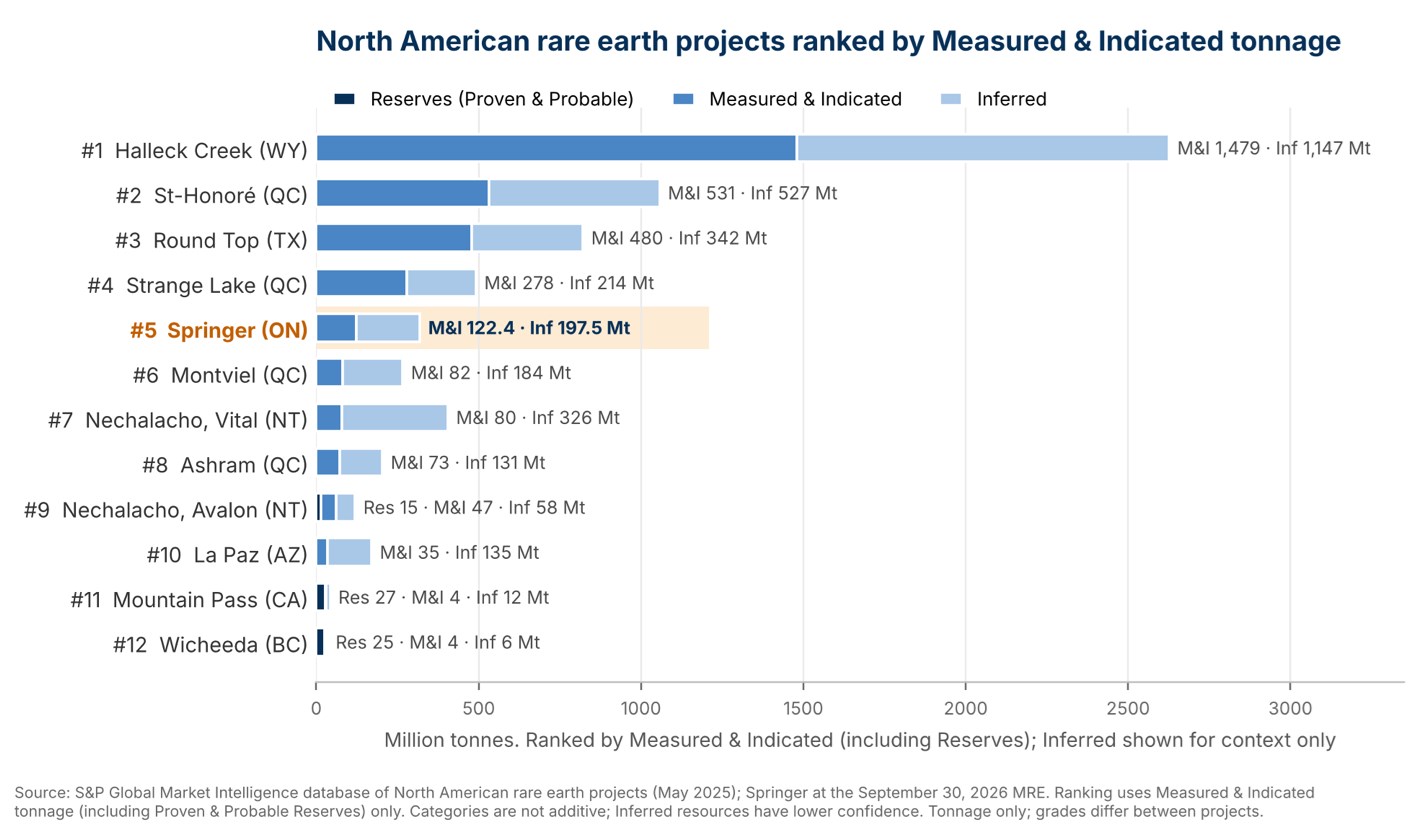
Figure 1. North American rare earth projects ranked by Measured and Indicated tonnage, including Reserves where reported. Inferred tonnage is shown separately for context and is not used in the ranking (S&P Global Market Intelligence database, May 2025; Springer at the September 30, 2026 MRE).
To view an enhanced version of this graphic, please visit:
https://images.newsfilecorp.com/files/9598/319617_a693a4df948cfb63_001full.jpg
Springer at a Glance
| Item | Detail |
| Location | About 70 km east of Sudbury and 8 km north of Sturgeon Falls, Ontario, on the traditional territory of the Nipissing First Nation. |
| Property | 4,879 hectares. Volta holds a |
| Access and infrastructure | Trans-Canada Highway and Highway 64, paved roads, on-site power lines fed from the Crystal Falls hydroelectric dam, natural gas pipeline and Canadian National Railway service, all within 8 km of the deposit. |
| Drilling in the MRE | The project dataset comprises 39 drill holes from the 2011-2012, 2025, and 2026 programs, including 13 holes (5,445 m) drilled in 2026. Of these, 38 drill holes were included in the MRE dataset. Drill hole SL-11-07 was excluded because it is spatially isolated from the drilling that defines the deposit. |
| Resource shape | Open pit reporting shell with a low strip ratio of 1.26 tonnes of waste per tonne of mineralized material. |
| Rare earth resource | Indicated Mineral Resource of 122.4 Mt grading |
| Supplementary gallium | 36 g/t Ga across the resource, including 14.8 Mt grading 56 g/t Ga (Indicated) and 19.6 Mt grading 53 g/t Ga (Inferred) in the Ga High Grade domain. |
| Next steps | Drilling to expand the high-grade rare earth and gallium zones, ongoing metallurgical test work, and a PEA targeted for the first half of 2027. |
Updated Mineral Resource Estimate
SLR Consulting (Canada) Ltd. (SLR) prepared an updated rare earth Mineral Resource estimate (MRE) for Volta Metals Ltd. (Volta) for the Springer Rare Earth Element and Gallium Deposit in Ontario, with an effective date of September 30, 2026. Indicated Mineral Resources total 122.4 Mt at an average net metal revenue (NMR) of C
TREO is the compositional total of the 15 rare earth oxides listed in the notes to Table 1. MREO is the sum of Pr₆O₁₁, Nd₂O₃, Dy₂O₃, and Tb₄O₇, expressed as a percentage. The rare earth Mineral Resource estimate is based on drilling and assay data available as of August 21, 2026 and is classified in accordance with the CIM Definition Standards for Mineral Resources and Mineral Reserves (May 2014). Reasonable prospects for eventual economic extraction (RPEEE) were demonstrated for the rare earth Mineral Resources by constraining the estimate within an optimized open pit shell and reporting blocks above a C
NMR is the estimated value per tonne calculated from four rare earth oxides: praseodymium oxide (Pr₆O₁₁), neodymium oxide (Nd₂O₃), dysprosium oxide (Dy₂O₃), and terbium oxide (Tb₄O₇). These four oxides comprise MREO and are the only rare earth oxides included in the pricing and recovery assumptions used to determine the reporting cut-off and pit constraint. TREO is a compositional total that also includes rare earth oxides that are not assigned value in the NMR calculation. Gallium is not included in the NMR calculation, reporting cut-off, pit optimization, or RPEEE assessment.
Table 1 summarizes the open pit rare earth Mineral Resources by classification and the High Grade and Main estimation domains. Table 2 presents block model sensitivities within the same optimized open pit shell at selected NMR cut-off values; C
Table 1: Summary of the Springer Open Pit Mineral Resources, September 30, 2026
| Classification | Domain | Tonnage (Mt) | NMR (C$/t) | Grade | |||||
| TREO (%) | MREO (%) | Pr₆O₁₁ (g/t) | Nd₂O₃ (g/t) | Dy₂O₃ (g/t) | Tb₄O₇ (g/t) | ||||
| Indicated | High Grade | 27.6 | 384 | 1.00 | 0.23 | 495 | 1,683 | 63 | 14 |
| Main | 94.8 | 176 | 0.47 | 0.11 | 234 | 792 | 24 | 6 | |
| Total | 122.4 | 223 | 0.59 | 0.13 | 293 | 993 | 33 | 8 | |
| Inferred | High Grade | 26.7 | 333 | 0.94 | 0.20 | 464 | 1,507 | 43 | 10 |
| Main | 170.8 | 169 | 0.46 | 0.10 | 226 | 754 | 24 | 6 | |
| Total | 197.5 | 191 | 0.53 | 0.11 | 258 | 856 | 27 | 6 | |
MREO represents approximately
Notes:
1. CIM (2014) definitions were followed for Mineral Resources.
2. Open pit Mineral Resources are reported within an optimized pit shell and above a C
3. The rare earth oxides included in the NMR calculation are Pr₆O₁₁, Nd₂O₃, Dy₂O₃, and Tb₄O₇, collectively referred to as MREO. MREO is the sum of these four oxides, expressed as a percentage. Only these oxides are assigned economic value in the NMR calculation; no other rare earth oxide, and no gallium, contributes to NMR.
4. Total rare earth oxides (TREO) is the sum of La₂O₃, CeO₂, Pr₆O₁₁, Nd₂O₃, Sm₂O₃, Eu₂O₃, Gd₂O₃, Tb₄O₇, Dy₂O₃, Ho₂O₃, Er₂O₃, Tm₂O₃, Yb₂O₃, Lu₂O₃, and Y₂O₃. TREO is a compositional total.
5. Rare earth oxide price assumptions are US
6. Metallurgical recovery assumptions are
7. NMR applies separation deductions of
8. The NMR factors applied are C
9. The average density of the reported Mineral Resource is 2.68 t/m³. Grades are reported as mass-weighted averages within the reporting constraints.
10. Mineral Resources that are not Mineral Reserves do not have demonstrated economic viability. No Mineral Reserves have been estimated.
11. Totals may not add or multiply accurately due to rounding.
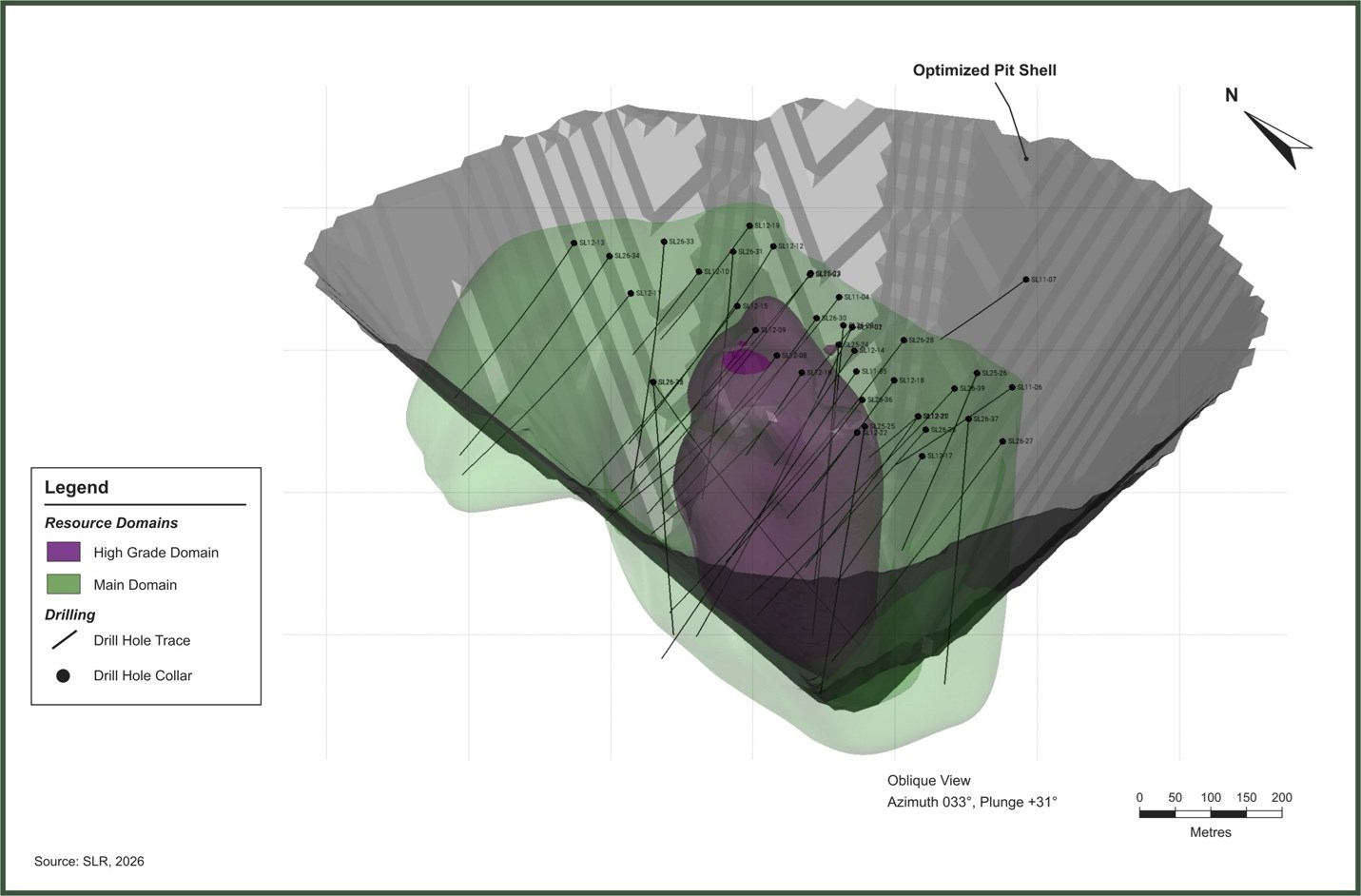
Figure 2. Springer rare earth resource domains, High Grade and Main, within the optimized pit shell, oblique view (Source: SLR, 2026).
To view an enhanced version of this graphic, please visit:
https://images.newsfilecorp.com/files/9598/319617_a693a4df948cfb63_002full.jpg
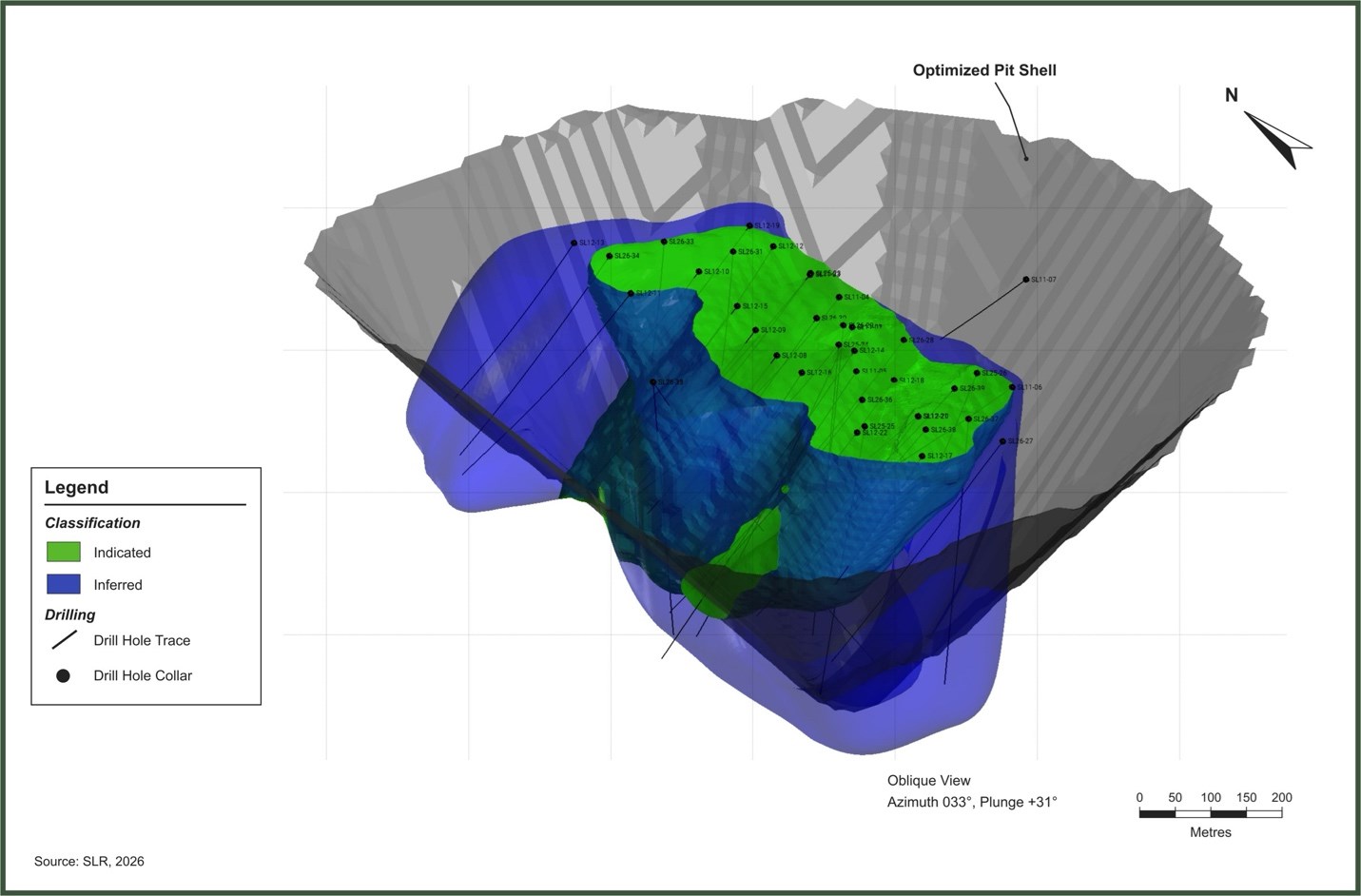
Figure 3. Springer Mineral Resource classification, Indicated (green) and Inferred (blue), within the optimized pit shell, oblique view (Source: SLR, 2026).
To view an enhanced version of this graphic, please visit:
https://images.newsfilecorp.com/files/9598/319617_a693a4df948cfb63_003full.jpg
Sensitivity to Cut-off
Table 2 presents block model sensitivities within the same optimized open pit shell at selected NMR cut-off values. The C
Table 2: Open Pit Mineral Resource Sensitivity to NMR Cut-off Value
| Classification | NMR Cut-off (C$/t) | Average Value and Grade | |||||||
| Mass (Mt) | NMR (C$/t) | TREO (%) | MREO (%) | Pr₆O₁₁ (g/t) | Nd₂O₃ (g/t) | Dy₂O₃ (g/t) | Tb₄O₇ (g/t) | ||
| Indicated | ≥150 | 83.7 | 272 | 0.72 | 0.16 | 358 | 1,214 | 40 | 9 |
| ≥100 | 114.1 | 233 | 0.62 | 0.14 | 306 | 1,039 | 34 | 8 | |
| ≥80 | 119.9 | 226 | 0.60 | 0.13 | 297 | 1,008 | 34 | 8 | |
| ≥60 | 122.2 | 224 | 0.59 | 0.13 | 293 | 995 | 33 | 8 | |
| ≥43 | 122.4 | 223 | 0.59 | 0.13 | 293 | 993 | 33 | 8 | |
| Inferred | ≥150 | 125.7 | 234 | 0.65 | 0.14 | 319 | 1,054 | 31 | 8 |
| ≥100 | 179.2 | 202 | 0.56 | 0.12 | 274 | 907 | 28 | 7 | |
| ≥80 | 190.6 | 196 | 0.54 | 0.12 | 265 | 876 | 27 | 7 | |
| ≥60 | 196.4 | 192 | 0.53 | 0.12 | 259 | 859 | 27 | 6 | |
| ≥43 | 197.5 | 191 | 0.53 | 0.11 | 258 | 856 | 27 | 6 | |
Notes:
1. CIM (2014) definitions were followed for Mineral Resources.
2. The C
3. The sensitivity results use the same block model, classification, density, NMR factors, commodity prices, metallurgical recovery assumptions, separation deductions, and optimized pit shell as the reported Mineral Resources. The pit shell was not re-optimized at each cut-off value.
4. The sensitivity results are not a mine plan, production schedule, production target, economic analysis, or statement of Mineral Reserves and do not demonstrate economic viability at any cut-off value.
5. NMR is calculated from Pr₆O₁₁, Nd₂O₃, Dy₂O₃, and Tb₄O₇ only. MREO is the sum of these four oxides, expressed as a percentage. TREO is a compositional total. Gallium and all other rare earth oxides are assigned no value in NMR.
6. Mineral Resources that are not Mineral Reserves do not have demonstrated economic viability. No Mineral Reserves have been estimated.
7. Totals may not add or multiply accurately due to rounding.
Table 3: Springer Open Pit Mineral Resource Tonnage and Average Rare Earth Oxide Grades, September 30, 2026
| Parameter | Unit | Indicated | Inferred |
| Tonnage | Mt | 122.4 | 197.5 |
| TREO | % | 0.59 | 0.53 |
| MREO | % | 0.13 | 0.11 |
| MREO / TREO | % | 22.4 | 21.7 |
| LREO | % | 0.56 | 0.50 |
| HREO | % | 0.03 | 0.03 |
| La₂O₃ | g/t | 1,426 | 1,290 |
| CeO₂ | g/t | 2,757 | 2,497 |
| Pr₆O₁₁ | g/t | 293 | 258 |
| Nd₂O₃ | g/t | 993 | 856 |
| Sm₂O₃ | g/t | 134 | 116 |
| Eu₂O₃ | g/t | 31 | 26 |
| Gd₂O₃ | g/t | 76 | 66 |
| Dy₂O₃ | g/t | 33 | 27 |
| Tb₄O₇ | g/t | 8 | 6 |
| Ho₂O₃ | g/t | 5 | 4 |
| Tm₂O₃ | g/t | 1 | 1 |
| Er₂O₃ | g/t | 12 | 10 |
| Yb₂O₃ | g/t | 8 | 7 |
| Lu₂O₃ | g/t | 1 | 1 |
| Y₂O₃ | g/t | 151 | 120 |
Notes:
1. CIM (2014) definitions were followed for Mineral Resources.
2. Average grades of each rare earth oxide are reported for the Indicated and Inferred open pit Mineral Resources. The tonnage, optimized pit shell, and C
3. Open pit Mineral Resources are reported within an optimized pit shell and above a C
4. The rare earth oxides included in the NMR calculation are Pr₆O₁₁, Nd₂O₃, Dy₂O₃, and Tb₄O₇, collectively referred to as MREO. MREO is the sum of these four oxides, expressed as a percentage. Only these oxides are assigned economic value in the NMR calculation; no other rare earth oxide or gallium contributes to NMR. The assumptions used in the NMR calculation are provided in the notes to the Mineral Resource statement.
5. Total rare earth oxides (TREO) is the sum of La₂O₃, CeO₂, Pr₆O₁₁, Nd₂O₃, Sm₂O₃, Eu₂O₃, Gd₂O₃, Tb₄O₇, Dy₂O₃, Ho₂O₃, Er₂O₃, Tm₂O₃, Yb₂O₃, Lu₂O₃, and Y₂O₃. TREO is a compositional total.
6. The MREO/TREO ratio is calculated as MREO divided by TREO and represents the proportion of TREO comprising the MREO oxides. It is a compositional ratio and does not represent metallurgical recovery, commercial payability, or revenue contribution.
7. Light rare earth oxides (LREO) are the sum of La₂O₃, CeO₂, Pr₆O₁₁, Nd₂O₃, and Sm₂O₃. Heavy rare earth oxides (HREO) are the sum of Eu₂O₃, Gd₂O₃, Tb₄O₇, Dy₂O₃, Ho₂O₃, Er₂O₃, Tm₂O₃, Yb₂O₃, Lu₂O₃, and Y₂O₃. LREO and HREO are compositional subtotals.
8. Rare earth elements were estimated as elemental grades and converted to oxide grades using stoichiometric conversion factors. Individual oxide grades are reported in g/t; TREO, MREO, LREO, HREO, and the MREO/TREO ratio are reported as percentages.
9. The average density of the reported Mineral Resources is 2.68 t/m³. Grades are reported as mass-weighted averages within the reporting constraints.
10. Mineral Resources that are not Mineral Reserves do not have demonstrated economic viability. No Mineral Reserves have been estimated.
11. Totals may not add or multiply accurately due to rounding.
Rare Earth Estimation Methodology
The updated estimate incorporates drilling and assay data available up to August 21, 2026, including data from the 2011-2012, 2025, and 2026 drilling programs. The resource dataset comprises 8,020 assay intervals from 38 drill holes, 4,089 rare earth element (REE) composites, and 548 density measurements. The updated interpretation includes revised High Grade and Main REE domains and an updated overburden surface. Overburden is excluded from the mineralized bedrock estimate.
Geological interpretation and block modelling were completed in Leapfrog Geo and Edge. Two nested wireframe domains, High Grade and Main, were developed using the combined grades of the four economic rare earth elements, Pr, Nd, Dy, and Tb. The High Grade domain is a continuous interpreted zone of higher-grade mineralization defined by a nominal combined Pr, Nd, Dy, and Tb grade of
Grade estimation used two search passes of 90 m and 180 m in the High Grade domain and an additional 240 m pass in the Main domain. The first pass required nine to 16 composites, and subsequent passes required five to 16 composites. A maximum of four composites per drill hole was applied in the first two passes. A 20 m soft boundary allowed limited sample sharing between the resource domains. No global assay cap was applied. In the second and third passes of the Main domain, the influence of elevated Pr, Nd, Dy, and Tb composite grades was restricted beyond approximately 60 m using grade thresholds of 450 g/t, 1,350 g/t, 40 g/t, and 10 g/t, respectively. These local restrictions limit high grade extrapolation rather than cap all assays or block grades.
Bulk density was estimated by inverse distance squared interpolation within the combined High Grade and Main resource domains using two 250 m searches and three to 12 samples. The first pass used a maximum of two samples per drill hole. Unestimated blocks within the combined resource domains and bedrock outside the resource domains were assigned a density of 2.70 t/m³. Overburden was assigned a density of 1.80 t/m³. Model validation included comparisons with composite grades and nearest-neighbour estimates, grade-distribution checks, and spatial swath comparisons. Historical density measurements from the 2011-2012 program were obtained in the field and are not supported by laboratory density certificates; this limitation was considered in assessing the density data used for the Mineral Resource estimate.
Resource classification considered geological and grade continuity, data quality, estimation support, and drill hole spacing. Indicated Mineral Resources are supported by a maximum drill hole spacing of 100 m. Inferred Mineral Resources are supported by drill hole spacing of up to approximately 200 m. Inferred Mineral Resources have a lower level of confidence than Indicated Mineral Resources and cannot be converted directly to Mineral Reserves. There is no certainty that further drilling will upgrade all Inferred Mineral Resources.
Analytical Methods and Data Verification
Recent drill core samples were analyzed by Activation Laboratories Ltd. (Actlabs) in Ancaster, Ontario, and SRC Geoanalytical Laboratories (SRC) in Saskatoon, Saskatchewan. Actlabs used fusion-based ICP-OES and ICP-MS methods for REE analyses, while SRC used lithium metaborate fusion with ICP-MS. Gallium grades used for estimation are based on the SRC assays rather than the Actlabs results. Gallium was measured analytically and was not derived from regression against zinc or aluminum. Laboratory certificates include analytical quality control results.
Quality assurance and quality control (QA/QC) review by SLR covered the 2011-2012 and 2025-2026 drilling and analytical datasets. The program included certified reference materials, blanks, field duplicates, and laboratory controls and repeats. Control results were reviewed for accuracy, contamination, and precision, with repeat analyses and geological review used to investigate discrepancies. Verification included selected comparisons of database records with laboratory results and did not include independent reanalysis of every sample.
Ms. Katharine Masun, M.Sc., MSA, P.Geo., of SLR reviewed the sampling, analytical, and QA/QC data and considers them adequate for the Mineral Resource estimate and the supplementary gallium estimate. The limitations associated with historical density measurements and preliminary metallurgical assumptions are described in this news release.
Reasonable Prospects for Eventual Economic Extraction
RPEEE were assessed for the open pit rare earth Mineral Resources using a Whittle optimized open pit shell, a revenue factor of 1.0, and a C
Table 4: Assumptions Used to Calculate Net Metal Revenue
| Rare earth oxide | Price (US$/kg oxide) | Recovery (%) | Separation deduction (%) | NMR factor (C$/t per g/t oxide) |
| Pr₆O₁₁ | 160 | 82.1 | 15 | 0.151 |
| Nd₂O₃ | 150 | 82.1 | 15 | 0.141 |
| Dy₂O₃ | 900 | 69.5 | 25 | 0.633 |
| Tb₄O₇ | 3,000 | 75.4 | 25 | 2.290 |
An exchange rate of C
Elemental block grades were converted to corresponding oxide grades. NMR was calculated for each block using the four oxide grades and the factors presented in Table 4. The factors incorporate the oxide price, exchange rate, assumed recovery, and separation deduction and were used solely to support the reporting cut-off and optimized pit constraint for the Mineral Resource estimate. No other rare earth oxide or gallium is included in the NMR calculation.
The four oxide grades are disclosed individually because they are the only REO grades assigned value in the NMR calculation used to support the reporting cut-off and optimized pit constraint. MREO, which is also reported in the Mineral Resource table, is the sum of Pr₆O₁₁, Nd₂O₃, Dy₂O₃, and Tb₄O₇, expressed as a percentage. No other REOs contribute to NMR.
As reported in Volta's June 1, 2026 news release, the recovery assumptions are based on bench-scale test work completed by SGS Canada Inc. (SGS) on a single master composite from Springer. The results are preliminary and do not demonstrate recovery to a saleable product or consistent recovery across the deposit. Additional test work is required to confirm these assumptions. The separation deductions used in the Mineral Resource estimate are assumptions and not established commercial sales terms.
The estimate supersedes the Mineral Resource estimate effective December 31, 2025, disclosed on February 23, 2026. Changes include additional drilling, revised geological and estimation domains, local controls on high grade extrapolation, updated density estimation, revised recovery and oxide price assumptions, a new pit constraint, and the addition of a supplementary gallium estimate within the reported open pit Mineral Resource volumes. The current and previous estimates use different technical and economic assumptions; changes in reported tonnes and grades cannot be attributed solely to drilling.
The Mineral Resource estimate may be materially affected by environmental, permitting, legal, title, taxation, socio-political, marketing, or other relevant issues. The estimate is also sensitive to assumptions regarding metal prices, recoveries (based on preliminary test work), operating costs, and the geologic interpretation. Additional metallurgical test work is in progress and may affect future resource estimates.
Comparison to Previous Estimate
Table 5 compares the current September 30, 2026 open pit Mineral Resource estimate with the previous December 31, 2025 estimate by classification and domain. Indicated tonnage increased by
The current estimate contains more tonnes at lower average TREO, MREO, and individual NMR-contributing rare earth oxide grades. Indicated TREO decreased from
The current Main domain, designated the Low Grade domain in the previous estimate, is not directly equivalent to the previous domain because the interpretation, geometry, estimation parameters, and reporting constraints have changed. The comparison also reflects additional 2026 drilling, revised geological and estimation domains, updated variography and search parameters, restrictions on high-grade extrapolation in the Main domain, updated density estimation, revised classification support, and a new optimized pit constraint. Therefore, the changes should not be viewed as a reconciliation limited to drilling.
Table 5: Comparison of Current and Previous Open Pit Mineral Resources by Classification and Domain
| Parameter | Domain | Indicated | Inferred | ||||
| Previous | Current | Change (%) | Previous | Current | Change (%) | ||
| Tonnage (Mt) | High Grade | 11.5 | 27.6 | +140 | 3.0 | 26.7 | +790 |
| Main / Low Grade | 45.1 | 94.8 | +110 | 116.5 | 170.8 | +47 | |
| Total | 56.6 | 122.4 | +116 | 119.5 | 197.5 | +65 | |
| NMR (C$/t) | High Grade | 251 | 384 | +53 | 254 | 333 | +31 |
| Main / Low Grade | 136 | 176 | +29 | 125 | 169 | +35 | |
| Total | 159 | 223 | +40 | 128 | 191 | +49 | |
| TREO (%) | High Grade | 1.10 | 1.00 | -9 | 1.16 | 0.94 | -19 |
| Main / Low Grade | 0.60 | 0.47 | -22 | 0.57 | 0.46 | -19 | |
| Total | 0.70 | 0.59 | -16 | 0.58 | 0.53 | -9 | |
| MREO (%) | High Grade | 0.25 | 0.23 | -8 | 0.25 | 0.20 | -20 |
| Main / Low Grade | 0.14 | 0.11 | -21 | 0.12 | 0.10 | -17 | |
| Total | 0.16 | 0.13 | -19 | 0.12 | 0.11 | -8 | |
| Pr₆O₁₁ (g/t) | High Grade | 540 | 495 | -8 | 559 | 464 | -17 |
| Main / Low Grade | 296 | 234 | -21 | 275 | 226 | -18 | |
| Total | 346 | 293 | -15 | 282 | 258 | -9 | |
| Nd₂O₃ (g/t) | High Grade | 1,846 | 1,683 | -9 | 1,848 | 1,507 | -19 |
| Main / Low Grade | 1,017 | 792 | -22 | 924 | 754 | -18 | |
| Total | 1,185 | 993 | -16 | 947 | 856 | -10 | |
| Dy₂O₃ (g/t) | High Grade | 68 | 63 | -7 | 70 | 43 | -39 |
| Main / Low Grade | 30 | 24 | -20 | 30 | 24 | -20 | |
| Total | 38 | 33 | -13 | 31 | 27 | -13 | |
| Tb₄O₇ (g/t) | High Grade | 15 | 14 | -7 | 15 | 10 | -33 |
| Main / Low Grade | 7 | 6 | -14 | 7 | 6 | -14 | |
| Total | 9 | 8 | -11 | 7 | 6 | -14 | |
Notes:
1. CIM (2014) definitions were followed for Mineral Resources.
2. The previous estimate is the open pit Mineral Resource estimate effective December 31, 2025. The current estimate is the open pit Mineral Resource estimate effective September 30, 2026.
3. The average density of the reported Mineral Resources is 2.7 t/m³ for the previous estimate and 2.68 t/m³ for the current estimate.
4. The current Main domain was called the Low Grade domain in the previous estimate. The domains differ in interpretation, geometry, estimation parameters, and reporting constraints and are not directly equivalent.
5. Previous High Grade and Low Grade domain NMR values were calculated from the previously reported NMR-contributing oxide grades using the NMR factors applied in the December 31, 2025 estimate. Total classification NMR values are the same as previously reported.
6. MREO is the sum of Pr₆O₁₁, Nd₂O₃, Dy₂O₃, and Tb₄O₇, expressed as a percentage.
7. The current estimate incorporates additional 2026 drilling, revised High Grade and Main domain interpretations, updated variography and search parameters, local restrictions on high grade extrapolation in the Main domain, updated density estimation, revised classification support, revised oxide prices and metallurgical recovery assumptions, and a new optimized pit constraint.
8. The current and previous estimates use different technical and economic assumptions. Changes in reported tonnage, grades, and NMR should not be interpreted as a drilling-only reconciliation or as a comparison of project economics.
9. Gallium is excluded from NMR and does not contribute to the reporting cut-off, pit optimization, RPEEE assessment, or comparison.
10. Percentage change is calculated as the current value minus the previous value, divided by the previous value.
11. Mineral Resources that are not Mineral Reserves do not have demonstrated economic viability. No Mineral Reserves have been estimated.
12. Totals may not add or multiply accurately due to rounding.
Supplementary Gallium Estimate
Table 6 presents a supplementary gallium estimate by nested Ga High Grade and Ga Main domains within the open pit reporting constraints and C
The Indicated and Inferred classifications apply to the reported open pit Mineral Resources and not to a standalone gallium Mineral Resource. Gallium is assigned no economic value and does not contribute to the NMR calculation, reporting cut-off, pit optimization, or the RPEEE supporting the open pit Mineral Resources.
Table 6: Supplementary Gallium Estimate within the Reported Open Pit Mineral Resources, September 30, 2026
| Classification | Domain | Tonnage (Mt) | Grade | Metal |
| Ga (g/t) | Ga (t) | |||
| Indicated | Ga High Grade | 14.8 | 56 | 836 |
| Ga Main | 107.6 | 33 | 3,591 | |
| Total | 122.4 | 36 | 4,427 | |
| Inferred | Ga High Grade | 19.6 | 53 | 1,030 |
| Ga Main | 177.9 | 35 | 6,176 | |
| Total | 197.5 | 36 | 7,206 |
Notes:
1. CIM (2014) definitions were followed for Mineral Resources.
2. Gallium is estimated within the gallium domain model and reported as supplementary information within the classified open pit Mineral Resources and their reporting constraints, including the optimized pit shell and C
3. Classification refers to the reported open pit Mineral Resource. No classification is assigned to gallium independently.
4. Gallium is assigned no economic value. It does not contribute to the NMR calculation, reporting cut-off, pit constraint, or RPEEE of the reported open pit Mineral Resource. The assumptions used in the NMR calculation are provided in the notes to the Mineral Resource statement.
5. No overall recovery to a saleable gallium product or commercial payability has been established.
6. Gallium grades and in situ contained gallium are supplementary estimates within the reported Mineral Resource volumes and do not represent additional resource tonnage or a separate gallium Mineral Resource. Contained gallium does not represent recovered or payable metal.
7. The average density of the reported Mineral Resource is 2.68 t/m³. Grades are reported as mass-weighted averages within the reporting constraints.
8. Mineral Resources that are not Mineral Reserves do not have demonstrated economic viability. No Mineral Reserves have been estimated.
9. Totals may not add or multiply accurately due to rounding.
Gallium was estimated by ordinary kriging from nominal 3.0 m composites within two nested gallium grade domains, Ga High Grade and Ga Main, using gallium variography. The Ga High Grade domain was guided by a nominal threshold of 50 g/t Ga. The combined volume of the nested gallium domains corresponds to the combined High Grade and Main rare earth resource domain volume reported in Table 1. However, the individual gallium domains do not correspond directly to the individual rare earth resource domains. Grade estimation used search passes of 90 m, 180 m, and 240 m. A 20 m soft boundary allowed limited sample sharing between the gallium domains.
Initial bench-scale flotation test work identified gallium in both the rare earth concentrate and flotation tailings. The available test work is insufficient to establish overall recovery to a saleable gallium product, processing costs, commercial payability, or saleability. Additional metallurgical test work is in progress. Until these factors are demonstrated, gallium is assigned no economic value and is reported only as supplementary information within the open pit Mineral Resource volumes. Gallium is not reported as a standalone Mineral Resource or included in the RPEEE assessment, and there is no certainty that it will be recovered or sold.
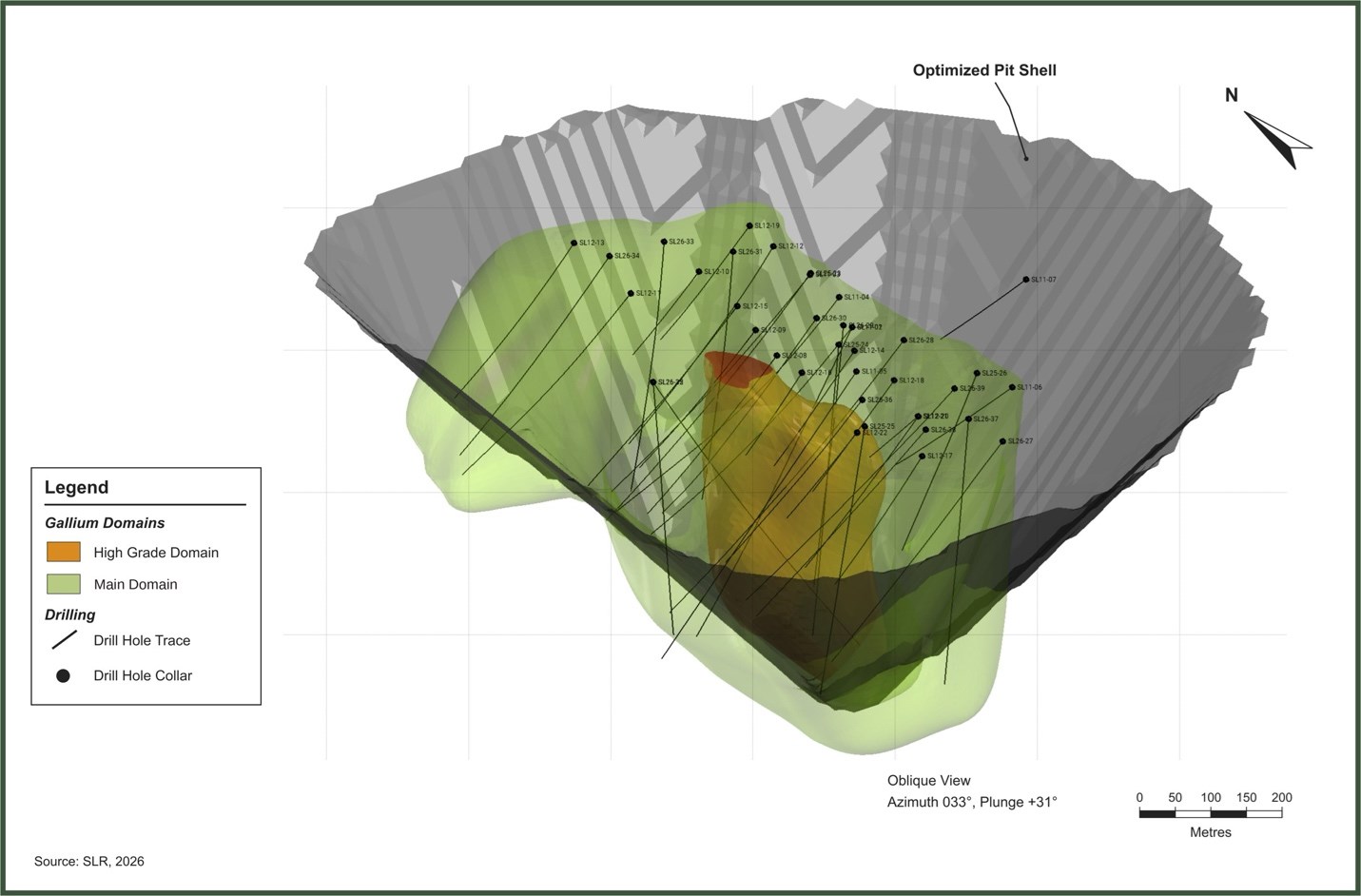
Figure 4. Springer gallium domains, Ga High Grade (orange) and Ga Main (green), within the optimized pit shell, oblique view (Source: SLR, 2026).
To view an enhanced version of this graphic, please visit:
https://images.newsfilecorp.com/files/9598/319617_a693a4df948cfb63_004full.jpg
CAUTIONARY STATEMENTS
Mineral Resources are not Mineral Reserves and do not have demonstrated economic viability. Inferred Mineral Resources have a lower level of confidence than Indicated Mineral Resources, and there is no certainty that further drilling will upgrade them. The cut-off sensitivity cases in Table 2 are not separate Mineral Resource estimates, production targets or economic evaluations.
Gallium is reported only as a supplementary estimate within the rare earth Mineral Resource and is assigned no economic value. Metallurgical test work has not established overall recovery to a saleable gallium product, processing costs, commercial payability or saleability. There is no certainty that gallium will be recovered or sold, or that it will be assigned value in any future estimate.
The North American ranking is based on a third-party database dated May 2025 that may not reflect the most recent estimates of other projects. Those estimates were prepared by other parties under different reporting standards (NI 43-101, SEC S-K 1300 and JORC), cut-offs and assumptions, and are not directly comparable. The ranking compares tonnage only. Market information in this news release is from third-party sources and has not been independently verified by the Company. There is no assurance that the planned drilling will expand the high-grade zone or that the PEA will be completed within the anticipated timeframe.
Qualified Persons
The rare earth Mineral Resource estimate and supplementary gallium estimate disclosed in this news release were prepared by Ms. Katharine Masun, M.Sc., MSA, P.Geo., Principal Resource Geologist with SLR Consulting (Canada) Ltd., who is independent of Volta. Ms. Masun is a Qualified Person as defined by National Instrument 43-101. The rare earth Mineral Resources were classified in accordance with the CIM Definition Standards for Mineral Resources and Mineral Reserves (May 2014). Ms. Masun has reviewed and approved the scientific and technical information in this news release relating to the rare earth Mineral Resource estimate and supplementary gallium estimate.
Details of the Mineral Resource estimate will be disclosed in an independent technical report prepared in accordance with National Instrument 43-101 Standards of Disclosure for Mineral Projects ("NI 43-101") by SLR Consulting (Canada) Ltd. The NI 43-101 Technical Report will be filed on SEDAR+ (www.sedarplus.ca) within 45 days of this news release.
Other scientific and technical information in this news release has been reviewed and approved by Dr. Julie Selway, P.Geo., VP Exploration, and a Qualified Person ("QP") as defined in National Instrument 43-101, Standards of Disclosure for Mineral Projects.
ABOUT VOLTA METALS LTD.
Volta Metals Ltd. (CSE: VLTA) (OTCQB: VOLMF) (FSE: D0W) is a critical mineral exploration company focused on rare earths, gallium, lithium, cesium and tantalum in Ontario, one of the world's most prolific emerging hard-rock critical mineral districts. Volta owns, has optioned and is exploring a portfolio of rare earth, gallium, lithium, cesium and tantalum projects in the province.
Volta's flagship is the Springer Rare Earth Element and Gallium Deposit, within the 4,879-hectare Springer Property on the traditional territory of the Nipissing First Nation, about 8 km north of Sturgeon Falls and 70 km east of Sudbury, Ontario. The project has direct access via the Trans-Canada Highway and Highway 64, with paved roads, on-site power lines fed from the Crystal Falls hydroelectric dam, a natural gas pipeline and Canadian National Railway service, all within 8 km of the deposit.
To learn more about Volta and its Springer and Aki projects, visit www.voltametals.ca.
ON BEHALF OF THE BOARD
For further information, contact:
Kerem Usenmez, President & CEO
Tel: 416.919.9060 | Email: info@voltametals.ca | Website: www.voltametals.ca
Neither the CSE nor the Canadian Investment Regulatory Organization (CIRO) accepts responsibility for the adequacy or accuracy of this release.
Forward-Looking Statements
This news release contains forward-looking statements relating to exploration activities, plans, strategies and other statements that are not historical facts. Forward-looking statements are often identified by terms such as "will", "may", "should", "anticipate", "expects", "plans", "targeting" and similar expressions. All statements other than statements of historical fact included in this news release are forward-looking statements that involve risks and uncertainties. Forward-looking information in this news release includes, but is not limited to, the filing of a Technical Report supporting the MRE and its timing; the Company's plans to drill to expand the high-grade rare earth and gallium zone; the completion and timing of a Preliminary Economic Assessment in the first half of 2027; the potential for gallium to be recovered as a by-product and to be assigned value in any future estimate; the results of metallurgical test work; the potential to expand the Mineral Resources; and future supply, demand and prices of rare earth elements and gallium. There can be no assurance that such statements will prove to be accurate, and actual results and future events could differ materially from those anticipated. Important factors that could cause actual results to differ materially from the Company's expectations include the risks detailed from time to time in the filings made by the Company with securities regulators; future prices of and demand for rare earth elements and gallium; changes to export control or trade measures affecting rare earth and gallium supply; the results of metallurgical test work, including the absence to date of test work demonstrating that gallium can be economically recovered from the Springer mineralization; changes in the assumptions underlying the MRE; the availability of drilling contractors, consultants and financing; and delays in, or the inability of the Company to obtain, any approvals, permits and authorizations required to carry out its business plans. Readers are cautioned not to place undue reliance on any forward-looking statements. Forward-looking statements in this news release are made as of the date of this news release, and the Company disclaims any intention or obligation to update or revise them, whether as a result of new information, future events or otherwise, other than as required by law.

To view the source version of this press release, please visit https://www.newsfilecorp.com/release/319617
FAQ
AI-generated questions and answers. How Rhea-AI works. Not financial advice.
How much did Volta Metals increase the Springer rare earth resource?
Springer's Indicated resource increased 116% to 122.4 million tonnes at 0.59% total rare earth oxides, from 56.6 million tonnes in February 2026. Inferred resources increased 65% to 197.5 million tonnes at 0.53%. The updated estimate is effective September 30, 2026.
When does Volta Metals expect the Springer preliminary economic assessment?
Volta targets the Springer preliminary economic assessment for the first half of 2027. It will incorporate the updated resource estimate and relevant results from planned drilling and ongoing metallurgical studies to evaluate preliminary development options and economic potential.
What reporting cut-off was used for Volta Metals' Springer resource estimate?
The Springer rare earth resource uses a C$43 per tonne net metal revenue cut-off within an optimized open-pit shell. Net metal revenue is the estimated value per tonne from the four magnet rare earth oxides. Gallium is excluded from that calculation and from the pit optimization.
When will Volta Metals file the updated Springer technical report?
An independent NI 43-101 technical report supporting the updated resource estimate will be filed on SEDAR+ within 45 days of the October 19, 2026 announcement.