
Voyager and Max Space to Accelerate Deep-Space Human Exploration
Voyager Technologies (NYSE: VOYG) and Max Space announced a strategic partnership to advance expandable space habitat technology for lunar and deep-space habitation and storage.
Sentiment and the balance of points
Rhea-AI Sentiment reads the wording of the document, how positive or negative its language is on a 1 to 5 scale. The balance of points shown with the takes weighs what the document actually discloses, so the two can disagree, for example when a trial that missed its main goal is described in upbeat language.




Expandable infrastructure serves as a foundation for long-duration space exploration and commercialization
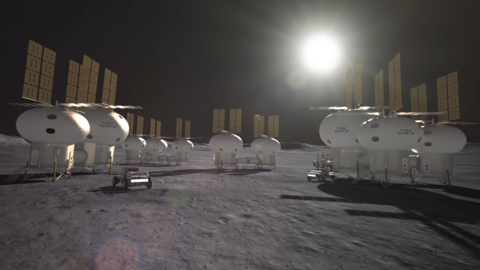
Voyager Technologies and Max Space announced a strategic partnership to advance expandable space habitats.
“This technology reflects a fundamental shift in how humanity will live and work in space,” said Dylan Taylor, chairman and CEO, Voyager. “The Moon is no longer a single destination or a flags-and-footprints exercise. It is the next operational domain in a growing space economy that spans exploration, science, national security and commercial development, where sustained operations require infrastructure designed for endurance, scalability and industrial execution.”
The collaboration brings together Voyager’s experience delivering mission-critical space systems and infrastructure with Max Space’s high-volume, low-mass expandable structure technology, creating a scalable approach to human operations on the lunar surface and critical to humanity’s expansion to Mars and beyond. The effort supports a growing national and commercial emphasis toward a sustained human presence and operational continuity beyond low-Earth orbit.
“Expandable structures represent a step change in how surface infrastructure can be delivered and deployed,” said Saleem Miyan, co-founder and CEO, Max Space. “Our structure is an evolutionary leap over previous generations, and it’s the only expandable technology with 40 years of on-orbit experience designed into it. Its architecture embodies increased capability, scalability and versatility that are essential for sustained deep-space human activity and to unleash the Lunar and Martian economies.”
The phased development path includes ground validation and in-space demonstrations later this decade, with the goal of enabling operational lunar and Mars capabilities aligned with NASA’s exploration timelines. The partnership emphasizes early risk retirement, interoperability and commercial scalability as guiding principles.
About Voyager Technologies
Voyager Technologies is a defense and space technology company committed to advancing and delivering transformative, mission-critical solutions. By tackling the most complex challenges, Voyager aims to unlock new frontiers for human progress, fortify national security, and protect critical assets from ground to space. For more information visit: voyagertechnologies.com and follow on LinkedIn and X.
About Max Space
Max Space builds space real estate, pioneering the only advanced expandable habitats, immense, superstrong and radically economical. The lightweight expandable habitat launches compactly and expands 20x once deployed in orbit or other destination, allowing a 350m3 fully equipped habitat to launch on a single Falcon 9 rocket. An evolutionary leap, the habitats scale seamlessly across Earth, Moon and Mars for space stations and surface habitats, uniquely accelerating human’s permanent presence beyond Earth. For more information visit www.getmaxspace.com and follow on LinkedIn.
Cautionary Statement Concerning Forward-Looking Statements:
This press release contains “forward-looking statements.” All statements, other than statements of historical fact, including those with respect to Voyager Space, Inc.’s (the “Company’s”) mission statement and growth strategy, are “forward-looking statements.” Although the Company’s management believes that such forward-looking statements are reasonable, it cannot guarantee that such expectations are, or will be, correct. These forward-looking statements involve many risks and uncertainties, which could cause the Company’s future results to differ materially from those anticipated. Potential risks and uncertainties include, among others, general economic conditions and conditions affecting the industries in which the Company operates; the uncertainty of regulatory requirements and approvals; and the ability to obtain necessary financing on acceptable terms or at all. Readers should not place any undue reliance on forward-looking statements since they involve these known and unknown uncertainties and other factors which are, in some cases, beyond the Company’s control and which could, and likely will, materially affect actual results, levels of activity, performance or achievements. Any forward-looking statement reflects the Company’s current views with respect to future events and is subject to these and other risks, uncertainties and assumptions relating to operations, results of operations, growth strategy and liquidity. The Company assumes no obligation to publicly update or revise these forward-looking statements for any reason, or to update the reasons actual results could differ materially from those anticipated in these forward-looking statements, even if new information becomes available in the future.
View source version on businesswire.com: https://www.businesswire.com/news/home/20260205214208/en/
Voyager Media Contact
Dana Carroll, VP Marketing & Communications, dana.carroll@voyagertechnologies.com
Max Space Media Contact
Jane Poynter, Product and Marketing, jane@getmaxspace.com
Source: Voyager Technologies