
Rural Hospitals Don't Need More Beds - They Need Smarter Capacity, Like Mobile ICUs
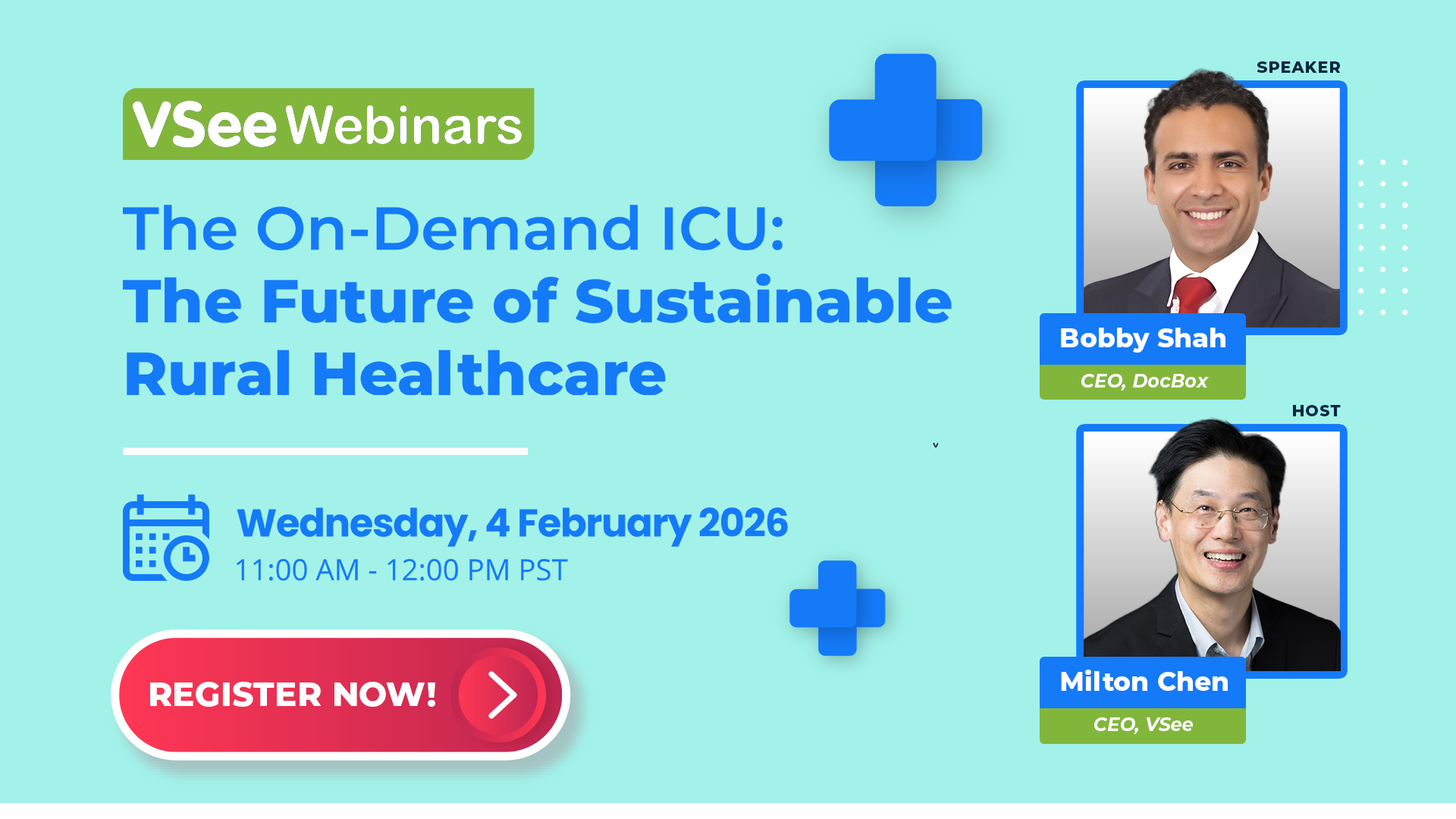
VSee Health (Nasdaq:VSEE) will host a live webinar, "The On‑Demand ICU: Sustainable Rural Healthcare", on February 4, 2026 at 11:00 AM PT / 2:00 ET.
Rhea-AI Summary
VSee Health (Nasdaq:VSEE) will host a live webinar, "The On‑Demand ICU: Sustainable Rural Healthcare", on February 4, 2026 at 11:00 AM PT / 2:00 ET. The session will discuss tele‑ICU and mobile ICU models for rural hospitals, staffing relief, clinician sustainability, and financial recovery.
Speakers include Docbox CEO Bobby Shah and VSee CEO Milton Chen. Topics highlight capturing up to $1M in recovered revenue over five years, automated vitals‑to‑EHR workflows, bi‑directional video, real‑time access to labs/PACS, and data/AI infrastructure for scalable remote ICU care.
Positive
- None.
Negative
- None.
Key Figures
- Recovered revenue opportunity
- $1M
- Potential rural hospital revenue recapture over five years via ICU interventions
- Revenue horizon
- 5 years
- Timeframe for recovering up to $1M in lost ICU-related revenue
- Webinar date
- February 4, 2026
- Scheduled date for VSEE rural ICU capacity webinar
- Webinar time
- 11:00 AM PT / 2:00 PM ET
- Scheduled start time for ICU capacity webinar
Historical Context
-
Announced AI-driven rural health platform targeting revenue recapture for hospitals.
-
Postponed 2025 annual stockholder meeting due to expected lack of quorum.
-
Regained Nasdaq equity compliance via conversions, warrant exercises and private placement.
-
Hosted webinar with Novant Health on scalable, profitable tele‑urgent programs.
-
Priced $6.0M private placement with shares and warrants at $0.61.
24h Move is the share-price change in the day after each event; other market factors may also have contributed.
Key Terms
icu medical
tele‑icu medical
mobile icu medical
ehr technical
augmented intelligence technical
AI-generated analysis. How Rhea-AI works. Not financial advice.




SAN JOSE, CALIFORNIA / ACCESS Newswire / January 29, 2026 / VSee Health (Nasdaq:VSEE), a leader in innovative telehealth technology, today announced it will be hosting a live webinar, "The On‑Demand ICU: Sustainable Rural Healthcare," February 4, 2026, 11:00 AM PT / 2:00 PM ET
Rural hospitals are under pressure like never before. Rising patient acuity, chronic staffing shortages, and limited access to intensivists are forcing facilities to transfer high‑acuity patients-and leave critical revenue on the table. But a new model is changing the equation.
Guest speaker Docbox CEO Bobby Shah, moderator VSee CEO Milton Chen will have a candid discussion on how on‑demand ICU, tele‑ICU, and mobile ICU models are helping rural hospitals expand critical care capacity-without building new units or having to hire scarce specialists.
You'll learn how leading health systems are using virtual ICU platforms to retain high‑acuity patients, standardize ICU care, support bedside teams, and scale capacity up or down in real time-all while improving clinician sustainability and financial performance.
What You'll Learn
How rural hospitals can recover up to
$1M in lost revenue over five years by capturing billable ICU interventionsHow automated vitals‑to‑EHR workflows reduce nurse burnout and documentation errors
How bi‑directional video and real‑time access to labs, PACS, and trends enable true remote bedside ICU support
Why data ownership and augmented intelligence infrastructure are critical for long‑term ICU scalability and hospital‑led innovation
Whether you're a hospital executive, clinical leader, or virtual care strategist, this webinar will show you how the Mobile and On‑Demand ICU is redefining what sustainable rural critical care looks like.
Register here to secure a spot:
About VSee Health
VSee Health (NASDAQ:VSEE), is an AI-powered telehealth technology and services company delivering digital health solutions through its scalable, API-driven platform. The Company's offerings integrate secure video, device data, and EHR connectivity to power hospital systems, health networks, and enterprise partners globally. VSee holds a FedRAMP High Authority to Operate (ATO) from the U.S. Department of Health and Human Services and serves clients including NASA, HHS ASPR, McKesson, DaVita, and the country of Qatar. Visit vsee.com.
About DocBox
DocBox (www.docboxmed.com) is dedicated to enabling data-driven healthcare. DocBox collects up to 3GB of structured data per ICU patient per day per bed and can reduce documentation time by 70 percent, giving clinicians quality time with the patient. DocBox applications allow healthcare providers to use data collected from AI, Machine Learning and Algorithms, enabling critical care to not only be at the bedside but also outside the healthcare provider's walls. The DocBox platform permits cohesive flow of data throughout the health delivery organization and provides units and hospital-wide operational metrics. It facilitates the ability to innovate utilizing rich and accurate big data sets and automatically captures billable clinical interventions.
High resolution photos available for download at https://docboxmed.com/downloads/
Forward-Looking Statements
Matters discussed in this news release that are not statements of historical or current facts, including but not limited to those relating to VSee Health's ability to improve healthcare access and provider efficiencies, are "forward-looking statements" within the meaning of the Private Securities Litigation Reform Act of 1995. Such statements include, but are not limited to, statements regarding the anticipated closing of the offering; the Company's anticipated use of proceeds from the offering; and other statements that are not historical facts, including statements which may be accompanied by the words "intends," "may," "will," "plans," "expects," "anticipates," "projects," "predicts," "estimates," "aims," "believes," "hopes," "potential" or similar words. Forward-looking statements may involve known and unknown risks, uncertainties and other factors that may cause performance or achievements to be materially different from historical results or from any future performance or achievements expressed or implied by such forward-looking statements. Accordingly, readers should not place undue reliance on any forward-looking statements. More information on risk factors relating to VSee Health and its technology and billing services is included from time to time in the "Cautionary Note Regarding Forward-Looking Statements," "Risk Factors" and "Management's Discussion and Analysis of Financial Condition and Results of Operations" sections of VSee Health's periodic and current filings with the SEC, which are also made available on VSee Health's website at www.vseehealth.com. Forward-looking statements speak only as of the date they are made, and VSee Health undertakes no obligation to publicly update or revise any forward-looking statements, whether as a result of new information, future events or otherwise that occur after that date, or otherwise. Readers are cautioned not to put undue reliance on forward-looking statements.
Contact:
Anne Chang
VSee Health
media@vsee.com
DocBox
info@docboxmed.com
VSee Investor Contact:
Milton Chen
VSee Health
investor@vsee.com
SOURCE: VSee Health
View the original press release on ACCESS Newswire
FAQ
AI-generated questions and answers. How Rhea-AI works. Not financial advice.