
V Ten Provides Update on Tanami Property Soil Sample Work Program, NT, Australia
Sentiment and the balance of points
Rhea-AI Sentiment reads the wording of the document, how positive or negative its language is on a 1 to 5 scale. The balance of points shown with the takes weighs what the document actually discloses, so the two can disagree, for example when a trial that missed its main goal is described in upbeat language.
Rhea-AI Summary
V Ten Metals (VTNMF) reported soil survey results that provided Tanami's first rare earth element data and identified two new exploration targets. The survey analyzed 183 samples from exploration licence EL 23848 in Australia's Northern Territory. Five consecutive samples at the Billabong Complex's southwest margin returned 85–112 parts per million total rare earth oxides, all in the survey's top 15%. Absolute levels were low and light rare earths dominated.
T1 spans about 2.8 km and shows elements that can point to gold, but no gold anomaly. T2 spans about 800 m and shows a pattern associated with nickel, copper and platinum-group elements. Both signals were modest and need confirmation. V Ten plans to test the rare earth signal and both targets in parallel using low-cost methods. Any drilling depends on the follow-up results.
Positive
- Minor pointTanami's first rare earth dataset establishes a baseline from 183 soil samples analyzed for 65 elements
- Minor pointSouthwest margin target R1 yielded 85–112 ppm total rare earth oxides across five consecutive samples, all in the survey's top 15%
- Minor pointNew target T1 showed a gold-indicator pattern over about 2.8 km, with antimony peaking at 0.55 ppm
- Minor pointNew target T2 showed a nickel-copper-platinum-group element pattern over about 800 m, with copper reaching 50 ppm
- Minor point. Forward-looking: it has not happened yet and may not happen.Planned low-cost follow-up will test the rare earth signal and both new targets in parallel
Negative
- Minor pointRare earth levels at R1 were low, with heavy rare earths accounting for about 13% of total rare earths
- Minor pointWide survey line spacing could not resolve whether zones enriched in heavy rare earths exist beneath surface cover
- Minor pointRare earth signal at the margin partly reflects the rock type, with thorium rising alongside rare earths
- Minor pointGold readings peaked at just 3.1 parts per billion across the survey, and T1 was not a gold anomaly
- Minor pointSignals at T1 and T2 were modest and need confirmation
- Minor point. Forward-looking: it has not happened yet and may not happen.Drill testing depends on follow-up results, which will determine whether any target advances
AI-generated analysis. How Rhea-AI works. Not financial advice.


Vancouver, British Columbia--(Newsfile Corp. - November 19, 2026) - V Ten Metals Corp. (TSXV: VTEN) (OTCQB: VTNMF) ("VTen" or the "Company") is pleased to report results from a 183-sample ultrafine soil geochemical survey at EL 23848 on the Company's Tanami Property (the "Property"), located in the Tanami District of the Northern Territory, Australia. The Property consists of four semi-contiguous granted exploration licenses ("ELs") EL 23848, EL 31402, EL 23874 and EL 23875, covering 1,237 sq km located in the Tanami Desert approximately 450km directly northwest of Alice Springs, Northern Territory, Australia.
VTen Metals Delivers First Rare Earth Dataset at Tanami Property and Identifies New Gold-Pathfinder and Ni-Cu-PGE-Style Targets in Previously Untested Basement
Samples were collected at 400 m spacing along nine lines about 2.5 km apart, crossing the Billabong Complex, an Archean basement inlier at the boundary of the Tanami Region and the Aileron Province, to test for hydrothermal unconformity-related REE mineralisation by analogy with Wolverine and Gambit at Browns Range, Western Australia. The survey returned the first rare earth element (REE) data from the property and identified two further targets for styles of mineralisation not previously recognised on the tenement. REE mineralisation reported at other Tanami unconformities is not necessarily indicative of mineralisation at EL 23848.
Highlights
First REE data on the property: 183 samples analysed for 65 elements including REE, Au, Pd and Pt; no REE analyses had previously been undertaken on EL 23848.
New gold-pathfinder target (T1): arsenic-tellurium-molybdenum zoning into antimony, with palladium, over about 2.8 km of the western line, in granite-gneiss terrain previously explored only for orogenic gold.
New Ni-Cu-PGE-style target (T2): copper, sulphur and palladium beside a chromium-nickel peak over about 800 m, with the longest heavy-REE-leaning run in the survey.
Blair Way notes: "this first dataset gives us a geochemical baseline for REE on EL 23848 and, unexpectedly, two further target styles in ground previously explored only for gold. Our priority is to confirm REE potential at the complex margin and follow up the new targets to gain better understanding of what may be there."
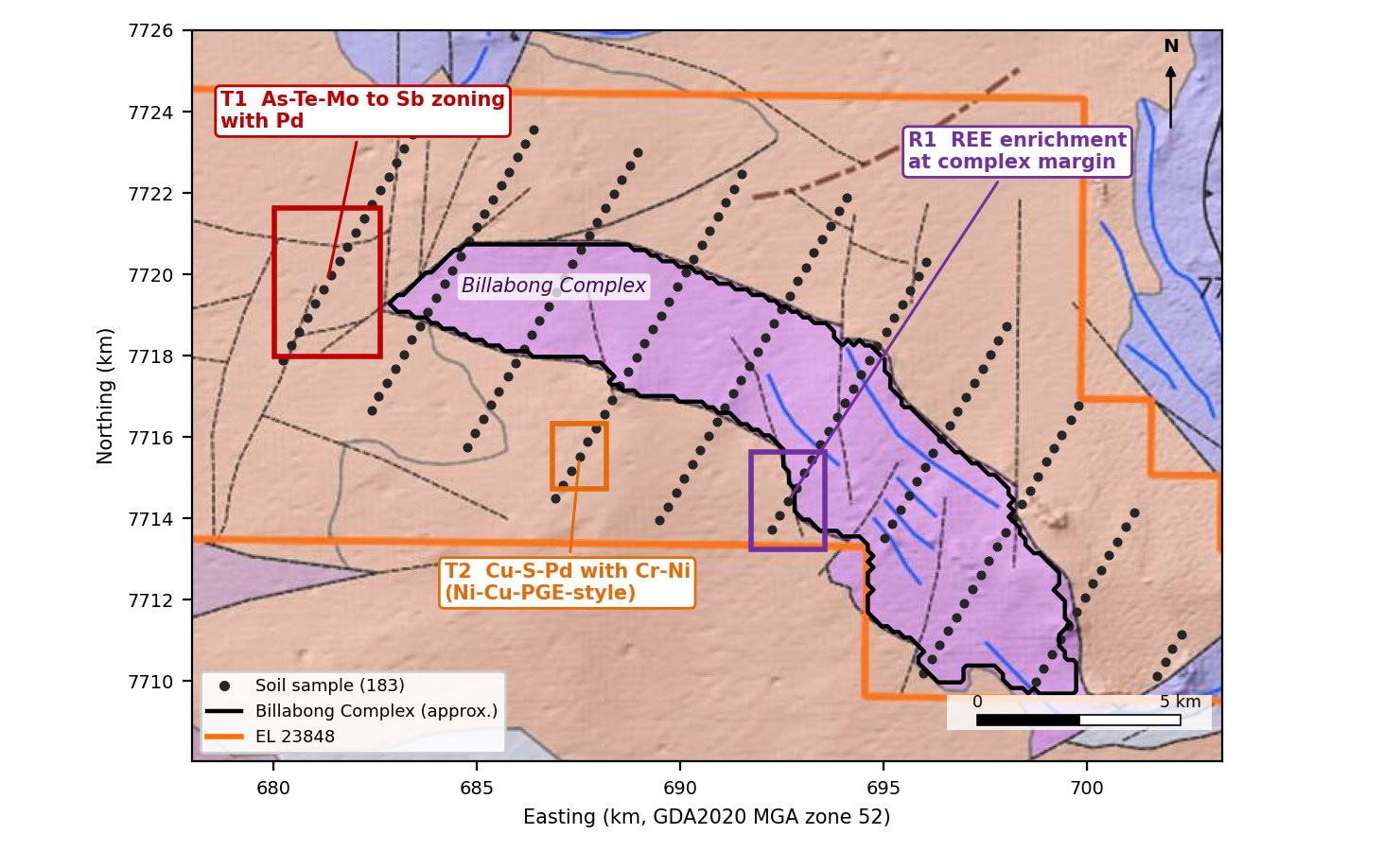
Figure 1. EL 23848 soil survey on the project geology, showing the Billabong Complex margin target (R1) and the two new target areas (T1 and T2). Coordinates GDA2020 MGA zone 52.
To view an enhanced version of this graphic, please visit:
https://images.newsfilecorp.com/files/10047/324696_620aa6b4f4e3bb68_002full.jpg
REE results
REE are highest along the south-west margin of the complex, where five consecutive samples on one line (R1) returned 85–112 ppm TREO, all in the top
Previously unrecognised targets
T1 lies 1.5–2.3 km north-west of the complex margin. Arsenic, tellurium, molybdenum and copper rise together over four consecutive samples and give way over the next four to an antimony peak of 0.55 ppm, about 2.3 times the survey median, with palladium elevated over the first part of the zone. Gold is low (survey maximum 3.1 ppb), consistent with earlier work, so T1 is a pathfinder response and not a gold anomaly; the same suite marks gold systems in ultrafine surveys elsewhere in Australia. T2 lies about 1.5–2.4 km outside the margin and combines copper (to 50 ppm), sulphur, palladium and platinum with a chromium-nickel peak, a pattern seen over mafic-ultramafic rocks. Amplitudes at both targets are modest and need confirmation.
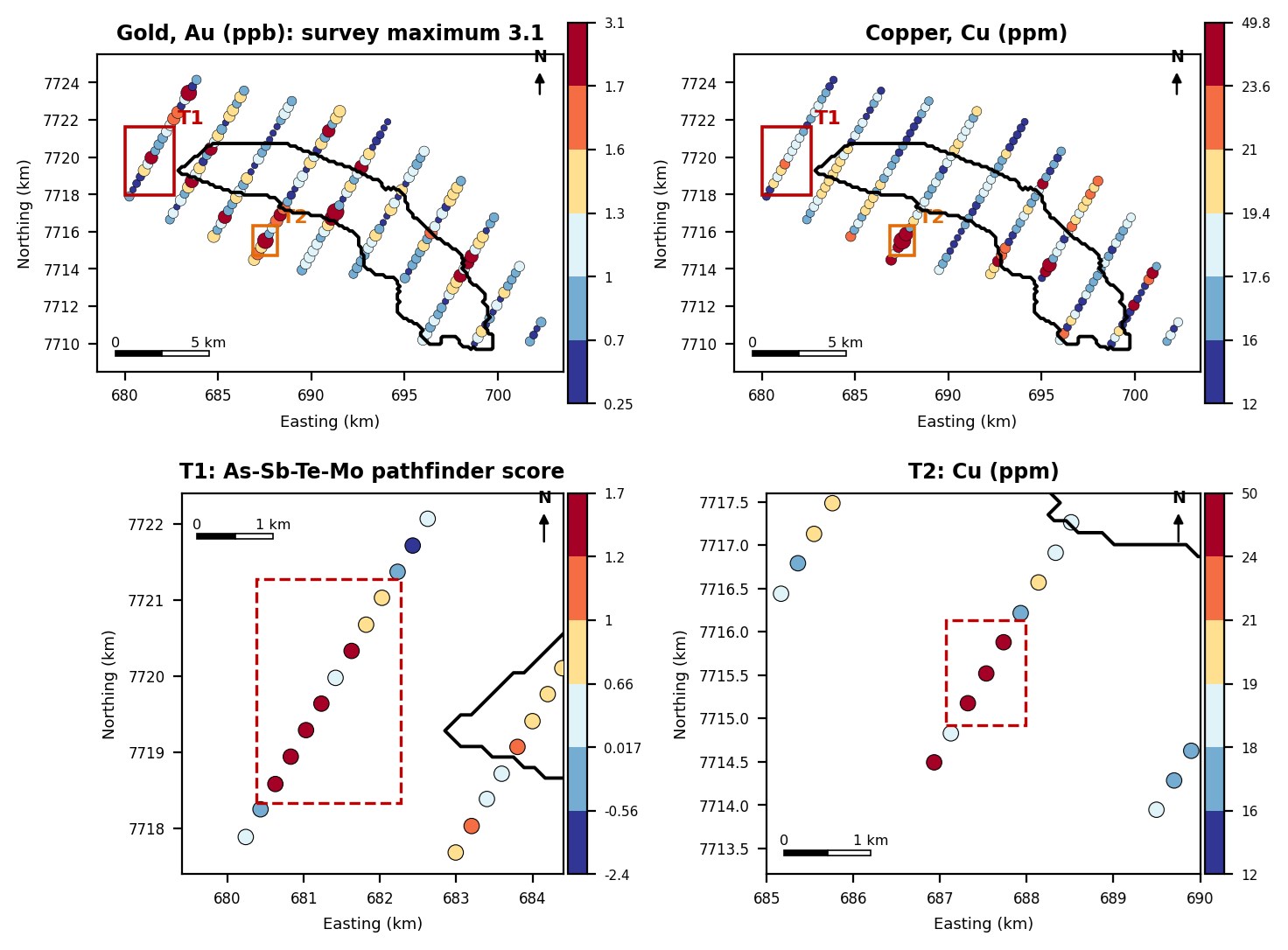
Figure 2. Gold and copper maps with the approximate Billabong Complex outline: survey-wide Au and Cu with targets T1 and T2 outlined, and zooms of the T1 pathfinder zone and the T2 copper response. Gold is low (maximum 3.1 ppb); T1 is a pathfinder response.
To view an enhanced version of this graphic, please visit:
https://images.newsfilecorp.com/files/10047/324696_620aa6b4f4e3bb68_003full.jpg
Next steps
Follow-up will confirm the REE signal and test the two new targets in parallel, using low-cost methods before any drilling is considered. Results will determine which targets, if any, advance to drill testing.
Qualified Person
Blair Way, B.Sc., P. Geo., CEO and President for the Company and Qualified Person as defined by National Instrument 43-101, approved and supervised the preparation of the technical information in this news release.
About V Ten Metals Corp.
VTen is a Canadian mining exploration company listed on the TSX Venture Exchange owns the Ni-Cu-PGE-Au Tanami Project, 1,237 km² strategically located adjacent to Newmont's Granites Mine located in Northern Territory, Australia. The company has a farm-in JV in place exploring for potential gold targets. VTen is led by a highly qualified team with a track record of successful exploration worldwide.
FOR FURTHER INFORMATION, PLEASE CONTACT:
Blair Way, CEO, President and Director
Telephone: +1 (800) 482-7560 (Main); +1 (800) 482-7560 (Other – Toll Free)
E-mail: info@vtenmetals.com
Cautionary Notes
Forward-Looking Statements
This news release contains forward-looking statements and forward-looking information (collectively, "forward- looking statements") within the meaning of applicable Canadian and United States legislation. Forward-looking statements are typically identified by words such as: "believes", "expects", "anticipates", "intends", "estimates", "plans", "may", "should", "would", "will", "potential", "scheduled" or variations of such words and phrases and similar expressions, which, by their nature, refer to future events or results that may, could, would, might or will occur or be taken or achieved. Accordingly, all statements in this news release that are not purely historical are forward-looking statements and include statements regarding beliefs, plans, expectations and orientations regarding the future including, without limitation, any statements or plans regarding the Agreement, the anticipated benefits of the Agreement, and any other matters in connection with the aforementioned items. Although the Company believes that such statements are reasonable and reflect expectations of future developments and other factors which management believes to be reasonable and relevant, the Company can give no assurance that such expectations will prove to be correct. Forward-looking statements involve known and unknown risks, uncertainties and other factors which may cause the actual results, performance or achievements of the Company to differ materially from any future results, performance or achievements expressed or implied by the forward-looking information. Such risks and other factors include, but are not limited to, the risk that the Company may not be able to execute and raise funds necessary to complete its planned future activities and proposed business plans.
Neither the TSXV nor its Regulation Services Provider (as that term is defined in the policies of the TSXV) accepts responsibility for the adequacy or accuracy of this release.

To view the source version of this press release, please visit https://www.newsfilecorp.com/release/324696
FAQ
AI-generated questions and answers. How Rhea-AI works. Not financial advice.