
Eco Wave Power Highlighted in U.S. Department of Energy National Laboratory Report Emphasizing the Strong Economic and Deployment Advantages of Coastal Structure-Integrated Wave Energy
Eco Wave Power (NASDAQ: WAVE) was highlighted in a U.S. Department of Energy national laboratory report on February 19, 2026, promoting Coastal Structure Integrated Wave Energy Converters (CSI-WECs) as lower-risk, dual-use assets.
Sentiment and the balance of points
Rhea-AI Sentiment reads the wording of the document, how positive or negative its language is on a 1 to 5 scale. The balance of points shown with the takes weighs what the document actually discloses, so the two can disagree, for example when a trial that missed its main goal is described in upbeat language.
Rhea-AI Summary
Eco Wave Power (NASDAQ: WAVE) was highlighted in a U.S. Department of Energy national laboratory report on February 19, 2026, promoting Coastal Structure Integrated Wave Energy Converters (CSI-WECs) as lower-risk, dual-use assets. The report cites 2,640 TWh theoretical U.S. potential, ~14% hardened coastline, and payback estimates of 5–6 years.
The analysis notes scalability from microgrids to grid-level generation and identifies Puerto Rico, Hawaii, Pribilof Islands, and Humboldt Bay as high-potential sites where Eco Wave performed preliminary analyses.
Positive
- Estimated U.S. wave potential of 2,640 TWh/year
- Capital payback estimated at approximately 5–6 years
- Approximately 14% of U.S. coastline already hardened for integration
- Eco Wave selected for preliminary analyses at 4 high-potential U.S. sites
- Scalability from microgrid to grid-level generation possible
Negative
- Analyses were preliminary and limited to four locations
- Projected device output given as ranges (tens to hundreds MWh)
- Commercial deployment remains dependent on increasing coastal infrastructure investments
Details
News Market Reaction – WAVE
On Feb 19, the day this news came out, WAVE closed 3.35% above the previous close.
Data tracked by StockTitan Argus for the Feb 19 session.
Key Figures
- U.S. wave energy potential
- 2,640 terawatt-hours per year
- Theoretical wave energy along U.S. coastlines
- Hardened coastline share
- 14%
- Portion of U.S. coastline with coastal defense structures
- Coastal population share
- 40%
- Portion of U.S. population in coastal counties
- Capital payback period
- five to six years
- Estimated CSI-WEC project payback from national lab analysis
- Project life horizon
- 20 years
- National lab estimate for CSI-WEC project value period
- Deployment length basis
- 10-meter deployments
- Normalized device deployment length in study analyses
- Global project pipeline
- 404.7 MW
- Pipeline under development cited in recent 6-K filings
- South Africa feasibility capacity
- 8.3 MW
- Technical potential at Port of Ngqura breakwater
Historical Context
-
Feasibility study showed about 8.3 MW potential at Port of Ngqura.
-
Jaffa Port pilot generated over 2,300 kWh with zero downtime in January.
-
LOI with Wavefront Asset Management for up to 100% equipment financing.
-
Porto project advanced with metocean assessment and execution plan submission.
-
December Jaffa Port production over 2,000 kWh with zero downtime in 2025.
24h Move is the share-price change in the day after each event; other market factors may also have contributed.
Key Terms
coastal structure integrated wave energy converters technical
techno-economic analysis technical
gis-based technical
microgrid technical
grid-level generation technical
grid-connected technical
onshore wave energy technical
AI-generated analysis. How Rhea-AI works. Not financial advice.




Los Angeles, California--(Newsfile Corp. - February 19, 2026) - Eco Wave Power Global AB (NASDAQ: WAVE) ("Eco Wave Power" or the "Company"), a leading developer of onshore wave energy technology, today announced its inclusion in a major U.S. Department of Energy ("DOE") national laboratory report emphasizing the high-value potential of Coastal Structure Integrated Wave Energy Converters ("CSI-WECs") across U.S. coastlines.
The report, authored by the National Laboratory of the Rockies for the DOE Office of Energy Efficiency and Renewable Energy Water Power Technologies Office (produced while operating as the National Renewable Energy Laboratory (NREL)), evaluates the technical, economic, and geographic opportunity for structure-integrated wave energy systems in the United States.
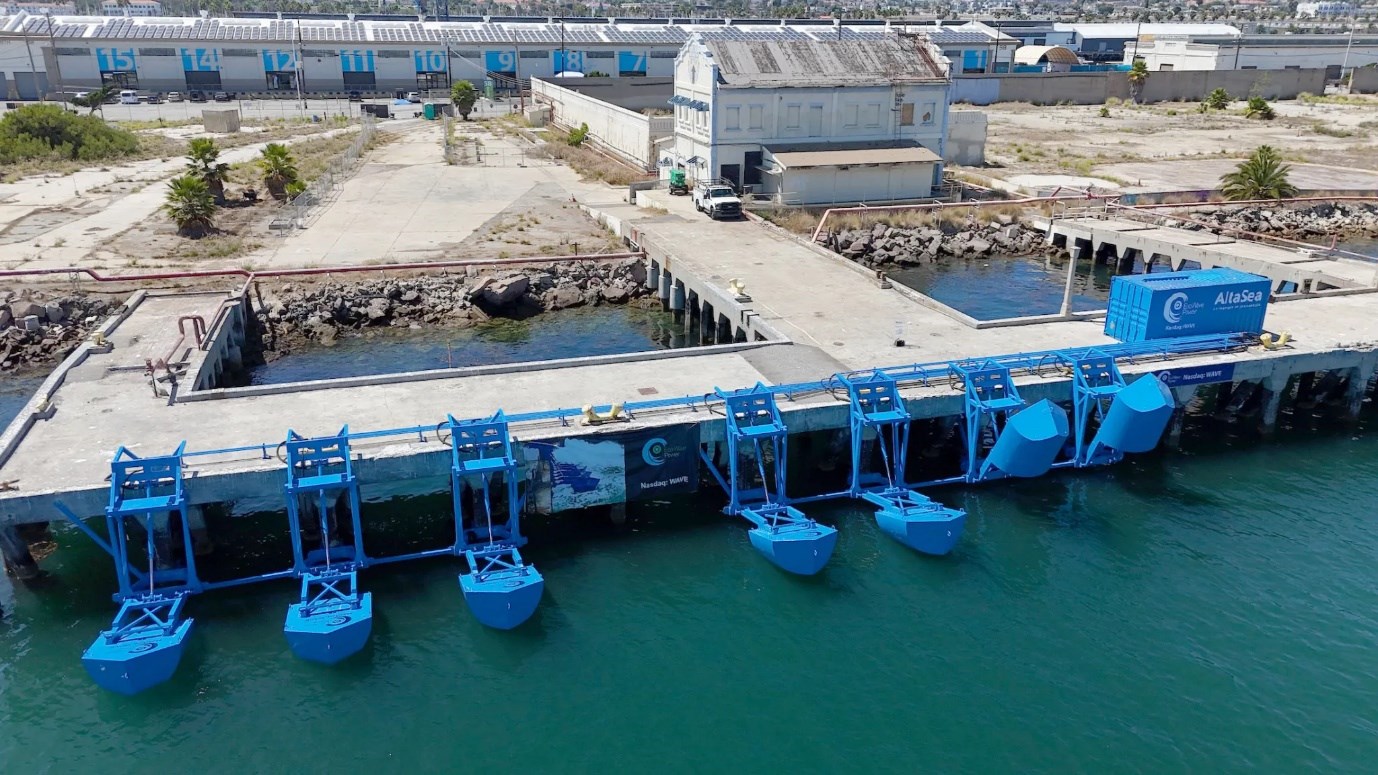
Eco Wave Power first U.S. demonstration project at the Port of Los Angeles (Photo Credit Erik Olsen)
To view an enhanced version of this graphic, please visit:
https://images.newsfilecorp.com/files/11247/284491_f0744cf3442eab41_001full.jpg
The national laboratory analysis identifies structure-integrated wave energy as a comparatively lower-risk and higher-value deployment pathway within the broader marine energy sector.
Unlike offshore wave projects that require standalone marine infrastructure, CSI-WEC systems are embedded directly into existing or planned coastal defense structures such as breakwaters, jetties, and harbor walls. This integration model:
Reduces capital intensity by leveraging pre-existing infrastructure
Minimizes subsea cabling and offshore installation complexity
Lowers operations and maintenance costs through onshore accessibility
Preserves the primary coastal protection function even if power generation is temporarily offline
The report concludes that this dual-use infrastructure model offers a more practical and financially attractive route to commercial marine energy deployment.
According to the study:
U.S. coastlines contain an estimated 2,640 terawatt-hours per year of theoretical wave energy potential
Approximately
14% of U.S. coastline is already hardened with coastal defense structuresNearly
40% of the U.S. population lives in coastal counties, many facing increasing erosion and flooding risks
As climate change accelerates coastal hazards, investment in sea walls, breakwaters, and harbor reinforcements is expected to rise. The report emphasizes that integrating wave energy converters into such infrastructure can meaningfully enhance lifetime asset value by transforming passive defense structures into revenue-generating clean energy assets.
The national laboratory's techno-economic analysis and GIS-based siting tool indicate that CSI-WEC deployments may achieve:
Capital payback periods estimated at approximately five to six years
Potential for millions of dollars in energy value over a 20-year project life
Scalability from microgrid applications to grid-level generation depending on available linear infrastructure
The research team highlights CSI-WEC systems as a high-value marine energy application that has historically been underexplored in the United States despite favorable economics and infrastructure synergies.
Eco Wave Power was one of only three wave energy developers selected to perform preliminary energy production analyses for four high-potential U.S. locations:
Puerto Rico
Hawaii
The Pribilof Islands
Humboldt Bay, California
Initial results demonstrated meaningful near-term deployment potential, with projected annual generation ranging from tens to hundreds of megawatt-hours per device under normalized 10-meter deployments, and the ability to scale output with extended infrastructure length.
The report's conclusions align with Eco Wave Power's demonstrated operational experience integrating wave energy systems into existing coastal structures, including:
A grid-connected project developed in partnership with EDF at Jaffa Port, Israel (EWP-EDF One Project), delivering electricity to the national grid
The Company's first U.S. demonstration project at the Port of Los Angeles, marking a significant milestone in introducing onshore wave energy technology to the American market
These deployments validate the structure-integration model highlighted in the national laboratory study.
"This independent national laboratory report underscores what we have consistently believed and demonstrated in the field: structure-integrated wave energy represents one of the most economically rational and deployable pathways for marine energy in the United States," said Inna Braverman, Founder and Chief Executive Officer of Eco Wave Power. "By converting coastal defense infrastructure into clean energy assets, we are not only strengthening community resilience but also unlocking new revenue streams and accelerating the transition to renewable power."
The full report is available at no cost through the National Laboratory of the Rockies in the following link: https://docs.nlr.gov/docs/fy26osti/90768.pdf.
This work was authored by the National Laboratory of the Rockies for the U.S. Department of Energy (DOE), operated under Contract No. DE-AC36-08GO28308. Funding was provided by the DOE Office of Energy Efficiency and Renewable Energy Water Power Technologies Office. The views expressed in the report do not necessarily represent those of the DOE or the U.S. Government.
About Eco Wave Power Global AB (publ)
Eco Wave Power Global (NASDAQ: WAVE) is a pioneering onshore wave energy company that transforms the power of ocean and sea waves into clean, reliable, and cost-efficient electricity through its patented, intelligent technology.
With a mission to accelerate the global transition to renewable energy, Eco Wave Power developed and operates Israel's first grid-connected wave energy power station, recognized as a "Pioneering Technology" by the Israeli Ministry of Energy and co-funded by EDF Renewables IL. In the United States, the Company recently launched the first-ever onshore wave energy pilot station at the Port of Los Angeles, in collaboration with Shell Marine Renewable Energy.
Eco Wave Power is expanding rapidly worldwide, with upcoming projects in Portugal, Taiwan, and India, representing a robust project pipeline of 404.7 MW under development. The Company has received international recognition and support from organizations including the European Union Regional Development Fund, Innovate UK, and the EU Horizon 2020 program, and was honoured with the United Nations Global Climate Action Award.
Eco Wave Power's American Depositary Shares (ADSs) are traded on the Nasdaq Capital Market under the ticker symbol "WAVE."
For more information, please visit: www.ecowavepower.com
For press inquiries, please contact: info@ecowavepower.com
Forward-Looking Statements
This press release contains forward-looking statements within the meaning of the "safe harbor" provisions of the U.S. Private Securities Litigation Reform Act of 1995 and other Federal securities laws. For example, the Company is using forward-looking statements in this press release when it states that the projected annual generation ranges from tens to hundreds of megawatt-hours per device under normalized 10-meter deployments, and the ability to scale output with extended infrastructure length and that structure-integrated wave energy represents one of the most economically rational and deployable pathways for marine energy in the United States. Forward-looking statements can be identified by words such as: "anticipate," "intend," "plan," "goal," "seek," "believe," "project," "estimate," "expect," "strategy," "future," "likely," "may," "should," "will", or variations of such words, and similar references to future periods. These forward-looking statements and their implications are neither historical facts nor assurances of future performance and are based on the current expectations of the management of Eco Wave Power and are subject to a number of factors, uncertainties and changes in circumstances that are difficult to predict and may be outside of Eco Wave Power's control that could cause actual results to differ materially from those described in the forward-looking statements. Therefore, you should not rely on any of these forward-looking statements. Except as otherwise required by law, Eco Wave Power undertakes no obligation to publicly release any revisions to these forward-looking statements to reflect events or circumstances after the date hereof or to reflect the occurrence of unanticipated events. More detailed information about the risks and uncertainties affecting Eco Wave Power is contained under the heading "Risk Factors" in Eco Wave Power's Annual Report on Form 20-F for the fiscal year ended December 31, 2024 filed with the SEC on March 3, 2025, which is available on the on the SEC's website, www.sec.gov, and other documents filed or furnished to the SEC. Any forward-looking statement made in this press release speaks only as of the date hereof. References and links to websites have been provided as a convenience and the information contained on such websites is not incorporated by reference into this press release.
To view the source version of this press release, please visit https://www.newsfilecorp.com/release/284491
FAQ
AI-generated questions and answers. How Rhea-AI works. Not financial advice.