
Wiley and IQVIA Release Cross-Sector Report on AI’s Promise and Pressure Points Across Healthcare Value Chain
Key Terms
ai technical
ai agents technical
real-world data medical
real-world evidence medical
clinical guidelines medical
trial design medical
value chain technical
peer review technical




Insights drawn from executive Summit hosted by Wiley and IQVIA with leaders from pharma, academia, health systems, technology companies and more
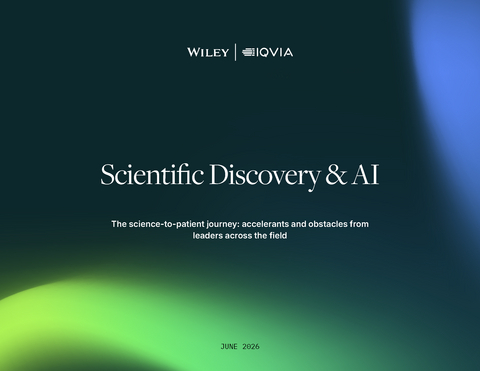
The report summarizes insights from The Summit — an invitation-only, two-day working session co-hosted by Wiley and IQVIA in May 2026. The session opened with a forward-looking perspective on AI and organizational change from Ethan Mollick,
A key focus of the report is the gap between AI's technical capability and the health system's ability to absorb it. AI is accelerating every stage of the journey from scientific discovery to patient benefit — but acceleration at one stage can create fracture at the next. Examining each stage of the science-to-patient value chain, participants identified five high-potential directions for the ecosystem:
- Decision-first discovery: Embracing AI for large-scale exploration to support wet lab target identification and validation.
- Structured negative data: Sharing vetted failed experiments to avoid unnecessary repetition.
- AI agents for patients: Deploying patient-facing AI to help them navigate health systems.
- Curated aggregation: Combining the scholarly record and real-world data as a trusted alternative to general-purpose AI search.
- Continuous learning loop: Feeding real-world evidence back into trial design, clinical guidelines and upstream research.
“For AI to deliver its full promise in healthcare and science, all parts of the system must be engaged. AI has vastly increased the speed at which we can resolve molecular identities and surface new candidates — but if the publishing model, clinical development infrastructure and real-world adoption don’t keep pace, those discoveries won’t reach patients as quickly as they should,” said Armughan Rafat, Wiley SVP, Chief AI & Data Analytics Officer. “That’s the conversation Wiley and IQVIA have convened. We didn’t set out to produce consensus, but rather to surface an honest diagnosis.”
"AI is already reshaping every stage of the healthcare value chain, but the real opportunity lies in connecting those stages into a continuous learning system. What emerged from The Summit is a clear need to move beyond isolated innovation toward integrated evidence ecosystems – where clinical research, real-world data and advanced analytics work in unison. By closing the loop between discovery, development and real-world outcomes, we can accelerate not just insight generation, but meaningful impact for patients," said Rob Kotchie, IQVIA President, Real World Evidence & Clinical Technology Solutions.
The report is also candid about identifying existing structural limits. A consistent finding across every stage of the value chain is that incentives are an impediment: the system rewards behaviors that don’t always optimize for science, patients or long-term progress. Addressing such misalignment requires collaboration across actors and structural change.
Scientific Discovery & AI: The Science-to-Patient Journey is available now at this link. The report maps the findings from The Summit across four stages of the science-to-patient value chain: Discovery & Early Research, Clinical Development & Evidence Generation, Validation & Dissemination and Real-World Adoption & Patient Impact.
Together, Wiley and IQVIA span the full value chain — from evidence creation and peer review through real-world clinical application — and are strongly positioned to connect the stakeholders who need to be in conversation.
About Wiley
Wiley (NYSE: WLY) is a global leader in authoritative content and research intelligence for the advancement of scientific discovery, innovation, and learning. With more than 200 years at the center of the scholarly ecosystem, Wiley combines trusted publishing heritage with AI-powered platforms to transform how knowledge is discovered, accessed, and applied. From individual researchers and students to Fortune 500 R&D teams, Wiley enables the transformation of scientific breakthroughs into real-world impact. From knowledge to impact—Wiley is redefining what's possible in science and learning. Visit us at Wiley.com and Investors.Wiley.com. Follow us on Facebook, X, LinkedIn and Instagram.
About IQVIA
IQVIA (NYSE:IQV) is a leading global provider of clinical research services, commercial insights and healthcare intelligence to the life sciences and healthcare industries. IQVIA’s portfolio of solutions are powered by IQVIA Connected Intelligence™ to deliver actionable insights and services built on high-quality health data, Healthcare-grade AI®, advanced analytics, the latest technologies and extensive domain expertise. IQVIA is committed to using AI responsibly, with AI-powered capabilities built on best-in-class approaches to privacy, regulatory compliance and patient safety, and delivering AI to the high standards of trust, scalability and precision demanded by the industry. With approximately 93,000 employees in over 100 countries, including experts in healthcare, life sciences, data science, technology and operational excellence, IQVIA is dedicated to accelerating the development and commercialization of innovative medical treatments to help improve patient outcomes and population health worldwide.
IQVIA is a global leader in protecting individual patient privacy. The company uses a wide variety of privacy-enhancing technologies and safeguards to protect individual privacy while generating and analyzing information on a scale that helps healthcare stakeholders identify disease patterns and correlate with the precise treatment path and therapy needed for better outcomes. IQVIA’s insights and execution capabilities help biotech, medical device and pharmaceutical companies, medical researchers, government agencies, payers and other healthcare stakeholders tap into a deeper understanding of diseases, human behaviors and scientific advances, in an effort to advance their path toward cures. To learn more, visit www.iqvia.com.
Category: All Corporate News
View source version on businesswire.com: https://www.businesswire.com/news/home/20260615344569/en/
Media Contact — Wiley: Geena De Rose / gderose@wiley.com
Media Contact — IQVIA: Alissa Maupin / alissa.maupin1@iqvia.com
Source: John Wiley and Sons