
Burson Quantifies the Value of Reputation, Revealing a $7 Trillion Global “Reputation Economy”
Burson (WPP) quantifies corporate reputation as a financial asset, estimating a global "Reputation Economy" worth $7.07 trillion and finding top reputation companies can earn an incremental 4.78% Reputation Return in shareholder value.




Analysis reveals companies with the strongest reputations earned a nearly five percent ‘Reputation Return’ in shareholder value
Study also warns that a company’s treatment of its employees in the age of AI is identified as a significant threat — and opportunity — to its financial value
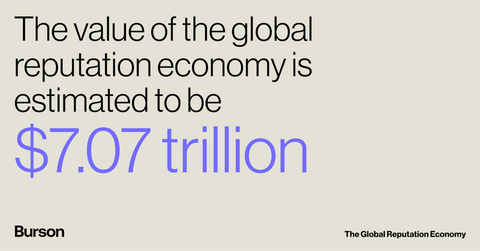
The research, “The Global Reputation Economy: A New Asset Class for a New Era,” has successfully quantified the financial value of reputation, moving it from a soft concept to a hard asset. The analysis found that among the companies studied, the magnitude of this “reputation return” could add anywhere from
“For decades, leaders have known intuitively that reputation matters, but they’ve never been able to quantify it as a financial asset; now, we can,” said Corey duBrowa, Global CEO, Burson. “Our research shows that reputation is an interconnected system that, when rigorously managed, can yield billions in measurable returns, build resilience against shocks, and give leaders the confidence to make bold moves. A strong reputation that can deliver financial impact goes well beyond the simple binary of trust.”
The New Reputational Battleground: AI and the Workplace
While reputation leaders excel across the board, the research identified the workplace as presenting both a significant opportunity and challenge. Though ranked lowest in terms of perceived importance (
The study warns this gap may become a crisis for companies that mishandle the integration of artificial intelligence.
“Businesses must go beyond having an ‘AI strategy’ and create an ‘AI people strategy,’ because how they manage this transition will be a powerful statement about how they value their employees,” said Matt Reid, Global Corporate and Public Affairs Lead, Burson, and
Additional Key Findings
-
Leaders Leave No Weak Links: Top-performing companies dominate across all eight drivers of reputation, scoring an average of 11 to 15 points higher on each lever. The biggest advantages were seen in Innovation (15.5-point gap), Product (15.2-point gap) and Governance (14.4-point gap).
-
A Counterintuitive Path to Recovery (Aerospace & Energy): In sectors where the cost of failure is catastrophic, or for industries viewed as problematic, reputation is being rebuilt from the “inside-out.” Two aerospace companies in the study saw the greatest reputation gains not from showcasing the superior engineering of their products but from focusing on operational integrity through Governance (+
7.9% ) and Workplace (+6.2% ). Similarly, the energy sector’s reputational gains are coming from a focus on Workplace (+0.9% ) and Citizenship (+0.9% ), not just sustainability narratives.
-
Finance Sector’s Multi-Billion-Dollar Erosion: The study noted a consistent decline in the Finance sector across Leadership (-
24% ) Governance (-11% ) and Citizenship (-15% ). For the companies analyzed, this erosion puts$4.3 billion 38% of their total reputational value of$11.4 billion
“Our research proves that the historical models for studying reputation were at best static and at worst not actionable,” duBrowa continued. “Reputation is organic and constantly evolving, so with a clear understanding of which components of reputation are strong or require action, businesses can focus with precision on predicting and influencing the forces that drive perception and fuel financial outcomes.”
Burson’s complete report, “The Global Reputation Economy: A New Asset Class for a New Era,” can be found here.
About the Research
Between October 2024 and October 2025 Burson used its Reputation Capital methodology to model 66 publicly traded companies in
About Burson
Burson is the global communications leader built to create value for clients through reputation. With highly specialized teams, industry-leading technologies and breakthrough creative, we help brands and businesses redefine reputation as a competitive advantage so they can lead today and into the future. Burson operates under WPP (LSE/NYSE: WPP), the creative transformation company. Learn more at www.bursonglobal.com.
View source version on businesswire.com: https://www.businesswire.com/news/home/20260113192212/en/
Catherine.Sullivan@bursonglobal.com
Source: Burson