
WeRide and Geely Farizon to Deliver 2,000 Purpose-Built Robotaxi GXRs by 2026, Advancing Large-Scale Global Commercialization
WeRide (NASDAQ: WRD) and Geely Farizon agreed to deliver 2,000 purpose-built Robotaxi GXR vehicles by 2026 and showcased an upgraded GXR due to roll off in Q3 2026.
Sentiment and the balance of points
Rhea-AI Sentiment reads the wording of the document, how positive or negative its language is on a 1 to 5 scale. The balance of points shown with the takes weighs what the document actually discloses, so the two can disagree, for example when a trial that missed its main goal is described in upbeat language.
Rhea-AI Summary
WeRide (NASDAQ: WRD) and Geely Farizon agreed to deliver 2,000 purpose-built Robotaxi GXR vehicles by 2026 and showcased an upgraded GXR due to roll off in Q3 2026. As of Jan 2026 WeRide operated 1,023 Robotaxis and expects its fleet to surpass 2,600 vehicles this year.
The GXR uses WeRide’s GEN8 with Sensor Suite 8.0, offering 17x point-cloud resolution, 600m detection range and claimed ~70% more reaction time; assembly time falls from one hour to under 10 minutes and vehicle cost is expected to decline ~15%.
Positive
- Firm order for 2,000 Robotaxi GXR units to be delivered by 2026
- Global fleet scale: operating fleet 1,023 (Jan 2026) expected >2,600 in 2026
- GEN8 Sensor Suite 8.0 increases point-cloud resolution by 17x and detection to 600m
- Assembly time cut from 1 hour to under 10 minutes
- Total vehicle cost expected to fall by 15%
Negative
- None.
Details
News Market Reaction – WRD
On Mar 9, the first trading day after this news, WRD closed 1.26% below the previous close.
Data tracked by StockTitan Argus for the Mar 9 session.
Key Figures
- Robotaxi GXR deliveries
- 2,000 vehicles
- Planned upgraded, purpose-built Robotaxi GXRs by 2026
- Existing Robotaxi fleet
- 1,023 vehicles
- Global Robotaxi fleet as of January 2026
- Projected fleet size
- 2,600 Robotaxis
- Expected global operating Robotaxi fleet in 2026
- LiDAR detection range
- 600 meters
- Detection range for GEN8 thousand-line LiDAR on Robotaxi GXR
- LiDAR resolution gain
- 17 times
- Increase in point-cloud resolution vs previous generation
- Reaction time gain
- 70% more
- Additional reaction time enabled by ultra-long-range LiDAR
- Assembly time reduction
- From 1 hour to under 10 minutes
- Robotaxi GXR vehicle assembly time using Farizon drive-by-wire chassis
- Vehicle cost reduction
- 15%
- Expected total vehicle cost decrease for Robotaxi GXR
Historical Context
-
Scheduled release of Q4 and full-year 2025 financial results and call details.
-
Launch of first commercial Robotaxi service with Uber in downtown Abu Dhabi.
-
Plan with Uber to deploy at least 1,200 Robotaxis across Middle East by 2027.
-
Launch of WeRide GENESIS simulation platform to enhance AV training and validation.
-
Robotaxi booking via WeChat Mini Program to broaden access and ride volume.
24h Move is the share-price change in the day after each event; other market factors may also have contributed.
Key Terms
lidar technical
drive-by-wire technical
autonomous driving technical
robotaxi technical
AI-generated analysis. How Rhea-AI works. Not financial advice.




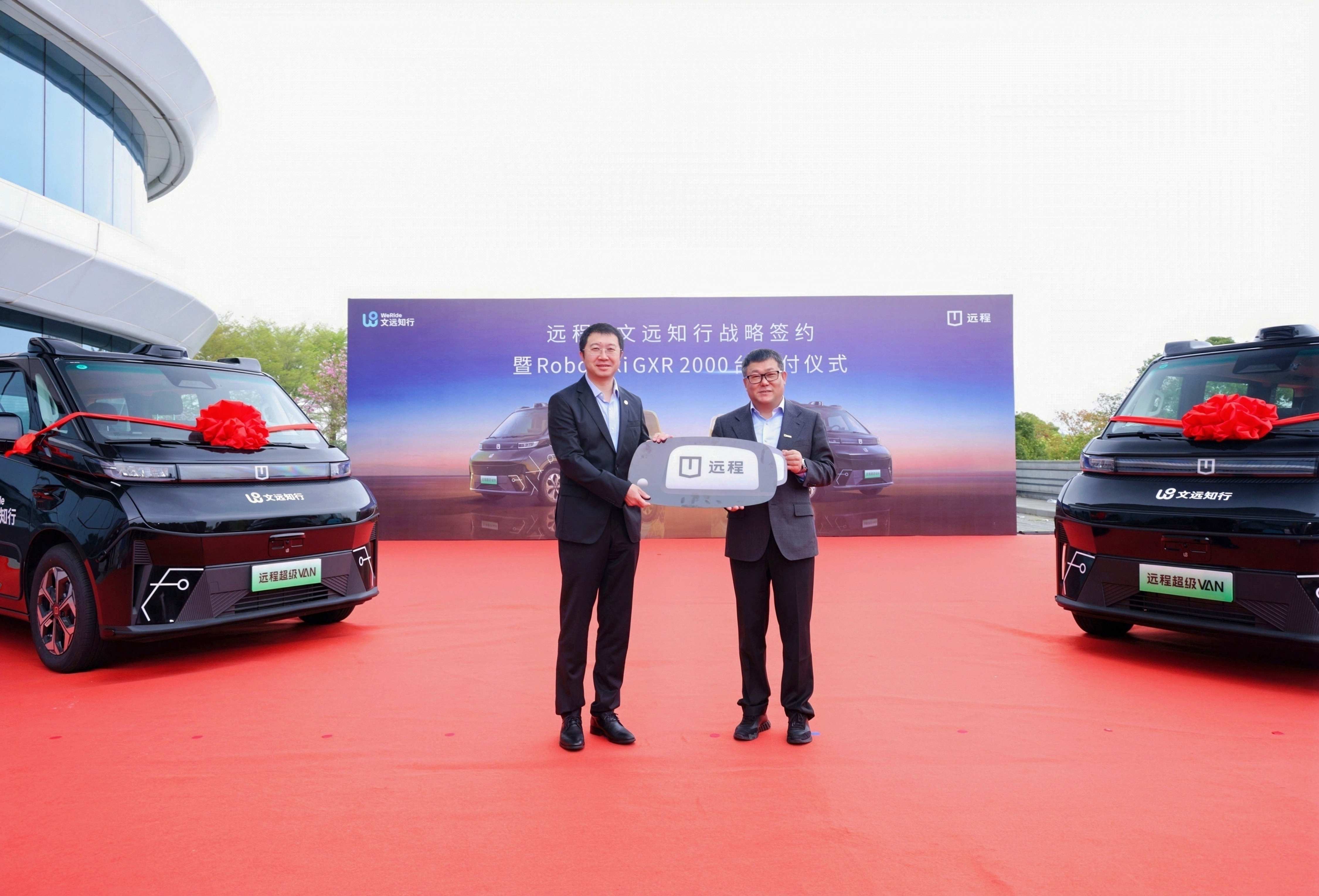
GUANGZHOU, China, March 08, 2026 (GLOBE NEWSWIRE) -- WeRide (NASDAQ: WRD, HKEX: 0800), a global leader in autonomous driving technology, today signed an expanded strategic cooperation agreement with Geely’s Zhejiang Farizon New Energy Commercial Vehicle Group (Geely Farizon). The two companies announced plans to deliver 2,000 upgraded, purpose-built, mass-produced Robotaxi GXRs by 2026, advancing WeRide's progress toward large-scale global Robotaxi commercialization.
As part of the signing ceremony, the companies also showcased the upgraded Robotaxi GXR. The new model is scheduled to officially roll off the production line in the third quarter of 2026. As of January 2026, WeRide's global Robotaxi fleet had 1,023 vehicles. With the addition of 2,000 new Robotaxi GXRs, WeRide expects its global operating Robotaxi fleet to surpass 2,600 Robotaxis this year, marking steady progress toward its vision of tens of thousands of vehicles by 2030.
Equipped with WeRide’s latest GEN8 autonomous driving system, the new Robotaxi GXR delivers a substantial upgrade over the previous generation. GEN8, built around WeRide’s self-developed Sensor Suite 8.0 (SS8.0), enhances vehicle safety, consistency, and long-term operational reliability. Its thousand-line LiDAR increases point-cloud resolution by 17 times and extends detection range to 600 meters – two to three times that of mainstream industry solutions.
This ultra-long-range capability provides over
Leveraging Farizon’s advanced AI-enabled drive-by-wire chassis, along with its mature supply chain and production management system, the Robotaxi GXR delivers major gains in manufacturing efficiency, reducing vehicle assembly time from one hour to under 10 minutes. Total vehicle cost is expected to decrease by another
“This deepened strategic collaboration between WeRide and Geely Farizon marks our shift from a product-level partnership to an integrated ecosystem, and is a significant milestone in WeRide’s global Robotaxi deployment. By combining technological leadership with high-efficiency mass production, we will accelerate commercial rollout of the Robotaxi GXR across key markets, including China, the Middle East, Southeast Asia, and Europe – delivering safer, more reliable, and more accessible autonomous mobility worldwide,” said Dr. Tony Han, Founder and CEO of WeRide.
“Our partnership with WeRide is not only a precise integration of technology and resources, but also a clear example of Farizon’s strategic transformation from manufacturing to providing comprehensive ‘intelligent manufacturing + services’ solutions. Moving forward, leveraging Farizon’s leading R&D capabilities, standardized intelligent manufacturing, and smart assembly capacity, we will establish a highly reliable and adaptable intelligent manufacturing foundation for the mass production and delivery of the purpose-built GXR model, providing strong support for the large-scale deployment of L4 autonomous driving technology,” said Mike Fan, CEO of Farizon New Energy Commercial Vehicle Group.
This strategic upgrade builds on a proven Robotaxi business model. In October 2024, WeRide launched the mass-produced Robotaxi GXR developed on Farizon’s SuperVAN platform. Four months later, it began fully driverless commercial operations in Beijing, followed by Guangzhou in August 2025. Today, the GXR operates fully driverless Robotaxi commercial services in Guangzhou, Beijing, and Abu Dhabi, and offers public passenger services in Dubai and Riyadh, with fully driverless operations set to launch in Dubai later this month. In Singapore, the GXR is completing trial operations ahead of public launch on April 1, 2026. With this expanding global footprint, WeRide’s Robotaxi business is now moving toward wider commercial deployment across multiple markets.
About WeRide
WeRide is a global leader and a first mover in the autonomous driving industry, as well as the first publicly traded Robotaxi company. Our autonomous vehicles have been tested or operated in over 40 cities across 11 countries. We are also the first and only technology company whose products have received autonomous driving permits in eight markets: China, the UAE, Singapore, France, Switzerland, Saudi Arabia, Belgium, and the US. Empowered by the smart, versatile, cost-effective, and highly adaptable WeRide One platform, WeRide provides autonomous driving products and services from L2 to L4, addressing transportation needs in the mobility, logistics, and sanitation industries. WeRide was named to Fortune's 2025 Change the World and 2025 Future 50 lists.
About Farizon
Farizon New Energy Commercial Vehicle Group is the commercial vehicle sector of Geely Holding Group. With the support of Geely Holding Group's Central Research Institute, Farizon New Energy Commercial Vehicle Group has founded China's largest new energy commercial vehicle research institute. It is responsible for the R&D of a new generation of green and intelligent commercial vehicle products based on passenger vehicle technology. It has formed two core technology routes of “Methanol + Electric”. Farizon has become China’s first commercial vehicle brand to offer a full range of new energy product. Farizon is committed to becoming a comprehensive intelligent and green transportation technology service provider.
Farizon has won the annual champion of the new energy commercial vehicle industry for four consecutive years. Farizon launched its “30111” Strategy, committing to achieve 1 million annual sales by 2030 and becoming a global new energy commercial vehicle group that ranks first in domestic commercial vehicle sales and first in global new energy commercial vehicle sales.
For more information regarding Farizon New Energy Commercial Vehicle Group please refer to the official website at https://global.geelycv.com/.
Media Contact
pr@weride.ai
Safe Harbor Statement
This press release contains statements that may constitute “forward-looking” statements pursuant to the “safe harbor” provisions of the U.S. Private Securities Litigation Reform Act of 1995. These forward-looking statements can be identified by terminology such as “will,” “expects,” “anticipates,” “aims,” “future,” “intends,” “plans,” “believes,” “estimates,” “likely to,” and similar statements. Statements that are not historical facts, including statements about WeRide’s beliefs, plans, and expectations, are forward-looking statements. Forward-looking statements involve inherent risks and uncertainties. Further information regarding these and other risks is included in WeRide’s filings with the U.S. Securities and Exchange Commission and announcements on the website of the Hong Kong Stock Exchange. All information provided in this press release is as of the date of this press release. WeRide does not undertake any obligation to update any forward-looking statement, except as required under applicable law.
A photo accompanying this announcement is available at https://www.globenewswire.com/NewsRoom/AttachmentNg/45c09f7e-c9ff-4a3c-9b44-3f188bd47940

FAQ
AI-generated questions and answers. How Rhea-AI works. Not financial advice.