
WeRide and Lenovo Collaborate to Deploy 200,000 Autonomous Vehicles Globally Over Five Years
WeRide (NASDAQ: WRD) and Lenovo announced an expanded collaboration to jointly deploy 200,000 Level 4 autonomous vehicles globally over five years, starting 2026.
Rhea-AI Summary
WeRide (NASDAQ: WRD) and Lenovo announced an expanded collaboration to jointly deploy 200,000 Level 4 autonomous vehicles globally over five years, starting 2026. The partnership combines WeRide’s global AV operations and Lenovo’s automotive-grade computing and supply chain to scale Robotaxis, autonomous minibuses, and sanitation vehicles.
The companies highlighted Lenovo-built HPC 3.0 on AD1 domain controller with NVIDIA DRIVE AGX Thor (>2,000 TOPS), and said HPC 3.0 cuts suite cost ~50% and lifecycle TCO ~84% versus HPC 2.0.
Positive
- 200,000 AVs planned deployment over five years
- HPC 3.0 delivers >2,000 TOPS AI computing power
- Suite cost reduced ~50% versus prior generation
- TCO lowered ~84% over lifecycle versus HPC 2.0
- Global footprint operations in 40+ cities across 12 countries
Negative
- Scaling Robotaxi services across varied regulatory regimes remains complex
- Consistent AV performance required across diverse urban and traffic conditions
Details
News Market Reaction – WRD
In the Apr 27 session, WRD gained 2.64%, reflecting a moderate positive market reaction.
Data tracked by StockTitan Argus on the day of publication.
Key Figures
- Planned AV deployment
- 200,000 autonomous vehicles
- Global deployment target over next five years starting 2026
- Deployment horizon
- Five years
- Timeline for joint deployment of autonomous vehicles
- Global cities
- Over 40 cities
- WeRide R&D, testing and operations footprint
- Global countries
- 12 countries
- WeRide’s autonomous driving operations coverage
- AI computing power
- Over 2,000 TOPS
- HPC 3.0 platform powered by NVIDIA DRIVE AGX Thor
- Suite cost reduction
- 50% reduction
- HPC 3.0 vs HPC 2.0 autonomous driving suite cost
- TCO reduction
- 84% reduction
- Lifecycle total cost of ownership vs HPC 2.0
- Autonomy level
- Level 4
- Large-scale commercialization of Level 4 autonomous driving
Historical Context
-
Filed 2025 Form 20-F with SEC, updating investors on full-year results.
-
WRD 3.0 achieved fourth consecutive win at China Urban Intelligent Driving Competition.
-
Debut and pre-sales of Aion N60 SUV, first co-developed vehicle powered by WRD 3.0.
-
Launched Ai.R autonomous public ride service with Grab in Singapore’s Punggol district.
-
Started fully driverless, fare‑charging Robotaxi operations with Uber in Dubai.
24h Move is the share-price change in the day after each event; other market factors may also have contributed.
Key Terms
level 4 autonomous driving technical
autonomous vehicles (avs) technical
robotaxis technical
physical ai technical
high-performance computing technical
domain controller technical
system-on-chip technical
total cost of ownership (tco) technical
AI-generated analysis. How Rhea-AI works. Not financial advice.




BEIJING, April 27, 2026 (GLOBE NEWSWIRE) -- WeRide (NASDAQ: WRD, HKEX: 0800), a global leader in autonomous driving technology, announced an expanded collaboration with Lenovo (HKSE: 0992) at Auto China 2026 to accelerate the large-scale commercialization of Level 4 autonomous driving worldwide. Starting 2026, the two companies expect to jointly deploy 200,000 autonomous vehicles (AVs), including Robotaxis, globally over the next five years, marking one of the industry’s most ambitious efforts to scale autonomous mobility.
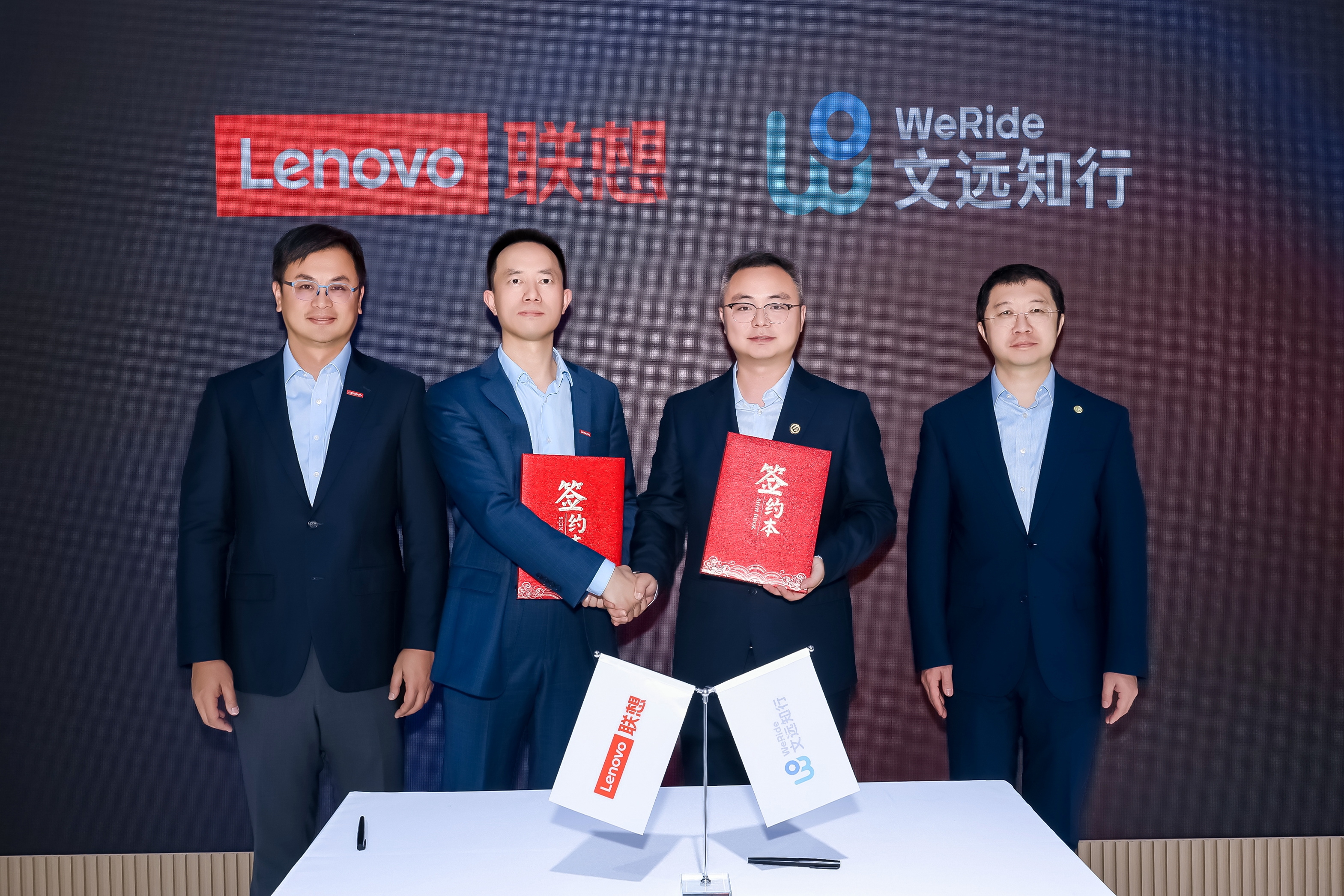
Liu Zhenya, Vice President of Technology at WeRide (third from left), and Peter Xu, Vice President and General Manager of Vehicle Computing at Lenovo (second from left), signed a cooperation agreement at Auto China 2026, witnessed by Dr. Tony Han, Founder and CEO of WeRide (fourth from left), and Ken Wong, Executive Vice President and President of Lenovo Solutions & Services Group (first from left)
This collaboration will accelerate the development of a global autonomous driving ecosystem, integrating critical elements across technology, computing infrastructure, and supply chain to enhance industry-wide collaboration and efficiency.
With R&D, testing, and operations across over 40 cities in 12 countries, WeRide has established the industry’s widest global footprint in autonomous driving, supported by its advanced technology platform and a proven commercial model. Lenovo contributes its strengths in intelligent computing, as well as its global manufacturing and supply chain capabilities, providing robust AI computing infrastructure and system engineering expertise for large-scale fleet deployment.
By combining their respective strengths, the two companies will connect key capabilities from cloud to vehicle, accelerating the deployment of Physical AI in real-world mobility scenarios.
Autonomous driving is emerging as one of the first large-scale applications of Physical AI, bringing intelligent systems into real-world operations. Among its applications, Robotaxis have emerged as the most mature commercial use case, bringing tangible benefits to cities and people. By reducing human error, improving fleet efficiency, and enabling 24/7 operations, autonomous mobility enhances road safety, transportation accessibility, and urban efficiency, while laying the foundation for smarter, more sustainable cities.
However, scaling Robotaxi services globally remains complex. AVs must perform consistently across varied urban environments, regulatory frameworks, and traffic conditions. At the same time, achieving the right balance between high-performance computing, system reliability, and cost efficiency is essential to moving from pilot deployments to sustainable commercial scale.
To address these challenges, Lenovo and WeRide are advancing a scalable technology foundation for autonomous driving. In July 2025, Lenovo and WeRide jointly launched the HPC 3.0 high-performance computing platform, first deployed in the mass-produced WeRide Robotaxi GXR. Built on Lenovo’s L4 autonomous driving domain controller AD1, HPC 3.0 is powered by the NVIDIA DRIVE AGX Thor system-on-chip and delivers over 2,000 TOPS of AI computing power.
The platform meets stringent global regulatory and safety requirements across complex road conditions with its auto-grade design and fully redundant hardware-software. From a cost perspective, HPC 3.0 reduces autonomous driving suite cost by
Lenovo supports the shift toward large-scale commercialization with its capabilities in vehicle computing, Hybrid AI, and global supply chain integration. Its AD1 domain controller combines high-performance AI computing with automotive-grade engineering to support stable deployment in complex environments, backed by its global manufacturing and delivery network.
Dr. Tony Han, Founder and CEO of WeRide, said: “Autonomous driving is entering a critical phase of commercial deployment, with industry competition shifting from pure technological capability to cost efficiency and scalable deployment. This expanded collaboration will further integrate WeRide and Lenovo’s core strengths in autonomous driving systems and computing platforms, creating a strong foundation for the planned global deployment of 200,000 AVs over the next five years.”
Peter Xu, Vice President and General Manager of Vehicle Computing at Lenovo, added: “Scalability is the defining challenge for autonomous driving, and computing is the foundation. Lenovo will continue to advance automotive-grade computing platforms while leveraging our global manufacturing and supply chain strengths to deliver replicable, large-scale capabilities for the industry. Deepening our collaboration with WeRide allows us to accelerate commercialization and bring Robotaxi services to global markets faster.”
Looking ahead, WeRide and Lenovo will continue to deepen collaboration on L4 AVs, including autonomous minibuses and sanitation vehicles. By accelerating the integration of autonomous driving into urban mobility and public services, both companies aim to scale intelligent mobility globally and drive the new phase of deployment.
About WeRide
WeRide is a global leader and a first mover in the autonomous driving industry, as well as the first publicly traded Robotaxi company. Our autonomous vehicles have been tested or operated in over 40 cities across 12 countries. We are also the first and only technology company whose products have received autonomous driving permits in eight markets: China, the UAE, Singapore, France, Switzerland, Saudi Arabia, Belgium, and the US. Empowered by the smart, versatile, cost-effective, and highly adaptable WeRide One platform, WeRide provides autonomous driving products and services from L2 to L4, addressing transportation needs in the mobility, logistics, and sanitation industries. WeRide was named to Fortune’s 2025 Change the World and 2025 Future 50 lists.
About Lenovo
Lenovo is a US
Media Contacts
WeRide:
Email: pr@weride.ai
Lenovo:
Email: baijie10@lenovo.com
Safe Harbor Statement
This press release contains statements that may constitute “forward-looking” statements pursuant to the “safe harbor” provisions of the U.S. Private Securities Litigation Reform Act of 1995. These forward-looking statements can be identified by terminology such as “will,” “expects,” “anticipates,” “aims,” “future,” “intends,” “plans,” “believes,” “estimates,” “likely to,” and similar statements. Statements that are not historical facts, including statements about WeRide’s beliefs, plans, and expectations, are forward-looking statements. Forward-looking statements involve inherent risks and uncertainties. Further information regarding these and other risks is included in WeRide’s filings with the U.S. Securities and Exchange Commission and announcements on the website of the Hong Kong Stock Exchange. All information provided in this press release is as of the date of this press release. WeRide does not undertake any obligation to update any forward-looking statement, except as required under applicable law.
A photo accompanying this announcement is available at:
https://www.globenewswire.com/NewsRoom/AttachmentNg/622ac9e4-c839-4089-9b06-e2f22266cd24

FAQ
AI-generated questions and answers. How Rhea-AI works. Not financial advice.