
WeRide Showcases Robotaxi GXR Powered by NVIDIA DRIVE Hyperion Platform at NVIDIA GTC 2026, Accelerating Southeast Asia Expansion and Beyond
WeRide (NASDAQ: WRD) showcased the Robotaxi GXR powered by the NVIDIA DRIVE Hyperion platform at GTC 2026, targeting Southeast Asia expansion.
Sentiment and the balance of points
Rhea-AI Sentiment reads the wording of the document, how positive or negative its language is on a 1 to 5 scale. The balance of points shown with the takes weighs what the document actually discloses, so the two can disagree, for example when a trial that missed its main goal is described in upbeat language.
Rhea-AI Summary
WeRide (NASDAQ: WRD) showcased the Robotaxi GXR powered by the NVIDIA DRIVE Hyperion platform at GTC 2026, targeting Southeast Asia expansion. The release highlights HPC 3.0 cutting autonomous suite cost by 50% and lowering TCO by 84%, a plan for > 2,600 active Robotaxis in 2026, and a binding agreement to deliver 2,000 GXRs by 2026. Current vehicle hardware costs are ~$40,000, with potential further reductions of 15% as fleets scale. Public AV trials in Singapore’s Punggol district begin April 1, 2026.
Positive
- Plan to expand to 2,600 active Robotaxis in 2026
- Agreement to deliver 2,000 mass-produced GXRs by 2026
- HPC 3.0 reduces autonomous-suite cost by 50%
- Estimated 84% lower total cost of ownership using integrated platform
- Manufacturing partnership with Geely Farizon for large-scale production
Negative
- Current autonomous vehicle hardware cost ~$40,000 per vehicle
Details
News Market Reaction – WRD
On Mar 17, the first trading day after this news, WRD closed 2.13% below the previous close.
Data tracked by StockTitan Argus for the Mar 17 session.
Key Figures
- Global robotaxi target
- 2,600 Robotaxis
- Planned active fleet globally by 2026
- Southeast Asia launch date
- April 1, 2026
- Public service start for AV trials in Singapore
- Global city footprint
- 40+ cities
- WeRide operations across 11 countries
- Country footprint
- 11 countries
- Geographic spread of WeRide deployments
- New GXR deliveries
- 2,000 vehicles
- Upgraded Robotaxi GXRs to be delivered by 2026
- Current hardware cost
- US$40,000 per vehicle
- Approximate hardware cost for Robotaxi GXR
- HPC 3.0 cost reduction
- 50%
- Reduction in autonomous driving suite cost
- TCO reduction
- 84%
- Reduction in total cost of ownership using HPC 3.0
Historical Context
-
Shareholders approved governance changes and a new 2026 share plan.
-
Robotaxi service integrated into Tencent Mobility for wider China access.
-
Agreement with Geely Farizon to deliver 2,000 Robotaxi GXRs by 2026.
-
Announcement of Q4 and FY2025 results release and earnings call date.
-
First commercial Robotaxi service launch with Uber in Abu Dhabi.
24h Move is the share-price change in the day after each event; other market factors may also have contributed.
Key Terms
nvidia drive hyperion technical
system-on-chip technical
total cost of ownership (tco) financial
autonomous vehicle technical
high performance computing unit technical
AI-generated analysis. How Rhea-AI works. Not financial advice.




- WeRide looks forward to introducing the NVIDIA DRIVE Hyperion platform-powered Robotaxi GXR in Southeast Asia, building on the strategic partnership with Grab
- This supports WeRide's roadmap of over 2,600 active Robotaxis globally by 2026 and tens of thousands by 2030
SAN JOSE, Calif., March 16, 2026 (GLOBE NEWSWIRE) -- WeRide (NASDAQ: WRD; HKEX: 0800), a global leader in autonomous driving technology, showcased its Robotaxi GXR at NVIDIA GTC 2026 today, expanding the model's global appearance. Building on the strategic partnership with Grab, Southeast Asia’s leading superapp and a WeRide shareholder, WeRide looks forward to introducing the vehicle across key Southeast Asian markets over time.
WeRide’s Robotaxi GXR is engineered for dense, complex urban environments like those across Southeast Asia. It leverages the NVIDIA DRIVE Hyperion autonomous vehicle development platform, powered by the NVIDIA DRIVE AGX Thor system-on-chip, which is integrated into WeRide's HPC 3.0 high performance computing unit. HPC 3.0 reduces autonomous driving suite cost by
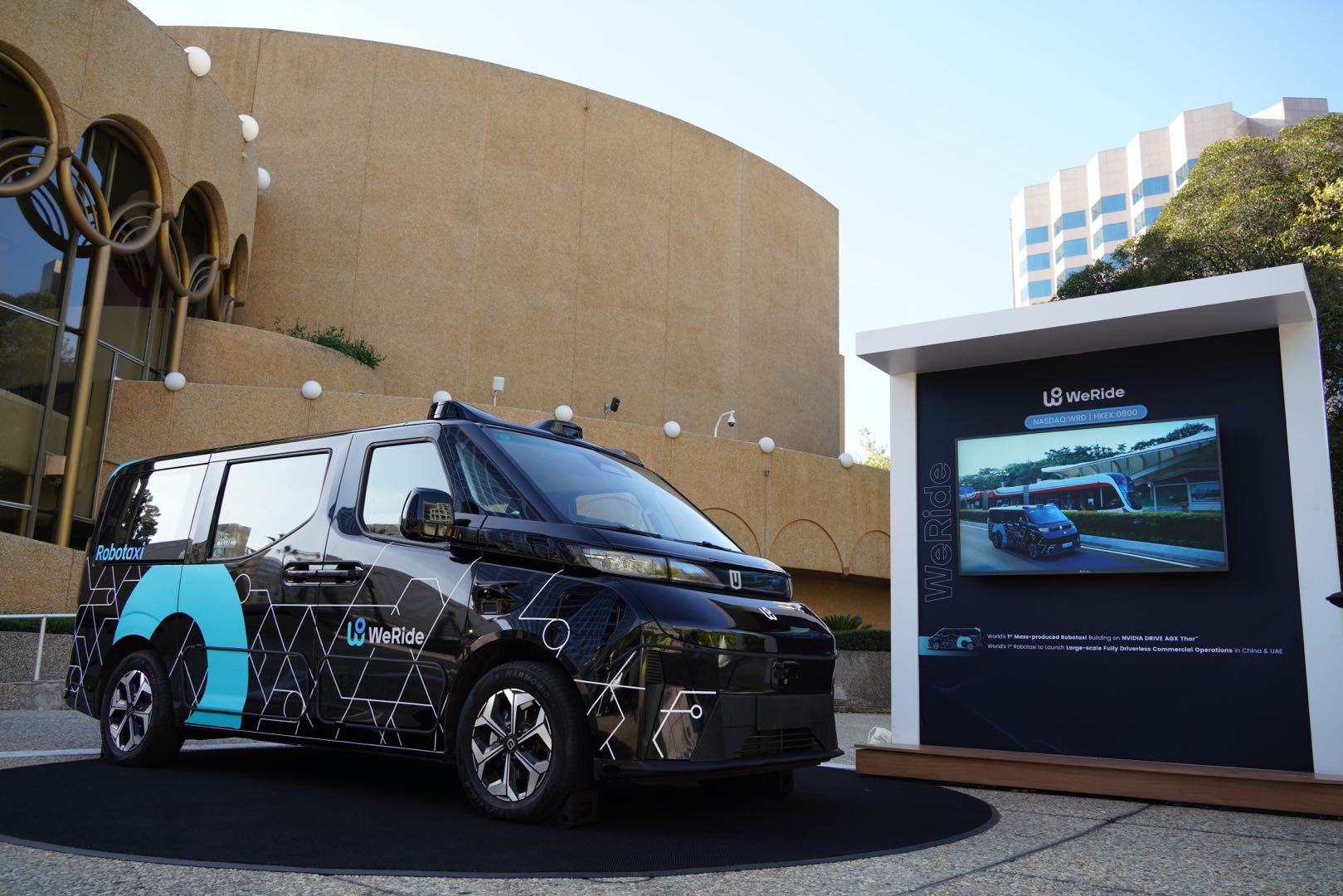
WeRide Robotaxi GXR at NVIDIA GTC 2026
Building on their previous commitment to deploy Robotaxis across Southeast Asia, WeRide and Grab have become the first in Singapore to launch AV trial operations in the Punggol district. Public service using WeRide’s vehicles is set to begin on April 1, 2026.
"Southeast Asia is a core growth market for WeRide’s Robotaxi business, where dense cities, progressive regulators, and strong partners like Grab enable scaled commercial operations. Our Robotaxi GXR is built for this reality. By utilizing the NVIDIA DRIVE Hyperion platform built on NVIDIA DRIVE AGX Thor within NVIDIA’s ecosystem, we can significantly reduce system costs while accelerating safe, reliable Level 4 Robotaxi operations across global markets," said Dr. Tony Han, Founder and CEO of WeRide.
"Together with WeRide, we are undertaking trial operations in Singapore to glean insights into how autonomous technology can best support local communities. The launch of the GXR showcases the cutting-edge capabilities our partnership can draw upon as we scale. We look forward to working closely with WeRide to integrate their latest technology into our regional roadmap as AV regulations and infrastructure mature across Southeast Asia," said Dominic Ong, General Manager of Autonomous at Grab.
“Autonomous vehicle developers need scalable computing platforms to support safe deployment across diverse operating environments,” said Rishi Dhall, vice president of automotive at NVIDIA. “By building on the NVIDIA DRIVE Hyperion platform, WeRide can accelerate the development and deployment of Level 4 autonomous vehicles while helping bring robotaxi services to more cities around the world.”
With a presence in over 40 cities across 11 countries, WeRide is the most internationally deployed autonomous driving company. This strong global footprint supports its plan to expand its active Robotaxi fleet to more than 2,600 Robotaxis this year and tens of thousands by 2030.
Manufactured by Geely’s Zhejiang Farizon New Energy Commercial Vehicle Group (Geely Farizon), the Robotaxi GXR is designed for continuous commercial operation and plays a central role in the WeRide ecosystem. Earlier this month, WeRide and Geely Farizon signed an agreement to deliver 2,000 upgraded purpose-built, mass-produced Robotaxi GXRs by 2026. With current hardware costs at approximately US
“Farizon highly recognizes WeRide as a global technology leader in L4 autonomous driving. The two parties will further deepen the cooperation to accelerate the factory-integrated mass production and deployment of the Robotaxi GXR, jointly opening a new chapter in the large-scale global commercialization of autonomous driving,” said Mike Fan, CEO of Farizon New Energy Commercial Vehicle Group.
WeRide will be exhibiting the Robotaxi GXR at booth #9007 during GTC 2026. In addition, WeRide’s Senior Vice President, Dr. Hua Zhong, will be delivering a talk covering how WeRide's end-to-end model enables the massive deployment from L2 to L4, powered by NVIDIA DRIVE AGX Orin and Thor.
About WeRide
WeRide is a global leader and a first mover in the autonomous driving industry, as well as the first publicly traded Robotaxi company. Our autonomous vehicles have been tested or operated in over 40 cities across 11 countries. We are also the first and only technology company whose products have received autonomous driving permits in eight markets: China, the UAE, Singapore, France, Switzerland, Saudi Arabia, Belgium, and the US. Empowered by the smart, versatile, cost-effective, and highly adaptable WeRide One platform, WeRide provides autonomous driving products and services from L2 to L4, addressing transportation needs in the mobility, logistics, and sanitation industries. WeRide was named to Fortune's 2025 Change the World and 2025 Future 50 lists.
Media Contact
pr@weride.ai
Safe Harbor Statement
This press release contains statements that may constitute “forward-looking” statements pursuant to the “safe harbor” provisions of the U.S. Private Securities Litigation Reform Act of 1995. These forward-looking statements can be identified by terminology such as “will,” “expects,” “anticipates,” “aims,” “future,” “intends,” “plans,” “believes,” “estimates,” “likely to,” and similar statements. Statements that are not historical facts, including statements about WeRide’s beliefs, plans, and expectations, are forward-looking statements. Forward-looking statements involve inherent risks and uncertainties. Further information regarding these and other risks is included in WeRide’s filings with the U.S. Securities and Exchange Commission and announcements on the website of the Hong Kong Stock Exchange. All information provided in this press release is as of the date of this press release. WeRide does not undertake any obligation to update any forward-looking statement, except as required under applicable law.
A photo accompanying this announcement is available at https://www.globenewswire.com/NewsRoom/AttachmentNg/4d918c3b-d0e6-4ee5-830d-23c2fdabb1ff

FAQ
AI-generated questions and answers. How Rhea-AI works. Not financial advice.