
34 Miles Out to Sea, Nowhere to Hide from the Sun: Tint World® and XPEL Team Up to Protect Historic Frying Pan Shoals Tower
An offshore eco-tourism tower becomes a showcase for XPEL window film performance in extreme, off-grid sun and heat conditions.




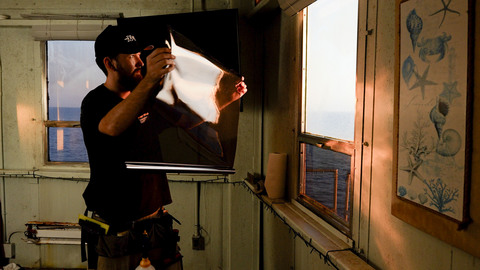
Tint World® Automotive Styling Centers™ and XPEL recently applied protective window film to the Frying Pan Shoals Tower, a decommissioned
Frying Pan Shoals Tower operates as a nonprofit eco-tourism destination, and the off-grid structure is exposed to constant, unfiltered Atlantic sun. Led by Tint World’s
"If we can tint this, we can tint anything,” has become something of an unofficial motto for the team since returning from the project.
Why an Offshore Tower Needed Window Film
Frying Pan Shoals Tower runs entirely off-grid, relying on battery and generator power for everything from lighting to climate control. With no shade, no landscaping, and near-constant sun exposure over open water, solar heat gain had become a constant drain on the structure's limited power supply. The newly installed window film blocks a significant amount of solar heat before it enters the building, which helps the tower's HVAC system work less to keep the space livable, and in turn helps conserve battery and generator power. For a facility that cannot simply plug into the grid, that efficiency gain matters.
"When consumers or, in this case, a nonprofit team, are trying to get more life and more value out of a structure they already have, window film is one of the most overlooked tools available," said Charles Bonfiglio, Founder and CEO of Tint World®. "This project is an intense example, but the principle is the same one we bring to every vehicle and building we work on: protect what you already have and make it perform better."
A Job That Tested More Than Skill
Getting the job done required more logistics than most installations Harman's team has tackled. Equipment, film, and crew had to travel by helicopter to reach the tower, and the work hours were squeezed into a narrow window shaped by ocean weather. There was no running to the supply store for a forgotten tool and no shade to escape the sun while working.
"Most people think of window tinting as something you do to a car in an afternoon," said Harman. "This job took days, a helicopter, and a lot of planning. But it is the same skill set and the same film technology, just applied somewhere nobody expects it."
Beyond the Ocean: Everyday Applications
While Frying Pan Shoals Tower is a notable case, the underlying benefits translate directly to homes, vehicles, boats, and businesses dealing with everyday sun exposure.
"Extreme environments are the best proof point for any film we make, and it doesn’t get much more extreme than an offshore tower with no shade for miles," said Lindsay Parks, XPEL’s North American Sales Manager - Architectural. "Our Dark Neutral
XPEL window film products are designed to:
-
Block
99% of harmful UV rays - Reduce solar heat gain and ease the load on HVAC and cooling systems
- Protect interiors, electronics, and furnishings from sun damage and fading
- Improve comfort in vehicles, homes, boats, and commercial spaces
- Support long-term preservation of structures and vehicles exposed to harsh conditions.
For more information on Tint World® and its automotive and residential window film services, please visit www.tintworld.com. For more information on XPEL, please visit www.xpel.com.
About Tint World® Automotive Styling Centers™
Founded in 1982, Tint World® Automotive Styling Centers™ is America's largest and fastest-growing automotive accessories and window tinting international franchise, specializing in window tinting, protective films, vehicle wraps, ceramic coatings, automotive electronics, and vehicle accessories. Tint World® Mobile Services™ includes Residential, Commercial, and Marine window tinting films, solar films, decorative films, safety and security films, and protective ceramic coatings. Tint World® has locations across
About XPEL
XPEL is a leading provider of protective films and coatings, including automotive paint protection film, surface protection film, automotive and architectural window films, and ceramic coatings. With a global footprint, a network of trained installers and proprietary DAP software, XPEL is dedicated to exceeding customer expectations by providing high-quality products, leading customer service, expert technical support and world-class training. XPEL, Inc. is publicly traded on Nasdaq under the symbol “XPEL”. To learn more, please visit https://www.xpel.com/.
View source version on businesswire.com: https://www.businesswire.com/news/home/20260910726878/en/
Media:
Tint World
Cole Koretos
ckoretos@franchiseelevator.com
XPEL
Steve Janisse
sjanisse@xpel.com
Alex Bentzlin
abentzlin@xpel.com
Source: XPEL, Inc.