
Drilling at Cat Creek Intersects a Copper-Molybdenum Porphyry System Visible Molybdenite-Chalcopyrite Over Significant Core Widths
The reported metal observations are preliminary; assays are needed to determine the grades of the drilled intervals.
Rhea-AI Summary
Solitario Resources (XPL) reported visible copper-molybdenum mineralization in its first two drill holes at Cat Creek in Colorado. The 100%-owned project yielded stronger visible mineralization in CC-002 than in CC-001. In CC-002, molybdenite was observed from 258.1 meters to the end of the 641.0-meter hole, mostly in trace amounts. It was more abundant from 371.8 to 584.5 meters. Visible chalcopyrite occurred locally across the lowest 110.5 meters, with disseminated material observed intermittently near the bottom.
CC-001 showed visible molybdenite from 250.5 to 280.5 meters and from 309.1 to 372.0 meters. No chalcopyrite was identified visually in that hole, though a handheld analyzer recorded copper concentrations of up to 500 ppm in its lower 100 meters. Laboratory grades are not yet available. Assay results are expected within two to three months.
Details
Market move: XPL +4.94% vs previous close. Cat Creek drill results
On Sep 28, the day this news came out, the latest delayed price for XPL is 4.94% above the previous close. The latest delayed price is $0.67.
Data tracked by StockTitan Argus (15 min delayed). Upgrade to Gold for real-time data.
Key Figures
- CC-002 molybdenite interval
- 382.9 m
- From 258.1 m downhole to the end of the hole at 641 m
- CC-002 chalcopyrite interval
- 110.5 m
- From 530.5 m downhole to the end of the hole at 641.0 m
- CC-002 matrix chalcopyrite interval
- 37.2 m
- Lower hole interval with abundant, well-developed, matrix-supported chalcopyrite intermittently observed
- CC-001 molybdenite interval
- 58 m
- From 314 m to 372 m, with increased visible molybdenite in the lower half
- Mo/quartz veinlet density
- Up to 12 per meter
- Among the four listed better molybdenite intervals in CC-002
- Assay results expected
- Two to three months
- Expected timing stated in the release
Historical Context
-
Reported one Cat Creek hole complete and a second underway before preliminary visual results.
24h Move is the share-price change in the day after each event; other market factors may also have contributed.
Key Terms
pxrf technical
molybdenite technical
chalcopyrite technical
fire assay technical
AI-generated analysis. How Rhea-AI works. Not financial advice.




DENVER, CO / ACCESS Newswire / September 28, 2026 / Solitario Resources Corp. ("Solitario") (NYSE American:XPL)(TSX:SLR) today announced preliminary visual results of its first two drill holes on its
Drill Hole CC-001 (Total Depth 415.5 m at an azimuth 340°-45° dip)
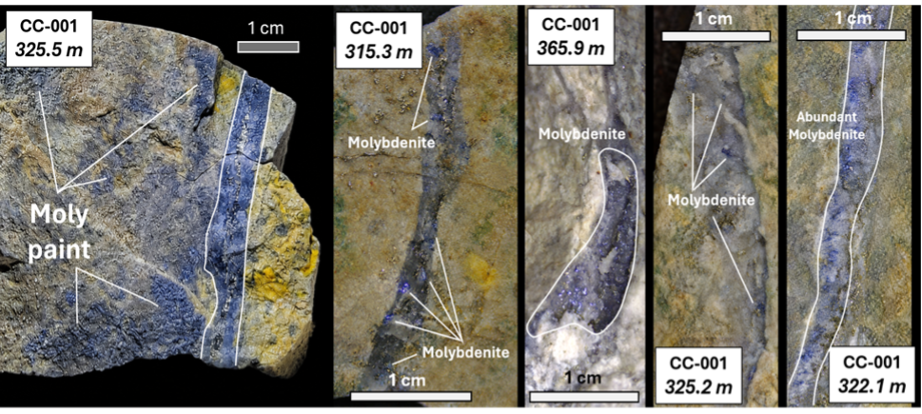
Based on preliminary core hole logging, CC-001 intersected visible molybdenite (MoS2) in two intervals. The first starting at 250.5 meters ("m") and continuing to 280.5 m, a core length of 30 m. Molybdenite occurred in trace amounts in this interval. The second interval, from 309.1 m to 372.0 m, had trace amounts of molybdenite in the upper half, but increased in abundance in the lower half (from 314 to 372 m) where visible molybdenite was associated with increased quartz vein densities. Within this 58-meter core interval, four intervals ranging from 2-12 m in length, contained up to 10 quartz veinlets per meter with increased concentrations of visible molybdenite.
The hole was terminated at 415.5 m in a post-mineral dike. Chalcopyrite was not identified visually, but pXRF analysis noted copper concentrations of up to 500 ppm in the lower 100 m of the hole. Core photos of better mineralized molybdenite intervals are provided below.
Drill Hole CC-002 (641.0 m at an azimuth 293°-65°dip)
CC-002 was drilled 286.5 m vertically deeper than CC-001 and intersected stronger visible molybdenite and chalcopyrite than in hole CC-001. Molybdenite was noted over a core length of 382.9 m, starting at 258.1 m downhole and continuing to the end of the hole at 641 m. Molybdenite content was noted as trace through much of this interval. However, more abundant molybdenite mineralization was intersected from 371.8 to 584.5 m. The following table lists the four best intervals:
| List of Better Molybdenite-Quartz Veinlet Intervals in CC-002 | |||
| Core Interval (meters) | Core Length | Number of Mo/Qtz Veins | |
| From | To | (meters) | per meter |
| 371.8 | 395.4 | 23.6 | 7 |
| 406.1 | 416.2 | 10.1 | 5 |
| 497.9 | 501.5 | 3.6 | 12 |
| 577.1 | 584.5 | 7.4 | 12 |
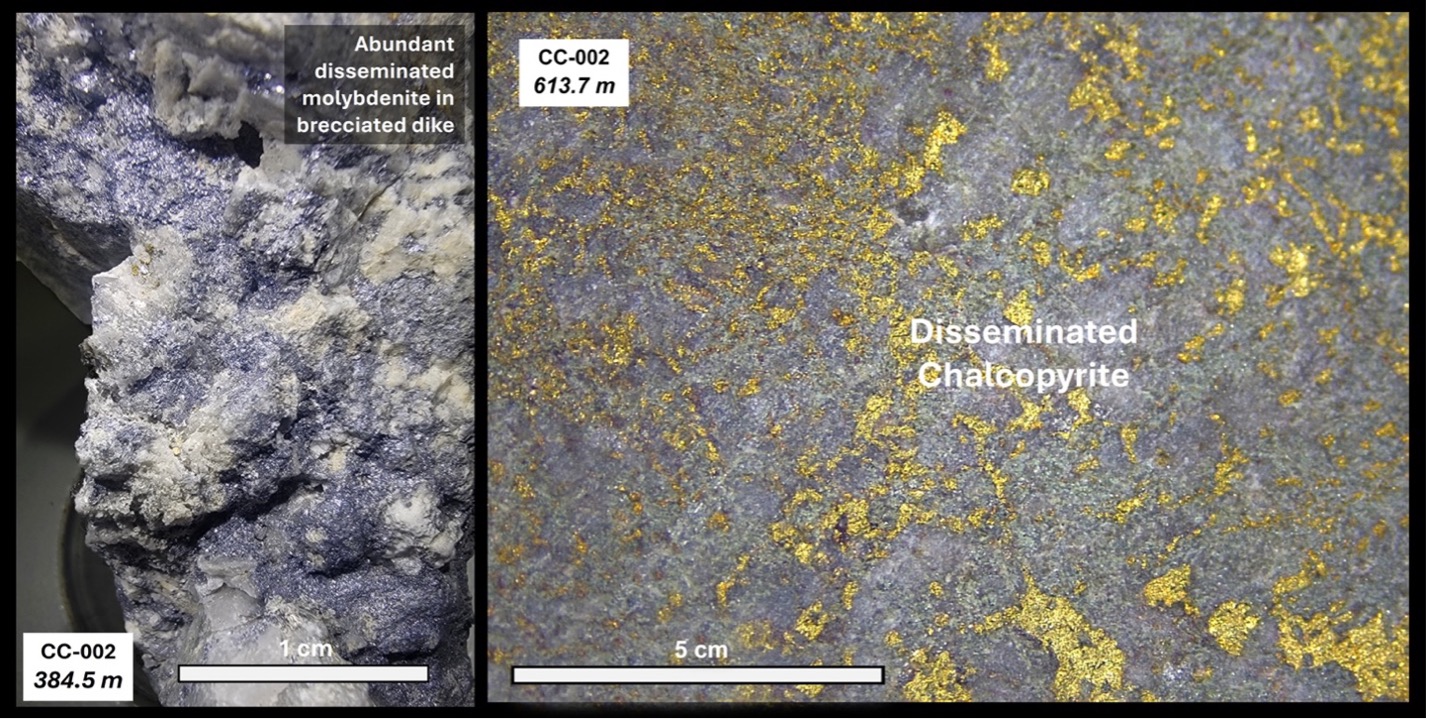
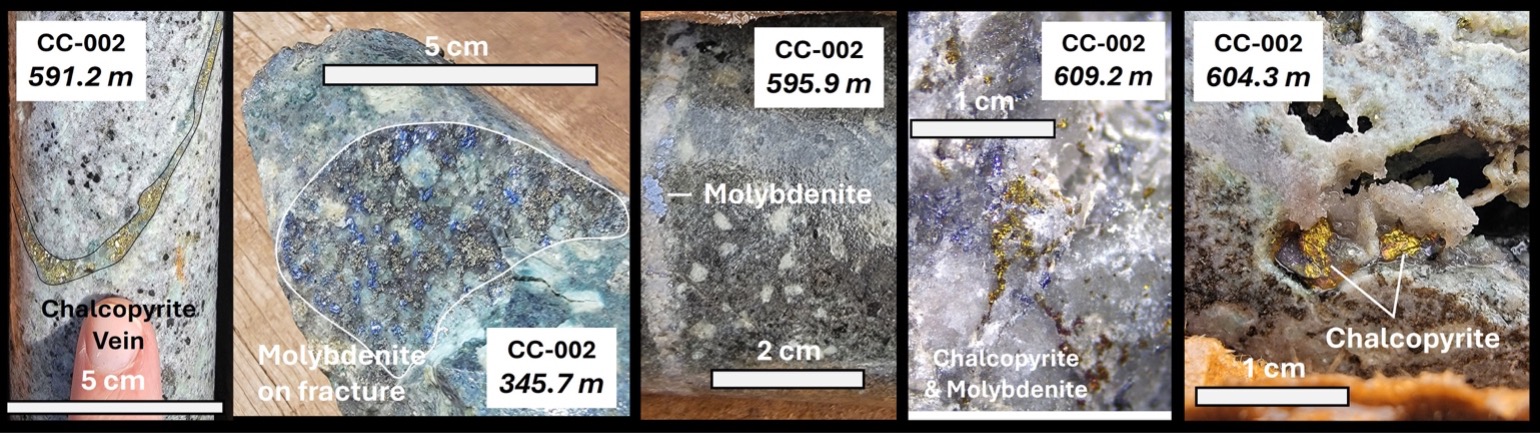
Importantly, visible chalcopyrite (CuFeS2) is locally present over a 110.5 m core interval in the lowest part of CC-002 from 530.5 m to the end of the hole at 641.0 m. In the lower 37.2 m of the hole, abundant, well-developed, matrix-supported, chalcopyrite was intermittently observed in intrusive breccia.
| Core Interval (meters) | Core Length | Chalcopyrite Form of | |
| From | To | (meters) | Occurrence |
| 530.5 | 573.5 | 43.0 | fracture coatings |
| 573.5 | 604.0 | 30.5 | fracture coatings & disseminated |
| 604.0 | 641.0 | 37.2 | strong disseminations in matrix |
Core photos from CC-002 of better mineralized intervals of visible molybdenite and chalcopyrite:
Chris Herald, President and CEO of Solitario, stated: "This is an outstanding start for Solitario at Cat Creek. Although we will not know the grade of the mineralized intervals until we receive assays, we do consider CC-001 and CC-002 to be potential discovery holes of a new copper-molybdenum porphyry system. This system is open to expansion and potentially improved grades, both at depth and along strike. We were surprised to see significant chalcopyrite in the lower part of hole CC-002 as we were expecting a molybdenum only porphyry system. The copper-molybdenum porphyry model is also supported by the presence of elevated rhenium values at surface.
CC-002 was drilled 286.5 m deeper than CC-001, consequently, we do not believe CC-001 was drilled deep enough to intersect the copper zone of this complex porphyry system. Alteration at the bottom CC-002 also suggests that it only penetrated the top of the copper porphyry mineralization as alteration appears to be transitioning from phyllic to potassic alteration. In other copper porphyry systems, the best copper values occur in and below the potassic alteration zone.
Many larger copper systems host significant amounts of molybdenum, both within the copper deposit and flanking the strongest parts of a copper porphyry. Consequently, we are planning to conduct a larger and more detailed Induced Polarization geophysical survey either later this fall or early next summer to help guide the next drilling campaign. Copper-molybdenum porphyry systems are also known to host rhenium and precious metals. Rhenium is one of the rarest metals on earth and an important critical metal for the defense and energy industries."
The Cat Creek Project was originally developed as a Colorado-style Climax/Henderson molybdenum target by Anaconda Copper (formerly one of the largest mining companies in the world). Anaconda conducted significant surface exploration, including detailed geologic mapping, geochemical sampling and a limited Induced Polarization ("IP") geophysical survey. The project was slated for drilling in mid-1983, but due to the sale of Anaconda by its parent, Atlantic Richfield (ARCO), all company-wide exploration activities were shut down in early 1983. The property was never drill tested and no further exploration activities were subsequently conducted on the property.
Cat Creek core samples for CC-001 have been split and recently sent to the laboratory for analysis. CC-002 core samples are just now starting to be processed. Assay results are expected within two to three months.
Sample Type, Sampling Methodology, Chain of Custody, Quality Control and Assurance
Cat Creek exploration core samples are being prepared and analyzed, at ALS Global, in Reno, Nevada, which is independent from Solitario. Thorough QA/QC protocols are followed on the Project, including insertion of duplicate, blank and standard samples in the assay stream for all drill holes. The samples are collected directly from the drill rig, logged, photographed, split into two samples, and half of each sample submitted directly to American Assay Labs through secure chain of custody protocols. All activities prior to shipment are directly supervised by Solitario geologists. Samples are pulverized from a 250g sample to
Qualified Person
The scientific and technical information contained in this news release has been reviewed and approved by Sandor Ringhoffer, CPG, SME RM, a geologic consultant of Solitario, who is a qualified person as defined by NI 43-101, Standards of Disclosure for Mineral Projects.
About Solitario
Solitario is a natural resource exploration company focused on high-potential Tier-1 gold, copper, zinc and critical metals (molybdenum and rhenium) projects.
In addition to its Cat Creek project, Solitario holds a
Solitario also has a
The Company is traded on the NYSE American ("XPL") and on the Toronto Stock Exchange ("SLR"). Solitario's Management and Directors hold approximately
Solitario has a long history of committed Environmental, Social and Responsible Governance ("ESG") of its business. We realize ESG issues are also important to investors, employees, and all stakeholders, including communities in which we work. We are committed to conducting our business in a manner that supports positive environmental and social initiatives and responsible corporate governance. Importantly, we work with joint venture partners that not only value the importance of ESG issues in the conduct of their business on our joint venture projects but are leaders in the industry in this important segment of our business.
For More Information Please Contact:
Chris Herald, President and CEO
Solitario Resources Corp.
Tel. 303-534-1030 ext. 1
Cautionary Statement Regarding Forward Looking Information
This press release contains forward-looking statements within the meaning of the U.S. Securities Act of 1933 and the U.S. Securities Exchange Act of 1934, and as defined in the United States Private Securities Litigation Reform Act of 1995 (and the equivalent under Canadian securities laws),that are intended to be covered by the safe harbor created by such sections. Forward-looking statements are statements that are not historical facts. They are based on the beliefs, estimates and opinions of the Company's management on the date the statements are made and address activities, events or developments that Solitario expects or anticipates will or may occur in the future, and are based on current expectations and assumptions. Forward-looking statements involve numerous risks and uncertainties. Consequently, there can be no assurances that such statements will prove to be accurate and actual results and future events could differ materially from those anticipated in such statements. The existence of historic mines and resources adjacent to Solitario's land positions or the similarity of Solitario's geology to other known mineral deposits, do not necessarily support the existence of economic mineral deposits on Solitario's land position. Such forward-looking statements include, without limitation, statements regarding the Company's expectation of the projected timing and outcome of engineering studies; expectations regarding the receipt of all necessary permits and approvals to implement a mining plan, if any, at any of its mineral properties. Important factors that could cause actual results to differ materially from those in the forward-looking statements include, among others, risks relating to risks that Solitario's and its joint venture partners' exploration and property advancement efforts will not be successful; risks relating to fluctuations in the price of zinc, gold, lead and silver; the inherently hazardous nature of mining-related activities; uncertainties concerning reserve and resource estimates; availability of outside contractors, and other activities; uncertainties relating to obtaining approvals and permits from governmental regulatory authorities; the possibility that environmental laws and regulations will change over time and become even more restrictive; and availability and timing of capital for financing the Company's exploration and development activities, including uncertainty of being able to raise capital on favorable terms or at all; risks relating to the impacts of pandemics or similar epidemics; as well as those factors discussed in Solitario's filings with the U.S. Securities and Exchange Commission (the "SEC") including Solitario's latest Annual Report on Form 10-K and its other SEC filings (and Canadian filings) including, without limitation, its latest Quarterly Report on Form 10-Q. The Company does not intend to publicly update any forward-looking statements, whether as a result of new information, future events, or otherwise, except as may be required under applicable securities laws.
SOURCE: Solitario Resources Corp.
View the original press release on ACCESS Newswire
FAQ
AI-generated questions and answers. How Rhea-AI works. Not financial advice.
What did Solitario Resources find in drill hole CC-002 at Cat Creek?
CC-002 showed visible molybdenite from 258.1 meters to the end of the 641.0-meter hole and local visible chalcopyrite across its lowest 110.5 meters. Molybdenite was mostly present in trace amounts, with more abundant material from 371.8 to 584.5 meters. Laboratory grades are not yet available.
When are Solitario Resources’ Cat Creek drill assays expected?
Assay results for the Cat Creek drilling are expected within two to three months. CC-001 core samples have been split and sent for analysis, while processing of CC-002 core samples is starting.
What further exploration does Solitario Resources plan at Cat Creek?
Solitario plans a larger, more detailed induced polarization geophysical survey either later this fall or early next summer. The company said the survey, which measures electrical properties underground, would help guide its next drilling campaign.