
York Space Systems Expands into GEO to Support Space Domain Awareness Missions
York owns the full scope of spacecraft design, sensor integration and mission execution for Tetra 3 and 4.
Sentiment and the balance of points
Rhea-AI Sentiment reads the wording of the document, how positive or negative its language is on a 1 to 5 scale. The balance of points shown with the takes weighs what the document actually discloses, so the two can disagree, for example when a trial that missed its main goal is described in upbeat language.




Tetra 3 and 4 missions clear Delta CDR; on track for Q4 spacecraft delivery
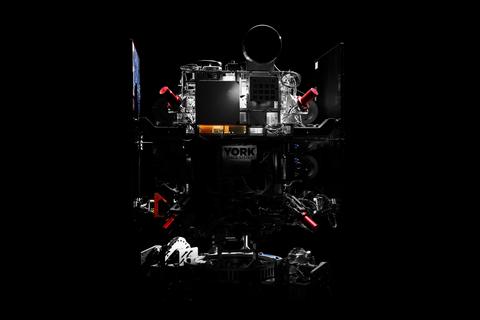
Nemesis extends York's prime integration model into GEO in support of SDA, adding a ninth unique mission set to the company’s broader portfolio of national defense capabilities. Across its portfolio, York supports missions ranging from assured communications and Synthetic Aperture Radar (SAR) to tactical warfighter support.
"Nemesis shows York can prime, integrate, and deliver against any mission our customers put in front of us, at any orbit," said Michael Lajczok, CTO of York. "That kind of range is what the national security community is asking from industry, and it's where the market is moving."
As prime contractor, York owns the full scope of spacecraft design, sensor integration, and mission execution. Under Tetra 3 and 4, York is integrating a full suite of mission sensors and Government Furnished Equipment (GFE) to execute realistic on-orbit threat presentation, independent range data collection, small satellite technology risk reduction, and experimental payload hosting. Integrated payloads include a Long Wave Infrared (LWIR) camera, a Light Detection and Ranging (LiDAR) sensor capable of ranging resident space objects at 20 kilometers, and a GEO-qualified Global Positioning System (GPS) Side Lobe Receiver.
The dCDR covered the addition of a new propulsion system required for full mission capability. York accommodated it under an accelerated schedule with no structural, thermal, or power impacts to the space vehicle, no impact to launch vehicle integration, and only minor harness and flight software updates.
"Absorbing a late-stage design change of this scope without cascading impacts is a defining requirement for prime integrators supporting national security missions," said Marc Cordova, VP of Programs at York. "Folding a new propulsion system into the baseline and clearing delta CDR on an accelerated schedule is a direct reflection of how York is architected to execute."
Tetra 3 and 4 will demonstrate capabilities that map directly to the priorities driving next-generation national security space architectures: rapid delivery, prime-level integration of complex sensor suites, and mission execution across orbital regimes. The Department of War (DoW) has signaled increased interest in SDA capabilities extending beyond low earth orbit (LEO) into medium earth orbit (MEO) and GEO. In that environment, the ability to field prime-integrated small satellite missions on accelerated timelines is becoming a defining requirement for industry partners and Tetra 3 and 4 positions York among the small number of providers demonstrating that capability at the prime level today, aligned with the SDA-focused programs shaping the DoW’s next-generation architecture priorities.
About York Space Systems
York Space Systems (NYSE: YSS) is a leading, U.S.-based national defense and commercial prime providing a comprehensive suite of mission-critical solutions for national security, government, and commercial customers. York is one of the only space and defense primes with proprietary hardware and software capabilities designed to address customers’ complex mission requirements across the critical elements of the entire space ecosystem throughout the mission lifecycle. York is purpose built to address evolving national security space challenges and to adapt to the ongoing shift in the U.S. government’s mission needs and procurement processes.
Forward-Looking Statements
This press release contains “forward-looking statements” within the meaning of, and we intend such forward-looking statements to be covered by, the safe harbor provisions of the Private Securities Litigation Reform Act of 1995. Forward-looking statements are inherently subject to risks and uncertainties, some of which cannot be predicted or quantified. In some cases, you can identify forward-looking statements by terminology such as “anticipate,” “believe,” “could,” “emerging,” “expand,” “expect,” “feasibility,” “intend,” “may,” “objective,” “plan,” “potential,” “should,” “will,” “would,” or the negative of these terms or other comparable terminology. In particular, statements about the use and execution of our production lot, the health of our spacecraft, our growing participation in next-generation space architectures and expanding mission areas, trends in commercial and government customer demand for specific technologies or mission types, our customers’ plans, and our expectations, beliefs, plans, strategies, objectives, prospects, assumptions, or future events or performance contained in this press release are forward-looking statements.
Factors that could cause actual results to differ materially from those expressed or implied by the forward-looking statements include: any failure of our spacecraft systems and related software to operate as intended, resulting in claims for product failures, schedule delays or other problems with existing or new products; significant competition in the global space and satellite market; our failure to establish and maintain important relationships with government agencies and prime contractors; the scarcity or unavailability of critical components used to manufacture our products or used in our development programs; disruptions in U.S. government operations and funding and budgetary priorities of the U.S. government; the inability to comply with any of our contracts or meet eligibility requirements to obtain certain government contracts; and the other factors set forth in our filings with the Securities and Exchange Commission. You should not place undue reliance on these forward-looking statements, which speak only as of the date stated, or if no date is stated, as of the date of this press release. We undertake no intent or obligation to publicly update or revise any of the estimates and other forward-looking statements made in this press release, whether as a result of new information, future events or otherwise, except as required by law.
References and links to websites have been provided as a convenience, and the information contained on such websites is not incorporated by reference into this press release. York is not responsible for the content of third-party websites.
View source version on businesswire.com: https://www.businesswire.com/news/home/20261005989692/en/
Media Contact
Sarah Nickell
Sarah.nickell@yorkspacesystems.com
Investor contact
Christopher Evenden
ir@yorkspacesystems.com
Source: York Space Systems