
STOCK TITAN

Rent or buy? How long it takes for buying a home to pay off in each metro

(Neutral)
(Neutral)
Tags

Zillow (NASDAQ:Z) released a 2026 Rent vs. Buy analysis showing the typical U.S. buyer breaks even versus renting in about six years, improved from 8.4 years in 2023.

Break-even times range from about four years in several Midwest/South metros to never in markets like San Francisco, San Jose and New Orleans, where renting stays ahead over 30 years. The study also highlights how mortgage rates, local price-to-rent gaps and down payment size shape outcomes, and promotes tools such as Zillow’s Rent vs. Buy Calculator, BuyAbility and CreditClimb.

Loading...
Loading translation...

Positive

  • None.

Negative

  • None.

News Market Reaction – ZG

+1.10%
3 alerts
+1.10% Session close to close
$8.49B Market Cap
0.0x Rel. Volume

In the Jun 4 session, ZG gained 1.10%, reflecting a mild positive market reaction. Our momentum scanner triggered 3 alerts that day, indicating moderate trading interest and price volatility.

Data tracked by StockTitan Argus on the day of publication.

Market Context

This announcement details Zillow’s latest rent-vs.-buy analysis, showing a national breakeven of 6 y...
Analysis

This announcement details Zillow’s latest rent-vs.-buy analysis, showing a national breakeven of 6 years, down from 8.4 years, with wide variation across metros. It reinforces Zillow’s positioning as a housing data and tools provider rather than signaling a strategic shift. In the past six months, similar market reports have led to only modest price moves. Investors may watch how such research supports engagement with products like the Rent vs. Buy Calculator and other homebuying tools.

Key Figures

National breakeven: 6 years Prior peak breakeven: 8.4 years Shortest breakeven: 4 years +5 more
8 metrics
National breakeven 6 years Typical buyer vs. renting, U.S. average
Prior peak breakeven 8.4 years National breakeven peak in October 2023
Shortest breakeven 4 years Markets like Columbus, Memphis and Buffalo
Analysis horizon 30 years Duration of fixed-rate mortgage used in model
U.S. table breakeven 6.0 years United States row in breakeven table
Cincinnati 5% vs 20% 5% and 20% Down payment comparison in Cincinnati example
Rate drop scenario 1% drop Impact on making buying realistic for more households
Rate rise scenario 1% rise Could move conditions back toward 2023–24 difficulty

Historical Context

5 past events · Latest: May 27 (Neutral)
Pattern 5 events
Date Event Sentiment 24h Move Catalyst
May 27 Rental concessions data Neutral +0.4% Update on rental concessions and vacancy trends across U.S. markets.
May 21 Home sales rebound Neutral +0.9% Report on sales growth where housing inventory has recovered.
May 18 Hot rental markets Neutral -1.2% Ranked Providence and other metros by rental market strength.
May 15 Seller survey results Neutral +0.5% Survey on seller preferences and Zillow’s Preview product exposure.
May 14 Dual agency costs Neutral -2.6% Research quantifying dollar impact of same-agent and off-MLS sales.

24h Move is the share-price change in the day after each event; other market factors may also have contributed.

Pattern Detected

Recent Zillow data releases have typically produced modest single-day moves, with no consistent positive or negative pattern.

Recent Company History

Over the past several weeks, Zillow has issued a series of housing and rental market research updates. Topics ranged from rising rental concessions, a rebound in home sales where inventory has recovered, and ranking Providence as a leading rental market, to seller-focused survey work and dual-agency cost research. One-day price reactions to these news items were modest, between about -2.62% and 0.89%. Today’s rent-vs.-buy breakeven analysis fits this pattern of data-heavy, sector-insight releases rather than company-specific strategic shifts.

Key Terms

30-year fixed-rate mortgage, renters insurance, down payment, mortgage interest deduction, +2 more
6 terms
30-year fixed-rate mortgage financial
"Zillow's analysis looked at what happens over the duration of a 30-year fixed-rate mortgage"
A 30-year fixed-rate mortgage is a home loan repaid over 30 years with the same interest rate and roughly the same monthly payment throughout the term, so borrowers know exactly what they will pay each month. It matters to investors because these loans form large pools of predictable cash flows that influence housing demand, bank balance sheets and bond-like investments; changes in these rates shift borrowing costs, consumer spending and the value of related securities, similar to a long-term fixed subscription that locks in price risk.
renters insurance financial
"For renters, the model factors in monthly rent and renters insurance"
A renters insurance policy is a contract that protects people who rent homes by covering their personal belongings, paying some living costs if the place becomes uninhabitable, and handling legal claims if a guest is injured—think of it as a safety net for your stuff and short-term bills. Investors watch renters insurance because the number of policies sold, claim costs and premium levels affect insurance company profits, property owners’ risk exposure and consumer spending patterns, all of which influence financial results.
down payment financial
"cash that wasn't spent on a down payment"
An initial upfront payment made by a buyer when purchasing a high-cost item—like a house, car, or large service—intended to cover part of the total price and reduce the amount financed. Think of it as a security deposit that shows commitment and lowers the lender’s risk; larger down payments typically mean smaller loans, lower monthly payments, and less chance of default. For investors, average down payment sizes signal buyers’ financial health, influence a lender’s credit exposure, and affect short‑term cash flow and long‑term demand in financing‑dependent markets.
mortgage interest deduction financial
"Tax benefits, including potential mortgage interest deduction, which are not included"
A mortgage interest deduction lets a homeowner subtract the interest paid on a home loan from their taxable income, which lowers the amount of tax they owe. For investors, it matters because the deduction changes homeowners’ after‑tax cash flow and can affect housing demand, mortgage lending, and the profitability of real estate-related companies; think of it like a routine discount that makes carrying a mortgage cheaper for many buyers.
down payment assistance programs financial
"Zillow shows buyers available down payment assistance programs on for-sale listings"
Down payment assistance programs provide funds—often as grants, low‑interest loans, or forgivable aid—from governments, nonprofits or employers to help buyers cover the upfront cash needed to buy a home. They matter to investors because they can expand the pool of potential homebuyers and influence housing demand, home prices and the credit quality of mortgages and securities, much like a coupon or starter loan that helps more people qualify for a purchase.
mortgage rates financial
"Mortgage rates are one of the most powerful levers in the rent-vs.-buy equation"
Mortgage rates are the interest percentages lenders charge when people borrow money to buy a home or refinance an existing loan. They determine how much borrowers pay each month and over the life of the loan — like the added cost on top of a car’s sticker price — and influence housing demand, consumer spending, and bank profitability, so investors watch them as a bellwether for the broader economy and financial markets.

AI-generated analysis. How Rhea-AI works. Not financial advice.

See more from StockTitan in Google Search and AI answers. Adds StockTitan as a preferred source · opens Google
Add on Google

New Zillow data shows buyers break even in six years nationally, but the timeline ranges from four years to never, depending on where you live 

  • Conditions for buyers have improved, shortening the national breakeven point to six years from a peak of 8.4 years in 2023. 
  • Buyers break even in as little as four years in Columbus, Memphis and Buffalo. In San Francisco, San Jose and New Orleans, today's prices and rents leave renting ahead even over 30 years. 
  • The decision to rent or buy is as much a lifestyle choice as a financial decision.
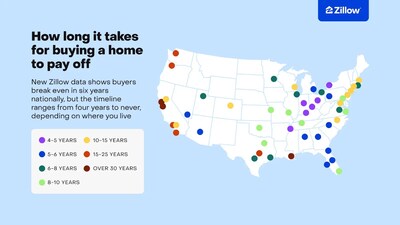
SEATTLE, June 4, 2026 /PRNewswire/ -- The answer to "Should I rent or buy?" depends almost entirely on where you live and how long you plan to stay. According to a new Zillow® Rent vs. Buy analysis, the typical home buyer breaks even relative to renting in about six years nationally, down from a peak of 8.4 years in October 2023. In affordable Midwest cities like Columbus and Indianapolis, that window shrinks to just four years. In high-cost coastal markets like San Francisco and San Jose, buying never surpasses renting over a full 30-year horizon. 

"For generations, Americans have been told that buying a home is the smartest financial move they'll ever make. This analysis finds the truth is more complicated," said Orphe Divounguy, senior economist at Zillow. "This research shows that both renting and buying can be smart decisions, just in different cities. The good news is that for buyers who are ready, conditions today are the most favorable they've been in years. But the ZIP code you choose may matter more than any other financial decision you make."

How the analysis works

Zillow's analysis looked at what happens over the duration of a 30-year fixed-rate mortgage when a typical household buys, versus rents, a home in each of the 50 largest U.S. metro areas. For buyers, the model accounts for all the direct costs of ownership including mortgage payments, property taxes, insurance, maintenance and closing costs. For renters, the model factors in monthly rent and renters insurance, plus the return on cash that wasn't spent on a down payment. 

Where buying pays off sooner

In the Midwest and parts of the South, the case for buying is clear. Columbus leads the country with a four-year break-even horizon. Memphis, Buffalo, Indianapolis, Cincinnati and Louisville follow, with buyers coming out ahead in less than five years.

In these markets, the relationship between home prices and rents is relatively balanced. The monthly cost of owning isn't dramatically higher than renting, so buyers don't have a big financial hole to dig out of at the start. Add in steady home value appreciation and you have a market where ownership starts paying off quickly. 

Where renting makes financial sense

In San Francisco, San Jose and New Orleans, renting holds the financial advantage throughout the entire 30-year time horizon. In Seattle, Austin, Los Angeles, San Diego and Portland, buying can eventually win, but only after 16–23 years.

The one thing these markets have in common is a wide gap between what it costs to own and what it costs to rent. That gap can be the result of high home prices, high insurance premiums or weak home value appreciation, and it may never close, even after decades. 

Making the choice

Buying is not automatically a bad deal in expensive markets, but it often becomes a long-term decision that can't be treated as purely financial. Buyers still benefit from:

  • Building equity and long-term wealth
  • A stable, predictable monthly payment
  • The ability to customize their space and put down roots in a community
  • Tax benefits, including potential mortgage interest deduction, which are not included in this analysis

Renting, meanwhile, offers its own set of lifestyle benefits, including: 

  • No maintenance or repair costs
  • Cash liquidity for other investments 
  • Greater financial flexibility
  • Ability to move when life calls for it

"The rent-versus-buy decision in 2026 is as much of a lifestyle decision as a financial one," said Amanda Pendleton, Zillow's home trends expert. "Do you want a backyard garden and a menagerie of pets? Or do you want to skip yard work entirely and have the flexibility to move on a whim? These types of lifestyle questions are as important as whether or not the math works in your favor."   

The rent-or-buy bottom line

Buy if: You plan to stay more than six years (nationally), your metro has a short break-even horizon, or you value stability and building equity.

Rent if: You might move in less than six years, you're in an expensive coastal market, or you want financial flexibility and liquidity.

To better understand what's right for you, Zillow's Rent vs. Buy Calculator is a great starting point that takes your personal finances into account. 

Busting the down payment myth

Conventional wisdom says to put down as much as you can, but this research suggests otherwise. A larger down payment means a smaller loan, lower monthly payments and less interest paid over time. That sounds like a clear win, but it ignores what happens to the money you don't put into the home. Cash held back from a down payment can be invested and, over time, those investment returns can outpace the savings from borrowing less. 

In Cincinnati, for example, a buyer who puts down just 5% breaks even about six months sooner than one who puts down 20%. The math works because the stock market returns on the extra cash outweigh the mortgage cost savings from a larger down payment, especially in a market where home values are rising steadily and rents are relatively high. 

The reverse is also true. In markets where owning is significantly more expensive than renting month to month, a larger down payment reduces that gap and becomes more valuable. The "right" down payment isn't always 20%. It's a function of your local market, your mortgage rate and what you'd realistically do with the money you keep.

The impact of mortgage rates

Mortgage rates are one of the most powerful levers in the rent-vs.-buy equation. The current six-year national breakeven sits at an inflection point: a rate drop of 1% could unlock buying as a realistic option for millions of additional households, while a 1% rise could push conditions back toward the difficulty of 2023–24.

Renters who want to become buyers have valuable digital tools to help them reach homeownership. When mortgage rates fluctuate, Zillow's BuyAbilitySM accounts for a buyer's personal rate scenario to help them understand what they can afford in real time. CreditClimb helps renters become buyers by using rent payments to build credit. And Zillow shows buyers available down payment assistance programs on for-sale listings. 

Breakeven points across major U.S. metros

Metro

Buying break-even point in years

United States

6.0

Columbus, OH

4.1

Memphis, TN

4.2

Buffalo, NY

4.2

Indianapolis, IN

4.3

Cincinnati, OH

4.6

Louisville, KY

4.8

Birmingham, AL

5.1

Detroit, MI

5.2

Las Vegas, NV

5.2

Pittsburgh, PA

5.3

Orlando, FL

5.4

Jacksonville, FL

5.4

Atlanta, GA

5.5

Tampa, FL

5.6

Phoenix, AZ

5.8

Charlotte, NC

5.9

Cleveland, OH

6.1

Houston, TX

6.3

Richmond, VA

6.4

Chicago, IL

6.5

Salt Lake City, UT

6.8

San Antonio, TX

7.7

Minneapolis, MN

7.8

Providence, RI

7.8

Kansas City, MO

8.5

Nashville, TN

8.8

Oklahoma City, OK

8.9

Miami, FL

9.0

Virginia Beach, VA

9.5

Dallas, TX

9.6

St. Louis, MO

9.8

Baltimore, MD

9.8

Milwaukee, WI

10.1

Philadelphia, PA

10.2

Denver, CO

10.2

Raleigh, NC

10.3

Riverside, CA

10.5

Washington, DC

12.0

New York, NY

12.5

Hartford, CT

13.7

Sacramento, CA

13.8

Boston, MA

13.9

Portland, OR

16.7

Los Angeles, CA

17.1

Austin, TX

18.4

Seattle, WA

19.7

San Diego, CA

23.3

San Francisco, CA

Renting beats buying over 30 years

San Jose, CA

Renting beats buying over 30 years

New Orleans, LA

Renting beats buying over 30 years

About Zillow Group

Zillow Group, Inc. (Nasdaq: Z and ZG) is reimagining real estate to make home a reality for more and more people. 

As the most visited real estate app and website in the United States, Zillow connects hundreds of millions of consumers with innovative technology, trusted agents and loan officers, and seamless digital solutions. With industry-leading tools and resources, Zillow supercharges real estate professionals so they can grow their businesses and deliver exceptional client experiences. For renters and housing providers, Zillow offers not only a robust marketplace but a set of end-to-end products and services to streamline applications, leases, payments and more. 

Zillow's ecosystem spans the entire home journey — from dreaming and shopping to renting, buying, selling and financing.

Zillow Group's affiliates, subsidiaries and brands include Zillow®, Zillow Premier Agent®, Zillow Home Loans®, Zillow Rentals®, Zillow® New Construction, Trulia®, StreetEasy®, Out East®, HotPads®, Follow Up Boss®, ShowingTime®, dotloop® and Zillow® Closing.

All marks herein are owned by MFTB Holdco, Inc., a Zillow affiliate. Zillow Home Loans, LLC is an Equal Housing Lender, NMLS #10287 (www.nmlsconsumeraccess.org). © 2026 MFTB Holdco, Inc., a Zillow affiliate.

(ZFIN)

Cision View original content to download multimedia:https://www.prnewswire.com/news-releases/rent-or-buy-how-long-it-takes-for-buying-a-home-to-pay-off-in-each-metro-302790430.html

SOURCE Zillow Group, Inc.

FAQ

What is the 2026 national rent versus buy breakeven point in Zillow’s (NASDAQ:Z) analysis?

According to Zillow, the typical U.S. homebuyer breaks even versus renting in about six years nationally. This is an improvement from a peak of 8.4 years in October 2023, reflecting somewhat better conditions for buyers in 2026.

Which metros have the fastest homebuying breakeven times in Zillow’s 2026 report for Z stock investors?

According to Zillow, Columbus has the shortest breakeven at about 4.1 years, with Memphis and Buffalo close behind. Several Midwest and Southern metros, including Indianapolis, Cincinnati and Louisville, see buyers come out ahead in under five years because ownership costs are closer to local rents.

Where does renting beat buying over 30 years in Zillow’s June 2026 rent versus buy study (Z)?

According to Zillow, renting stays financially ahead for at least 30 years in San Francisco, San Jose and New Orleans. In these markets, large gaps between ownership costs and rents, driven by prices, insurance or weak appreciation, prevent buying from overtaking renting even over decades.

How do mortgage rate changes affect the rent versus buy breakeven in Zillow’s 2026 analysis?

Zillow notes that mortgage rates are a powerful lever in the rent-versus-buy equation. A 1% rate drop from current levels could make buying realistic for millions more households, while a 1% increase could push conditions back toward the difficulty seen in 2023–2024.

What does Zillow’s 2026 research say about the ideal down payment size for homebuyers?

According to Zillow, the “right” down payment is not always 20% and depends on market and investor behavior. In some markets, keeping cash invested can help a 5% down buyer break even faster, while in high cost-to-own areas a larger down payment can narrow monthly cost gaps.

How can Zillow tools like the Rent vs. Buy Calculator, BuyAbility and CreditClimb help renters become buyers?

Zillow’s tools help renters evaluate when buying makes sense and how much they can afford. The Rent vs. Buy Calculator incorporates personal finances, BuyAbility reflects individual mortgage rate scenarios, and CreditClimb uses rent payments to build credit, while listings highlight available down payment assistance programs.

In which metros does buying take more than 15 years to beat renting, according to Zillow’s 2026 data?

According to Zillow, buying takes 16–23 years to surpass renting in Seattle, Austin, Los Angeles, San Diego and Portland. These markets share large gaps between ownership and rental costs, so buyers often need very long horizons before homeownership becomes financially advantageous.
