
What Happens to Your Shares When a Company Files for Bankruptcy


When a company files for bankruptcy, you still own your shares and they may keep trading. In Chapter 11, the plan the court confirms decides how they are treated. Of 37 recent filers with US-traded shares in our review, 19 had a plan take effect, and the existing shares were cancelled at all 19.
The short answer. A bankruptcy filing does not by itself cancel anyone’s shares, and the stock may go on trading for a while. The law generally pays creditors before owners, so a reorganization plan often cancels the existing stock and gives any new shares to creditors. Below we walk through each step from the official sources, with our recent review as brief context.
Our review of recent bankruptcy plans
On this page
- What happens to my shares when a company files for bankruptcy?
- Can you still sell a stock after the company files for bankruptcy?
- Do shareholders get anything in bankruptcy?
- Who gets paid first in bankruptcy?
- How to find what the bankruptcy plan gives shareholders
- Does the same ticker mean my old shares survived bankruptcy?
- Chapter 11 vs Chapter 7 for shareholders
- How long does Chapter 11 take?
- What letters and calls do shareholders get after a bankruptcy filing?
- What happens to worthless stock on your taxes?
- How we counted
- Frequently asked questions
What happens to my shares when a company files for bankruptcy?
Filing alone does not automatically cancel your shares. You still own them, and in general the case does not put your personal assets at risk beyond your investment in the shares, according to the courts’ guide. In Chapter 11, the plan that takes effect determines how existing shares are treated, and the timing varies.
A filing opens a court case, and in Chapter 11 the company usually keeps running its business while the case lasts. The company stays “in possession” and may borrow new money with the court’s approval, as the federal courts’ guide to Chapter 11 puts it. The same guide says a corporation’s case “does not put the personal assets of the stockholders at risk other than the value of their investment in the company’s stock.”
It also matters who filed. A corporation exists separately from its owners, and a large group is often made of many companies. When only a subsidiary files, the parent’s shares are not the shares in that case.
The central document is the plan of reorganization. It sorts claims and interests into classes and says how each class is treated. Creditors in classes whose rights the plan changes generally vote on it, usually after a disclosure statement explains the plan. Shareholders form a class too, and the SEC says they may be asked to vote, with a disclosure statement and a ballot (SEC Investor Bulletin, 2015).
A class that receives nothing under a plan is treated as having rejected it (11 U.S.C. 1126(g)). A court may confirm a plan despite a rejecting shareholder class only if the applicable confirmation requirements are met (11 U.S.C. 1129).
- Company files The case starts. Filing alone does not cancel your shares, and they may still trade.
- Stock may leave the exchange A bankrupt company may lose its exchange listing. Its shares may then trade over the counter, often with a Q added to the symbol.
- Plan and vote A plan sorts claims and interests into classes. A class that receives nothing is treated as having rejected it.
- Court confirms A court may confirm a plan despite a rejecting shareholder class only if the applicable confirmation requirements are met.
- Plan takes effect In many cases the plan cancels the old shares, and new shares, if any, usually go to creditors.
The plan specifies how each class is treated, the courts’ guide says. The SEC’s bulletin describes the usual result: a reorganized company may issue new shares, “holders of the ‘old’ common stock generally do not receive any of these shares,” and creditors, including bondholders, usually receive them instead.
Can you still sell a stock after the company files for bankruptcy?
Bankruptcy alone does not prohibit trading under federal law; other trading restrictions may apply. A bankrupt company may lose its exchange listing, and its shares may then trade over the counter, often with a Q added to the symbol.
“There is no federal law that prohibits trading of securities of a company solely because it is in bankruptcy,” the SEC’s bulletin says. It adds that companies in bankruptcy “are generally unable to meet the listing standards to continue to trade on the NYSE or NASDAQ,” and that delisted shares “may continue to trade on over-the-counter securities markets.”
FINRA says bankrupt companies “typically have the letter ‘Q’ appended to the end of their stock symbols” (FINRA). The SEC notes that a Q “may be added” after a filing.
A trading price may differ from what a plan later provides. The SEC says investors “are often confused by the fact that, despite the likelihood that the common stock of a bankrupt company will be cancelled, the company’s securities may continue to trade” before the company emerges.
Do shareholders get anything in bankruptcy?
Often not, according to the SEC, which says common stock in a bankrupt company “is likely to be worthless” because it is last in line. Our review of recent cases points the same way, though it is no forecast for any company.
The SEC’s bulletin explains why. Creditors, “including bondholders, suppliers and employees, all come before holders of the company’s common stock,” and “even if a company successfully reorganizes, its plan of reorganization often cancels the existing shares.” FINRA adds that “in a small number of cases” shareholders may receive substantial compensation, such as cash or shares in the new company, where the company was in relatively good health when it filed.
In our review of 37 companies with US-traded shares that filed from June 2025 to October 2026, 19 had a plan take effect; the plans cancelled the existing shares at all 19 companies and provided no distribution to existing shareholders at 14.
Five plans provided some form of distribution or contingent entitlement. For the other 18 companies we could not confirm a plan that had taken effect. Five of them are Chapter 7 cases, which do not use a plan.

Show the data
| From | To | Value |
|---|---|---|
| Filed | Plan took effect | 19 |
| Filed | Not verified | 18 |
| Plan took effect | Distribution or right | 5 |
| Plan took effect | No distribution | 14 |
These counts describe a small group of recent cases, as we found them in the companies’ filings and court records. They are not odds for any other company, whose outcome depends on its own plan.
The Bankruptcy Code also provides for a committee of equity holders. The court may order one “if necessary to assure adequate representation,” and such a committee ordinarily consists of the seven largest holders willing to serve (11 U.S.C. 1102).
Who gets paid first in bankruptcy?
Secured claims generally have priority against their collateral; common shareholders generally rank behind creditors. FINRA’s list of who gets paid first runs from secured bondholders to unsecured bondholders, subordinated debt, preferred stock and then common stock.
The Bankruptcy Code sets distribution priorities, subject to applicable exceptions. In a Chapter 7 liquidation, money from the trustee’s sales goes first to priority claims and then to unsecured creditors. Late claims, penalties and interest follow, and the sixth and last step reads “to the debtor” (11 U.S.C. 726). Each class must be paid in full before the next is paid anything, the courts’ Chapter 7 guide explains.
Chapter 11 reaches a similar order through its confirmation rules. Suppose an impaired class of unsecured creditors does not accept the plan and is not paid in full. The plan can then generally be confirmed only if no one junior to that class gets “any property” for the junior claim or interest (11 U.S.C. 1129(b)). Lawyers call it the absolute priority rule.
Plans can still treat creditor classes differently. A class left unimpaired is treated as having accepted the plan, the courts’ Chapter 11 guide says. So a plan may keep paying some creditors in the ordinary course while other classes accept new shares. Certain claims arising from purchases or sales of the debtor’s common stock receive the same priority as common stock (11 U.S.C. 510(b)).
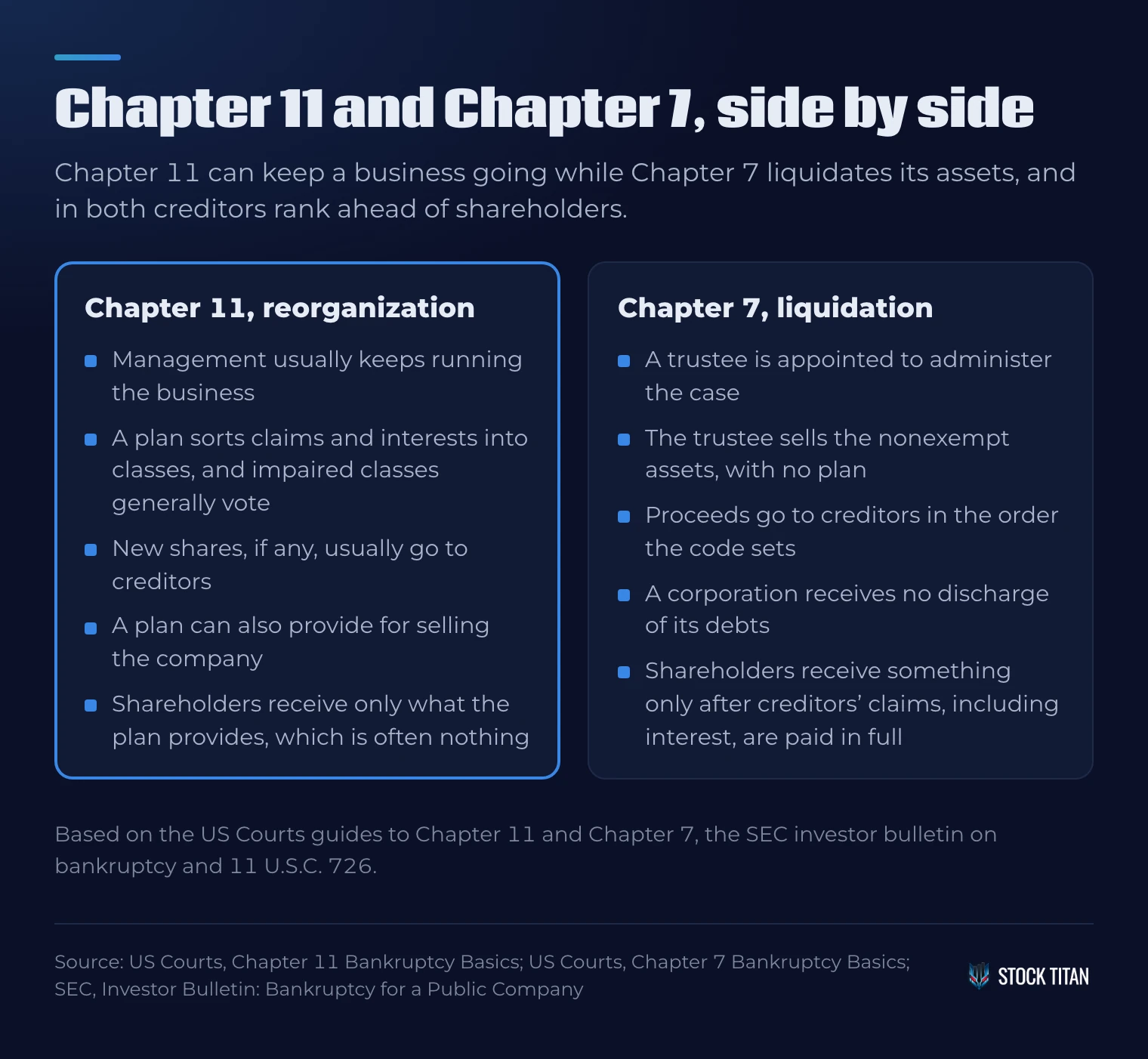
Read the infographic as text
Chapter 11, reorganization
- Management usually keeps running the business
- A plan sorts claims and interests into classes, and impaired classes generally vote
- New shares, if any, usually go to creditors
- A plan can also provide for selling the company
- Shareholders receive only what the plan provides, which is often nothing
Chapter 7, liquidation
- A trustee is appointed to administer the case
- The trustee sells the nonexempt assets, with no plan
- Proceeds go to creditors in the order the code sets
- A corporation receives no discharge of its debts
- Shareholders receive something only after creditors’ claims, including interest, are paid in full
Based on the US Courts guides to Chapter 11 and Chapter 7, the SEC investor bulletin on bankruptcy and 11 U.S.C. 726.
How to find what the bankruptcy plan gives shareholders
Good starting points are the plan and its disclosure statement, which are filed in the court case. The plan says how each class, including the class for existing shares, is treated.
For companies subject to Form 8-K reporting, these reports provide information about the bankruptcy proceedings, the SEC’s bulletin says.
The plan must classify claims and specify how each class will be treated. Where required, the disclosure statement must give enough information for a creditor to make an informed judgment about the plan, according to the courts’ Chapter 11 guide.
Two labels help read a class. “Impaired” generally means the plan alters holders’ rights, subject to statutory exceptions (11 U.S.C. 1124). “Deemed to reject” means the plan gives the class no property, so it is treated as having rejected the plan (11 U.S.C. 1126(g)).
Plans often change along the way. Whoever proposed the plan may modify it before confirmation, the courts’ Chapter 11 guide says. The treatment has to be read in the plan as confirmed, together with the confirmation order, any amendments and the notice of the effective date.
This explains the rules in general; it is not legal or tax advice, and your own case may differ.
Does the same ticker mean my old shares survived bankruptcy?
Not necessarily. A reorganized company can issue new shares that trade under a familiar name or symbol, while the plan cancels the old shares.
The SEC’s bulletin describes the pattern. When a plan issues new stock, “the new shares will be traded without the ‘Q’ and the ‘old’ shares (if still traded) will retain the ‘Q.’” It adds that “holders of the ‘old’ common stock generally do not receive any of these shares,” so a price quoted for the new stock says little about the old shares.
Chapter 11 vs Chapter 7 for shareholders
Chapter 11 lets the company keep operating while it works out a plan. Chapter 7 generally liquidates the company’s assets under a trustee. For shareholders the result is often similar, because creditors rank ahead of owners.
The courts call Chapter 7 a liquidation, “the sale of a debtor’s nonexempt property and the distribution of the proceeds to creditors” (US Courts). A corporation does not receive a discharge of its debts in Chapter 7, a relief the code keeps for individuals.
Chapter 11 is not only about survival. FINRA notes that a Chapter 11 case does not rule out a sale, and that the whole company may be sold with the court’s approval.
How long does Chapter 11 take?
It varies widely. The SEC says the process “may take months, if not years,” and a median from recent cases is no guide for any one case.
The law limits how long the company alone can propose a plan, not how long the case can last. In ordinary Chapter 11 cases, only the company may generally file a plan during the first 120 days, subject to court reduction or extension of that period. With extensions, the exclusive period cannot run past 18 months from filing, according to the US Courts Chapter 11 guide.
In the 19 cases in our review, the median was 112 days from filing to the plan taking effect.
What letters and calls do shareholders get after a bankruptcy filing?
Case information usually comes through your broker or directly from the company, the SEC says, and it may include the plan, a disclosure statement and a ballot. FINRA also warns about unsolicited offers to recover investment losses.
If you hold shares through a broker, the SEC’s bulletin says, the broker should forward the company’s information. Generally, holders entitled to vote receive the plan or a summary, a court-approved disclosure statement, a ballot and notice of the confirmation hearing. Different procedures can apply, including to prepackaged plans, the courts’ Chapter 11 guide notes. A class that receives nothing does not vote, because the law treats it as having rejected the plan. Even if holders cannot vote, the bulletin says, they should get a summary of the disclosure statement and a notice of how to file an objection.
FINRA warns about unsolicited offers, often for an up-front fee, to recover investment losses (FINRA). This warning does not characterize legitimate legal, claims-administration or recovery services.
What happens to worthless stock on your taxes?
This is a general discussion of US federal individual income tax rules for taxable investments. The IRS treats a stock that became completely worthless during the year as sold on the last day of that tax year.
The rule is in IRS Publication 550: stocks “that became completely worthless during the tax year are treated as though they were sold on the last day of the tax year,” and the loss is reported on Form 8949. A bankruptcy filing alone does not establish that a stock is completely worthless or that a loss is deductible.
For a worthless security, Publication 550 sets a longer window to claim a credit or refund. The deadline is 7 years from the date the original return had to be filed, or 2 years from the date the tax was paid, whichever is later.
The same publication caps the net capital loss deducted against other income at $3,000 a year, or $1,500 for a married person filing a separate return. Any unused part can be carried over to later years.
This explains the rules in general; it is not legal or tax advice, and your own case may differ.
How we counted
Our review covers the 37 companies we identified with US-traded shares that report to the SEC. Each filed its own petition under the US Bankruptcy Code from June 1, 2025 to October 19, 2026. We found them through the SEC’s EDGAR full-text search for Form 8-K Item 1.03, “Bankruptcy or Receivership,” and for petition wording. We read their filings on sec.gov and in StockTitan’s SEC filings database, plus court documents posted by claims agents where companies had stopped reporting.
We left out cases where only a subsidiary filed, state-law assignments for the benefit of creditors, receiverships, foreign proceedings and cases that began before June 2025. A plan counts as having taken effect when the company or the claims agent reported its effective date. “No distribution” means the plan as confirmed provided none to existing shareholders; it does not describe any holder’s own loss. Where we could not confirm a status, we say so and count no outcome. The median is the middle of the 19 calendar-day spans from petition to effective date. The review is a snapshot of recent cases, not a complete census or a forecast.
Frequently asked questions
What does Q mean at the end of a stock symbol?
A Q added to a symbol usually marks a company in bankruptcy. FINRA says bankrupt companies “typically” get the letter Q appended to their stock symbols, and the SEC says new shares issued under a plan trade without it.
Can I sell a stock after it is delisted?
Often, yes. Delisting from an exchange ends trading there, but the shares may keep trading over the counter if there is a market and a broker that handles them. Bankruptcy alone does not prohibit trading under federal law; other trading restrictions may apply.
Will my old shares turn into new shares after Chapter 11?
Only if the plan provides for it. The SEC says holders of the old common stock generally do not receive the new shares, which usually go to creditors.
Can shareholders lose more than they invested when a company goes bankrupt?
Generally not because of the company’s own bankruptcy case. The federal courts’ guide says a corporation’s Chapter 11 case does not put stockholders’ personal assets at risk other than the value of their investment in the stock. Buying on margin means borrowing from your broker to pay for shares, and that loan is a separate debt. The SEC warns that with margin “you can lose more money than you have invested” (SEC).
Is Chapter 7 or Chapter 11 worse for shareholders?
In Chapter 7, shareholders receive something only after creditors’ claims, including interest, are paid in full. Chapter 11 can keep the business going, yet the SEC says a plan often cancels the existing shares even when the company reorganizes.
Where can I read a company’s bankruptcy filings on StockTitan?
For companies subject to Form 8-K reporting, the SEC says these reports provide information about the bankruptcy proceedings. StockTitan’s live 8-K feed lists new reports, and each company’s filings page collects its own. Our guide to Form 8-K material events explains how to read them.
Sources
- StockTitan live 8-K filings feed
- StockTitan, Form 8-K material events explained
- US Courts, Chapter 11 Bankruptcy Basics
- US Courts, Chapter 7 Bankruptcy Basics
- SEC, Investor Bulletin: Bankruptcy for a Public Company
- SEC, Investor Bulletin: Understanding Margin Accounts
- FINRA, What a Corporate Bankruptcy Means for Shareholders
- FINRA, It Can Be Hard to Recover from Recovery Scams
- 11 U.S.C. 1129, confirmation of a plan
- 11 U.S.C. 1126, acceptance of a plan
- 11 U.S.C. 1124, impairment
- 11 U.S.C. 1102, committees
- 11 U.S.C. 726, distribution of the estate
- 11 U.S.C. 510, subordination
- IRS Publication 550, Investment Income and Expenses
The information provided in this article is for educational and informational purposes only. It does not constitute financial advice, investment recommendation, or an endorsement of any particular investment strategy. Past performance does not guarantee future results. Investors should conduct their own research and consult with a qualified financial advisor before making investment decisions.