
ACI Worldwide Report: Global Refund Volumes Surge 18% as Retailers Tighten Returns
Key Terms
reverse logistics technical
ai-driven identity verification technical
real-time monitoring technical
real-time analytics technical
fraud management technical
omnichannel technical




New analysis shows holiday-driven refund growth, rising fraud risk, and growing pressure on retail margins despite strong eCommerce growth
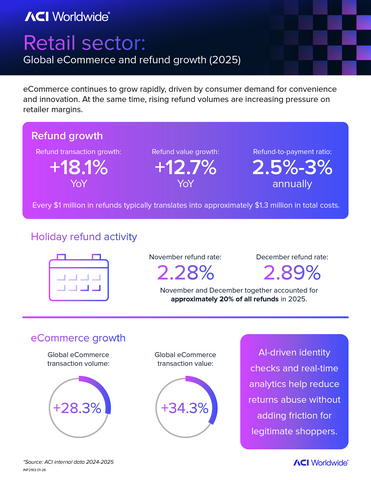
Refund activity peaked sharply during the holiday season; November and December together accounted for approximately
The findings come amid continued growth in global eCommerce. Across all retail sectors, eCommerce transaction volumes grew
While refund rates are rising more slowly than eCommerce transactions, their financial impact for retailers remains significant. Every
As refund volumes accelerate, retailers are rethinking their approach to returns and fraud management. This includes deploying AI-driven identity verification, real-time monitoring, and tighter, more adaptive return policies. Increasingly, merchants are applying real-time analytics traditionally reserved for fraud prevention to refund and return activity—seeking to reduce abuse while preserving a frictionless experience for legitimate customers.
“The sharp rise in refund volumes is exposing a growing pressure point for retailers—one that directly threatens margins, especially during peak periods and extended return windows,” said Adriana Iordan, head of merchant product management and payments intelligence at ACI Worldwide. “Retailers need smarter, AI‑driven controls that spot abuse in real time and adapt policies dynamically, without adding friction for genuine customers. By bringing fraud and refund management together, merchants can curb losses, protect profitability, and still deliver a customer seamless experience—even as refund volumes continue to climb.”
Key Highlights at a Glance (Year‑on‑Year, Retail)
-
Refund Growth: Refund transactions increased
18.1% , while refund value rose12.7% , indicating higher refund frequency but lower average refund values. -
Holiday Surge: November and December together accounted for ~
20% of annual refunds, driven by extended return windows and elevated fraud risk. -
Refund‑to‑Payment Ratio: Averaged
2.5% –3% across the year, highlighting growing pressure within omnichannel retail environments.-
January–October:
2.25% -
November:
2.28% -
December:
2.89%
-
January–October:
-
Payment Expansion: eCommerce payment volumes increased
28.3% , with transaction values up34.3% , reflecting sustained consumer spending growth. - Strategic Implications: The widening gap between payment growth and refund growth underscores the opportunity for retailers to tighten refund controls without eroding customer experience—particularly during peak periods.
About the Report:
ACI’s Global Annual Ecommerce Report provides insight on the latest eCommerce trends based on an analysis of billions of global retail transactions processed in 2024 and 2025.
About ACI Worldwide
ACI Worldwide, an original innovator in global payments technology, delivers transformative software solutions that power intelligent payments orchestration in real time so banks, billers and merchants can drive growth, while continuously modernizing their payment infrastructures, simply and securely. With nearly 50 years of trusted payments expertise, we combine our global footprint with a local presence to offer enhanced payment experiences to stay ahead of constantly changing payment challenges and opportunities.
© Copyright ACI Worldwide, Inc. 2026
ACI, ACI Worldwide, ACI Payments, Inc., ACI Pay, Speedpay, and all ACI product/solution names are trademarks or registered trademarks of ACI Worldwide, Inc., or one of its subsidiaries, in
View source version on businesswire.com: https://www.businesswire.com/news/home/20260202280601/en/
Media
Katrin Boettger | Communications and Corporate Affairs Director | katrin.boettger@aciworldwide.com
Pierce Rohrmann I Head of Communications and Corporate Affairs I pierce.rohrmann@aciworldwide.com
Source: ACI Worldwide