
Aduro Clean Technologies and AstroTurf Sign MOU for Synthetic Turf Recycling
Aduro Clean Technologies (Nasdaq: ADUR) and AstroTurf signed an MOU to evaluate using Aduro’s Hydrochemolytic™ Technology (HCT) on end-of-life synthetic turf.
Rhea-AI Summary
Aduro Clean Technologies (Nasdaq: ADUR) and AstroTurf signed an MOU to evaluate using Aduro’s Hydrochemolytic™ Technology (HCT) on end-of-life synthetic turf.
The collaboration will study how mechanical pre-treatment and HCT could recover PE/PP components and convert them into liquid hydrocarbon products for circular petrochemical feedstock.
The MOU is an evaluation framework only and does not include commercial deployment terms.
Positive
- MOU with AstroTurf creates formal framework to assess HCT for synthetic turf recycling
- Builds on prior lab work showing selective conversion of PE/PP from post-use turf to hydrocarbon products
- Access to AstroTurf’s 60-year turf expertise supports understanding of field recovery and end-of-life logistics
- Aligns with rising policy focus on producer responsibility, landfill diversion, and circular outcomes in North America and Europe
Negative
- MOU is only an evaluation stage with no definitive commercial or licensing agreements in place
- No financial terms or revenue impact disclosed for the collaboration
- Recycling pathway depends on complex pre-treatment including de-infill, separation, cleaning, and side-stream management
- Future commercial arrangements would require separate agreements, so outcomes remain uncertain
Details
News Market Reaction – ADUR
In the Jun 30 session, ADUR gained 3.28%, reflecting a moderate positive market reaction.
Data tracked by StockTitan Argus on the day of publication.
Key Figures
- Industry experience
- 60 years
- AstroTurf legacy in synthetic sports surfacing
Historical Context
-
Closing of a non-brokered LIFE equity offering to fund development and operations.
-
European unit signed MOU to evaluate feedstock logistics for FOAK HCT plant.
-
Filing of amended LIFE offering document for planned private placement financing.
-
Closing of US and Canadian underwritten public share offering to fund projects.
-
Pricing of underwritten public offering and concurrent LIFE private placement.
24h Move is the share-price change in the day after each event; other market factors may also have contributed.
Key Terms
polyethylene technical
polypropylene technical
steam-cracker feedstock technical
AI-generated analysis. How Rhea-AI works. Not financial advice.




Collaboration will evaluate technical and economic requirements for recovering PE and PP from end-of-life synthetic turf
LONDON, Ontario and DALTON, Ga., June 30, 2026 (GLOBE NEWSWIRE) -- Aduro Clean Technologies Inc. (“Aduro” or the “Company”) (Nasdaq: ADUR) (TSX: ACT) (FSE: 9D5), a clean technology company using the power of chemistry to transform lower value feedstocks, like waste plastics, heavy bitumen, and renewable oils, into resources for the 21st century, and AstroTurf Corporation (“AstroTurf”), the original inventor and innovator of synthetic sports surfacing, today announced the signing of a Memorandum of Understanding (“MOU”) to evaluate the application of Aduro’s Hydrochemolytic™ Technology (“HCT”) to end-of-life synthetic turf.
The MOU establishes a framework for Aduro and AstroTurf to evaluate how HCT, together with appropriate mechanical pre-treatment, can support a technical and economic pathway for recovering the polyethylene (“PE”) and polypropylene (“PP”) fractions of end-of-life synthetic turf and converting them into liquid hydrocarbon products suitable for use as circular feedstock in existing petrochemical infrastructure. The parties intend to work together to better understand the practical requirements, material preparation steps, and process considerations needed to advance recycling options for synthetic turf waste. For Aduro, the engagement builds on its existing work on synthetic turf materials and provides another opportunity to collaborate with a recognized industry participant, following prior testing conducted through a separate confidential engagement with another global synthetic turf producer.
Synthetic turf is a highly engineered, multi-material product designed for durability, performance, and long service life. It also contains valuable PE and PP components, including grass blades, thatch, and backing layers, that can be difficult to recover because they are embedded in a system that may include cured polyurethane backing or adhesive materials, infill, sand, rubber, and accumulated field-use contamination. Aduro’s previously announced laboratory testing of post-use synthetic turf demonstrated selective conversion of the PE and PP components into shorter-chain hydrocarbon products suitable for further upgrading or use as steam-cracker feedstock, while also confirming the importance of upstream preparation and separation.
Through the MOU, Aduro and AstroTurf intend to assess the practical steps required to recover and prepare the PE/PP fraction from end-of-life turf for HCT evaluation. The work is expected to focus on the pathway from field recovery and disassembly through de-infill, separation of non-target materials, cleaning or preparation of the polyolefin-rich fraction, and potential management of side streams. By connecting Aduro’s chemical conversion approach with AstroTurf’s 60-year legacy in synthetic sports surfacing and practical knowledge of turf system design, installation, and end-of-life considerations, the collaboration aims to define how mechanical pre-treatment and HCT conversion can work together as part of a broader recycling pathway for complex turf systems.
“This collaboration with AstroTurf allows Aduro to work directly with a recognized name in synthetic turf to better understand the full end-of-life challenge,” said Ofer Vicus, Chief Executive Officer of Aduro. “Our prior testing showed that the polyethylene and polypropylene components of post-use turf can be converted using HCT, but the broader opportunity depends on understanding how those materials are recovered, prepared, and delivered into the process. Working with AstroTurf gives us an opportunity to connect our chemistry with real-world product knowledge, field recovery considerations, and the practical requirements needed to evaluate a more complete recycling pathway.”
AstroTurf has publicly advanced sustainability initiatives focused on manufacturing, installation, and end-of-life operations, including partnerships intended to divert end-of-life turf from landfill and support circular recycling pathways. The MOU with Aduro provides an additional route for evaluating how advanced chemical recycling may complement existing mechanical recycling, take-back, and material recovery approaches.
“At AstroTurf, we have always believed that innovation should extend beyond field performance to include responsible end-of-life solutions,” said Robert Mitchell, Vice President of Development and Strategy at AstroTurf. “Working with Aduro gives us an opportunity to evaluate another pathway for difficult-to-process turf materials and to better understand how advanced recycling technologies may support circularity in our industry. This is an evaluation stage, but it is an important one as customers, communities, and regulators continue to look for more complete solutions for synthetic turf systems.”
The need for synthetic turf recycling is increasing as more fields reach end of life and as customers, communities, and regulators seek practical alternatives to landfill disposal. Policy frameworks in North America and Europe are placing greater emphasis on producer responsibility, recycled content, landfill diversion, and traceable circular outcomes, with New York State’s carpet extended producer responsibility framework providing one example of how end-of-life obligations may shape future demand for recycling solutions.
The MOU does not establish commercial deployment terms or a definitive commercial arrangement. Any future commercial, licensing, supply, tolling, or joint development arrangement would require separate definitive agreements between the parties. The collaboration remains part of Aduro’s broader stage-gated approach to evaluating HCT across complex plastic waste streams with industry participants.
About AstroTurf Corporation
AstroTurf® Corporation is the original inventor and innovator of synthetic sports surfacing, with a 60-year legacy in the development of synthetic turf systems. The company offers advanced, multi-sport and specialized synthetic turf systems with proprietary engineered technologies, serving schools, colleges, professional sports teams, municipalities, and recreational facilities. AstroTurf products are designed with a focus on performance, safety, durability, and sustainability. For more information, visit https://www.astroturf.com
About Aduro Clean Technologies
Aduro Clean Technologies is a developer of patented water-based technologies to chemically recycle waste plastics; convert heavy crude and bitumen into lighter, more valuable oil; and transform renewable oils into higher-value fuels or renewable chemicals. The Company’s Hydrochemolytic™ technology relies on water as a critical agent in a chemistry platform that operates at relatively low temperatures and cost, a game-changing approach that converts low-value feedstocks into resources for the 21st century. For more information, visit https://www.adurocleantech.com
For further information, please contact:
Abe Dyck
Head of Corporate Development / Investor Relations
ir@adurocleantech.com
+1 226 784 8889
AstroTurf Media Contact:
Gary Jones
Director of Marketing
gary.jones@astroturf.com
Forward-Looking Statements
This news release contains forward-looking statements within the meaning of applicable securities laws. Forward-looking statements include, but are not limited to, statements regarding the MOU between Aduro and AstroTurf; the expected scope, objectives, and potential benefits of the collaboration; the evaluation of Hydrochemolytic™ Technology (“HCT”) for end-of-life synthetic turf; the potential development of pre-treatment, separation, feedstock preparation, and logistics approaches for synthetic turf waste; the potential conversion of polyethylene and polypropylene fractions into liquid hydrocarbon products; and the Company’s broader technology validation, scale-up, and commercialization pathway.
Forward-looking statements are based on management’s current expectations and assumptions, including assumptions regarding the continued cooperation of Aduro and AstroTurf; the availability of suitable end-of-life synthetic turf feedstock; the ability to prepare polyethylene- and polypropylene-rich fractions suitable for HCT evaluation; the performance of HCT on pre-treated synthetic turf feedstocks; the progression of technical testing, partner engagement, certification, offtake, financing, and related development workstreams; and the Company’s ability to execute its development and commercialization plans.
Such risks and uncertainties include, but are not limited to: the risk that the collaboration may not progress as expected; the risk that suitable feedstock may not be available in sufficient quantity, quality, consistency, composition, or economic terms; the risk that pre-treatment, de-infill, separation, or preparation steps may not achieve the required specifications or economics; technical, operational, regulatory, certification, financing, supply chain, logistics, and integration risks; risks related to the development, scale-up, commercialization, and market acceptance of HCT; risks related to partner engagement, feedstock aggregation, product quality, customer acceptance, market conditions, policy development, and competition; and other risks described in the Company’s filings available on SEDAR+ at www.sedarplus.ca and EDGAR at www.sec.gov.
Readers are cautioned not to place undue reliance on forward-looking statements. Except as required by applicable law, Aduro undertakes no obligation to update or revise any forward-looking statements, whether as a result of new information, future events, or otherwise.
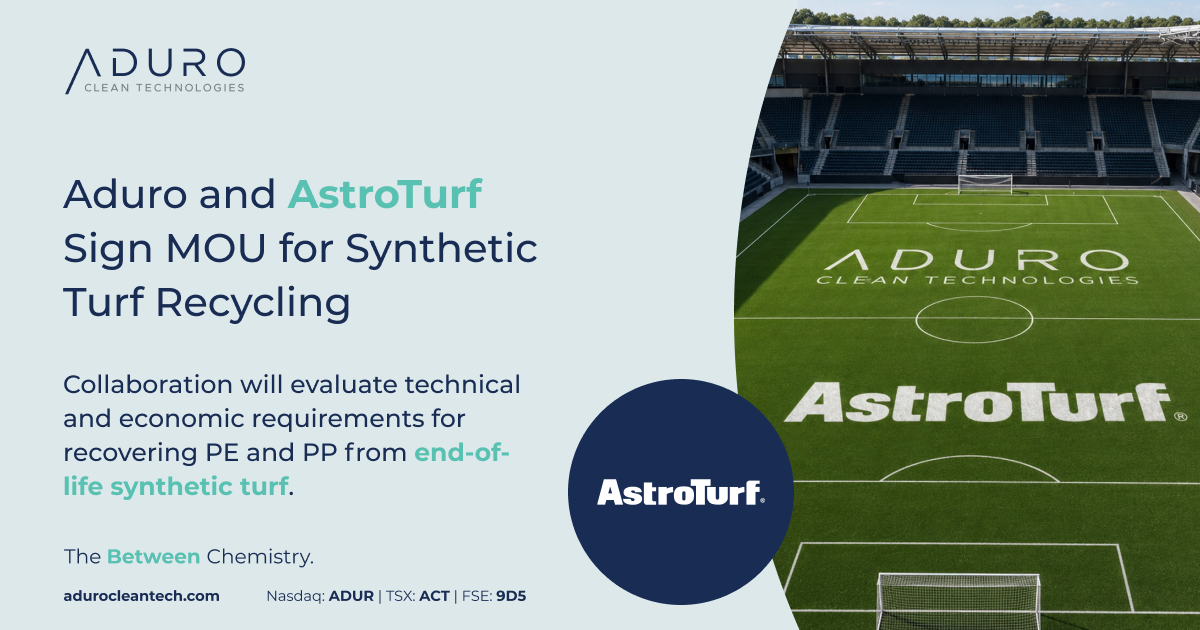
A photo accompanying this announcement is available at https://www.globenewswire.com/NewsRoom/AttachmentNg/b6a2a47c-ef61-42f6-b003-49e1c845e41c

FAQ
AI-generated questions and answers. How Rhea-AI works. Not financial advice.