
Aehr Receives Follow-On Order for Fully Automated Wafer-Level Burn-In Systems Powering AI Optical I/O and Data Center Interconnects
Rhea-AI Summary
Aehr Test Systems (NASDAQ:AEHR) received a follow-on purchase order from its lead silicon photonics customer for wafer-level test and burn-in equipment used in data center optical interconnects and AI optical I/O.
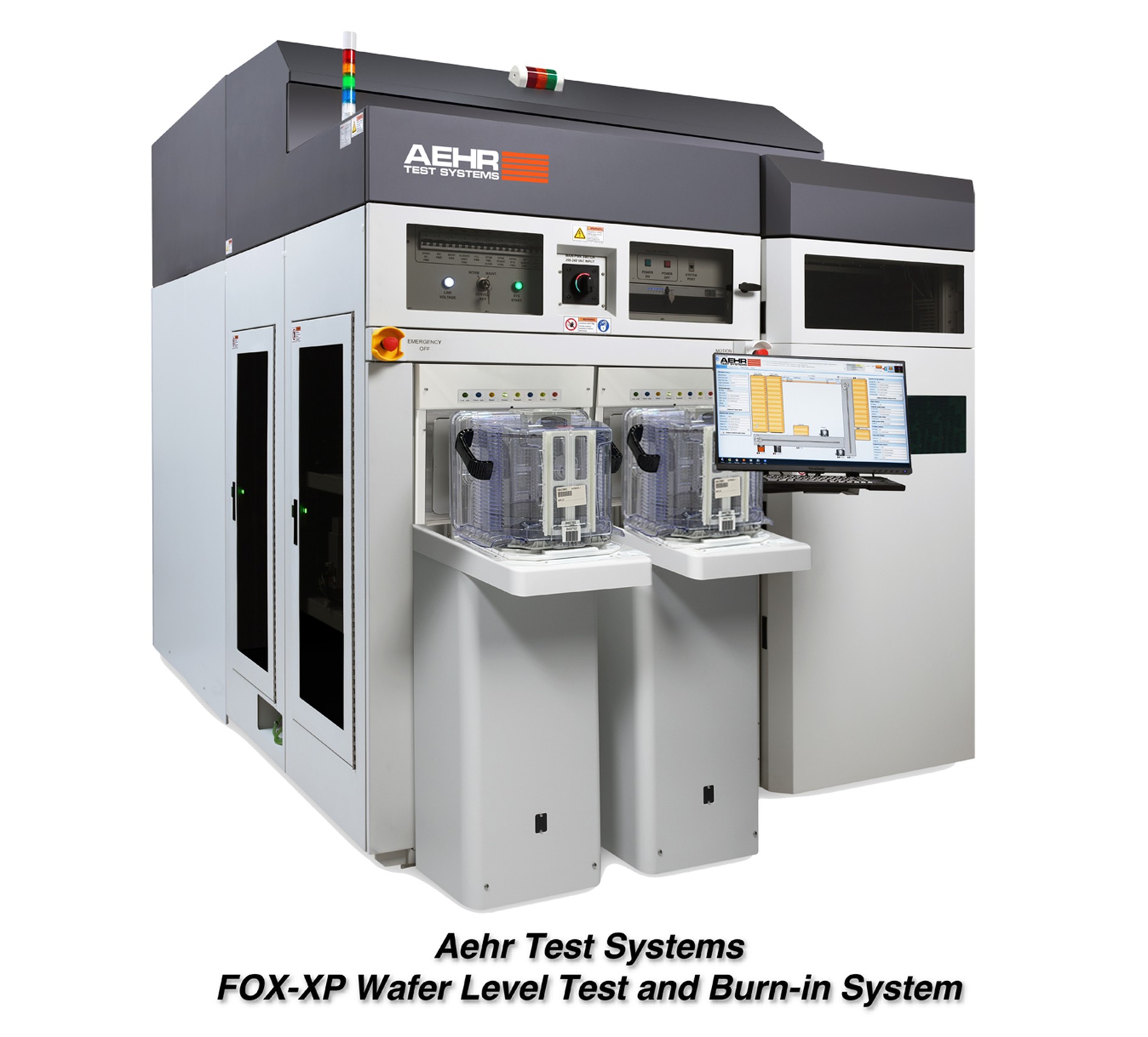
The order covers one new ultra-high-power FOX-XP system and an upgrade to an existing FOX-XP, each supporting up to nine 300mm wafers in parallel at 3,500 watts per wafer. Aehr expects shipment in the second half of calendar 2026.
Positive
- Follow-on purchase order for one new FOX-XP system and one FOX-XP upgrade
- Systems support up to nine 300mm wafers in parallel at 3,500W per wafer
- Shipment expected in the second half of 2026, showing near‑term production timeline
Negative
- Purchase order value not disclosed, leaving revenue impact unclear
- Shipments scheduled for H2 2026 could defer revenue recognition into the second half of the year
Details
News Market Reaction – AEHR
On Mar 3, the day this news came out, AEHR closed 5.43% below the previous close.
Data tracked by StockTitan Argus for the Mar 3 session.
Key Figures
- Wafers per system
- up to 9 x 300mm wafers
- FOX-XP wafer-level test and burn-in configuration
- Power per wafer
- up to 3500 watts per wafer
- FOX-XP ultra-high-power burn-in capability
- WaferPak contactors
- up to 9 FOX WaferPak units
- Supported per FOX-XP system
- Optical transceiver speeds
- 800G and 1.6T
- Targeted higher-speed optical connectivity in AI data centers
- Shipment timing
- second half of calendar 2026
- Expected shipment of new and upgraded FOX-XP systems
- Wafer size
- 300mm
- Silicon photonics wafers under test and burn-in
- Evaluation duration
- 3–6 months
- Prior WLBI application evaluation program for AI processors
- AI chip market projection
- $60B to $600B (2023–2032)
- Long-term AI chip market growth from prior AI news
Previous AI Reports
-
Received $14M FOX-XP wafer-level burn-in order from lead AI processor customer.
-
Initial production order for multiple Sonoma systems for next-gen AI ASIC processors.
-
Over $5.5M in Sonoma system orders and launch of fully automated Sonoma platform.
-
WLBI evaluation order from leading AI processor supplier using FOX-XP systems.
-
Follow-on orders for six Sonoma systems from major hyperscaler to expand AI capacity.
24h Move is the share-price change in the day after each event; other market factors may also have contributed.
Key Terms
wafer-level burn-in technical
silicon photonics technical
optical i/o technical
secs/gem automation technical
co-packaged optics technical
linear-drive optics technical
AI-generated analysis. How Rhea-AI works. Not financial advice.




FREMONT, CA / ACCESS Newswire / March 3, 2026 / Aehr Test Systems (NASDAQ:AEHR), a leading provider of test and burn-in solutions for semiconductor devices used in artificial intelligence (AI), data center, automotive, and industrial applications, today announced it has received a follow-on purchase order from its lead silicon photonics customer for production wafer-level test and burn-in of silicon photonics integrated circuits used in data center optical interconnects and emerging optical I/O architectures for AI processors.
The order reflects expanding production volumes as demand accelerates for optical connectivity solutions powering next-generation AI training and inference infrastructure.
The order includes:
One new ultra-high-power FOX-XP™ wafer-level test and burn-in system with full 300mm SECS/GEM automation, and
An upgrade of an existing FOX-XP system to the new ultra-high power, fully automated configuration
Each system is configured to test up to nine 300mm wafers in parallel at up to 3500 watts per wafer and supports up to nine FOX WaferPak™ proprietary full-wafer contactors. The systems also include Aehr's fully integrated FOX WaferPak AutoAligner™ for hands-free, high-volume production.
Aehr expects to ship the systems in the second half of calendar 2026.
Silicon Photonics and Optical I/O Demand Accelerates With AI Data Center Expansion
Silicon photonics is rapidly becoming a critical enabling technology in next-generation AI data centers, where performance and energy efficiency are increasingly limited by electrical I/O constraints. Industry analysts and hyperscale operators continue to highlight the rapid expansion of optical connectivity within AI clusters, including higher-speed optical transceivers (800G and 1.6T), linear-drive optics (LPO), packaged optics, and co-packaged optics (CPO) architectures. Recent industry reports and hyperscaler announcements point to multi-year growth in fiber-optic infrastructure and silicon photonics deployment tied directly to AI data center buildouts.
FOX-XP: High-Power Wafer-Level Burn-In for Silicon Photonics ICs
Aehr's FOX platform is designed to enable accelerated burn-in, reliability qualification, and production screening at the wafer level, significantly reducing cost and enabling earlier detection of infant mortality and latent reliability issues - particularly important for silicon photonics ICs that will be deployed in high-volume data center environments and high uptime AI infrastructure.
Aehr believes it is the first company to successfully demonstrate and ship a multi-wafer burn-in solution for silicon photonics transceivers, enabling earlier reliability screening and significant cost savings compared with traditional package-part testing. It is now seeing increased volumes from its lead customer and other customers, which is driving new production capacity requirements.
CEO Commentary
"This follow-on order further validates the accelerating adoption of the FOX wafer-level burn-in (WLBI) platform for silicon photonics integrated circuits used in data center optical connectivity and emerging optical I/O architectures for AI processors," said Gayn Erickson, President and CEO of Aehr Test Systems. "Our FOX-XP systems deliver industry-leading power-per-wafer capability, enabling production screening of these high-power, high-current devices at scale.
"With expanding AI infrastructure deployments and our recent manufacturing capacity enhancements, we believe we are well positioned to support significant growth both in our WLBI and packaged-part burn-in systems as customers ramp production."
About Aehr Test Systems
Headquartered in Fremont, California, Aehr Test Systems is a leading provider of test solutions for testing, burning-in, and stabilizing semiconductor devices in wafer level, singulated die, and packaged part form, and has installed thousands of systems worldwide. Increasing quality, reliability, safety, and security needs of semiconductors used across multiple applications, including electric vehicles, electric vehicle charging infrastructure, solar and wind power, computing, advanced artificial intelligence (AI) processors, data and telecommunications infrastructure, and solid-state memory and storage, are driving additional test requirements, incremental capacity needs, and new opportunities for Aehr's products and solutions. Aehr has developed and introduced several innovative products including the FOX-PTM families of test and burn-in systems and FOX WaferPakTM Aligner, FOX WaferPak Contactor, FOX DiePak® Carrier and FOX DiePak Loader. The FOX-XP and FOX-NP systems are full-wafer contact and singulated die/module test and burn-in systems that can test, burn-in, and stabilize a wide range of devices such as leading-edge silicon carbide-based and other power semiconductors, 2D and 3D sensors used in mobile phones, tablets, and other computing devices, memory semiconductors, processors, microcontrollers, systems-on-a-chip, and photonics and integrated optical devices. The FOX-CP system is a low-cost single-wafer compact test solution for logic, memory and photonic devices and the newest addition to the FOX-P product family. The FOX WaferPak Contactor contains a unique full-wafer contactor capable of testing wafers up to 300mm that enables IC manufacturers to perform test, burn-in, and stabilization of full wafers on the FOX-P systems. The FOX DiePak Carrier allows testing, burning in, and stabilization of singulated bare die and modules up to 1024 devices in parallel per DiePak on the FOX-NP and FOX-XP systems up to nine DiePaks at a time. Acquired through its acquisition of Incal Technology, Inc., Aehr's new line of high-power packaged part reliability/burn-in test solutions for AI semiconductor manufacturers, including its ultra-high-power Sonoma family of test solutions for AI accelerators, GPUs, and high-performance computing (HPC) processors, position Aehr within the rapidly growing AI market as a turnkey provider of reliability and testing that span from engineering to high volume production. For more information, please visit Aehr Test Systems' website at www.aehr.com.
Safe Harbor Statement
This press release contains certain forward-looking statements within the meaning of Section 27A of the Securities Act of 1933 and Section 21E of the Securities Exchange Act of 1934. Forward-looking statements generally relate to future events or Aehr's future financial or operating performance. In some cases, you can identify forward-looking statements because they contain words such as "may," "will," "should," "expects," "plans," "anticipates," "going to," "could," "intends," "target," "projects," "contemplates," "believes," "estimates," "predicts," "potential," or "continue," or the negative of these words or other similar terms or expressions that concern Aehr's expectations, strategy, priorities, plans, or intentions. Forward-looking statements in this press release include, but are not limited to, future requirements and orders of Aehr's new and existing customers; Aehr's ability to receive orders and generate revenue in the future, as well as Aehr's beliefs regarding the factors impacting the foregoing, including the growth of the markets referred to herein; Aehr's ability to integrate Incal efficiently; and the timing and extent to which the acquisition is accretive. The forward-looking statements contained in this press release are also subject to other risks and uncertainties, including those more fully described in Aehr's recent Form 10-K, 10-Q and other reports filed from time to time with the Securities and Exchange Commission. Aehr disclaims any obligation to update information contained in any forward-looking statement to reflect events or circumstances occurring after the date of this press release.
CONTACT:
Aehr Test Systems
Vernon Rogers
EVP of Sales & Marketing
vrogers@aehr.com
PondelWilkinson, Inc.
Todd Kehrli or Jim Byers
Analyst/Investor Contact
tkehrli@pondel.com
jbyers@pondel.com
SOURCE: Aehr Test Systems
View the original press release on ACCESS Newswire
FAQ
AI-generated questions and answers. How Rhea-AI works. Not financial advice.